
Tanzania or Kenya? Serengeti or Masai Mara? Every year, hundreds of thousands of travelers experience their first safari in East Africa — and nearly all of them ask this question. The truth is that both countries offer extraordinary experiences, but with major differences in terms of budget, crowds, and landscapes. Tanzania captivates with the vast wilderness of the Serengeti and the unique Ngorongoro Crater, while Kenya shines with the accessibility of the Masai Mara and the iconic views of Kilimanjaro from Amboseli. Here is the complete guide to making the right choice in 2026, park by park, season by season, budget by budget.
1. Serengeti — the endless Tanzanian savanna
The greatest wildlife show on Earth
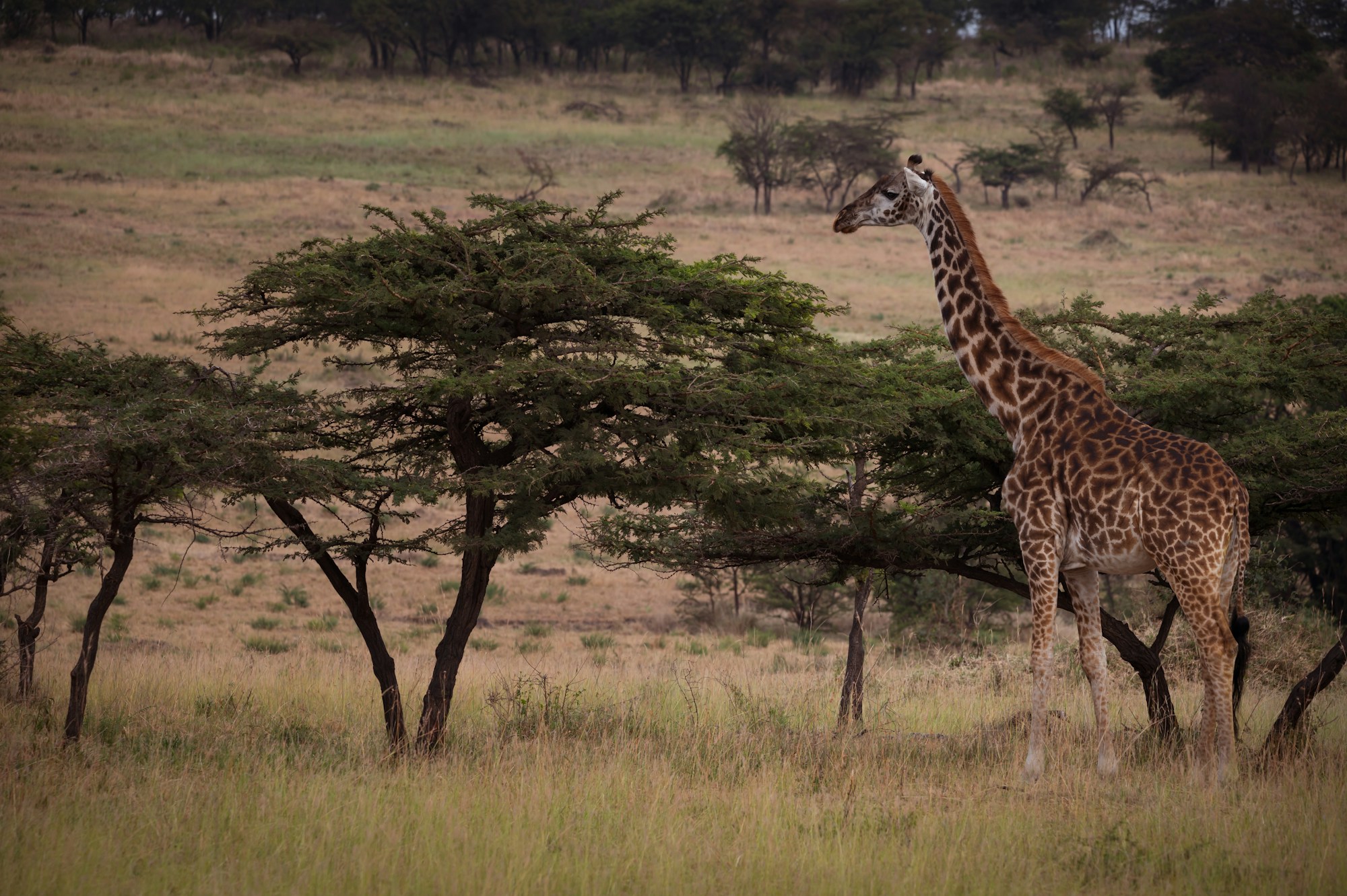
Serengeti National Park is simply the most famous wildlife park in the world, and for good reason: its 14,763 km² of endless plains are home to the largest concentration of large mammals in Africa. Listed as a UNESCO World Heritage Site since 1981, the Serengeti hosts approximately 1.5 million wildebeest, 300,000 zebras, and 200,000 Thomson’s gazelles during the Great Migration — a phenomenon described as the « greatest wildlife show on Earth. »
The park is divided into several distinct zones. The central Seronera plains offer the best year-round wildlife viewing, thanks to the Seronera River which attracts predators during the dry season. The western corridor, less visited, is ideal for watching the Grumeti River crossings between May and July. To the north, the Lobo and Kogatende region, near the Mara River, offers the most spectacular crossings between July and October.
Highlights
- Complete Big Five: Lion, leopard, elephant, buffalo, and black rhinoceros (rare) are all present in the park.
- Great Migration: Epicenter of the phenomenon — the Serengeti is the only place where you can observe the full migration cycle over an entire year.
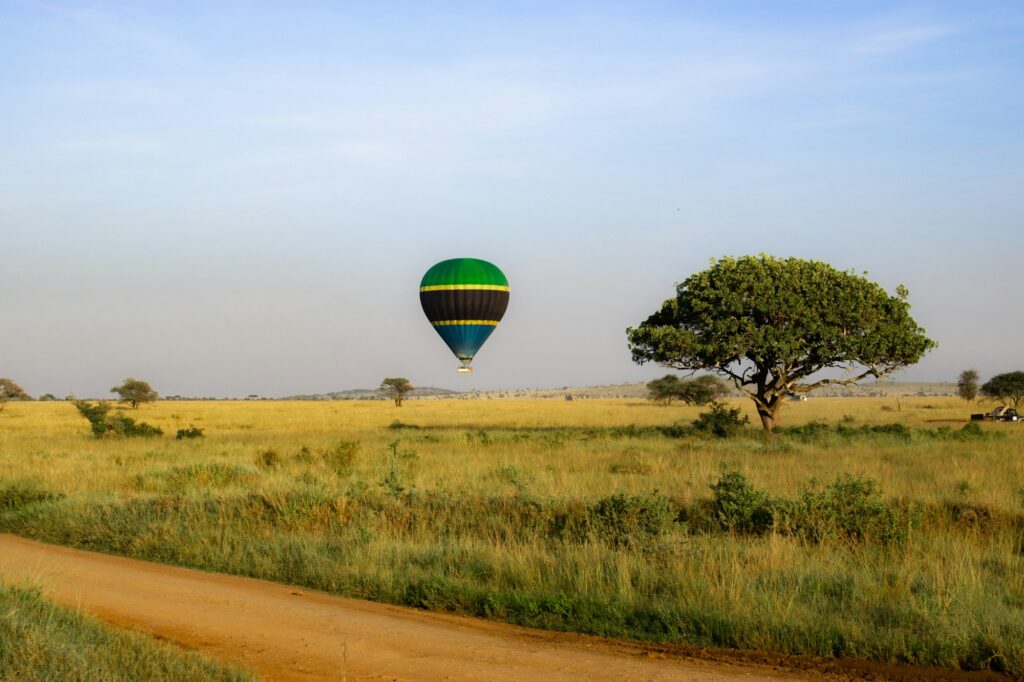
- Hot air balloon ride: Fly over the plains at sunrise (approx. 500-600 USD) — an unforgettable experience above the herds.
- Fewer crowds: The park’s immense size allows you to get away from tourist areas and experience moments of complete solitude in the bush.
Park entry fees are 70 USD per adult per day (35 USD for children aged 5 to 15). According to TANAPA (Tanzania National Parks Authority), these rates were revised in 2024. A classic 3-4 day safari in the Serengeti costs between 250 and 600 USD per person per day, all-inclusive, depending on the level of accommodation.
2. Masai Mara — Kenya’s crown jewel
The highest animal density in Africa
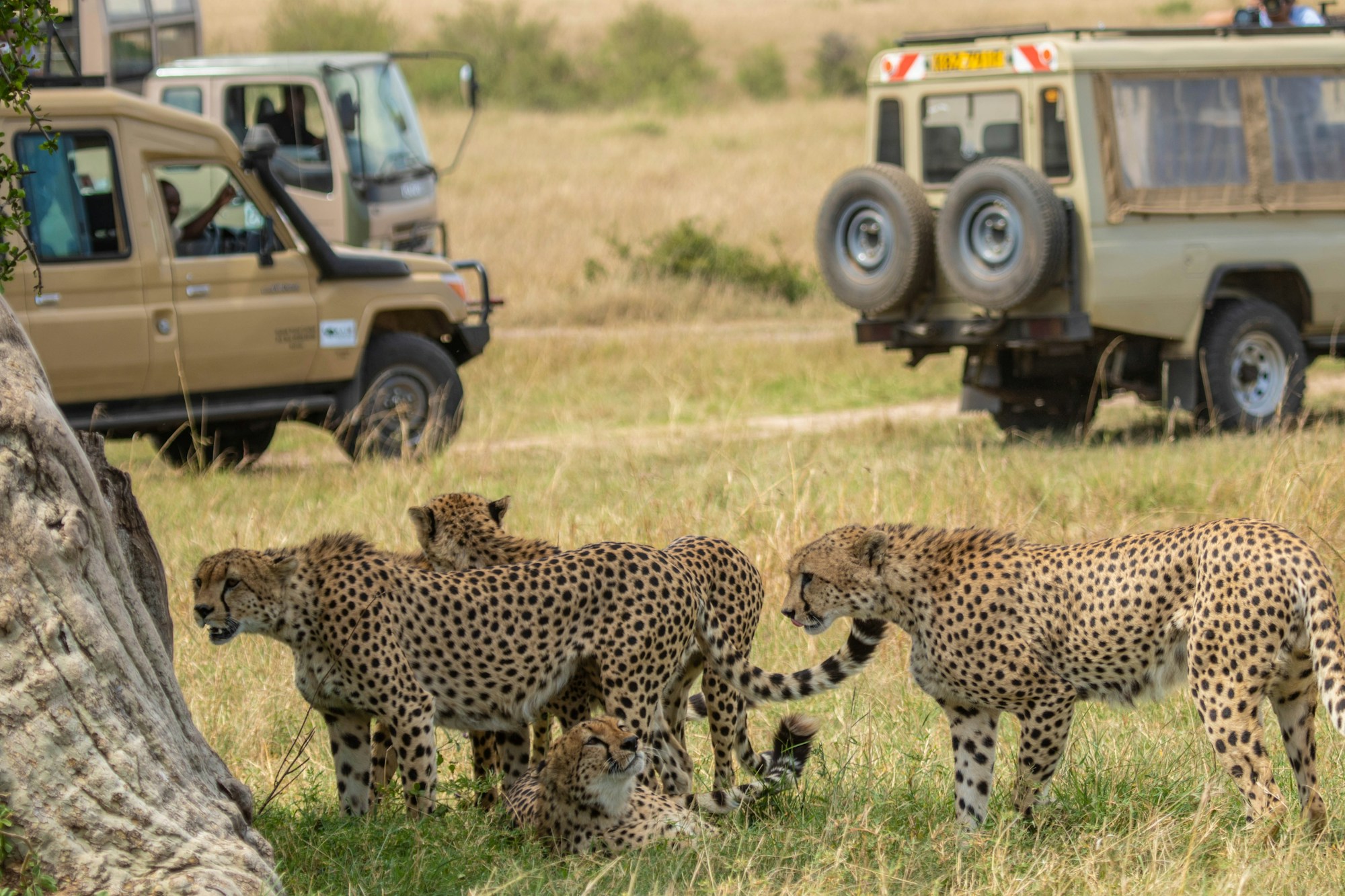
The Masai Mara National Reserve is the natural extension of the Serengeti on the Kenyan side. Smaller (1,510 km²), it compensates with an exceptional animal density — probably the highest in Africa. According to Kenya Wildlife Service, the reserve permanently hosts over 95 mammal species and 570 bird species.
The Masai Mara is world-famous for the Mara River crossings (July to October), where thousands of wildebeest face Nile crocodiles in a spectacle as dramatic as it is natural. But even outside the migration, the reserve offers exceptional sightings: lions (with super-prides numbering up to 30 individuals), cheetahs, leopards, and enormous herds of buffalo.
Highlights
- Mara River crossings: The most intense moment of the Great Migration — thousands of wildebeest plunge into crocodile-infested waters.
- Accessibility: Just 5 hours by road or 1 hour by flight from Nairobi. The Mara is the most accessible park in East Africa.
- Private conservancies: Adjacent conservancies (Olare Motorogi, Mara North, Naboisho) offer exclusive safaris with fewer vehicles and night game drives.
- Maasai culture: Meet local Maasai communities and discover their ancestral semi-nomadic way of life.
The Masai Mara is more affordable than the Serengeti for a first safari. A 3-day/2-night safari in a mid-range lodge costs between 400 and 800 USD per person. Entry fees are 80 USD per adult per 24 hours (40 USD for children). According to SafariBookings, peak season (July-October) prices are 30 to 50% higher than low season.
3. Ngorongoro — the record-breaking crater
The world’s largest intact caldera
The Ngorongoro Crater is a unique geological phenomenon: a volcanic caldera 20 km in diameter and 600 m deep that permanently shelters approximately 25,000 to 30,000 animals in a natural enclosed space. Listed as a UNESCO World Heritage Site, it is the only place in Tanzania where you have a good chance of spotting black rhinoceroses, with approximately 26 individuals remaining in the crater.
The crater floor offers a mosaic of habitats: grasslands, swamps, acacia forests, and Lake Magadi (an alkaline salt lake that attracts flamingos). This diversity guarantees varied sightings in a single day of game driving. You can reasonably expect to see all Big Five in a single day — something extremely rare elsewhere.
Highlights
- Big Five in one day: The exceptional animal concentration makes it possible to observe lions, elephants, buffalo, leopards, and black rhinos in a single descent.
- Black rhinoceroses: One of the last refuges for this critically endangered species — approximately 26 individuals live in the crater.
- Black-maned lions: The crater is famous for its male lions with dark, thick manes, more impressive than those of plains lions.
- Combinable with the Serengeti: Located just 3 hours by road from the Serengeti’s south gate (Naabi Hill Gate), it fits perfectly into a northern Tanzania circuit.
Entry fees to the Ngorongoro Conservation Area are 70.80 USD per adult per 24 hours, plus a crater service fee of 295 USD per vehicle to descend into the crater. According to the NCAA (Ngorongoro Conservation Area Authority), the number of vehicles allowed simultaneously in the crater is limited to preserve the ecosystem.
4. Amboseli — the Kilimanjaro postcard
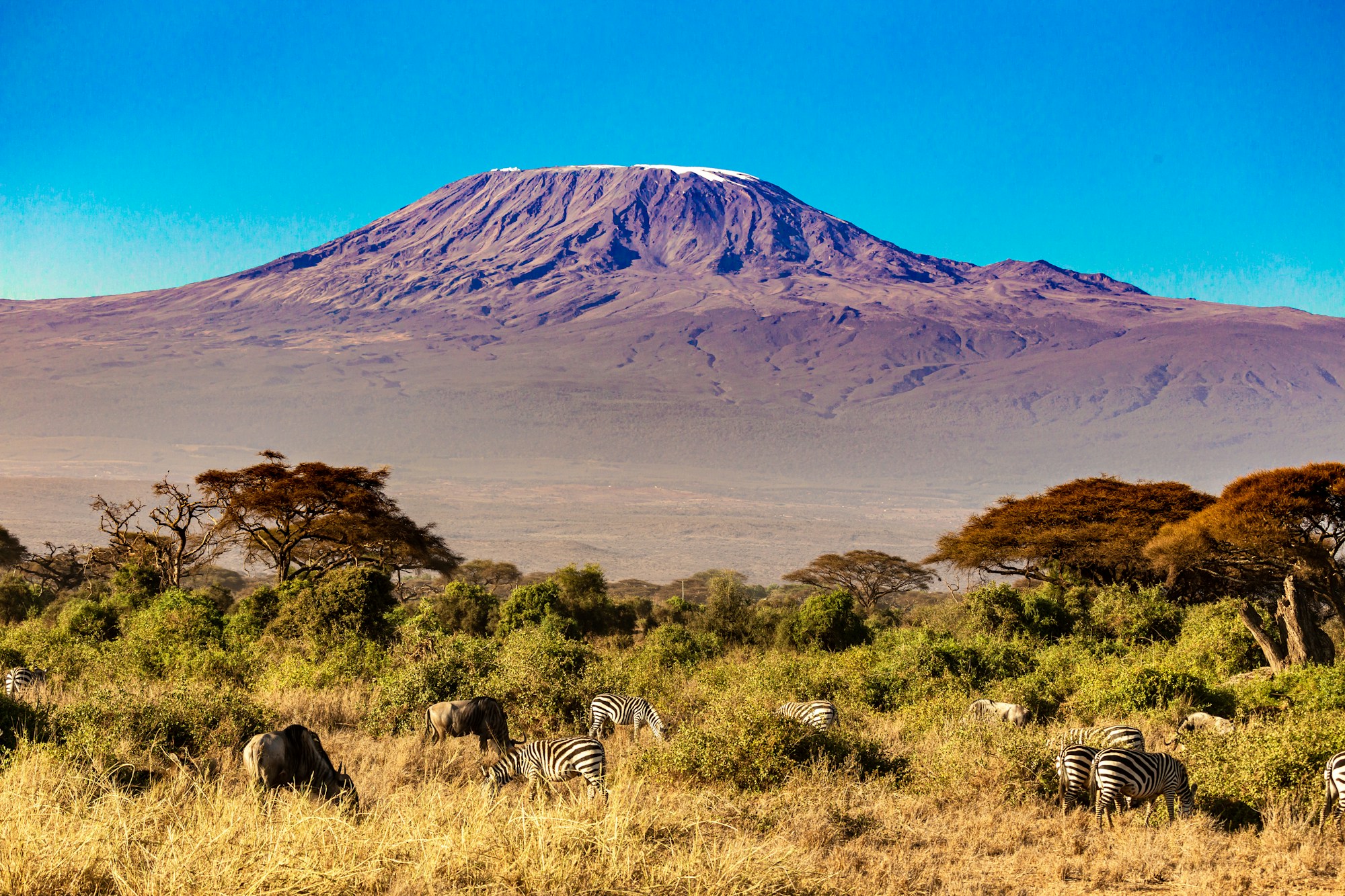
Giant elephants at the foot of the roof of Africa
Amboseli National Park arguably offers Africa’s most beautiful postcard: herds of elephants with majestic tusks moving in front of the eternal snows of Kilimanjaro (5,895 m), the roof of Africa. Small in size (392 km²), Amboseli is immense in photogenic appeal.
The park is world-renowned for its big tusker elephants, studied for over 50 years by the Amboseli Trust for Elephants founded by Cynthia Moss. The permanent swamps fed by Kilimanjaro’s meltwater attract abundant wildlife even in the dry season: hippos, buffalo, flamingos, and over 400 bird species.
Highlights
- Kilimanjaro backdrop: Sunrises and sunsets with a clear Kilimanjaro offer the most stunning safari photos in Africa.
- Big tusker elephants: Amboseli is home to elephants with the largest tusks on the continent, thanks to decades of protection.
- Close to Nairobi: Just 4 hours by road from Nairobi (240 km), perfect for a 2-3 day safari.
- Observation Hill: This panoramic viewpoint offers a 360° view of the park, the swamps, and Kilimanjaro.
Entry fees are 60 USD per adult per 24 hours. Amboseli is one of Kenya’s most affordable parks, with quality lodges and camps starting from 150-250 USD per night on half-board. A 2-night safari combined with transport from Nairobi costs between 350 and 700 USD per person.
5. Tarangire — the secret of baobabs and elephants
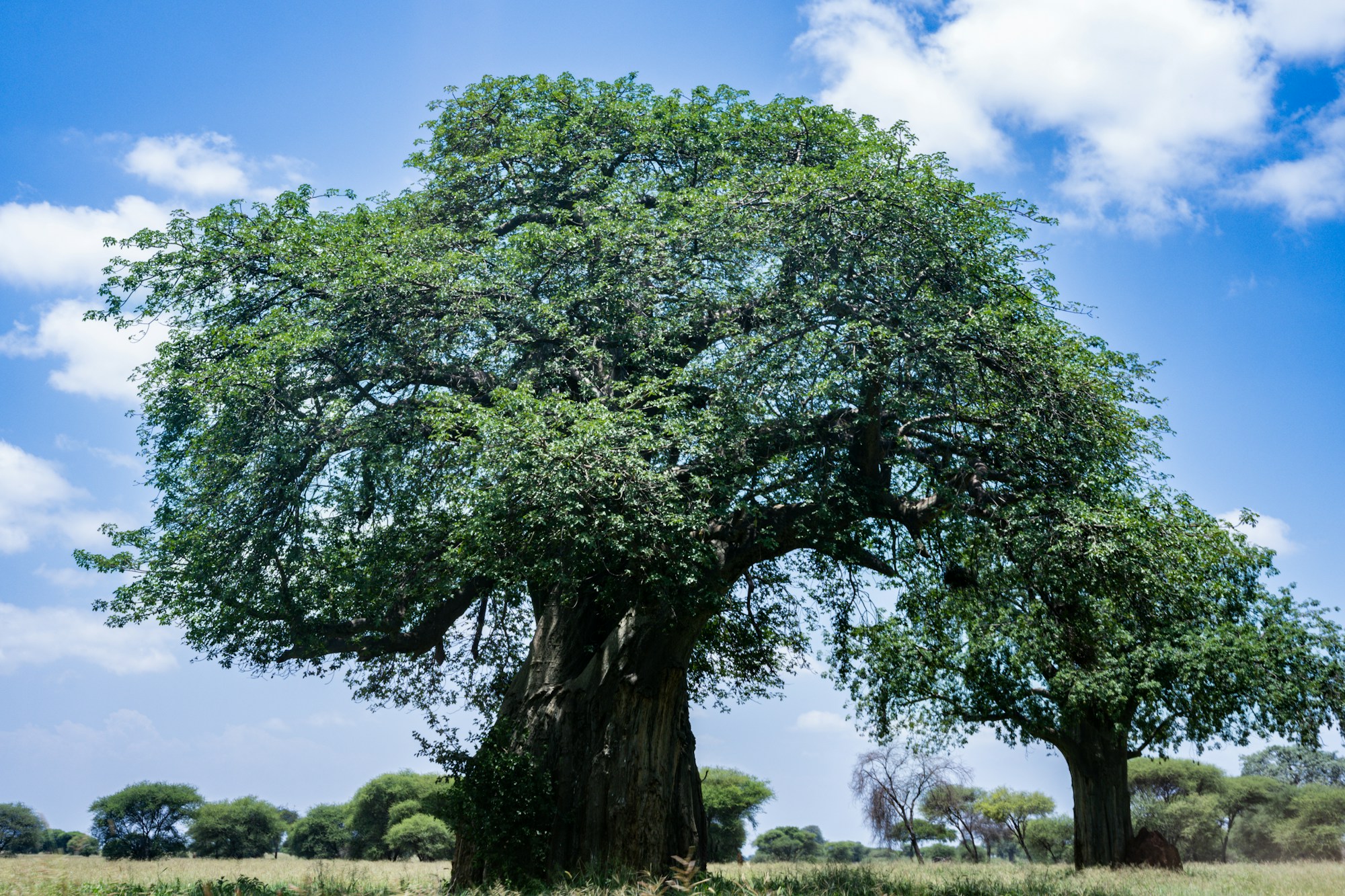
The quiet alternative to the Serengeti
Often overshadowed by its illustrious neighbors, Tarangire National Park is nonetheless Tanzania’s third-largest park (2,850 km²) and offers a radically different safari experience. Its landscapes of ancient baobab trees and open savanna, crossed by the Tarangire River, create an almost surreal setting, especially during the dry season when the river becomes the only water source in the region.
Between June and November, Tarangire concentrates the second-largest animal migration in Tanzania: up to 300,000 zebras and wildebeest converge on the river. The park also hosts the largest elephant population in northern Tanzania — herds of 200 to 300 individuals are not uncommon during the dry season.
Highlights
- Giant baobabs: Ancient trees reaching up to 25 meters tall and 10 meters in diameter — a unique spectacle in East Africa.
- Mega-herds of elephants: During the dry season, hundreds of elephants gather along the Tarangire River.
- Tree-climbing pythons: Tarangire is known for its African pythons that perch in the branches of acacia trees.
- Fewer tourists: Much quieter than the Serengeti or Ngorongoro, with only a fraction of the visitors.
Entry fees are 53.10 USD per adult per day — significantly cheaper than the Serengeti or Ngorongoro. Tarangire fits perfectly into a northern Tanzania circuit: it is located just 2 hours by road from Arusha and can be combined with Lake Manyara (30 min) and Ngorongoro (2h30).
6. Tsavo — the red elephants of Kenya’s largest park
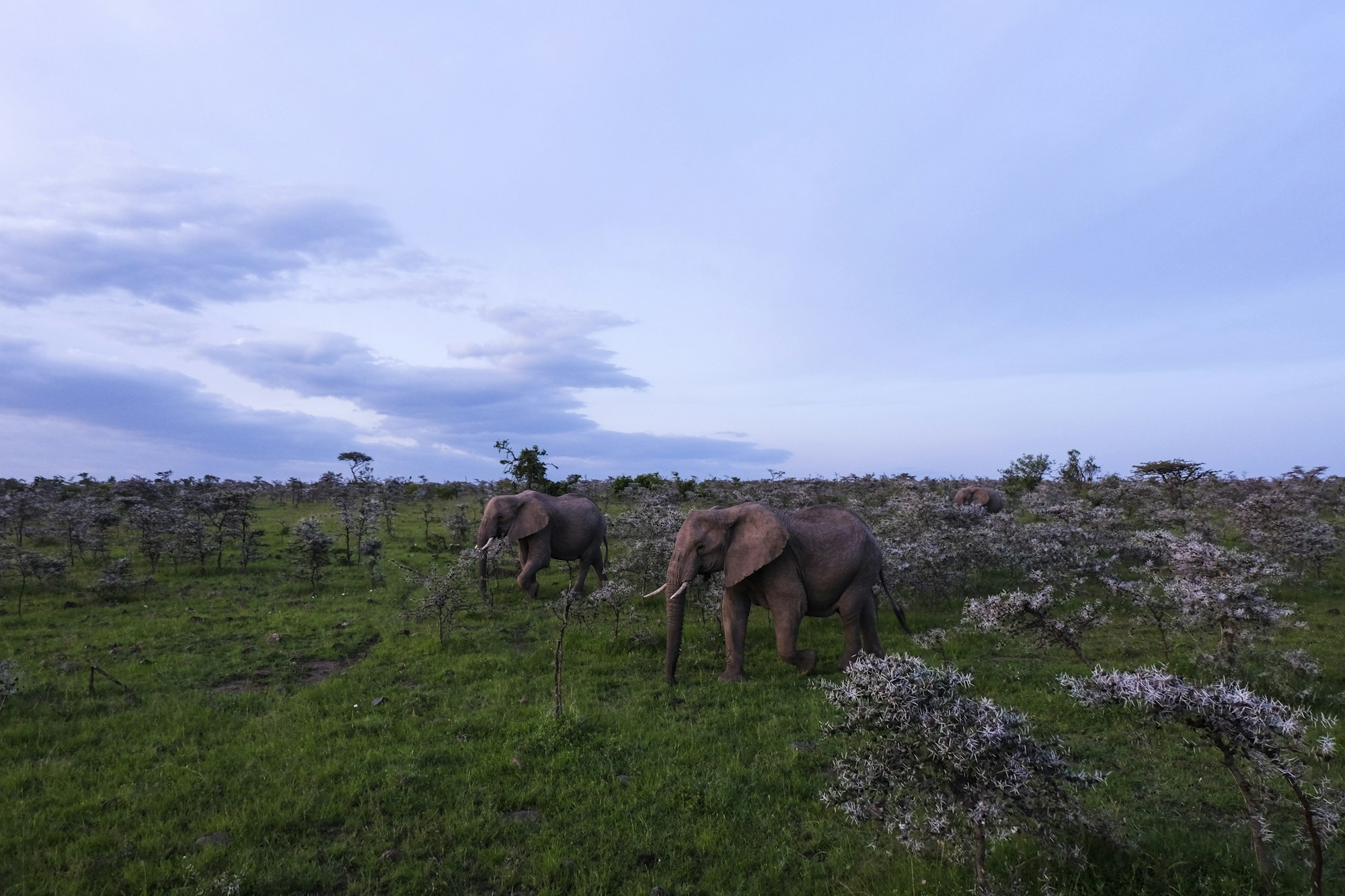
Tsavo East and Tsavo West: two parks, two atmospheres
With a combined area of 22,000 km², Tsavo East and Tsavo West together form Kenya’s largest protected area — and one of the largest in Africa. The park is famous for its red elephants, which cover themselves in the characteristic red laterite soil of the region, giving them a striking and unique appearance.
Tsavo East, flatter and more arid, with its semi-arid savanna plains, offers an atmosphere of absolute wilderness. The Galana River and its Lugard Falls attract crocodiles and hippos. Tsavo West is more mountainous and greener, with the Mzima Springs — crystal-clear springs where you can observe hippos and crocodiles from an underwater observatory.
Highlights
- Red elephants: The elephants roll in the red laterite soil, creating a photographic spectacle unique in the world.
- Off-the-beaten-path safari: Much less visited than the Masai Mara or Amboseli, with an authentic sense of adventure.
- Mzima Springs: Crystal-clear water springs with an underwater observatory to view hippos and fish.
- Budget-friendly: Entry fees of only 52 USD/day — one of the most affordable major parks in East Africa.
Entry fees are 52 USD per adult per 24 hours for each park. Tsavo is located between Nairobi and Mombasa, making it a natural stopover to combine safari and beach on the Kenyan coast. According to KWS, the best time is the dry season (June-October and January-March).
7. The Great Migration — month-by-month calendar
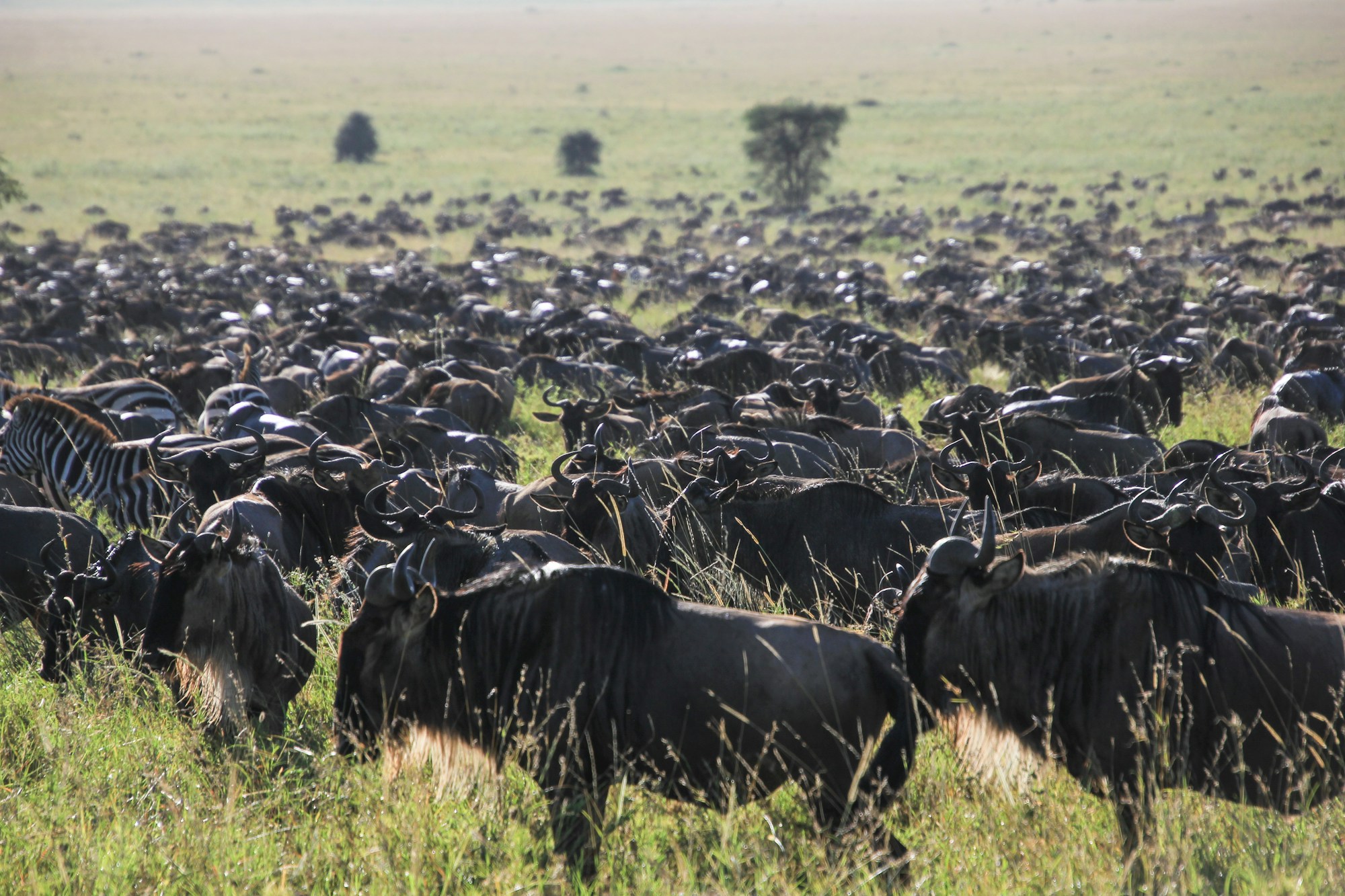
1.5 million wildebeest in perpetual motion
The Great Migration is considered one of the « seven new wonders of the natural world. » Every year, approximately 1.5 million wildebeest, accompanied by 300,000 zebras and 200,000 Thomson’s gazelles, travel a circuit of 3,000 km between the Serengeti (Tanzania) and the Masai Mara (Kenya) in search of fresh pastures.
Migration calendar
| Period | Location | Event |
|---|---|---|
| January — March | Southern Serengeti (Ndutu) | Calving season — 8,000 baby wildebeest are born each day over 2-3 weeks. Predators in abundance. |
| April — May | Central/Western Serengeti | The herds move northward. Long rainy season — fewer vehicles, reduced prices. |
| June — July | Western corridor (Grumeti) | First crossings of the Grumeti River. Giant crocodiles lying in ambush. |
| August — October | Northern Serengeti / Masai Mara | Spectacular crossings of the Mara River. THE highlight of the migration. |
| November — December | Eastern/Southern Serengeti | Return southward. Short rains — lush green landscapes and low season. |
8. Accommodation — from camping to luxury lodges
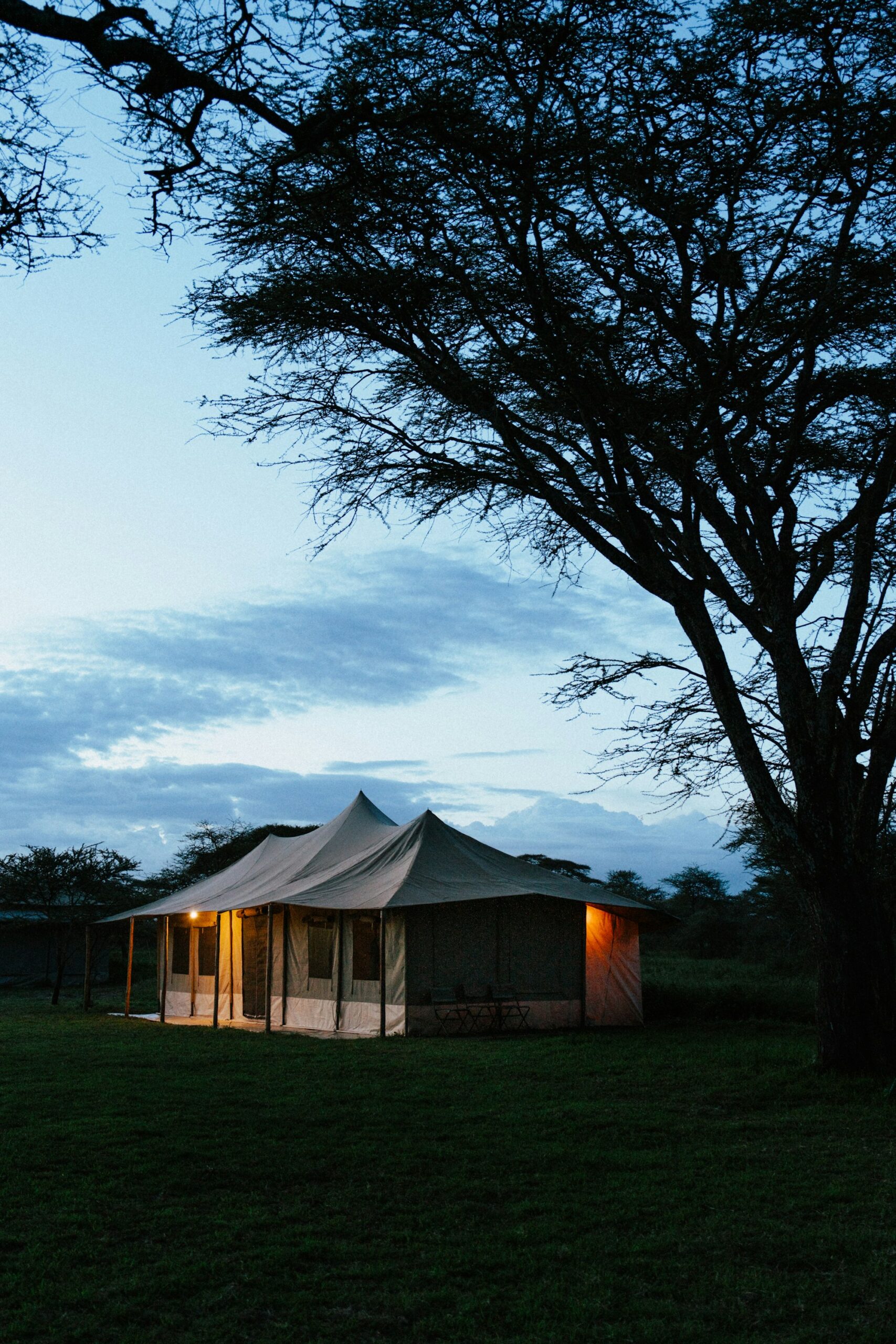
Finding the right value for money
The choice of accommodation significantly impacts the budget of a safari. In East Africa, four main categories are available, each with its own advantages.
Accommodation type comparison
| Type | Price/night | Best for | Included |
|---|---|---|---|
| Public camping | 30-50 USD | Adventurers, budget travelers | Pitch only (bring your own equipment) |
| Basic tented camp | 150-250 USD | Good value for money | Half-board, furnished tent, hot shower |
| Mid-range lodge | 250-500 USD | Comfort without excess | Full board, pool, bar, restaurant |
| Luxury tented camp | 600-2,000+ USD | Exclusive experience | All-inclusive, private game drives, expert guides, spa |
In Tanzania, accommodation in the Serengeti and Ngorongoro is generally 20 to 30% more expensive than in Kenya, due to distances and logistics. In Kenya, the Masai Mara offers a wider range from camping at 30 USD to ultra-luxury camps at 2,000 USD per night.
9. 2026 Budget — Tanzania vs Kenya
How much does an East Africa safari cost?
Budget is often the deciding factor when choosing between Tanzania and Kenya. Here is a detailed comparison for 2026.
Cost comparison by country
| Expense | Tanzania | Kenya |
|---|---|---|
| Round-trip flight from Paris | 500-800 EUR (Kilimanjaro) | 450-700 EUR (Nairobi) |
| Park fees / day | 53-71 USD | 52-80 USD |
| 5-day safari (budget) | 1,200-1,800 USD/pers. | 800-1,400 USD/pers. |
| 5-day safari (comfort) | 2,500-4,000 USD/pers. | 2,000-3,500 USD/pers. |
| 5-day safari (luxury) | 5,000-10,000+ USD/pers. | 4,000-8,000+ USD/pers. |
| Visa | 50 USD (e-Visa) | 50 USD (eTA) |
| Tips / day | 15-25 USD (guide + driver) | 15-25 USD (guide + driver) |
Budget verdict: Kenya is overall 20 to 30% cheaper than Tanzania for an equivalent safari. The main difference comes from accommodation costs and internal transport (distances in Tanzania are longer). However, Tanzania offers larger and less crowded parks, justifying the extra cost for many travelers.
10. Practical tips — visa, vaccines, when to go
Everything you need to know before you go
Visa and formalities
| Requirement | Tanzania | Kenya |
|---|---|---|
| Visa | e-Visa required (50 USD) via immigration.go.tz | eTA required (50 USD) via etakenya.go.ke |
| Passport | Valid for at least 6 months + 2 blank pages | Valid for at least 6 months + 2 blank pages |
| East Africa Visa | 100 USD — allows entry to Tanzania, Kenya, and Uganda (90 days, multiple entries). Ideal if you’re combining both countries. | |
Vaccines and health
- Yellow fever: Vaccination required for Tanzania (international certificate required). Recommended for Kenya if coming from an endemic country.
- Malaria: Antimalarial prophylaxis strongly recommended (Malarone, Doxycycline, or Lariam). Consult a specialist doctor 4-6 weeks before departure.
- Hepatitis A and B: Recommended by the Institut Pasteur. DTP and typhoid boosters advised.
- Travel insurance: Essential with repatriation and medical expenses coverage. Consider cancellation insurance for safaris booked well in advance.
Best season by park
| Park | Peak season | Low season (reduced prices) |
|---|---|---|
| Serengeti | June — Oct. (northern migration) / Jan. — March (calving) | April — May, November |
| Masai Mara | July — October (crossings) | November — May (except holidays) |
| Ngorongoro | June — October | March — May (long rains) |
| Amboseli | June — Oct. / Jan. — Feb. | April — May, November |
| Tarangire | June — November | March — May |
| Tsavo | June — Oct. / Jan. — March | April — May, November |
What to pack?
- Safari clothing: Neutral colors (beige, khaki, olive). Avoid dark blue and black which attract tsetse flies.
- Layers: Mornings at altitude (Ngorongoro, Serengeti) can be cold (5-10°C). A fleece and windbreaker are essential.
- Binoculars: Essential for observing animals from a distance. An 8×42 or 10×42 model is ideal.
- Sun protection: SPF 50+ sunscreen, wide-brimmed hat, sunglasses. The altitude and proximity to the equator make UV radiation very intense.
11. Tanzania vs Kenya — the verdict
Which country to choose for a first safari?
| Criteria | Tanzania | Kenya |
|---|---|---|
| Budget | Higher (+20-30%) | More affordable |
| Park diversity | Exceptional variety | Very good choice |
| Crowds | Fewer tourists | More crowded |
| Accessibility | Longer drives | Parks closer together |
| Migration | Visible year-round | July — October only |
| Beach after safari | Zanzibar (domestic flight) | Diani / Watamu (by road) |
| Big Five | Excellent chances | Excellent chances |
| Ideal for | Immersive, wild safari | First safari, budget-conscious |
Our recommendation: For a first safari, Kenya offers the best combination of accessibility, price, and experience, with the Masai Mara and Amboseli over 5-7 days. For travelers seeking a more exclusive experience and willing to invest more, Tanzania (Serengeti + Ngorongoro + Tarangire over 7-10 days) offers an unparalleled immersion. And if budget allows, a combined Kenya + Tanzania circuit of 10-14 days is simply the holy grail of safari.
Frequently Asked Questions
What is the best time to go on safari in East Africa?
The dry season (June to October) is considered the best time for a safari in East Africa. The low vegetation makes wildlife easier to spot, as animals concentrate around water sources. This is also the period of the Great Migration in the Masai Mara. However, the calving season (January-March) in the southern Serengeti is equally spectacular and less crowded. Prices are 30 to 50% lower in the low season (April-May, November).
How much does a safari in Kenya or Tanzania cost in 2026?
A 5-day safari in Kenya (Masai Mara + Amboseli) costs between 800 and 1,400 USD per person on a budget package, and 2,000-3,500 USD for comfort. In Tanzania (Serengeti + Ngorongoro), expect 1,200 to 1,800 USD on a budget and 2,500-4,000 USD for comfort. These prices include transport, full-board accommodation, game drives, and park fees. Add the international flight (450-800 EUR from Paris), visa (50 USD), and tips (15-25 USD/day).
Can you see the Big Five in a single safari?
Yes, it is entirely possible to see the Big Five (lion, leopard, elephant, buffalo, rhinoceros) in a single safari, particularly in the Ngorongoro Crater in Tanzania, where the chances of observing all of them in a single day are the highest in Africa. In the Masai Mara (Kenya) and the Serengeti (Tanzania), a 3-4 day safari offers excellent odds. The black rhinoceros remains the most difficult animal to spot, as it is rare and elusive.
Should you choose Tanzania or Kenya for a first safari?
For a first safari, Kenya is often recommended: the Masai Mara and Amboseli are easily accessible from Nairobi, prices are more affordable (20-30% cheaper than Tanzania), and the tourist infrastructure is well developed. Tanzania is better suited for travelers seeking a wilder and more exclusive experience, with larger parks (Serengeti) and unique sites like the Ngorongoro Crater. Your budget, length of stay, and priorities (migration, Big Five, landscapes) will determine the best choice.
What vaccines are required for an East Africa safari?
The yellow fever vaccine is mandatory for entering Tanzania (international certificate required upon arrival). For Kenya, it is required if you are arriving from a country where yellow fever is endemic. Vaccines against hepatitis A, hepatitis B, and typhoid are strongly recommended. Antimalarial treatment (Malarone, Doxycycline) is essential — consult an international vaccination center or your doctor at least 4 to 6 weeks before departure.
Is a safari suitable for children?
Yes, a safari can be an extraordinary experience for children, but you need to choose the right format. Most parks and lodges accept children from age 5-6 for game drives (some luxury lodges impose a minimum age of 8-12). Kenya is more suitable for families thanks to shorter distances between parks. Parks like Amboseli and the Masai Mara offer easy, close-range wildlife sightings. Opt for family-friendly lodges with a pool and children’s activities, and limit drives to 3-4 hours maximum per day.
How can you witness the Great Wildebeest Migration?
The Great Migration is a continuous 3,000 km cycle between the Serengeti (Tanzania) and the Masai Mara (Kenya). The most spectacular river crossings take place between July and October: in July in the western corridor of the Serengeti (Grumeti River), and from August to October at the northern Serengeti/Masai Mara border (Mara River). The calving season (January-March) in the southern Serengeti is a lesser-known but equally fascinating alternative. Book your safari in the right area based on the month — a good tour operator will adjust your itinerary according to the herds’ movements.
Can you combine safari and beach in East Africa?
Absolutely, and it’s one of East Africa’s great advantages. In Tanzania, combine a safari in the Serengeti or Ngorongoro with a few days in Zanzibar (1-hour flight from Arusha or the Serengeti). In Kenya, follow up a safari in the Masai Mara or Tsavo with the beaches of Diani Beach or Watamu on the Indian coast (3-4 hours by road from Tsavo). Plan 4-5 days of safari + 3-4 days of beach for an ideal 7-10 day combination.
Sources
- UNESCO — Serengeti National Park — World Heritage listing
- UNESCO — Ngorongoro Conservation Area — World Heritage listing
- TANAPA (Tanzania National Parks Authority) — Rates and regulations for Tanzanian national parks
- KWS (Kenya Wildlife Service) — Information on Kenyan reserves and national parks
- NCAA (Ngorongoro Conservation Area Authority) — Rates and access to the Ngorongoro Crater
- Amboseli Trust for Elephants — Research and conservation of Amboseli elephants
- SafariBookings — Safari comparison and verified reviews
- Tanzania Immigration — Online e-Visa application
- eTA Kenya — Electronic Travel Authorization for Kenya
- Institut Pasteur — Vaccination recommendations for travelers
Research conducted on February 16, 2026 with 190 sources analyzed.
Ready to Experience Your First Safari?
Discover our East Africa itineraries and start planning the adventure of a lifetime. From wild Kenya to majestic Tanzania, your safari awaits.
Explore Africa itineraries