
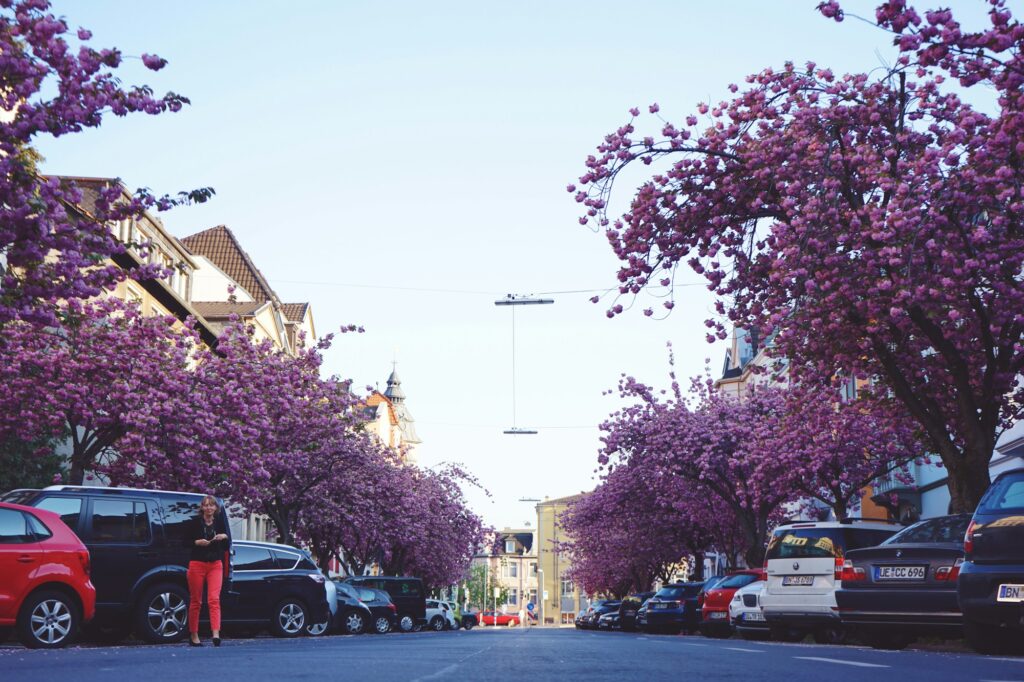
You don’t need to fly to Japan to experience hanami. Every spring, thousands of Japanese cherry trees (Prunus serrulata) transform the streets, parks and cemeteries of Europe into tunnels of pink petals. From the legendary Heerstraße in Bonn to the century-old groves of Parc de Sceaux, from Bispebjerg Cemetery in Copenhagen to the banks of the Moselle in Metz — Europe offers its own versions of sakura, all accessible by train from France. This guide covers the best cherry blossom spots in Europe for spring 2026, with bloom dates, budgets, train access and photography tips for each destination.
1. Bonn, Germany — The Heerstraße and Europe’s Most Famous Cherry Blossom Tunnel
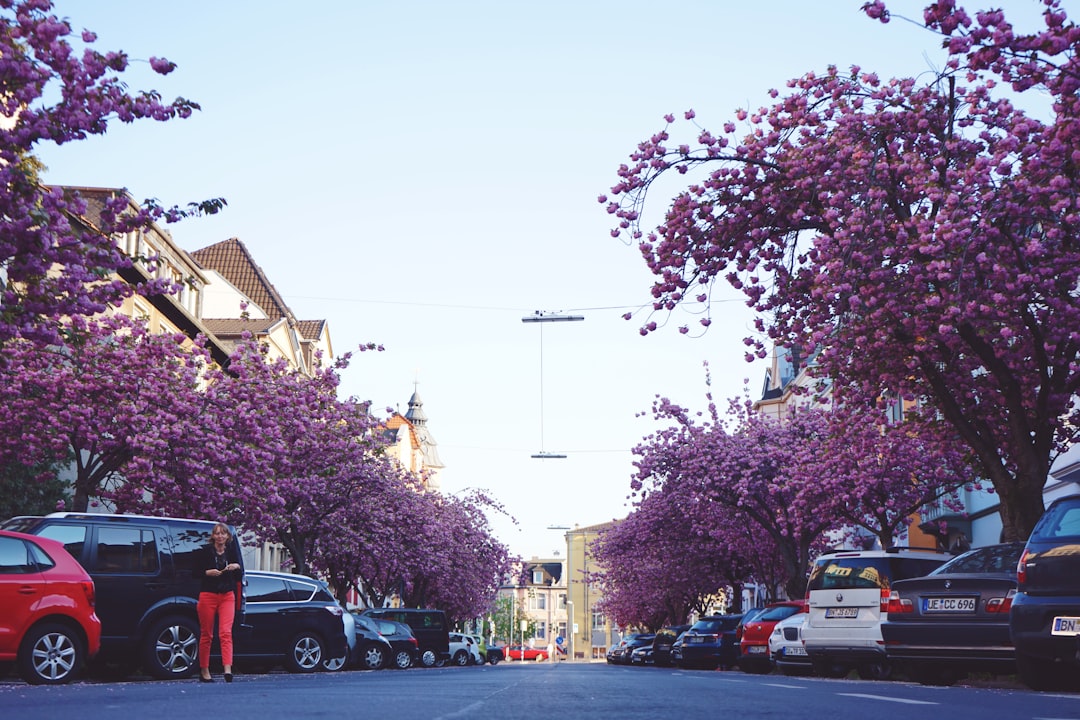
60 Kanzan cherry trees that turn a street into a pink cathedral
From the first days of April, the Heerstraße and Breite Straße in Bonn’s old town transform into tunnels of pink cherry blossoms. The 60 Prunus serrulata ‘Kanzan’ trees, planted in the 1980s during the Altstadt urban renewal, spread their funnel-shaped crowns over the roadway, creating a spectacular pink canopy. The peak bloom lasts ten to fourteen days, typically around mid-April.
But the Heerstraße is just the beginning. In the same neighbourhood, cherry trees line the Maxstraße, Dorotheenstraße, Franzstraße and Georgstraße, with overlapping bloom periods from late March to mid-April. On the right bank of the Rhine, Beuel is home to 47 additional double-flowered cherry trees along Professor-Neu-Allee — the same variety as on the Heerstraße, but with far fewer visitors.
- Heerstraße + Breite Straße — The iconic pink tunnel, perfect for photography
- Maxstraße — The cul-de-sac where blooming starts first, in late March
- Professor-Neu-Allee (Beuel) — 47 cherry trees, right bank, without the crowds
- « Early bird » tour — Depart at 7am, before the crowds (organised by the city)
2. Paris and Île-de-France — Parc de Sceaux, Jardin des Plantes and Hidden Spots
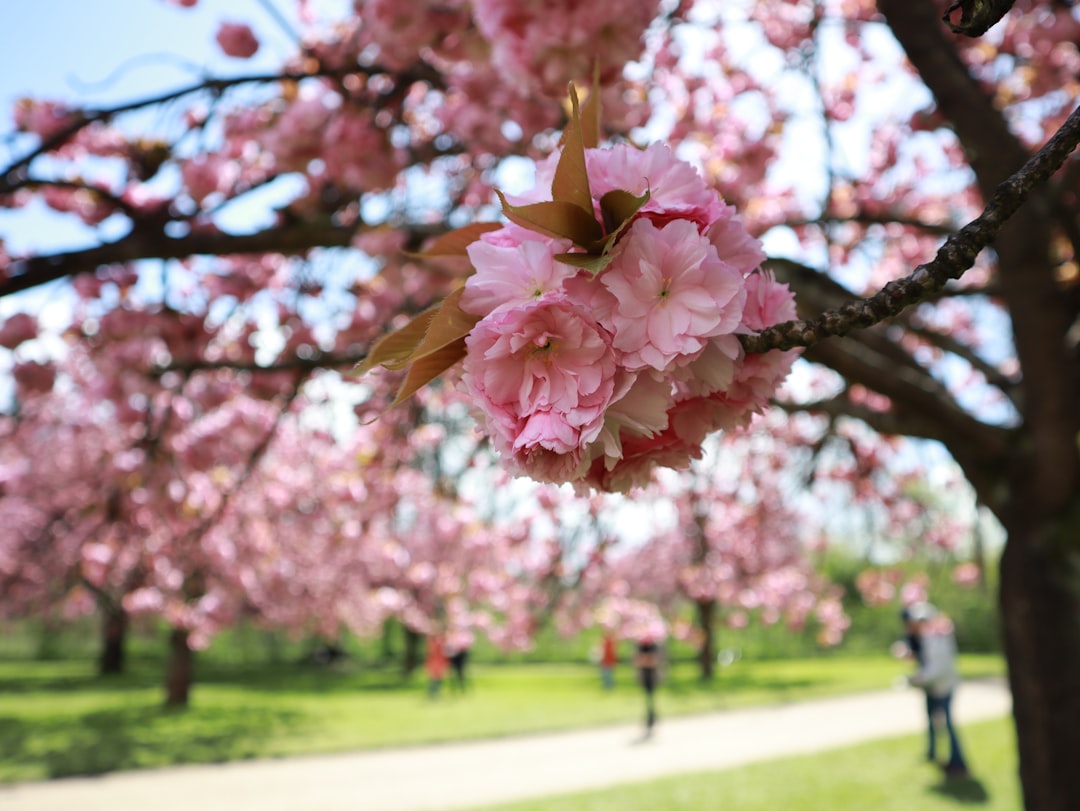
From the Domaine de Sceaux to Square Gabriel Pierné: Parisian hanami
Parc de Sceaux — The undisputed jewel of the region. The Domaine départemental de Sceaux, designed by Le Nôtre in the 17th century, is home to 150 cherry trees including 144 near-century-old Prunus serrulata ‘Kanzan’, spread across two groves in the southern part of the park. The Hanami de Sceaux takes place from April 4 to 19, 2026, featuring taiko concerts, creative workshops and Japanese storytelling every weekend.
New for 2026: Access to the cherry groves now requires a reservation via the OSCAR app (free). 3,500 spots per day, with 1,400 bookable in advance and 2,100 available on the day. The century-old trees have been weakened by a fungus — a necessary conservation measure.
Jardin des Plantes — Europe’s oldest botanical garden (founded in 1626) is home to a remarkable specimen: a Shirotae cherry tree standing 8 metres tall with a 12-metre spread, whose flattened shape is unique in Paris. It blooms from late March. Free admission, opens at 7:30am.
Square Gabriel Pierné — Saint-Germain-des-Prés’ best-kept secret. Tucked behind the Institut de France, this square offers pink cherry blossoms against a backdrop of classical stone, with a fountain at the centre. Open 24/7, no reservation needed — the perfect antidote to Sceaux in 2026.
- Parc de Sceaux — RER B to « Sceaux » or « Bourg-la-Reine », 144 Kanzan cherry trees (reservation required in 2026)
- Jardin des Plantes — Métro Jussieu, arrive at 7:30am for the Shirotae all to yourself
- Square Gabriel Pierné — Métro Pont Neuf, ideal during morning golden hour
- Neuilly-sur-Marne — 480 cherry trees at Parc des 33 Hectares, free access, THE crowd-free spot (RER A then bus 113)
3. Copenhagen, Denmark — Bispebjerg, Langelinie and the Sakura Festival
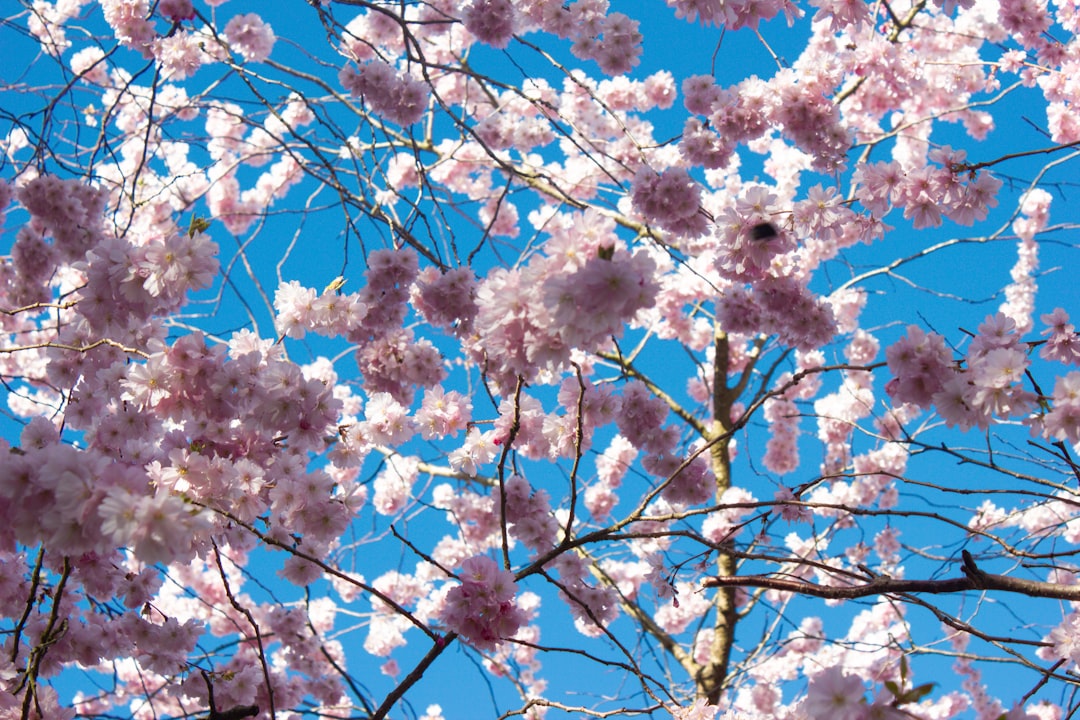
Cherry trees in a Danish cemetery: the spirit of mono no aware
Bispebjerg Cemetery — This is one of Europe’s most unexpected spectacles: an avenue of pink cherry trees in a 43-hectare cemetery in northern Copenhagen. Far from any funereal cliché, Danes come to bask in the sun beneath the sakura — a poetic contrast that perfectly embodies the Japanese concept of mono no aware, the sensitivity to the ephemeral. Crowds gather on weekends; aim for a Tuesday or Wednesday morning for photos without anyone in the frame.
Langelinie Park & Sakura Festival — A stone’s throw from the Little Mermaid and the Kastellet, Langelinie is home to over 200 cherry trees and the Sakura Festival organised by the Japanese Embassy for the past 18 years. Calligraphy workshops, martial arts demonstrations, dance performances and Japanese food tastings. In 2025, the festival took place on April 26 and 27 — expect a similar weekend in late April 2026.
- Bispebjerg Kirkegård — Enter via Frederiksborgvej, bus from the city centre
- Langelinie Park — Near the Little Mermaid, Sakura Festival in late April
- Grundtvig’s Church — Right next to Bispebjerg, remarkable expressionist architecture
- Petal carpet — Visit 5–7 days after peak bloom for the hanafubuki effect (petal shower)
4. Metz, France — The Esplanade, the Plan d’Eau and Lorraine’s Sakura
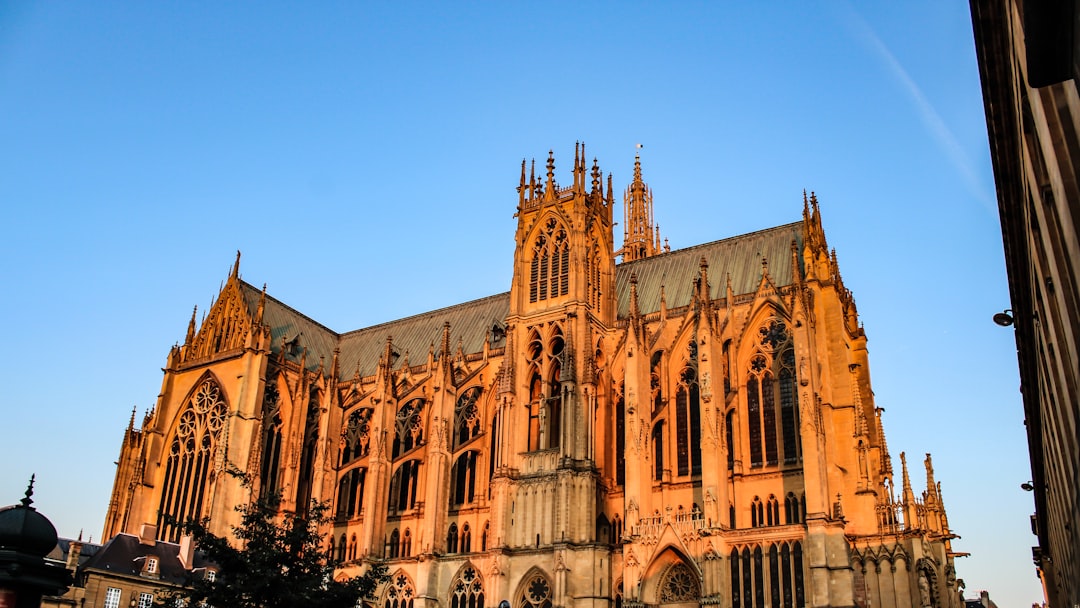
Cherry blossoms between a Gothic cathedral and Wilhelmine architecture
Metz boasts one of France’s least-known green treasures when it comes to sakura. The Esplanade, a vast listed promenade along the banks of the Moselle, is planted with rows of ornamental cherry trees that turn pink in early April. The Plan d’Eau de Metz and the banks of the Seille offer waterside reflections reminiscent of Japan’s blossom-lined rivers — a photo opportunity you won’t find anywhere else in Europe.
The Moselle valley’s microclimate produces a slightly earlier bloom than other cities in eastern France. The cherry trees mingle with the Cathédrale Saint-Étienne (one of the tallest Gothic naves in France, with 6,500 m² of stained glass) and the Wilhelmine Imperial Quarter, creating a unique Franco-Germanic architectural contrast. It is one of the least touristy sakura destinations in France.
- The Esplanade — Listed promenade, rows of cherry trees along the Moselle
- Plan d’Eau — Cherry tree reflections on the water, ideal for photography
- Centre Pompidou-Metz — White origami-style roof contrasting with the cherry blossoms (€7–14)
- Cathédrale Saint-Étienne — 6,500 m² of stained glass, including works by Chagall
5. Amstelveen, Netherlands — The Kersenbloesempark and Its 400 Named Cherry Trees
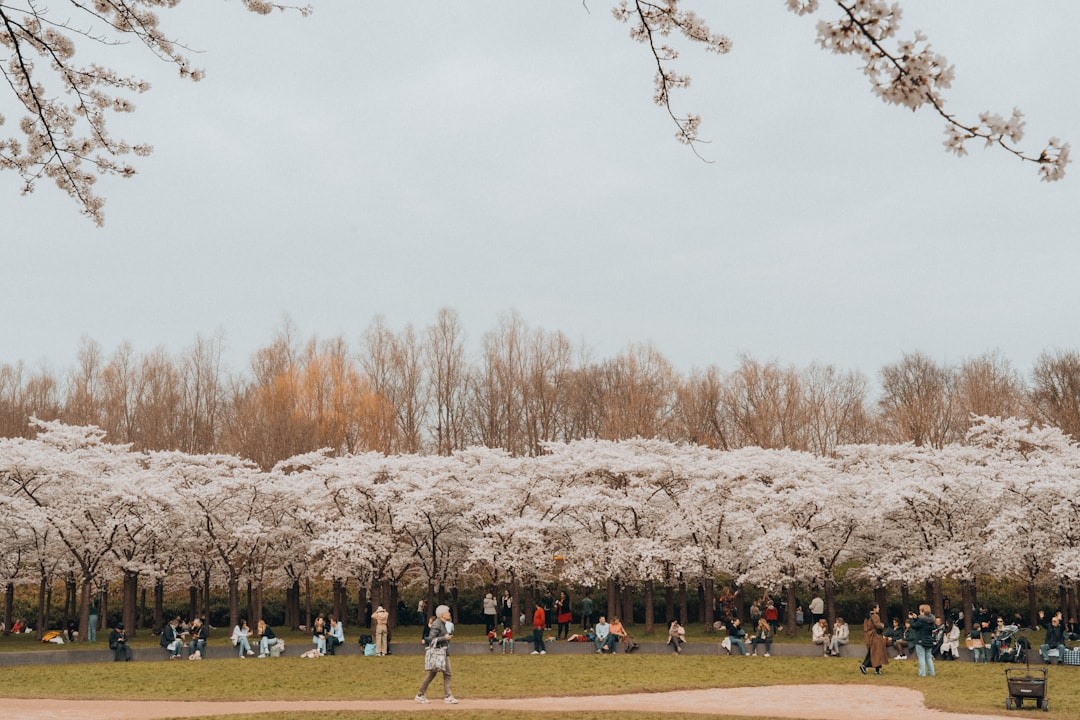
400 Japanese cherry trees, each bearing a woman’s first name
South of Amsterdam, the suburb of Amstelveen is home to a remarkable collection of over 400 Japanese cherry trees, donated in 2000 by the Japanese Women’s Club to the municipality. Each tree bears a woman’s first name — 200 Japanese names and 200 Dutch names. In spring, the Kersenbloesempark (« Cherry Blossom Park ») transforms into an ocean of pink petals that draws photographers and families alike.
The bloom lasts roughly two weeks, from late March to late April depending on temperatures. Weekends can get very busy; on weekdays, the atmosphere is much calmer. Combined with the neighbouring Amsterdamse Bos, it makes for a full day immersed in Dutch spring nature.
- Kersenbloesempark — Burgemeester A. Colijnweg 68, bus 347/348 from Amsterdam
- Amsterdamse Bos — Neighbouring urban forest, perfect as a complement
- By bike — Rent a bike in Amstelveen to explore the park + the Dutch countryside
- Cherry trees + windmills — A unique combination you won’t find anywhere else in Europe
6. Stockholm, Sweden — The Kungsträdgården and the King’s Sakura
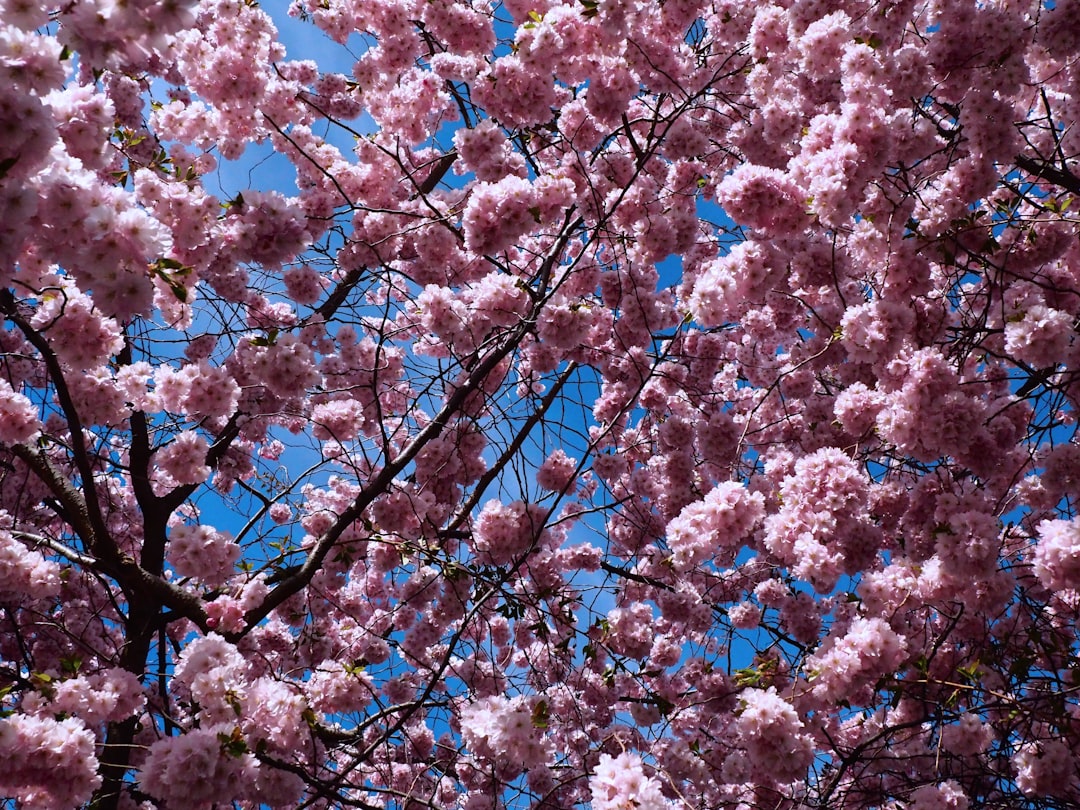
63 cherry trees gifted by Japan to the King of Sweden
The Kungsträdgården (« King’s Garden »), in the heart of Stockholm, owes its springtime fame to the 63 Japanese cherry trees gifted in 1998 to King Carl XVI Gustaf. When these trees bloom in late April, while every other tree in the city remains bare, the contrast is striking: thick pink clouds amid a city still in winter mode.
The Nordic light of late April — 16 hours of daylight — provides exceptional conditions for photography. A Hanami festival takes place here every year in late April, drawing thousands of Stockholmers. In Gothenburg, the Botaniska Trädgården also celebrates its own Hanami with colourful lanterns among the cherry trees — perfect for a « Nordic sakura » itinerary combining both cities.
- Kungsträdgården — Central Stockholm, Kungsträdgården metro station
- Hanami Festival — Late April, festive atmosphere beneath the cherry trees
- Gothenburg (bonus) — Botaniska Trädgården, colourful lanterns among the cherry trees
- 16 hours of light — Exceptional photography conditions in late April
7. Practical Tips: Bloom Dates, Photography and Train Access
2026 Bloom Calendar at a Glance
| Destination | Country | Estimated 2026 Peak | Access from Paris |
|---|---|---|---|
| Neuilly-sur-Marne | France | March 10–20 | RER A (30 min) |
| Square Gabriel Pierné | France | March 25 – April 5 | Métro (10 min) |
| Jardin des Plantes | France | March 25 – April 5 | Métro (15 min) |
| Metz — Esplanade | France | March 28 – April 12 | TGV (1h20) |
| Bonn — Heerstraße | Germany | April 5–18 | Train (3h20) |
| Parc de Sceaux | France | April 4–21 | RER B (40 min) |
| Amstelveen | Netherlands | April 5–20 | Train (3h20) |
| Copenhagen — Bispebjerg | Denmark | April 5–15 | Train (~10h) |
| Copenhagen — Langelinie | Denmark | April 15–30 | Train (~10h) |
| Stockholm — Kungsträdgården | Sweden | April 25 – May 5 | Train (~15h) |
Photography Tips for Capturing European Sakura
Light: Aim for the morning golden hour (7am–9am) — the low-angle rays lend a translucency to the petals that’s impossible to replicate at midday. Blue hour (6am–7am) creates striking misty effects.
Composition: Look for the natural tunnels formed by overarching branches (Heerstraße, Bispebjerg) and use them as leading lines. Near water (Metz, Langelinie), seek out reflections. Use a macro lens for flower details, a wide angle for landscapes, and a polarising filter to intensify the colours.
Weather: Right after rain, wet petals glisten beautifully. In a light breeze, time the « petal shower » (hanafubuki) 5 to 7 days after peak bloom — a magical moment that few photographers manage to capture.
Sakura by Rail: A 10-Day Circuit Across Europe
An ideal itinerary: Metz (Day 1–2) → Bonn (Day 3–4) → Amstelveen/Amsterdam (Day 5–6) → Copenhagen (Day 7–8) → return to Paris (Day 9–10). Total train budget in 2nd class, booked in advance: €180–280 for the entire circuit. All sites are accessible by public transport from the central stations.
Practical Info for Your Sakura Trip
Bike tours, canal cruises, walking tours and more. Free cancellation on most bookings.
Frequently Asked Questions About Cherry Blossoms in Europe
Are European cherry trees the same as those in Japan?
Yes, they are indeed the same tree: Prunus serrulata, the Japanese flowering cherry. Most of the trees that adorn Bonn, Sceaux and Amstelveen are double-flowered cherry trees (Prunus serrulata ‘Kanzan’), native to Japan and prized for their dense, vivid pink blossoms.
How long does the cherry blossom season last in Europe?
Peak bloom lasts a maximum of ten to fourteen days. The warmer it gets, the faster the bloom fades. Allow at least 5 days of flexibility in your travel plans to maximise your chances.
Can you picnic under the cherry trees at Parc de Sceaux in 2026?
Yes, picnicking is allowed during Hanami at the Domaine de Sceaux (April 4–19, 2026). However, in 2026 access requires a reservation: 3,500 spots per day, with 1,400 bookable in advance via the OSCAR app (free) and 2,100 available on the day.
What is the least touristy cherry blossom spot in Europe?
Bispebjerg Cemetery in Copenhagen and Parc des 33 Hectares in Neuilly-sur-Marne (480 cherry trees, free access) offer a far less crowded experience than Bonn or Sceaux. In Metz, the Esplanade remains largely overlooked by mainstream tourist circuits.
Is climate change affecting cherry blossom dates?
Yes, significantly. Bloom periods are becoming increasingly unpredictable. In 2026, the almond trees in Madrid bloomed as early as January 28, four days earlier than the previous year. On average, blooms are advancing by about a week compared to the 2000s. Check local forecasts before planning your trip.
How can I track cherry blossom progress in real time?
For Bonn, Victoria Harlos publishes a « cherry blossom blog » with the current state of the bloom. For Sceaux, follow the Domaine de Sceaux Instagram accounts or call 01 41 87 29 50. For all spots: use Google Maps (real-time foot traffic) and local hashtags (#KirschblüteBonn, #HanamiSceaux, #CopenhagenCherryBlossom).
Is it better to visit the cherry blossoms on a weekday or weekend?
On a weekday, early in the morning (before 8am). Cherry blossom season draws large crowds on weekends, particularly in Bonn and Sceaux. For photographers, the ideal window is the morning golden hour (7am–9am) on a weekday. Friday morning offers a good balance between accessibility and tranquillity.
Can you do a sakura train circuit across Europe?
Absolutely. An ideal 10-day itinerary: Metz (Day 1–2) → Bonn (Day 3–4) → Amstelveen/Amsterdam (Day 5–6) → Copenhagen (Day 7–8) → return to Paris (Day 9–10). Total train budget in 2nd class, booked in advance: €180–280 for the entire circuit. All sites are accessible by public transport from the central stations.
Sources
- City of Bonn — Cherry blossoms in Bonn’s old town
- Le Japon à Paris — Hanami at the Domaine de Sceaux 2026
- Enlarge Your Paris — Mandatory reservation at Sceaux in 2026
- Time Out Paris — 12 places to see cherry blossoms in Paris
- Scandinavia Dreaming — Cherry trees at Bispebjerg Cemetery
- Rove.me — Cherry Blossom in Copenhagen 2026
- Visit Amstelveen — Cherry Blossom Park Amstelveen
- Le Petit Journal Stockholm — Japanese cherry blossom season in Stockholm
- Sortir à Paris — Hanami 2026 in Neuilly-sur-Marne
- Nunkie — Complete guide to spring flowers in Europe 2026
Research conducted on March 4, 2026
Plan Your Sakura Trip Across Europe
Discover hundreds of detailed itineraries created by our community of travellers. From Bonn’s Heerstraße to Stockholm’s Kungsträdgården, find inspiration for your next spring trip in Europe.
Explore all itineraries