
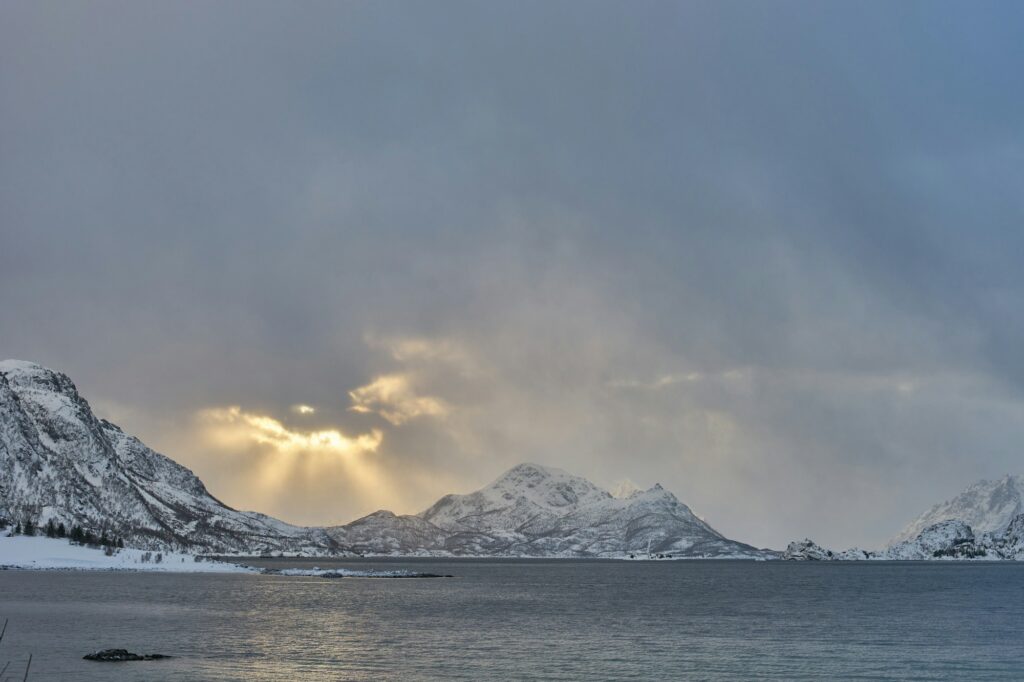
At North Cape, the midnight sun is visible from 14 May to 29 July 2026 — 77 consecutive days without darkness. The Nordkapp plateau stands 307 metres above the Arctic Ocean; the true northernmost point on the continent, Knivskjellodden, is reachable on foot in a 6–7 hour return hike. Tromsø — a direct 3h35 flight from London Gatwick — offers 64 days of permanent sun. For maximum light, plan your trip around the summer solstice on 21 June 2026.
It’s 2am. The sun hasn’t set. On the Nordkapp plateau, 307 metres above the Arctic Ocean, the light is a deep orange that skims the clifftops and carves long shadows across the rock. Gulls cry. Campervans are parked facing the steel globe erected in 1978 — the monument that’s become the icon of the northernmost point of continental Europe. Some travellers have arrived from a cruise ship anchored at Honningsvåg. Others have driven through the night from Tromsø. All are waiting for the moment when the sun brushes the horizon without ever crossing it.
That’s the midnight sun — not just a prolonged twilight, but the sun itself, visible above the horizon at midnight, at 1am, at 4am. A phenomenon made possible by Earth’s axial tilt (23.44°) at latitudes beyond the Arctic Circle (66°33′ N). Norway is the world’s most accessible showcase: in Svalbard, the record stands at 125 consecutive days of permanent daylight; in Tromsø, you can touch down direct from London Gatwick in under 4 hours.
In 2025, northern Norway recorded 1.29 million foreign overnight stays between June and August — an absolute record, according to SSB (Statistics Norway). The « coolcation » trend — swapping Mediterranean heatwaves for Arctic latitudes — has driven this surge since the 2025 heat event (21 consecutive days above 30°C in Arctic Norway). This guide gives you the exact 2026 dates, a destination comparison and a realistic budget.
1. North Cape: the 307-metre plateau at the edge of Europe
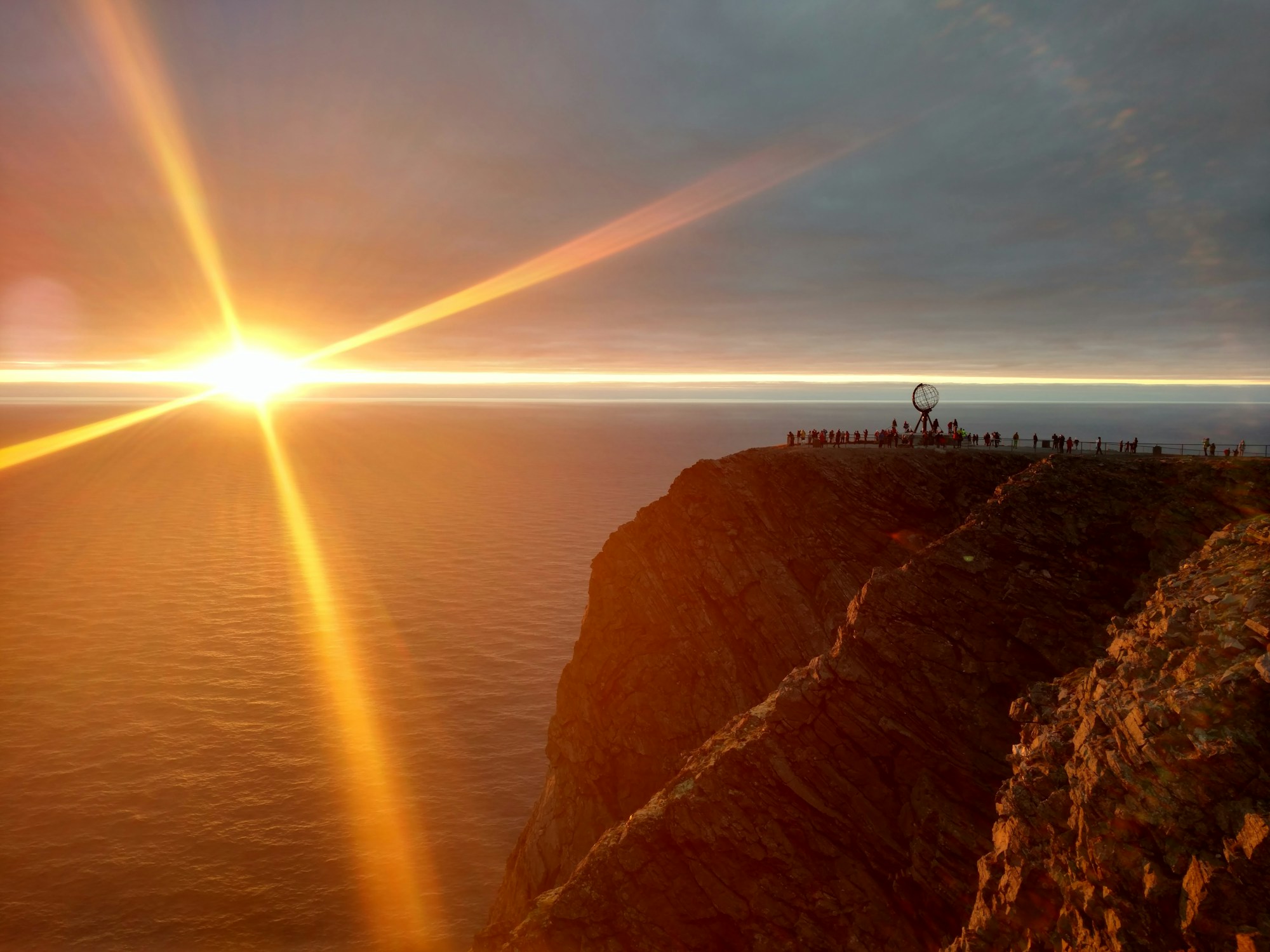
Nordkapp, Magerøya island
North Cape isn’t geographically Europe’s northernmost point, but it’s the most accessible by road: a flat plateau at 71°10’21 » N, connected to the mainland since 1999 via the Magerøya undersea tunnel (toll-free, 212 metres deep). Around 250,000 visitors come each year, according to nordkapp.no. The site is commercially managed by Scandic Hotels, but a ruling by the West Finnmark court recently upheld public access to the outdoor plateau — under Norway’s friluftsloven (right to roam), the exterior plateau remains free. Only the Nordkapphallen visitor centre charges admission (350 NOK / ~£25, ticket valid 24h), per Life in Norway.
The Nordkapphallen is open 24/7 in June and July and includes a panoramic film, museum, Grotto of Lights, chapel and wi-fi. The 24h ticket allows multiple entries — useful if fog covers the plateau on arrival and clears later in the morning. On 21 June 2026 (summer solstice), the sun won’t drop below 21° above the horizon at midnight, according to Visit Norway. That’s the peak of the phenomenon.
Highlights
- Steel globe and 307m cliffs: 360° views across the Arctic Ocean
- Accessible by road (E6 + E69) or by Hurtigruten cruise (Honningsvåg stop)
- Outdoor plateau free to access (2026 court ruling against Scandic Hotels)
- Knivskjellodden 18km return: the true northernmost point — no crowds, no entry fee
2. Tromsø: the ideal base for the midnight sun
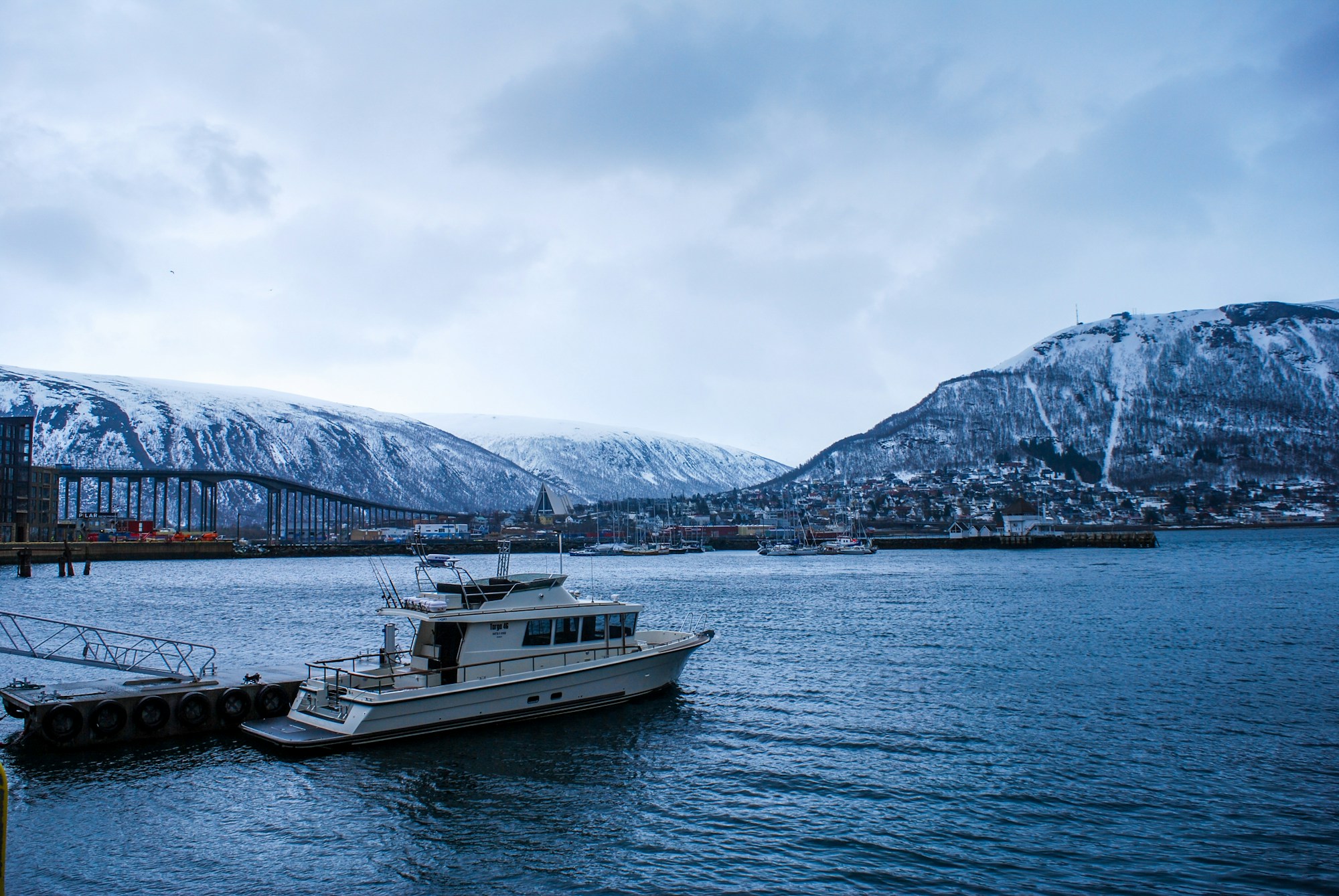
Tromsø, 69.7°N
With 77,000 inhabitants, Tromsø is Norway’s largest city north of the Arctic Circle — sitting 350km beyond that line. Norwegian and easyJet both fly direct from London Gatwick (LGW) to Tromsø (TOS) in around 3h35. The midnight sun is visible here from 20 May to 22 July 2026 — 64 days. According to Tromso.blog, locals dine on terraces at 11pm, children play outside at 1am, and joggers do their harbour laps at 11:30pm as if it were high noon. There’s no real « evening » here — just a day that never ends.
The most popular activity is the nocturnal hike. The Sherpatrappa staircase (1,200 stone steps, best started at 11pm) climbs to 420m altitude with panoramic views over the archipelago. The Fjellheisen cable car offers the same view in 4 minutes (open until 1am in summer, 1,306 NOK with the Tromsø Pass covering museums and Polaria). The island of Sommarøy, an hour’s drive away, is nicknamed « the Caribbean of the Arctic »: white sand, turquoise water at 5–10°C. Kayakers can reach Sommarøy on a guided night tour (4–6h, €140–200). For more routes, our guide on kayak routes in the Scandinavian fjords covers the best options along the Norwegian coast.
The Midnight Sun Marathon in Tromsø drew 9,000 runners from 97 nations on 20 June 2026 — a participation record for the race, which starts at 10:30pm and is run entirely under the sun. Details at msm.no. Worth noting for future trips: the city has voted to introduce a 3% tourist tax on overnight stays from 1 January 2027, according to The Local Norway — Tromsø will be the first Norwegian city to take this step.
For a guided exploration of Arctic landscapes and fjords around Tromsø:
Tromsø is also the northern lights capital in winter — a phenomenon entirely separate from the midnight sun (the two don’t coexist). Our guide on northern lights in Tromsø in 2026 covers the December–March season if you’re thinking of returning in the dark months.
Highlights
- Best infrastructure in northern Norway: fine dining, bars, a university
- Sherpatrappa hike or Fjellheisen cable car open until 1am
- Night sea kayaking to Sommarøy — turquoise Arctic beaches an hour’s drive away
- Midnight Sun Marathon on 20 June 2026 — 9,000 runners, 97 nations
3. Lofoten and Senja: the picture-postcard landscapes of the far north
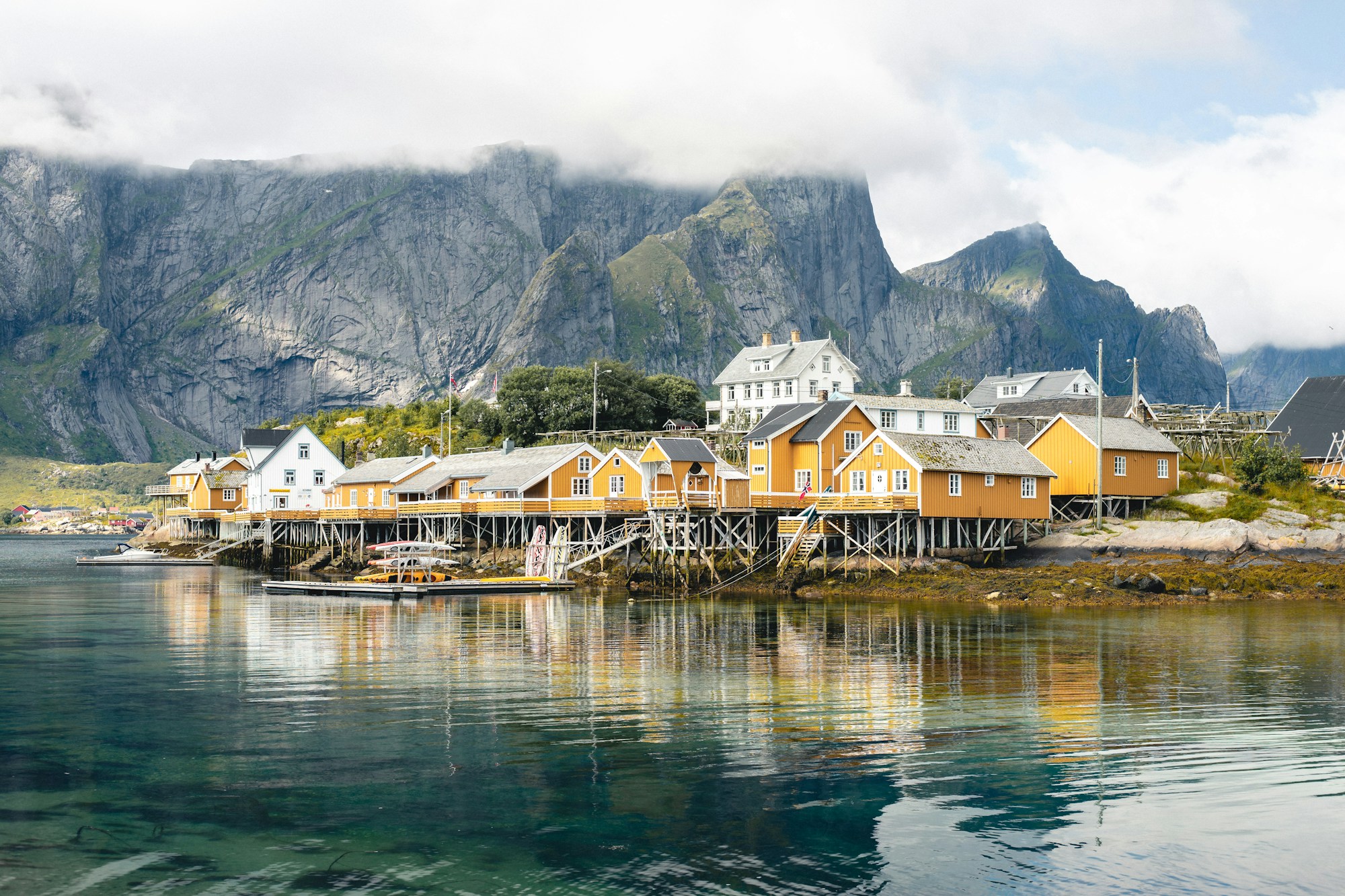
Lofoten, 68.2°N
The Lofoten archipelago is one of Norway’s most sought-after photography destinations: jagged peaks plunging into turquoise fjords, rorbuer (traditional red timber fishermen’s cabins) on stilts, waters of startling clarity at 68°N. The midnight sun is visible here from approximately 25 May to 18 July 2026 at Svolvær — around 55 days, according to Guide to Lofoten. But the Lofoten Islands are also the most thoroughly documented case of Nordic overtourism: roughly 1 million visitors a year for just 25,000 permanent residents, according to a Nordregio study (2025).
Villages not to miss: Reine (the classic view from Hamnøy bridge), Henningsvær (galleries and cafés in an island-village), Å i Lofoten (southernmost tip, open-air museum village). For hiking, Reinebringen (700m, 2–3h return) delivers the iconic view over the rorbuer and fjords. To escape the crowds without sacrificing scenery, the island of Senja — 2h30 by road from Tromsø — offers equivalent cliffs and fjords with far fewer visitors. The Segla summit (639m) overlooks an open Atlantic seascape. Senja remains largely undiscovered by international tourists and is a credible alternative before the crowds arrive.
Highlights
- Rorbuer on the water — sleep in traditional fishermen’s cabins from €105/night
- Reinebringen hike: iconic view over Reine in 3h return
- White-tailed eagles everywhere — birdwatching safari by kayak
- Senja as a crowd-free alternative — Segla and the wild west coast
4. Svalbard: 125 days of permanent light — a world record
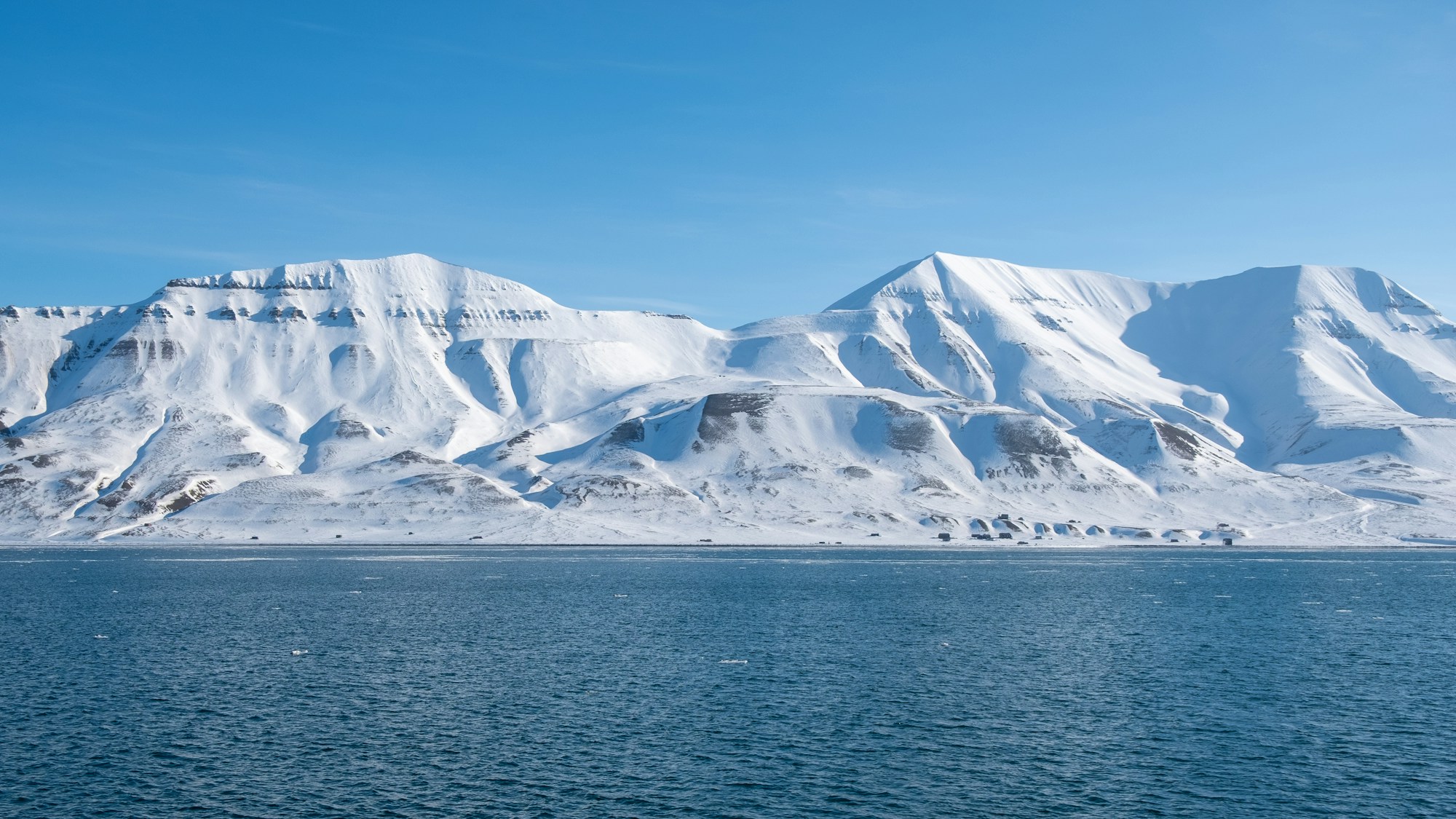
Svalbard / Longyearbyen, 78°N
Svalbard, at 78°N, is the most intense midnight sun experience accessible to the general public. From 20 April to 22 August 2026, the sun does not set over Longyearbyen (pop. 3,000) — 125 consecutive days, a world record for an inhabited place, according to Visit Svalbard. No visa is required for British nationals (Svalbard Treaty). Since January 2025, new regulations impose a minimum distance of 300–500 metres from polar bears (around 300 individuals on the archipelago). Any excursion outside Longyearbyen must be done with an armed guide, according to Poseidon Expeditions.
Midnight activities in Svalbard have a dimension no other destination can match. Glaciers — visibly retreating from one season to the next — can be hiked at night under golden light. The floating sauna SvalBad, moored at the fjord’s edge, lets you take an ice-cold dip at 2am under a sky that never turns dark. Wildlife safaris by 4×4 or e-bike through Adventdalen offer sightings of Svalbard reindeer (a short-legged endemic subspecies), Arctic foxes and walruses. Longyearbyen’s local cuisine — reindeer, Arctic salmon, seal — is served across its 15 restaurants and bars.
Highlights
- 125 days of permanent sun — world record for an accessible inhabited place
- Polar bears, walruses, endemic reindeer, seals — unique Arctic wildlife
- SvalBad floating sauna and glacier hikes under golden light
- No visa required for British nationals — an internationally unique territory
5. All 2026 dates and how to plan your trip
Complete midnight sun dates for 2026
| Location | Latitude | Start | End | Duration |
|---|---|---|---|---|
| Svalbard | 78°N | 20 April | 22 August | 125 days |
| Nordkapp | 71.2°N | 14 May | 29 July | 77 days |
| Hammerfest | 70.7°N | 16 May | 27 July | 73 days |
| Alta / Kirkenes | 70°N | 16–17 May | 26–27 July | ~72 days |
| Tromsø | 69.7°N | 20 May | 22 July | 64 days |
| Senja | 69.5°N | ~20 May | ~22 July | ~64 days |
| Vesterålen / Andenes | 69.3°N | 22 May | 21 July | 61 days |
| Lofoten (Svolvær) | 68.2°N | 25–28 May | 14–18 July | ~50 days |
| Bodø | 67.3°N | 2–4 June | 8–10 July | 35 days |
| Arctic Circle | 66.5°N | 12 June | 1 July | 20 days |
Sources: ViewNorway, Visit Norway, Arctic Norway Tours, Explore Finnmark
Which period should you choose?
The optimal window is the third week of June, centred on the solstice of 21 June 2026. At that date, every location in the table above is in full midnight sun. Weather-wise, July is statistically drier in Tromsø (11 rainy days versus 20+ in June). For a combination of culture and light, the Sami festival Riddu Riđđu (8–12 July 2026, Manndalen, Kåfjord) brings together artists and indigenous communities under the midnight sun at 69°N — a rare pairing.
Getting there
Flights from London to Tromsø peak in price 3–4 weeks before the solstice — comparing fares in May for a June departure is your best bet. Road access to North Cape via the E69 is open without restriction from April to mid-October. Our guide to Norway 2026: fjords, Lofoten and a 2-week itinerary maps out a circuit combining several of the destinations above.
Budget by profile (1 week, per person)
| Profile | Total budget | Details |
|---|---|---|
| Budget traveller | £600–£850 | Wild camping (allemannsretten, free), Kiwi/Rema 1000 supermarkets, free activities |
| Mid-range | £1,250–£2,100 | Hostel or 3-star hotel, 1–2 guided activities, restaurant for lunch |
| Comfort | £2,500–£4,200 | 4-star hotel or lodge, guided activities, restaurants, Fjellheisen included |
| Svalbard premium | £4,200+ | Boutique lodge (Funken Lodge, Basecamp), armed guides, safaris, Oslo–LYR flight |
The allemannsretten — the right to roam enshrined in Norwegian law — allows camping on any uncultivated land at least 150 metres from dwellings. In practice, wild camping is free across the vast majority of northern Norway. With a tent and self-catering from local supermarkets, a week in Tromsø or the Lofoten Islands can come to £600–£850 all-in including flights.
Practical information for your stay
Telenor 4G/LTE network: reliable coverage in urban areas and along main roads (E6, E69, Lofoten Islands). Europe plans from $4 covering 42 countries including Norway. Coverage is limited in very remote areas (inland Finnmark tundra, Svalbard outside Longyearbyen).
From $4For Arctic outdoor activities (glacier hiking, sea kayaking, wildlife safaris), cover of at least £20,000 in medical expenses plus repatriation is essential. UK travellers can use their Global Health Insurance Card (GHIC) — valid in Norway since January 2024 — for basic state healthcare, though a contribution may still apply. Repatriation and specialist care remain at your own expense.
From $56 / 4 weeksFrequently asked questions about the midnight sun in Norway
When can you see the midnight sun at North Cape in 2026?
At North Cape (Nordkapp), the midnight sun is visible from 14 May to 29 July 2026 — 77 consecutive days without darkness. The light is most intense around the solstice on 21 June 2026, when the sun stays at least 21° above the horizon at midnight. To avoid the cruise ship crowds (which arrive heavily between 11:30pm and 12:30am), aim to visit between 1am and 4am. Source: ViewNorway.
Is the midnight sun actually visible, or is it just diffuse light?
Beyond the Arctic Circle and during the relevant period, the solar disc is literally visible above the horizon at midnight — it’s not just a faint ambient glow. This is the sun itself, skimming the horizon, projecting a golden-orange light that lasts for hours. The higher the latitude, the more intense the effect. In Svalbard (78°N), the sun doesn’t even touch the horizon for 125 days. The light resembles a perpetual golden hour — no transition to night. Source: Visit Norway.
How do you sleep under the midnight sun in Norway?
Permanent light blocks melatonin production and can cause insomnia for the first 2–3 days. Locals rely on heavy blackout curtains. For travellers, the essentials are: a quality sleep mask (with foam padding, not an airline plastic shell), silicone earplugs (Arctic gulls start screaming at 4am), fixed meal times and avoiding screens in the evening. A gentle melatonin supplement can speed up adaptation in the first few days. Quality hotels in northern Norway all have proper blackout shutters. Source: Visit Norway.
Tromsø, Lofoten, North Cape or Svalbard — which is best for the midnight sun?
It depends on your travel style. Tromsø: best accessibility (direct flight from London in under 4h) and the widest infrastructure — ideal for a first Arctic trip. Lofoten: Norway’s most photographed landscapes and the iconic rorbuer — book 6 months ahead for peak season. North Cape: the symbolic « edge of Europe » experience, with the free Knivskjellodden alternative for hikers. Svalbard: the most extreme option (125 days, polar bears) but also the most expensive (£2,500–£4,500/week). To escape the Lofoten crowds, Senja (2h30 from Tromsø) offers equivalent scenery in comparative peace.
Is Norway too expensive to visit for the midnight sun?
Norway is one of Europe’s priciest countries, but there are ways to keep costs down. Wild camping is legally free thanks to the allemannsretten (minimum 150 metres from dwellings). Kiwi, Rema 1000 and Coop supermarkets let you eat for £13–£25 per day. With a tent and self-catering, a week in Tromsø or the Lofoten Islands can come to £600–£850 flights included. Mid-range accommodation and dining pushes the budget to £1,250–£2,100. Source: Tromso.blog.
Is a tourist tax in place in Norway in 2026?
A national law passed in 2026 allows Norwegian municipalities to levy 3% on hotel overnight stays. Tromsø has voted to implement it from 1 January 2027 — it will be the first Norwegian city to do so. Other tourist hotspots (Lofoten, Nordkapp) may follow in the coming years. Wild campers and motorhome travellers are not affected. Source: The Local Norway (25 June 2026).
Sources
- Visit Norway — Midnight Sun — official guide and dates by location
- ViewNorway — Midnight sun dates by latitude — complete 2026 table
- Arctic Norway Tours — Complete 2026 guide — durations and destinations compared
- Explore Finnmark — Midnight Sun Norway — dates for Nordkapp, Alta, Hammerfest
- Nordkapp — Official site — Nordkapphallen, opening hours and prices
- Life in Norway — Nordkapp court ruling — free access to the plateau (2026)
- Nord-Norge — Knivskjellodden — true northernmost point of continental Europe
- Tromso.blog — Midnight Sun Guide — local life and nocturnal activities
- Tromso.blog — Budget Guide Tromsø 2026 — realistic daily budget
- Midnight Sun Marathon — Official — 20 June 2026 race, 9,000 runners
- Riddu Riđđu — Sami Festival 2026 — 8–12 July 2026, Manndalen, Kåfjord
- Guide to Lofoten — Midnight Sun — dates and activities on the archipelago
- Nordregio 2025 — Lofoten overtourism — 40:1 tourist-to-resident ratio
- Visit Svalbard — Midnight Sun — 125 days, Longyearbyen
- Poseidon Expeditions — New Svalbard regulations — polar bears (Jan. 2025)
- SSB (Statistics Norway) — Record overnight stays 2025 — 40.6 million overnight stays
- The Local Norway — Tromsø tourist tax — 3%, applicable January 2027
- NHS Business Services Authority — GHIC in Norway — valid since January 2024
- Skyscanner — London Gatwick to Tromsø — flight options from the UK
Research compiled on 29 June 2026 from 65 primary sources.
Ready to plan your midnight sun trip?
Explore Pixidia’s personalised itineraries for northern Norway: Tromsø, Lofoten or Svalbard. Build a trip that actually fits your travel style.
Explore Arctic destinations