
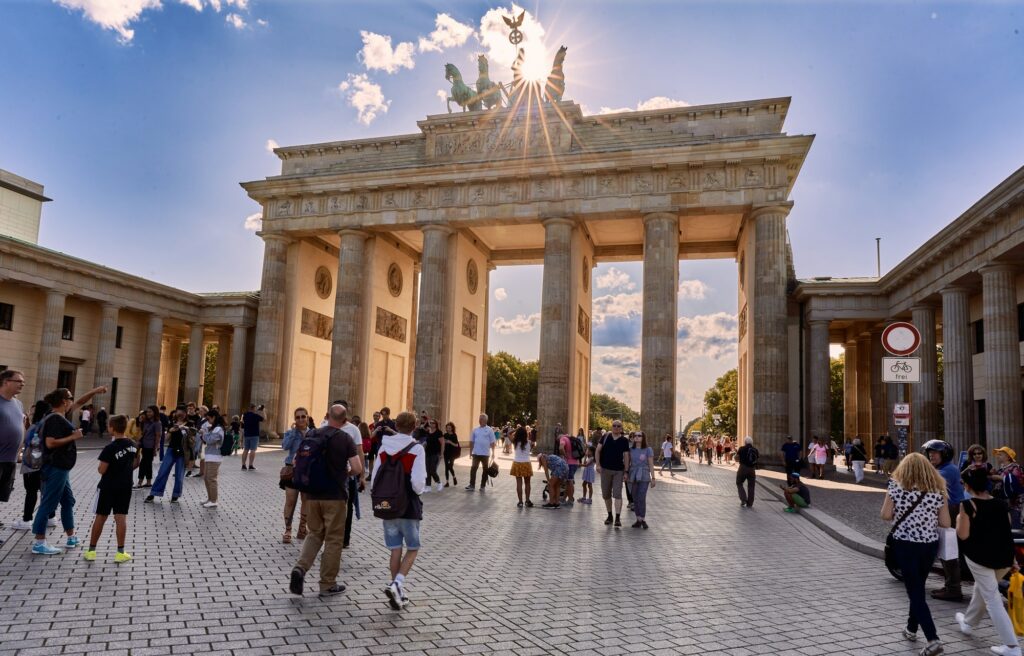
Christopher Street Day Berlin is running as a two-day event for the first time ever, on 24 and 25 July 2026. An opening evening, « Democracy Night », takes place on the Friday at the Brandenburg Gate, followed by the 48th parade on the Saturday, setting off at noon from Leipziger Straße. The march and the closing rally are entirely free and typically draw around 500,000 people, up to a million at the record-breaking 2019 edition. Book accommodation in Schöneberg now: prices climb fast as summer approaches.
Berlin hosts Germany’s biggest LGBTQIA+ gathering every summer, and the 2026 edition changes format for the first time in its history. This guide covers the new two-day programme, the parade route, the political backdrop around it, and everything you need to plan your trip, from budget to where to stay.
The weekend of 24-25 July 2026: the new two-part format
Democracy Night and the 48th parade: the confirmed programme
For the first time in its history, Christopher Street Day Berlin now runs across two days. According to csd-berlin.de, confirmed by berlin.de and visitBerlin.de, the weekend opens on Friday 24 July 2026 with « Democracy Night », a gathering from 6pm to 11pm at the Brandenburg Gate combining three stages, artistic performances and political speeches.
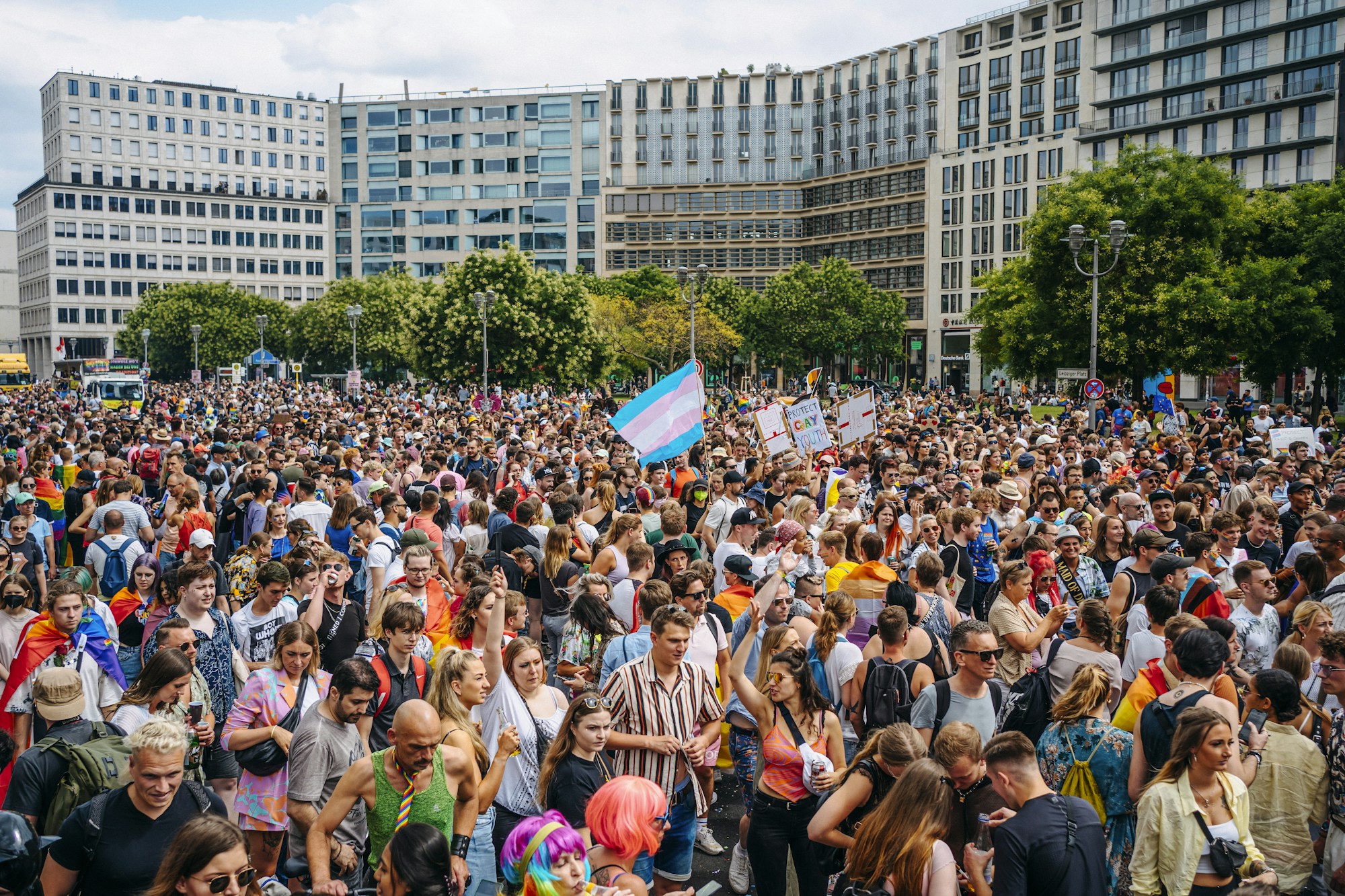
The 48th parade itself takes place on Saturday 25 July 2026. The official opening is set for 11:30am, ahead of the first vehicle setting off at noon sharp, at the corner of Leipziger Straße and Spittelmarkt. The procession then crosses Potsdamer Platz, Bülowstraße and Nollendorfplatz before reaching Straße des 17. Juni and the Brandenburg Gate, where the first groups arrive around 3:30pm for a free closing rally: several music stages, community stalls and food running into the evening.
The 2026 motto, « Haltung ist hot » (« taking a stand is hot »), is no throwaway line: it’s directly tied to Berlin’s House of Representatives election on 20 September 2026, in which 16 and 17-year-olds will be able to vote for the first time. The detailed line-up for the closing rally’s music stages is traditionally announced late by the organiser, Berliner CSD e.V.: at this stage, no artists have been confirmed for this edition.
As a rough benchmark (figures from the 2025 edition, since the 2026 line-up hasn’t been announced yet), the procession featured around 75 decorated floats and more than 100 walking groups, backed by close to 1,000 additional police officers and 280 first responders.
Weekend highlights
- Democracy Night from Friday evening, a first in CSD Berlin’s history
- A route crossing several iconic neighbourhoods, from the historic centre to the Brandenburg Gate
- Official parties running late into the night: SMUDGE on Friday, House of Pride on Saturday
Half a century of history, from Christopher Street to Berlin
The name « Christopher Street Day » traces directly back to the Stonewall riots, which broke out on the night of 27-28 June 1969 at the Stonewall Inn, a gay bar in Greenwich Village, New York. A police raid that turned into several nights of resistance became the founding act of the modern gay liberation movement. Our guide to NYC Pride 2026 covers these founding sites in detail, now protected as the Stonewall National Monument.
The concept crossed the Atlantic ten years later: Bernd Gaiser organised Berlin’s very first edition on 30 June 1979, with just 400 marchers walking from Savignyplatz to Halensee. Growth since then has been dramatic, as the table below shows: reunification in 1990 sent turnout climbing immediately, the million mark was passed in 2019 for Stonewall’s 50th anniversary, before a drop to 65,000 participants in 2021 during the pandemic, then a stabilisation at around 500,000 in recent years.
| Year | Estimated attendance |
|---|---|
| 1979 | About 400 (first edition) |
| 1990 | About 15,000 (after reunification) |
| 1998 | About 300,000 |
| 2012 | About 700,000 |
| 2019 | About 1,000,000 (all-time high) |
| 2021 | About 65,000 (pandemic impact) |
| 2023-2025 | About 500,000 |
One political landmark has left a lasting mark on Berlin’s CSD history: in 2001, Berlin’s governing mayor Klaus Wowereit made his now-famous declaration, « Ich bin schwul, und das ist auch gut so » (« I’m gay, and that’s a good thing »), a defining moment for gay political visibility in Germany. Since late 1999, the event has been run by Berliner CSD e.V., an association that took over from three historic organisations: the Sonntags-Club, the LSVD and Mann-o-Meter.
How many people attend, and how Berlin compares with other Pride events
In recent years (2023-2025), the organiser has reported turnout of around 500,000, with an all-time high close to a million in 2019. That makes CSD Berlin Germany’s most iconic and longest-running LGBTQIA+ gathering, even if Cologne claims, in some years, a slightly higher turnout for its own event.
| City | 2026 dates | Typical turnout |
|---|---|---|
| Berlin | 24-25 July | About 500,000 (up to 1 million in the record year) |
| Cologne | 19 June – 5 July | Up to 1-1.5 million |
| Hamburg | 25 July – 2 August | About 260,000 |
| Munich | 11-28 June | About 250,000 |
| Frankfurt | July | About 250,000 |
Cologne hosts the country’s most attended gathering in absolute terms; our guide to CSD Cologne 2026 covers its own programme in full, running from 19 June to 5 July. Hamburg, Munich and Frankfurt round out the calendar of Germany’s big LGBTQIA+ dates, each with its own timing and atmosphere.
On a European scale, summer 2026 is particularly packed: Madrid Pride (MADO) claims more than two million participants between 25 June and 5 July, an event we cover in our guide to Madrid Pride 2026, while Amsterdam hosts WorldPride for the first time, from 25 July to 8 August 2026, overlapping directly with the Berlin weekend. The Spartacus Gay Travel Index 2026 also ranks Germany 4th worldwide, tied with Belgium, Canada and Portugal, behind Iceland, Malta and Spain.
A tense political backdrop in 2026
The political context around the 2026 edition remains tense. On 1 July 2025, on public broadcaster ARD, Federal Chancellor Friedrich Merz defended Bundestag President Julia Klöckner’s decision not to fly the rainbow flag above parliament for Christopher Street Day, saying the Bundestag « is not a circus tent ». Klöckner confirmed the flag would only be raised once a year, on 17 May, a policy carried over into 2026. In response, Berlin’s transport operator BVG repainted a U-Bahn station in rainbow colours. According to Euronews, a petition launched by the NGO All Out gathered close to 10,000 signatures.
The official organisation is dealing with its own internal tensions too. Several groups, including LesMigraS, TransInterQueer and Radical Queers Berlin, accuse Berliner CSD e.V. of drifting towards « rainbow capitalism » and are running a parallel event, the Internationalist Queer Pride, under the slogan « Queer Liberation Not Rainbow Capitalism ». According to gay45.eu, these criticisms come as the association lost more than half its sponsors in 2025, around €200,000 in sponsorship, before finding new ones.
Looking further ahead, Berliner CSD e.V. has announced its bid to host WorldPride 2032, going head-to-head with London. If successful, it would be a first for Germany.
Schöneberg and Kreuzberg: Berlin’s queer scene, far beyond the parade
Nollendorfplatz, a century of queer history
Long before it became a stop on the parade route, the Schöneberg district around Nollendorfplatz was already considered Europe’s oldest continuously active gay neighbourhood. As early as the 1920s, Berlin’s queer scene was the most visible in the world here: British writer Christopher Isherwood lived here in the early 1930s and documented its « radical openness » in his writing, which later inspired the musical Cabaret. A 1938 map still listed 57 gay and lesbian venues around the square, before the Nazi regime methodically dismantled this scene from 1933 onwards: the Eldorado cabaret, on Motzstraße, became the local headquarters of the SA (the Nazi paramilitary) as early as 1932.
Opened in 1985, the Schwules Museum, now based on Lützowstraße in Tiergarten, is the world’s first museum dedicated to gay history. Its library holds around 20,000 volumes, and entry costs €9 (€3 concession). Nearby, Pink Triangle Park honours the memory of the gay victims of Nazism.
For a more alternative vibe, head to Kreuzberg: the historic Möbel Olfe bar, SO36’s Gayhane night or the queer art space Barbie Deinhoff’s extend a nightlife scene that’s more underground than Schöneberg’s. Our guide to Kreuzberg covers ten addresses for exploring this alternative district and its street art.
Don’t miss
- Pink Triangle Park, a memorial to the gay victims of Nazism
- Motzstraße and Fuggerstraße, the heart of the historic gay bar scene
- Berghain nearby, world-famous but with no direct link to CSD
To get between these neighbourhoods easily, especially with Saturday’s road closures, a guided bike tour is the most practical way to see the city differently:
Planning your trip: budget, accommodation and transport
Getting to Berlin from the UK
From the UK, easyJet, British Airways and Ryanair all fly direct to Berlin several times a day, with fares ranging from around £45-50 on a good deal up to roughly £120-145 for a late booking; fare-comparison sites suggest booking seven to thirteen weeks ahead can meaningfully cut the cost. A lower-carbon alternative: take the Eurostar to Paris (or Brussels), where European Sleeper’s direct overnight service to Berlin takes over, with reclining seats from around €30 (about £26). We’ve covered this connection in detail in our guide to the Paris-Berlin night train.
Entry requirements and formalities
As a UK passport holder, you don’t need a visa for a short trip to CSD Berlin: British nationals can still enter Germany visa-free for tourism, within the standard 90-days-in-180 Schengen limit. You’ll need a valid passport rather than just a driving licence or ID card, and should expect biometric checks (fingerprints and a facial scan) at the border under the EU’s Entry/Exit System (EES), fully in force at Schengen’s external borders since 10 April 2026, in place of the old passport stamp. The separate ETIAS travel authorisation, a paid online pre-registration for visa-exempt visitors including the UK, isn’t expected to become mandatory before the last quarter of 2026, so it won’t affect this event, but it’s worth checking the latest gov.uk travel advice closer to your trip.
Budget and accommodation
On accommodation, budget an average of €130 (about £112) a night for a 3-star hotel, €168 (about £144) for a 4-star, or around €32 (about £28) in a hostel; an Airbnb-style rental runs to around €217 (about £187) a night in summer, close to €1,510 (about £1,300) for a full week. Every guide we’ve checked recommends booking several months ahead, since prices climb sharply as the CSD weekend approaches. Schöneberg remains the most recommended area for its proximity to the route, ahead of Mitte, Kreuzberg and Friedrichshain.
Getting around during the weekend
Several central roads will be closed to traffic on Saturday 25 July: stick to public transport (a day ticket for zones AB costs from €11.20, about £9.60, on the BVG network) or walking. From Berlin Brandenburg Airport (BER), the Airport Express (FEX) reaches the central station in 20-25 minutes, departing every 15 minutes.
Practical information for your trip
Stay connected without worrying about network overload during the big crowds, with data plans sized to fit the length of your trip.
From $4 (1 GB)Cover built for the unexpected during your stay in Germany, with Nomad Insurance plans you can compare and buy online in a couple of minutes.
From $56 / 4 weeksFrequently asked questions
What is the exact date of Christopher Street Day Berlin 2026?
CSD Berlin 2026 runs across two days for the first time: « Democracy Night » opens the weekend on Friday 24 July from 6pm to 11pm at the Brandenburg Gate, followed by the 48th parade on Saturday 25 July, setting off at noon from Leipziger Straße. This date is confirmed by cross-checking csd-berlin.de, berlin.de and visitBerlin.de.
Is it free to take part in the parade?
Yes. The parade, the closing rally at the Brandenburg Gate and the Motzstraßenfest street festival on 18-19 July are all entirely free and open to everyone. Only the official parties, such as House of Pride or SMUDGE, charge admission, roughly €15-90 (about £13-77) depending on the event.
Do UK citizens need a visa to attend CSD Berlin?
No visa is required for a short stay. UK passport holders can still enter Germany visa-free for tourism, within the standard 90-days-in-180 Schengen limit, provided they travel on a valid passport rather than an ID card. Since 10 April 2026, expect biometric checks under the EU’s Entry/Exit System instead of a passport stamp; the separate ETIAS authorisation isn’t expected to become mandatory before the last quarter of 2026.
How many people take part in CSD Berlin each year?
In recent years (2023-2025), the organiser has reported turnout of around 500,000. The all-time high dates back to 2019, with roughly a million participants marking the 50th anniversary of the Stonewall riots.
Which neighbourhood should you stay in for CSD Berlin?
Schöneberg, around Nollendorfplatz, remains the most recommended choice for its proximity to the route and its historic gay-neighbourhood atmosphere. Mitte and Kreuzberg are two solid alternatives. Book several months ahead: prices rise quickly as the weekend approaches.
Is Berlin a safe city for LGBTQIA+ couples?
Specialist guides continue to rank Berlin among Europe’s safest cities day to day for LGBTQIA+ people, despite a documented rise in hate-related incidents nationally in recent years. A significant security operation is in place on parade day.
Why is the event called Christopher Street Day?
The name comes from Christopher Street in Greenwich Village, New York, home to the Stonewall Inn. The riots that broke out there in June 1969 marked the starting point of the modern gay liberation movement, commemorated every year under this name in Germany.
Are there other CSD events in Germany around the same time?
Yes, Germany holds more than a hundred CSD events every summer. Cologne claims the highest turnout in absolute terms, while Hamburg, Munich and Frankfurt round out the calendar of major dates, each with its own schedule.
Sources
- csd-berlin.de — Demo & Route 2026 — Official parade route and schedule
- csd-berlin.de — Official Parties 2026 — Full line-up of official parties
- berlin.de — Official confirmation of the two-day format
- visitBerlin.de — Official practical information
- visitBerlin.de — 11 Tips — Official visitor tips
- Wikipedia — Berlin Pride — History and attendance figures
- The Berliner — Photo retrospective of CSD Berlin
- Euronews — Controversy over the rainbow flag at the Bundestag
- GAY45 — Internal divisions and the Internationalist Queer Pride
- Germany Travel (DZT) — Comparison of CSD events across major German cities
- Auswärtiges Amt — Visa rules for Germany
- misterb&b — Safety information for LGBTQIA+ travellers in Berlin
- Nomadic Boys — LGBTQIA+ traveller accounts and tips
- Wikipedia — Schwules Museum — History of the world’s first gay museum
Information verified on 2 July 2026.

Plan your trip with Pixidia
Pixidia learns how you travel and helps you build a trip that truly fits you and everyone coming along.
Open the planner