
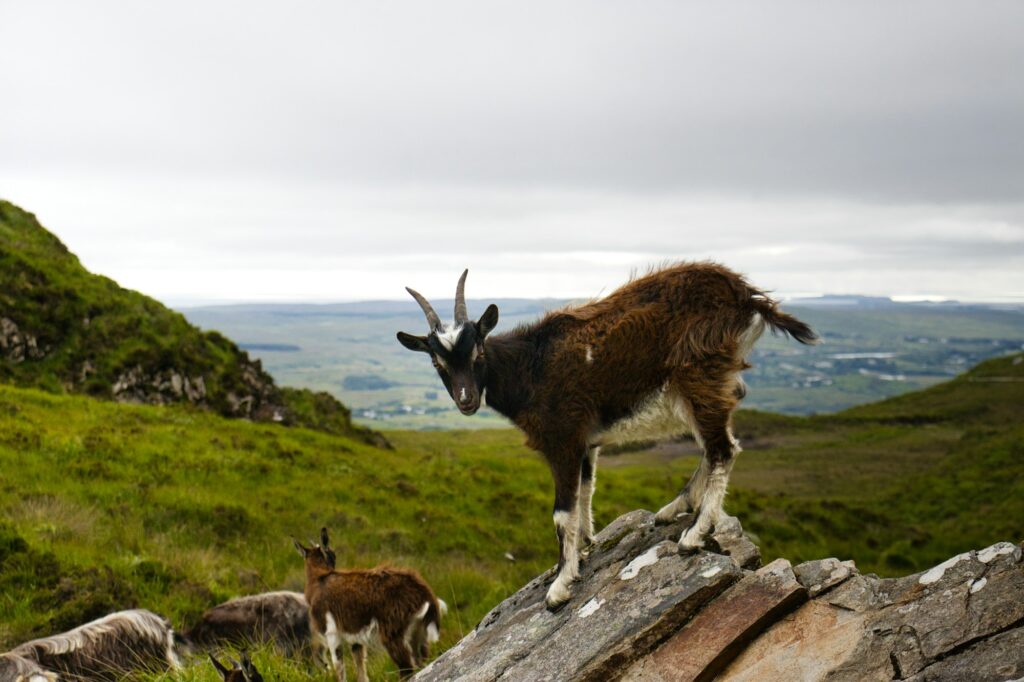
Puck Fair 2026 runs from Monday 10 to Wednesday 12 August in Killorglin, County Kerry: a wild goat is crowned “King Puck” and reigns over the town for three days, a tradition traced back to a royal charter of 1613. Entry is completely free, no ticket required. Organisers expect a crowd estimated at 80,000 to 100,000+ visitors, for a town of just 2,163 residents. Book your accommodation now: supply in Killorglin itself is very limited during the festival.
Every year for generations, the small town of Killorglin has crowned a wild goat captured in the nearby mountains and hoisted it onto a platform above the main street for three days of street celebration. From 10 to 12 August 2026, Puck Fair once again brings together Ireland’s oldest horse fair, a completely free street market and a one-of-a-kind crowning ceremony, in a County Kerry that’s begging to be extended with the Ring of Kerry, the Skellig Islands or the Dingle Peninsula. Between Celtic legend, a 19th-century tax dodge and an ongoing animal welfare debate, this festival is as old as it is unusual — and deserves more than a passing detour.
Puck Fair 2026 in Killorglin: dates, location and the essentials
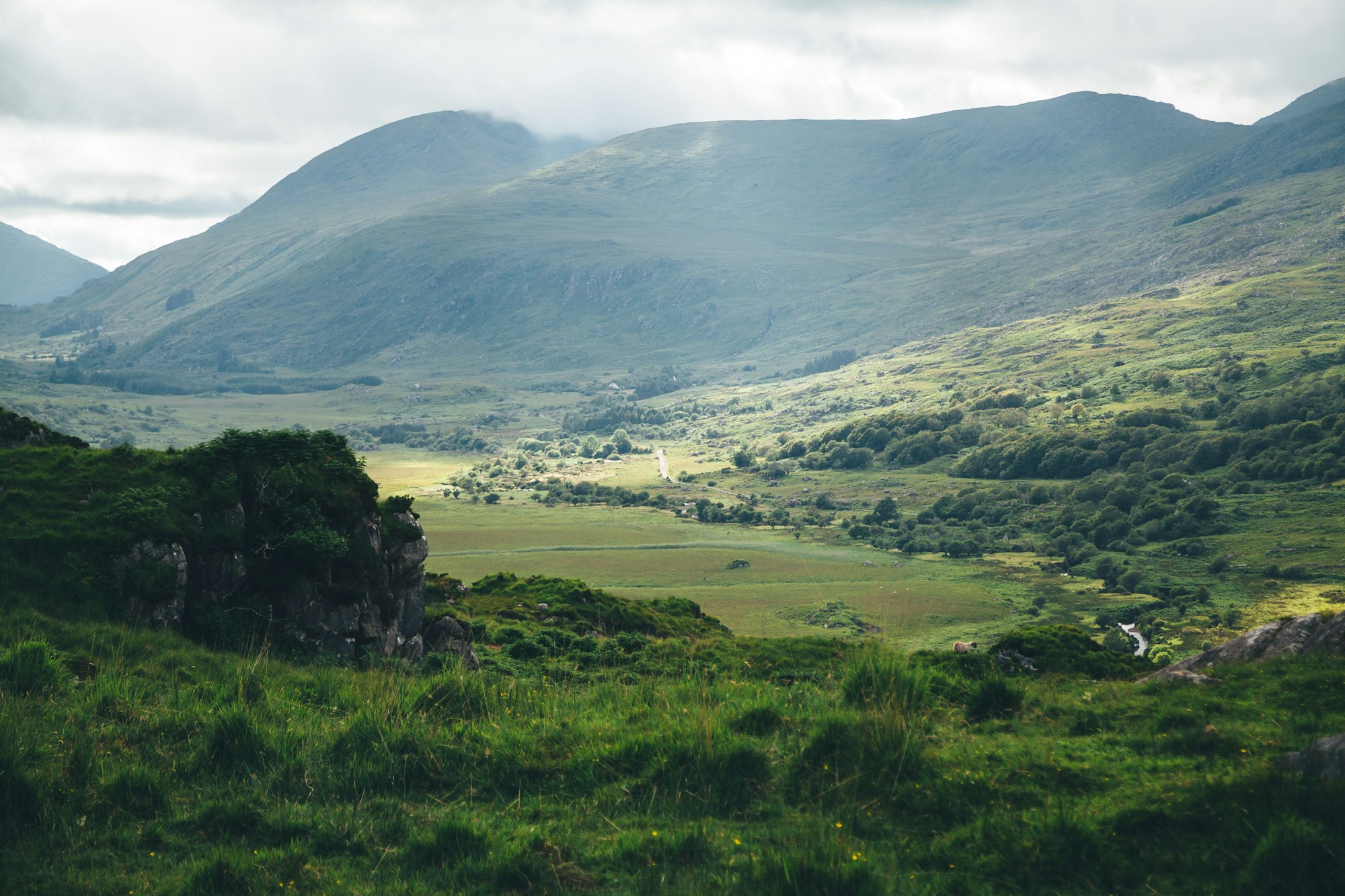
Three days of street celebration on Killorglin’s main street
Puck Fair, known in Irish as Aonach an Phoic (“the fair of the male goat”), is widely considered Ireland’s oldest popular festival still celebrated today. Its legal existence dates back to 1613, when a royal charter granted by King James I to Killorglin landowner Jenkin Conway authorised him to hold “a fair on Lammas Day and two days after”, according to the official Puck Fair timeline. Each year, a goat captured in the surrounding mountains is brought into town, crowned by a local schoolgirl elected “Queen of Puck”, then hoisted onto a platform where it “reigns” over Killorglin for three days before being safely returned to the hills.
Exact attendance has never been officially counted, since it’s a free, open-access street event, but estimates repeated across multiple sources put the figure at 80,000 to over 100,000 visitors over the three days — a considerable influx for a town of 2,163 residents at the 2022 census, according to CityPopulation.de. Puck Fair is described as the main social, economic and cultural driver of the local calendar: Killorglin reportedly has 2.2 local jobs per working-age resident, the highest job density of any Irish town according to figures cited by the municipality, though no verified euro figure for the festival’s own economic impact could be confirmed.
Highlights
- Ireland’s oldest popular festival still celebrated, traced back to a royal charter of 1613
- Free, open street access, no ticket and no paid enclosure
- Three distinct acts: Gathering Day, Fair Day and Scattering Day
Many visitors use their time in Killorglin to fit in an excursion around the Ring of Kerry, since the town marks the starting point of the route when approached from Killarney.
Why crown a goat in Killorglin? Three legends, no certainty
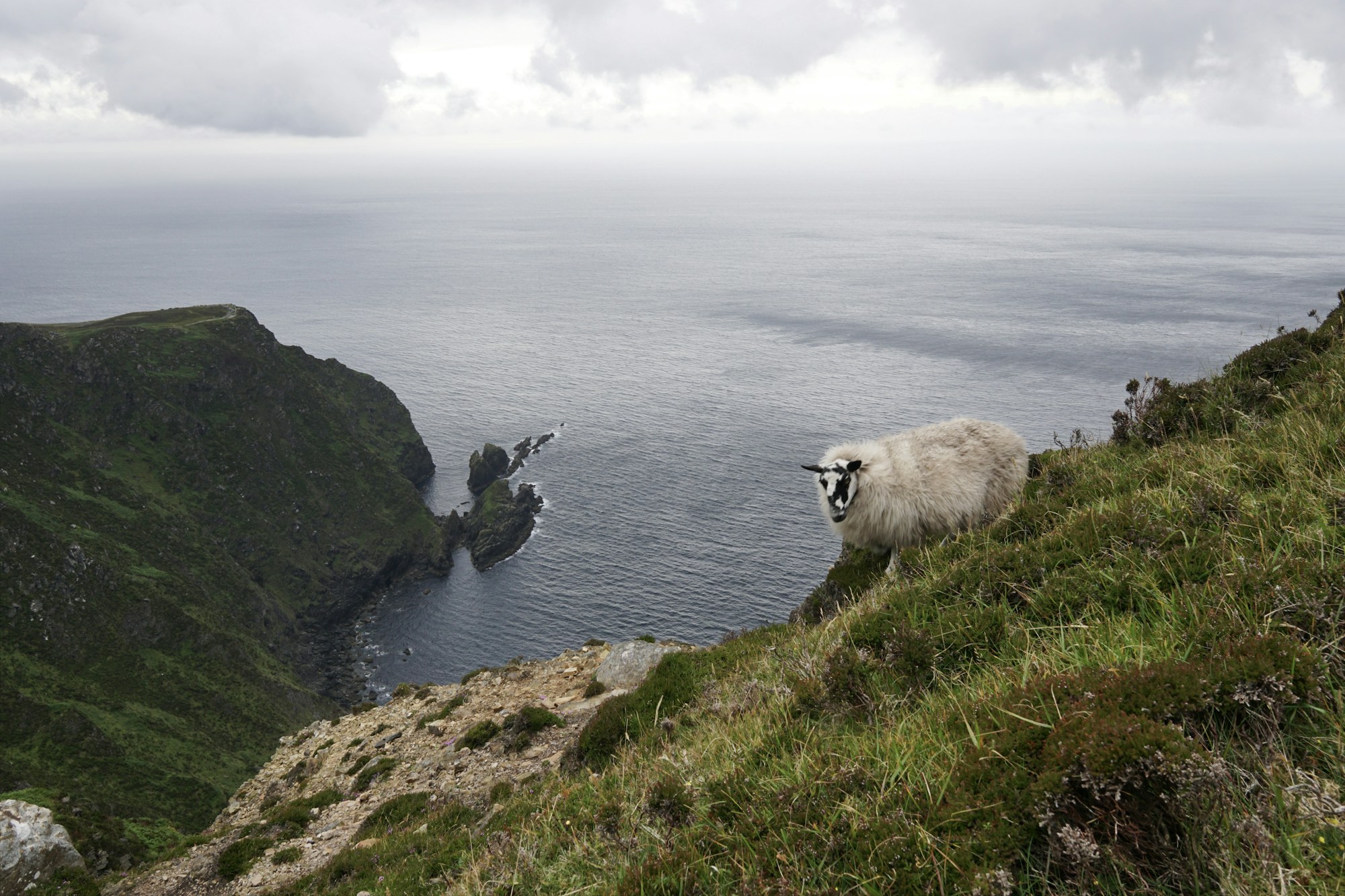
From Lughnasadh to Daniel O’Connell: three tales that can all be true at once
Two different kinds of age are often confused here. The fair itself is legally ancient: the 1613 royal charter granted to Jenkin Conway originally covered nothing more than the right to hold a commercial fair. The specific ritual of crowning the goat is only documented in writing from the 1840s onwards, according to the festival’s official timeline. In other words: the fair itself is over 400 years old, but there’s no written proof that the goat-crowning ceremony is just as old, even though tourism marketing often presents the two as one unbroken tradition.
Three legends coexist without necessarily contradicting one another. The first ties the fair to the pre-Christian Celtic festival of Lughnasadh, a harvest celebration dedicated to the god Lugh, in which the goat is said to symbolise fertility, according to IrishCentral. The second tells of a goat fleeing Oliver Cromwell’s troops in the 17th century, said to have alerted Killorglin’s residents to imminent danger, hence the town’s lasting gratitude to the species, according to The Irish Post. The third, better documented on paper, points to a tax dodge from 1808: a young lawyer named Daniel O’Connell is said to have argued that goat fairs fell outside a ban on levying taxes on livestock, and a goat was hoisted onto a stand to legitimise the collection of dues, according to Ireland’s Eye Magazine.
Highlights
- Royal charter of 1613, granted by King James I to Jenkin Conway
- Irish name Aonach an Phoic, “the fair of the male goat”
- Three legends that overlap rather than compete
Puck Fair is generally billed as “Ireland’s oldest festival”, a defensible claim but one worth qualifying: the Rose of Tralee claims the title of longest continuously run festival for over 50 years, a different kind of continuity from the age of a charter, while the Banagher Horse Fair points to a charter from 1608, five years older than Killorglin’s. Elsewhere in the country, other major popular gatherings cultivate their own legend, like Dublin’s St Patrick’s Festival, far younger in its current form but just as much a part of local identity.
The hour-by-hour programme: Gathering Day, Fair Day, Scattering Day
The festival follows a fixed, unchanging schedule that goes back centuries, split into three clearly defined acts, according to the official Puck Fair website and the tourist board Discover Kerry:
| Day | Date | Programme |
|---|---|---|
| Gathering Day | Monday 10 August | Horse fair at Evans Field, Tralee Road (early morning); parade at 5pm; King Puck crowned at the Puck Stand at 5:30pm |
| Fair Day | Tuesday 11 August | Historic cattle fair, Langford Street, held under charter since 1613; market and street entertainment from 11:30am to 9:45pm |
| Scattering Day | Wednesday 12 August | King Puck’s dethronement parade, the goat’s return to the mountains; fireworks at midnight |
All told, the festival offers around 12 hours of free entertainment a day, close to 36 hours in total of traditional music, street performances and funfair rides across the three days. The one notable restriction flagged by the official website: only plastic cups are allowed on the street during the festival, and parking is cash-only (€10 a day) across three designated car parks, Annadale Road, Killarney Road and Tralee Road.
Highlights
- 10 August packs in the most ritual: morning horse fair, crowning at 5:30pm
- Close to 36 hours of free entertainment across the three days
- €10 parking, cash only, across three designated car parks
The crowning, the Queen of Puck and the goat’s capture
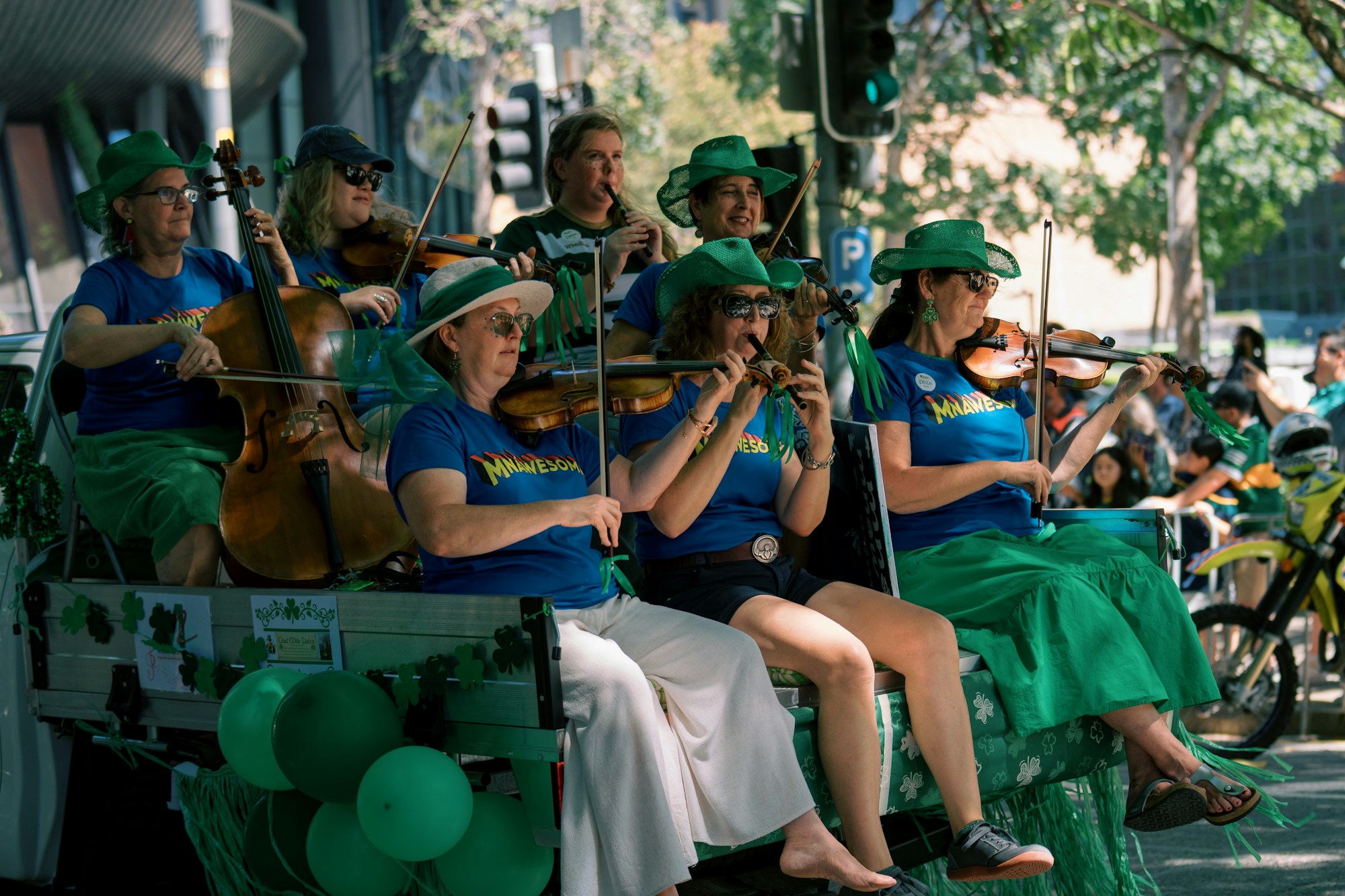
Scarlett Moriarty, 2026’s Queen of Puck, will crown King Puck on 10 August
Every edition starts with the capture: a local team of “goat catchers” heads up into the MacGillycuddy’s Reeks to catch a wild goat. The animal is examined by a vet, who issues a full health certificate, before being acclimatised to human handlers for around three weeks, according to IrishCentral. The crowning traditionally goes to a local schoolgirl in her final year of primary school, elected “Queen of Puck” after submitting a letter explaining why she wants the role. For the 2026 edition, that honour went to Scarlett Moriarty, crowned at the festival’s launch evening at 10 Bridge Street, Killorglin, according to RadioKerry.ie.
Since the 2023 adjustments, the goat stays on its platform for around 48 hours, from the evening of 10 August to the evening of 12 August, compared with continuous display across all three full days previously. It has permanent access to water and food, regular veterinary checks and a larger enclosure; a post-event examination confirms there’s no harm done before it’s returned to the mountains. One anecdote passed down by the local committee: in 1905, a previous King Puck, nicknamed “King Skellig Mör”, was given as a mascot to the American battleship USS Vermont, according to The Irish Post. The festival’s cultural footprint reaches well beyond Killorglin: playwright John Millington Synge attended in August 1906, just months before the premiere of his controversial play The Playboy of the Western World, and singer Christy Moore dedicated an entire album to it, simply titled King Puck (1993).
Highlights
- 2026’s Queen of Puck, Scarlett Moriarty, was crowned at the official launch evening
- The goat is acclimatised to human handlers for around three weeks before the festival
- Veterinary care covers King Puck’s entire reign — before, during and after
The goat’s welfare in question: an ongoing controversy
Capturing a wild animal and displaying it for several days has long drawn occasional criticism. It came to a head in August 2022: during a heatwave, the Irish Department of Agriculture’s animal welfare helpline received 175 reports of concern about King Puck. The animal was taken down from its suspended cage twice to be moved into the shade, with hourly vet checks, according to the Irish Times. The department said it would review the matter, and since 2023 organisers have cut the goat’s display time (see above), while keeping the crowning tradition itself in place.
Animal rights groups continue to call for an end to using a live animal altogether. Laura Broxson, of the National Animal Rights Association, sums up the inconsistency she objects to: “If we accept it’s wrong to keep a goat caged for three days, we can’t consider it fine to do so for a few hours either.” She has proposed symbolic alternatives — a wooden effigy, an animatronic goat or a giant plush toy — according to Lovin.ie. Local officials, on the other hand, firmly defend the tradition: councillor Johnny Healy-Rae argues that “the goat is treated better than a human”, well fed, watered and checked by a vet every hour; the organising committee stresses that mountain goats are naturally solitary animals suited to high ground, and details a three-phase veterinary protocol covering before, during and after the festival.
Legally, Ireland’s Animal Health and Welfare Act 2013 governs animal welfare, with specific provisions for farmed animals destined for consumption — a category King Puck, caught in the wild, doesn’t strictly fall under. No reliable public legal analysis has settled the point definitively: at this stage, it remains more a matter of public debate than a resolved legal dispute.
How to get to Killorglin and where to stay during the festival
The nearest airport, Kerry (KIR), sits about 22 km from Killorglin, a 21-minute drive, but there’s no direct bus link: you’ll need to change at Killarney bus station, according to Rome2Rio. Cork Airport, better served for international flights, is 108 km away, around 1h 30m by road. From Dublin, it’s 319 km and around 3h 27m by car, or roughly 4h 24m by train (€30-45) to Killarney with a connection; if you’re extending your stay around the capital, Dublin’s whiskey distilleries are worth the detour on the way there or back. From Killarney, a local bus reaches Killorglin in 27 to 31 minutes, and a dedicated shuttle, Flynn’s Coaches, runs specifically during the festival’s three days.
EU citizens, European Economic Area nationals, Swiss nationals or British citizens (Common Travel Area) can enter freely, without a visa, on a passport or national ID card alone, according to Citizens Information, the Irish government’s site. Ireland isn’t part of the Schengen Area, so time spent here doesn’t count against the 90-day Schengen limit for travellers affected by it. If you’re hiring a car to combine Puck Fair with the Ring of Kerry, remember driving is on the left, the legal blood alcohol limit is 0.05%, stricter than in the US, and hire cars come with manual transmission by default, according to The Irish Road Trip.
For somewhere to stay, options within Killorglin itself remain limited: Kingstons Townhouse (rooms above a family-run pub) and The Bianconi Inn (a historic hotel right in the centre) are the safe bets, along with a handful of glamping sites nearby. There’s no campsite inside the town; the closest options are around Killarney (Beech Grove, Fossa, Mannix Point). The best fallback remains Killarney itself, 22 km away, with a far wider choice of hotels. Experienced travellers are unanimous on this point: book several months ahead, as availability fills up fast during the festival, according to The Irish Road Trip.
On budget, a trip to Ireland averages €68 a day for budget travellers, €169 mid-range and €417 for a high-end trip, according to BudgetYourTrip.com. Worth knowing: Ireland’s early-August bank holiday (the first Monday of the month, 3 August 2026) falls a week before Puck Fair and can push prices up across the whole period — and remember Ireland runs on the euro, not sterling. On the weather front, expect an average temperature of 15.3°C in Kerry in August, with rain possible on three to eight days of the month: a light rain jacket is worth packing, even in high summer, though there’s no need to overdramatise conditions that stay perfectly manageable.
Highlights
- Kerry Airport 22 km away, no direct bus link (connect via Killarney)
- No campsite inside Killorglin: Killarney, 22 km away, is the recommended fallback
- Ireland isn’t in the Schengen Area: your stay doesn’t count towards your 90 days
Making the most of County Kerry
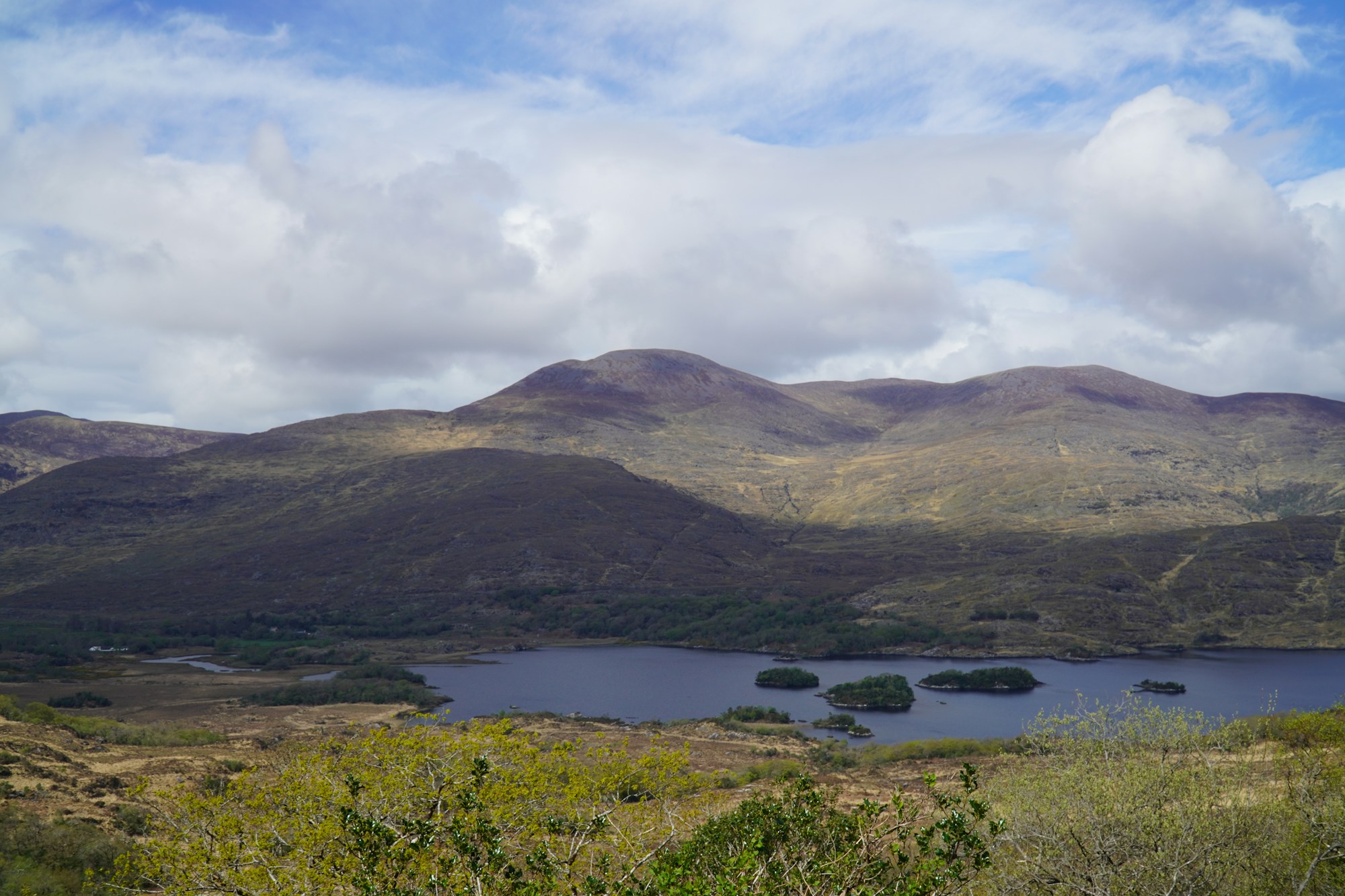
The Ring of Kerry, the Skellig Islands and the Dingle Peninsula, right on Killorglin’s doorstep
Killorglin marks the start of the Ring of Kerry when approached from Killarney: this 179 km driving route runs through Kenmare, Sneem, Caherdaniel, Waterville, Cahersiveen, Kells, Glenbeigh and Beaufort. It’s best driven clockwise, since organised tour coaches traditionally run the other way, according to The Ring of Kerry. Right nearby, Killarney National Park covers 10,000 free hectares around three lakes, Ross Castle and Muckross House (paid entry), backed by the MacGillycuddy’s Reeks, Ireland’s highest mountain range, where Carrauntoohil peaks at 1,038 m, according to National Parks Ireland. It’s in these very mountains that the “goat catchers” capture each year’s future King Puck.
Further out to sea, the Skellig Islands, a UNESCO World Heritage Site made famous by two Star Wars films, are reached from the port of Portmagee: expect to pay €100-140 for a landing trip (2h 30m on the island, climbing the historic 618 steps) or €60-70 for a simple cruise past the islands, according to Skelligislands.com. The quota is strict — 180 visitors a day spread across 15 licensed boats — and booking months ahead is essential, across a season that runs from 9 May to 30 September. The Dingle Peninsula, with Inch Beach, Slea Head and its 4,000-year-old stone huts, is best explored over a full day. A little further south, Cork Airport is just 108 km and 1h 30m away by road, making it easy to pair Puck Fair with Cork, one of Ireland’s rising destinations.
Highlights
- Killarney National Park (10,000 hectares) is free, except for Muckross House
- Skellig Michael: a strict quota of 180 visitors a day, book months ahead
- The Dingle Peninsula is best explored over a full day
August stays a busy month in Kerry: the Rose of Tralee International Festival, Ireland’s longest continuously run festival for over 50 years, takes place in late August just twenty minutes away by road; add in the Dingle Races (7-9 August), the Kenmare Fair (15 August) and National Heritage Week (15-23 August 2026) — plenty of reasons to extend an already packed trip.
Practical info for your stay in Kerry
Stay connected the moment you land at Kerry or Cork airport, no hunting for a local SIM card: set up on your phone in a few minutes.
Data plans from a few eurosCover for a lively few days between crowds, left-hand driving and Kerry side trips: Nomad Insurance gives global coverage from $56/4 weeks, with 10% off through our link.
From $56 / 4 weeksFrequently asked questions
What are the exact dates of Puck Fair 2026?
The festival runs from Monday 10 to Wednesday 12 August 2026 in Killorglin, County Kerry — fixed dates repeated every year, according to the official Puck Fair website.
Is Puck Fair free to attend?
Yes, entry is completely free with no ticket needed: it’s a street festival open to everyone. Only parking (€10, cash only) and anything you buy on site come at a cost.
Why is a goat crowned in Killorglin?
Several legends coexist with no definitive answer: pre-Christian Celtic roots tied to Lughnasadh, a legend about a goat warning the town of Cromwell’s approaching troops, or an 1808 tax dodge attributed to Daniel O’Connell. The written tradition of crowning the goat itself is only documented from the 1840s onwards.
How do you get to Killorglin from the nearest airport?
Kerry Airport (KIR) is about 22 km away, a 21-minute drive, but there’s no direct bus: you’ll need to go via Killarney. Hiring a car or taking a taxi remain the simplest options.
Do you need to book accommodation far in advance?
Yes, absolutely, several months ahead: supply in Killorglin itself is very limited and there’s no campsite in town. Killarney, 22 km away, offers a much wider choice if everything’s booked up.
Is the goat captured for Puck Fair mistreated?
It’s a matter of debate. Since 2023, display time has been cut to around 48 hours with stronger veterinary monitoring, following a 2022 controversy (175 reports during a heatwave). Animal rights groups are calling for an end to using a live animal altogether; the organising committee and local officials defend the current protocol.
Is Puck Fair suitable for families with children?
Yes, during the day: funfair rides, street performances and free traditional music make it a family event on 10 and 11 August. It’s best to head off before nightfall if you’d rather avoid the livelier, more alcohol-fuelled evening atmosphere, with pubs staying open until 3am.
Is Puck Fair really Ireland’s oldest festival?
That’s the most widely repeated claim, backed by a 1613 royal charter and near-unbroken running since (aside from Covid cancellations in 2020-2021). Other Irish events claim comparable titles on different grounds: the Rose of Tralee for its modern continuity, the Banagher Horse Fair for a charter dating from 1608.
Sources
- Puckfair.ie: official festival website, programme and practical information
- Puckfair.ie/timeline: official timeline, the 1613 charter and the crowning tradition documented from the 1840s
- Puckfair.ie/information: official practical information (parking, rules)
- Discover Kerry: the county’s official tourist board
- The Ring of Kerry: tourism association for the driving route
- CityPopulation.de: Killorglin population, 2022 census
- IrishCentral: origins and legends of Puck Fair
- IrishCentral: the goat’s capture and veterinary monitoring protocol
- Ireland’s Eye Magazine: the legend of Daniel O’Connell’s tax dodge
- The Irish Post: the Cromwell legend and general overview
- RadioKerry.ie: official launch of the 2026 edition and Queen of Puck Scarlett Moriarty
- The Irish Times: animal welfare controversy, 2022 heatwave
- Lovin.ie: the animal rights groups’ position
- RTE.ie: legal dispute over pub licensing hours, July 2025
- TripAdvisor: visitor reviews and accounts
- Rome2Rio: transport from Kerry Airport
- Citizens Information: entry requirements for Ireland, the Irish government’s website
- The Irish Road Trip: practical tips and accommodation
- The Irish Road Trip: guide to driving in Ireland
- BudgetYourTrip.com: average daily budget in Ireland
- National Parks Ireland: Killarney National Park, official government site
- Skelligislands.com: boat trips to Skellig Michael
Research conducted on 4 August 2026.

Plan your trip with Pixidia
Pixidia learns how you travel and helps you build a trip that truly fits you and everyone coming along.
Open the planner