
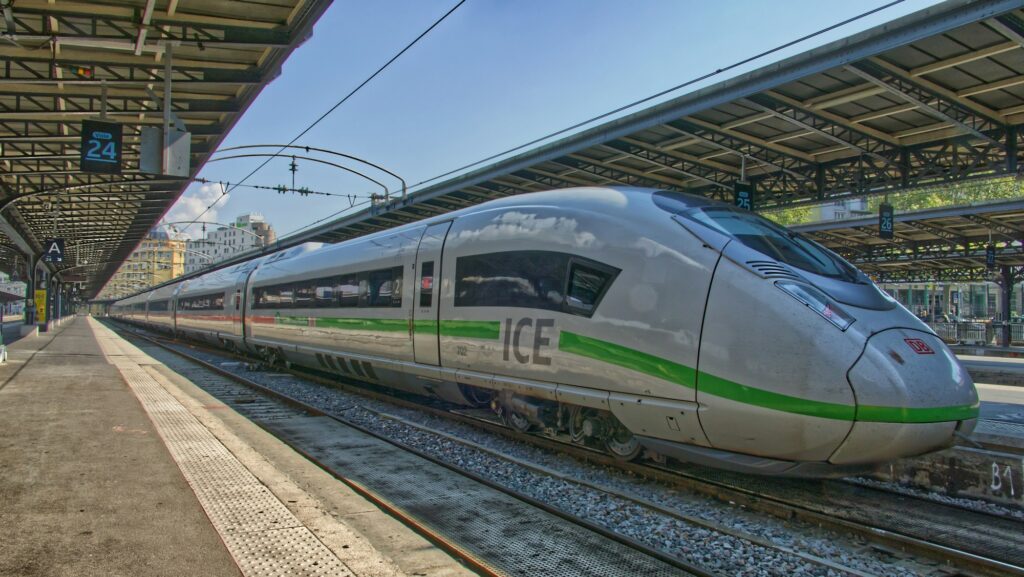
SNCF opens Christmas 2026 ticket sales on Wednesday 30 September, usually from 5:45-6am French time. The date covers TGV INOUI, INTERCITÉS and OUIGO Grande Vitesse for every journey between 13 December 2026 and 6 January 2027 — a window that spans the whole of France’s Christmas school holidays. In 2025, 1.6 million tickets sold on day one alone, with fares on the busiest routes doubling within hours. If your trip includes Bordeaux, Toulouse, Lyon or Marseille, book from the moment sales open.
One Wednesday in late September sets the price of your French Christmas. On 30 September 2026, SNCF opens ticket sales in a single day for TGV INOUI, INTERCITÉS, OUIGO Grande Vitesse and the international TGVs that connect with Eurostar at Paris Gare du Nord. Whether you live in France or you’re building a Christmas markets trip from London through Strasbourg or the Alps, this guide covers the exact sale calendar, the pricing mechanic that pushes fares up within minutes, and the concrete tactics for travelling at the best fare, or falling back on a reliable alternative if your train shows sold out.
The exact SNCF Christmas 2026 ticket sale calendar

Four sale calendars, one pivot date
According to SNCF Connect, Wednesday 30 September 2026 opens sales simultaneously for TGV INOUI and INTERCITÉS on every journey made between Sunday 13 December 2026 and Wednesday 6 January 2027, plus OUIGO Grande Vitesse for a much wider window, running until 2 July 2027. International TGVs to Spain, Italy and Switzerland (TGV Lyria) also open that day, for travel up to the end of March 2027. SNCF consistently opens sales on a Wednesday, ten to eleven weeks before the holidays start: Christmas 2025 opened on 1 October 2025, Christmas 2024 on 2 October 2024.
This travel window fully covers France’s Christmas school holidays, shared by all three school zones: Saturday 19 December 2026 to Sunday 3 January 2027, with classes resuming Monday 4 January. OUIGO Train Classique (except Paris-Brussels) follows a rolling calendar, opening 60 days before each departure with no fixed date, so it’s worth checking SNCF Connect regularly from mid-October onward. Regional TER trains open 3 to 5 months ahead depending on the region and aren’t tied to the 30 September date at all.
If you’re travelling from the UK, Eurostar’s own Christmas 2026 sale is already open, covering journeys between 13 December 2026 and 17 March 2027, and you can book a through-journey pairing Eurostar with a connecting SNCF TGV directly on eurostar.com: you’ll get two separate tickets with the connection already timed for you, and Eurostar and SNCF’s own agreements rebook you onto the next available train at no extra cost if you miss it because of a delay. Since the EU’s Entry/Exit System became fully operational on 10 April 2026, build in extra time at St Pancras or Gare du Nord for the added biometric checks, especially around 26-28 December, the busiest days of the whole season.
Highlights
- TGV INOUI, INTERCITÉS and OUIGO Grande Vitesse all open the same day, potentially from as early as 5:45-6am
- The 13 December-6 January window covers the whole of France’s Christmas holidays, across every school zone
- International TGVs (Spain, Italy, Switzerland) also open that day, for travel up to the end of March 2027
If your Christmas trip includes Alsace, the 30 September window also opens journeys to Strasbourg’s Christmas market, one of the oldest in Europe, or the Alsace wine route villages from Strasbourg.
Why fares jump within hours
SNCF doesn’t run a fare grid that climbs mechanically over time — it runs a tiered sales counter. A quota of seats at the lowest fare goes on sale, and once it’s gone, the system automatically switches to the next tier up. The faster demand builds on a given route, the faster the tiers burn through, sometimes within minutes on the most sought-after lines.
During the Christmas 2025 sale opening, one tracker recorded a Paris-Lyon fare that went from €39 at 7am to €90 two hours later, according to French rail-fare tracker Voyagerentrain.fr. A year earlier, the same route went from €85 to €151, a 78% jump, despite SNCF communications promising « stable fares ». Booking « early » alone doesn’t guarantee anything: what matters is how fast your specific route fills relative to the algorithm’s forecast. A quiet route can even see its price drop the night before departure to clear the last seats.
Concrete ways to pay less
Beyond booking speed, several schemes can cut the bill or lock in a fair fare without being glued to a screen at 6am.
| Card or pass | Price | Discount | Best for |
|---|---|---|---|
| Carte Avantage | €49/year | -30% (holder + 1 companion), up to -60% for 3 children | Ages 27-59, occasional travellers |
| Carte Famille Nombreuse | €19 (3 years) | From -30% (3 children) to -75% (6+ children) | Large families |
| Carte Liberté | €349/year (€299 Contrat Pro) | -30% in 2nd class, up to -45% in 1st, fixed price year-round | Frequent, last-minute travellers |
| Max Jeune | €79/month | €0 journeys, subject to availability | Ages 16-27, with a backup plan for Christmas |
These cards and passes are sold to any SNCF Connect customer, whatever your nationality or where you live — but the ones aimed at frequent travellers (Carte Liberté, Max Jeune) only pay for themselves if you’re making several French train journeys within the year. On the Max Jeune subscription (formerly TGVmax), caution is warranted for the festive season: several consistent sources, including UFC-Que Choisir, report that the seat quotas reserved for Max subscribers shrink, or even disappear entirely, on the busiest trains during school holiday periods. It’s safer to plan a fare-based backup than to rely on the subscription alone for 24 or 27 December.
Three other useful habits
- Set up a low-fare alert on SNCF Connect, which notifies you as soon as a fare below your budget appears on the route you’re tracking
- Use the price-lock option (an exchangeable/refundable ticket held for 7 days instead of 30 minutes), unavailable on OUIGO, Eurostar and TER routes with a connection
- Travel mid-week, early morning or late evening: 20 to 40% cheaper than peak slots
For travellers with flexible dates, an Interrail pass can also be worth considering if your Christmas trip spans several European countries.
Indicative fares on the busiest routes
According to Comparateur-trains.fr, the 2026 fare ranges by train type give a rough sense of the budget to expect, before yield management pushes prices up further. All fares below are in euros, the currency SNCF sells in regardless of where you book from.
| Train type | Average range | Price per km |
|---|---|---|
| TER | €8-25 | €0.10-0.18/km |
| OUIGO | €10-45 | €0.02-0.06/km |
| Intercités | €20-55 | €0.08-0.14/km |
| TGV INOUI | €30-130 | €0.06-0.17/km |
On the routes most in demand for Christmas, the gap between OUIGO and TGV INOUI stays wide: Paris-Lyon, €16-39 up to €35-95; Paris-Marseille, €19-49 up to €45-120; Paris-Bordeaux, €16-45 up to €40-110. For Christmas 2025, 6 days before departure, the floor fares recorded fell to €19 on TGV INOUI and OUIGO, and €15 maximum on Intercités.
Worth knowing if you’re heading to south-west France: OUIGO Train Classique now links Paris-Austerlitz to Bordeaux since 4 April 2026 (via Les Aubrais, Saint-Pierre-des-Corps, Poitiers, Angoulême), with fares from €10, on a 5 to 5.5-hour journey. Sales open 60 days before departure, with no fixed date for Christmas.
Strikes, weather risk and your rights if delayed
As of publication (3 September 2026), no strike is confirmed for the 13 December 2026-6 January 2027 period. France’s rail industrial climate this year has seen several one-off mobilisation days (13 January, 10 June, 26 September, 20-22 November 2026), but no source currently targets the Christmas holidays specifically. This absence of notice guarantees nothing for the future — normal vigilance is still worth keeping, with no particular alert at this stage.
Winter 2026-2027 weather trends, still indicative at this range, point to a slightly negative temperature anomaly and a risk of snow from as early as December, including at low altitude in the north-east. SNCF activates its « extreme cold » plan every year between December and March, with close to 40 snowploughs pre-positioned to limit disruption from ice on overhead cables or points failures.
If disruption does happen, EU Regulation 2021/782 sets out compensation precisely, and it applies to any passenger regardless of nationality:
- 60 to 119 minutes’ delay on final arrival: 25% ticket refund
- 120 minutes’ delay or more: 50% ticket refund
- Cancellation: full refund, plus 75% compensation on the amount paid, processed within 30 days
Station crowds: the days and time slots to target
26 December, the busiest day of the winter
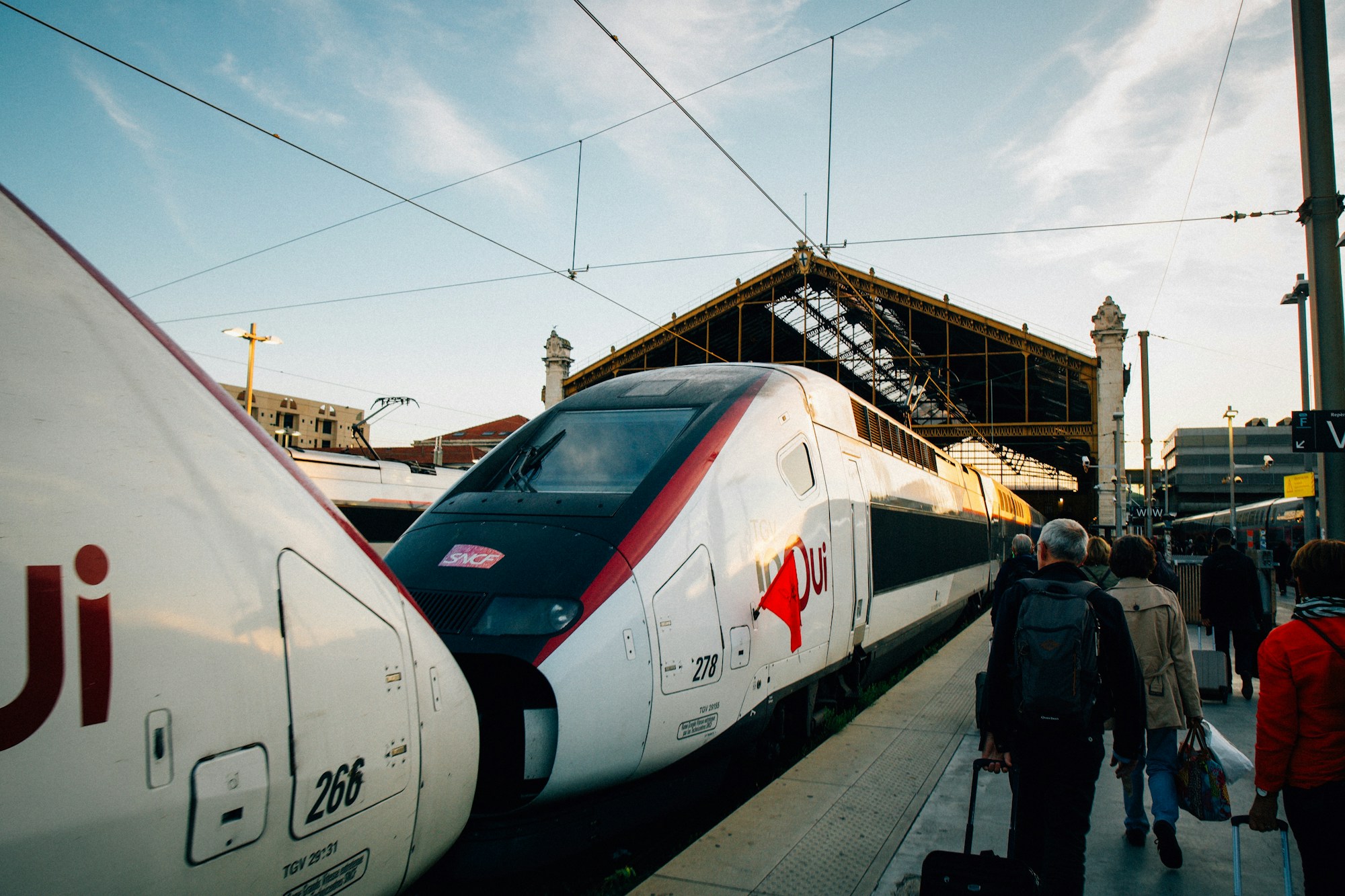
According to Trainline, reported by Sortiraparis, the least busy days remain 24, 25, 31 December and 1 January, with specific slots to target: 24 December between 11am-2pm, 25 December between noon-3pm, 31 December between 1-3pm, 1 January between 8am-2pm. By contrast, 26, 27 and 28 December concentrate the post-Christmas return to major cities and the New Year departure rush — the busiest days of the season.
Early-morning (8-9am) or late (10pm) trains are generally cheaper and less crowded than midday slots. Eleven to twelve weeks after sales opened last year, the Paris-Bordeaux route was already 72% full, and Paris-Toulouse 82% — a signal worth taking seriously if either is on your route, including for a Eurostar-plus-TGV connection through Paris.
Highlights
- 25 December between noon and 3pm remains one of the quietest slots of the whole winter
- Smaller towns (Clermont-Ferrand, Mulhouse) offer far more availability than the major cities
- Travelling on 26, 27 or 28 December means booking from 30 September, without delay
What to do if your route shows sold out
Setting up a « sold-out train » alert on SNCF Connect notifies you if a seat frees up. Beyond that, several credible alternatives can still get you to a Christmas destination without breaking the bank or getting stuck.
| Option | Indicative price (Paris-Lyon) | CO2/passenger |
|---|---|---|
| TGV INOUI | €35-95 | ~1.9 kg |
| Ride-share (BlaBlaCar) | €29-42 | 33-43 g/km with 3 passengers |
| FlixBus | €19-32 | Higher than train, book 3-5 weeks ahead |
| Solo car | Tolls + fuel | ~90 kg |
TER regional trains, which don’t require a reservation or run to a quota on most lines, remain a reliable fallback when the main lines show full, and can be combined with a TGV leg. FlixBus has effectively become the only national long-distance coach operator following BlaBlaCar Bus’s phased withdrawal by the end of 2026; on routes with strong rail competition, its fares stay contained around €19-32, with the train acting as a natural price ceiling. Multimodal comparison sites (Kombo, Omio) let you view every option in one search if the train becomes too expensive or fully booked. If you’re travelling on a combined Eurostar-plus-TGV ticket, Eurostar’s own rebooking guarantee with SNCF also covers you if the connecting leg is disrupted.
If you’re after a Christmas market with fewer crowds than Strasbourg, our pick of off-the-beaten-track Christmas markets covers several alternatives reachable by train.
The train stays the greenest option, fare aside
According to EcoCO2, a Paris-Marseille TGV journey emits roughly 1.9 kg of CO2 per passenger, against close to 90 kg for a car carrying a single person over the same distance. Ride-sharing narrows the gap without closing it: with 3 passengers, a car drops to 33-43 g of CO2 per passenger-kilometre, still 14 to 18 times more emissions-intensive than the TGV. The psychologically high price of peak-period tickets nonetheless pushes some travellers toward more carbon-heavy alternatives, which is exactly why booking from 30 September, rather than defaulting to the car for lack of planning ahead, makes both economic and environmental sense.
Families, luggage and pets: what to know
- Groups of 10 or more: discounts of 60% (children 4-12), 30% (12-27) and 10% (adults) via SNCF’s dedicated group booking line (French-language service), tickets issued 11 days before departure
- OUIGO luggage: one hand bag and one cabin bag included free (size-limited), an extra large bag for €5 on the Essentiel fare
- Pets: €7 (€10 from 2026) for an animal under 6 kg in a closed carrier on TGV INOUI/Intercités; above that weight, a short lead and muzzle are compulsory, maximum 2 animals per passenger
- Children aged 0-3: travel free without a seat, or at the child fare if a seat is needed
If your Christmas trip crosses a border
30 September also opens the international TGVs to Spain, Italy and Switzerland. To stay connected without swapping SIM cards on those legs, an eSIM sets up in a few minutes before you leave.
From €4.50 for 1GB / 7 daysFor a ski stay or a string of international legs over the holidays, travel insurance covering trip disruption, medical costs and lost luggage rounds out your basic cover.
From $56 / 4 weeksFrequently asked questions
Why are French train tickets for Christmas so expensive?
SNCF runs a yield-management system: the cheapest seats go on sale in limited numbers, then the price climbs in tiers as the train fills up. The stronger and faster the demand, which is systematically the case when Christmas sales open, the faster the low tiers disappear — sometimes within minutes on the most sought-after routes. Source: Voyagerentrain.fr.
Do I really need to book at 6am on 30 September?
It’s the most reliable strategy for high-demand routes (Paris-Bordeaux, Paris-Toulouse, Paris-Rennes, Paris-Marseille, Paris-Lyon), where floor fares can vanish in under two hours. On quieter routes, it’s possible to find good fares later, even at the last minute if the train doesn’t fill as expected, but that’s a gamble, not a reliable strategy for the festive period.
What if my route shows sold out?
Set up a sold-out-train alert on SNCF Connect to be notified of a cancellation, fall back on a TER regional train (no compulsory reservation or quota) for part of the journey, or consider ride-sharing and coach options, which are generally more available last-minute and less exposed to sudden scarcity. If you booked Eurostar plus a connecting TGV through eurostar.com, their joint rebooking guarantee also covers a disrupted connection.
Does the Max Jeune pass work for Christmas travel?
In theory yes, but in practice the seat quotas reserved for Max subscribers are heavily reduced during school holiday periods, and can fall to zero on the busiest trains. SNCF adjusts quotas based on sell-out risk, so it’s safer to plan a fare-based backup for Christmas journeys on this subscription. Source: UFC-Que Choisir.
Is there a strike risk over the Christmas 2026 holidays?
No strike is confirmed for this period as of publication (3 September 2026). France’s rail industrial climate this year has seen several one-off mobilisations, but nothing currently targets Christmas 2026 specifically. If disruption does occur, EU Regulation 2021/782 provides a 25-50% refund for a delay, and a full refund plus 75% compensation for a cancellation. Source: europa.eu.
Which are the least crowded days to travel over the holidays?
24, 25, 31 December and 1 January are statistically the least in-demand days, with specific time slots worth targeting. By contrast, 26, 27 and 28 December generally sell out first, driven by the post-Christmas return to major cities and the New Year departure rush. Source: Trainline via Sortiraparis.
Sources
- SNCF Connect — Ticket sale opening calendar
- Eurostar — Booking a connecting SNCF TGV journey
- Eurostar — Christmas 2026 / Winter 2027 ticket sale
- Seat61 — London to Paris by Eurostar
- Voyagerentrain.fr — SNCF Christmas 2026 ticket sale opening
- Éducation nationale — Official French school calendar
- UFC-Que Choisir — Max Jeune/TGVmax subscribers left behind
- SNCF Connect — Creating fare alerts
- SNCF Connect — Price-lock option
- Comparateur-trains.fr — 2026 fare guide
- Sortiraparis — How to avoid station crowds over Christmas
- Your Europe — Rail passenger rights
- EcoCO2 — Carbon footprint, plane vs. train
- SNCF Connect — OUIGO luggage policy
- SNCF Voyageurs — Travelling with a pet
Research and fact-checking completed on 3 September 2026.

Plan your trip with Pixidia
Pixidia learns how you travel and helps you build a trip that truly fits you and everyone coming along.
Open the planner