
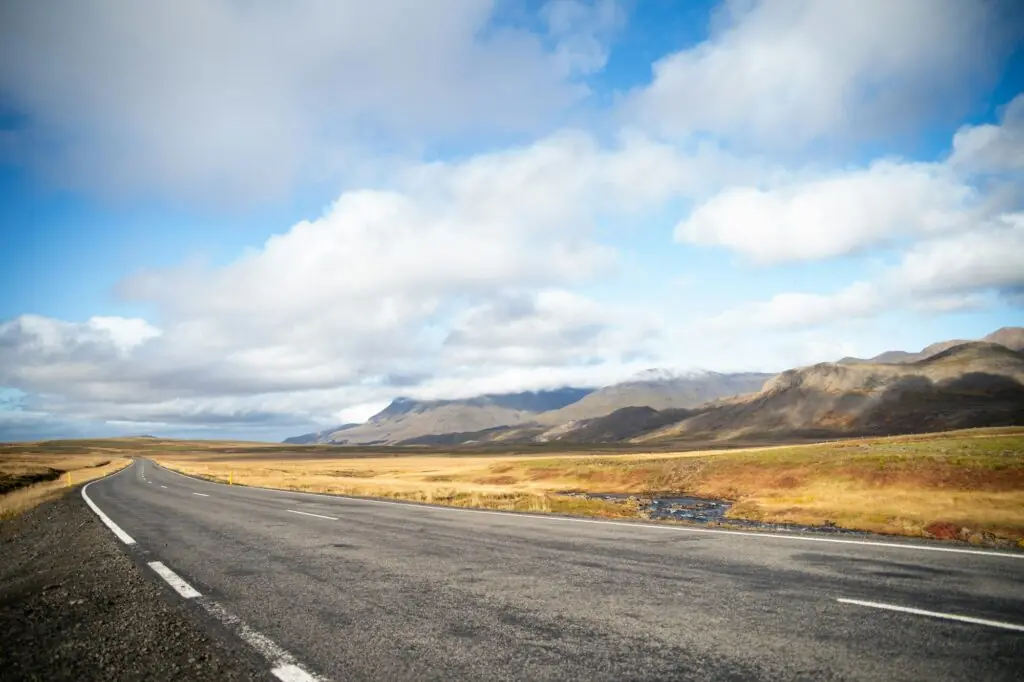
In 2026, a standard 2WD car is all you need to complete Iceland’s Ring Road between May and September. Route 1 runs for around 1,300-1,340 km and is 95-98% paved. A 4×4 is only a legal requirement on the F-roads in the highlands, which open in dribs and drabs from late May to September. Since 1 January 2026, a mileage charge has been added to every rental (roughly 1,390-1,550 ISK a day, depending on the company). My advice: put the extra 4×4 budget towards gravel and wind protection instead — those cover the damage you’re actually likely to have on a standard loop of the ring.
I drove the whole Ring Road in a small hire car, not a 4×4, and never once felt like I was taking an unreasonable risk. What follows isn’t a list of generalities copied from ten different sites — it’s what I checked myself before, during and after the trip: the real question behind the car-size choice, the F-roads and their erratic opening dates, the wind that rips doors off their hinges far more often than snow ever blocks a road, the gravel and sand/ash cover nobody offers you upfront, the distances between petrol stations, and the traps that cost you points at roundabouts or single-lane bridges. I’ve also added the 2026 developments an older article simply can’t know about: the mileage charge that came into force in January, fuel prices climbing back up over summer, and the case of the French tourists fined in June for off-road driving.
1. Do You Need a 4×4 for Iceland in 2026? What I Actually Drove
2WD or 4×4: the question that costs you money for nothing
Route 1, the road everyone calls the Ring Road, is not a highland track. It’s 95-98% paved, with the few unsurfaced stretches mostly in the East Fjords around Djúpivogur, according to National Geographic. On a standard loop between May and early October, a small or compact car does the job perfectly well: it’s cheaper, it uses less fuel, and it goes everywhere I needed to go, including the well-maintained secondary roads of the Golden Circle or the South Coast. A 4×4 only becomes a legal requirement, not just a sales pitch, the moment you take a road numbered with an « F »: driving one in a 2WD automatically voids your insurance, whatever level of cover you’ve bought, according to Northbound.
| Car | Ring Road, May to September | F-roads (highlands) | Winter, October to April |
|---|---|---|---|
| Compact 2WD hatchback | Enough for Route 1 and the Golden Circle or South Coast roads | Not allowed: a 2WD on an F-road is an offence and voids the insurance | Less reassuring on snow and ice |
| 4×4 or AWD SUV | Works, but not needed on Route 1 | Required | Strongly recommended |
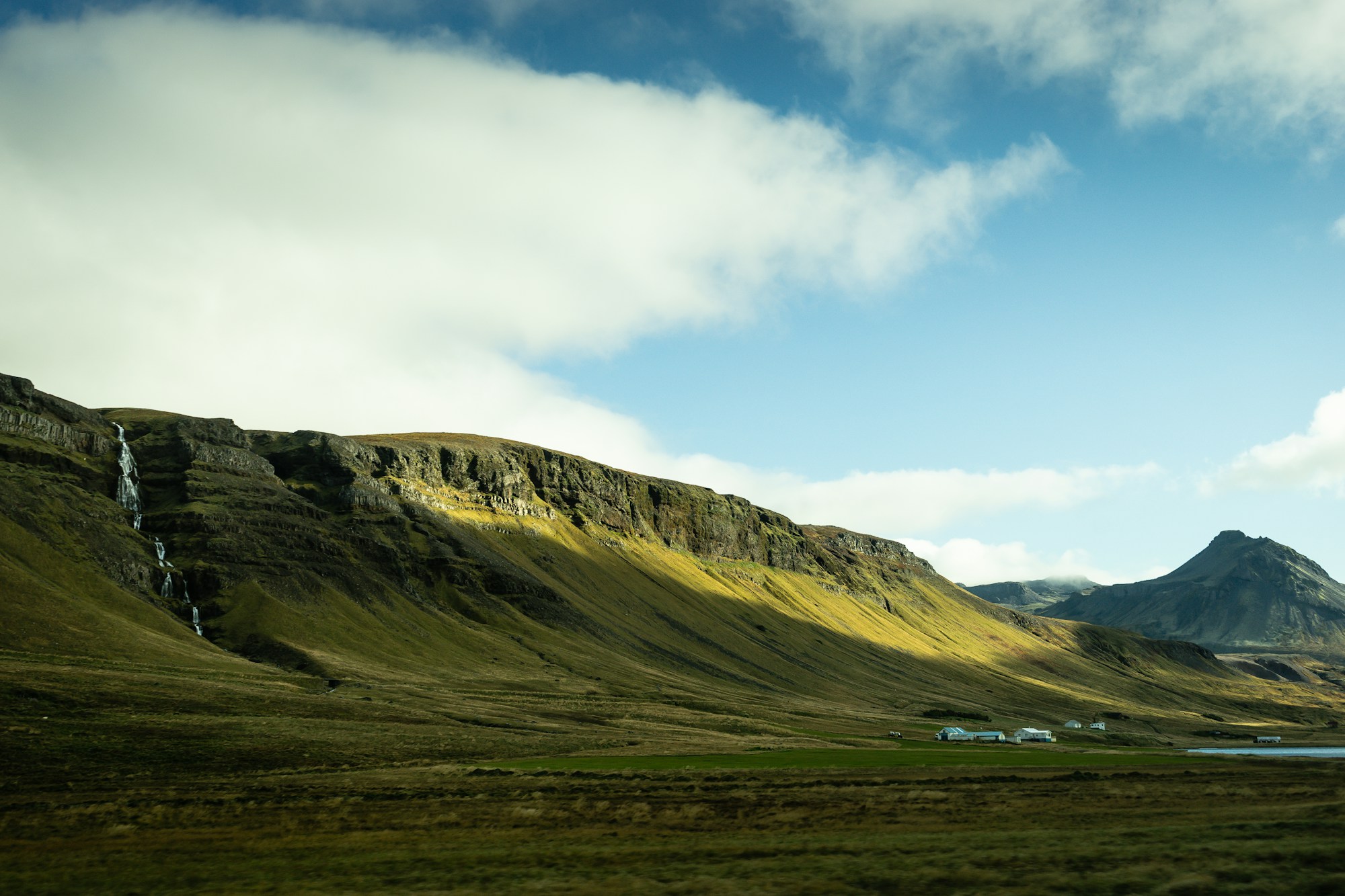
I’ve noticed several Icelandic rental companies sell the 4×4 upgrade themselves as extra peace of mind rather than a genuine necessity for a standard loop. That’s fair enough for winter, when snow and ice make four-wheel drive far more reassuring. It isn’t true for a summer spent on Route 1 and its immediate surroundings. And not all 4x4s are equal on the F-roads either: some are manageable in a small SUV like a Dacia Duster, others need a Toyota Land Cruiser, and the toughest of all — crossing the Krossá river at Þórsmörk, for instance — call for a modified vehicle, a « superjeep ». Rental companies stick a label on the dashboard confirming whether a car is cleared for F-roads, as SafeTravel.is points out.
Key points
- A 2WD is enough for the full loop between May and early October
- A national driving licence is enough for the UK, the EU, France, the US or Canada — no international permit needed
- Rental companies clearly label on a sticker whether a car is cleared for F-roads
2. F-Roads: The Real Line Between Drivable and Off-Limits Without a 4×4
A world apart, opened one road at a time
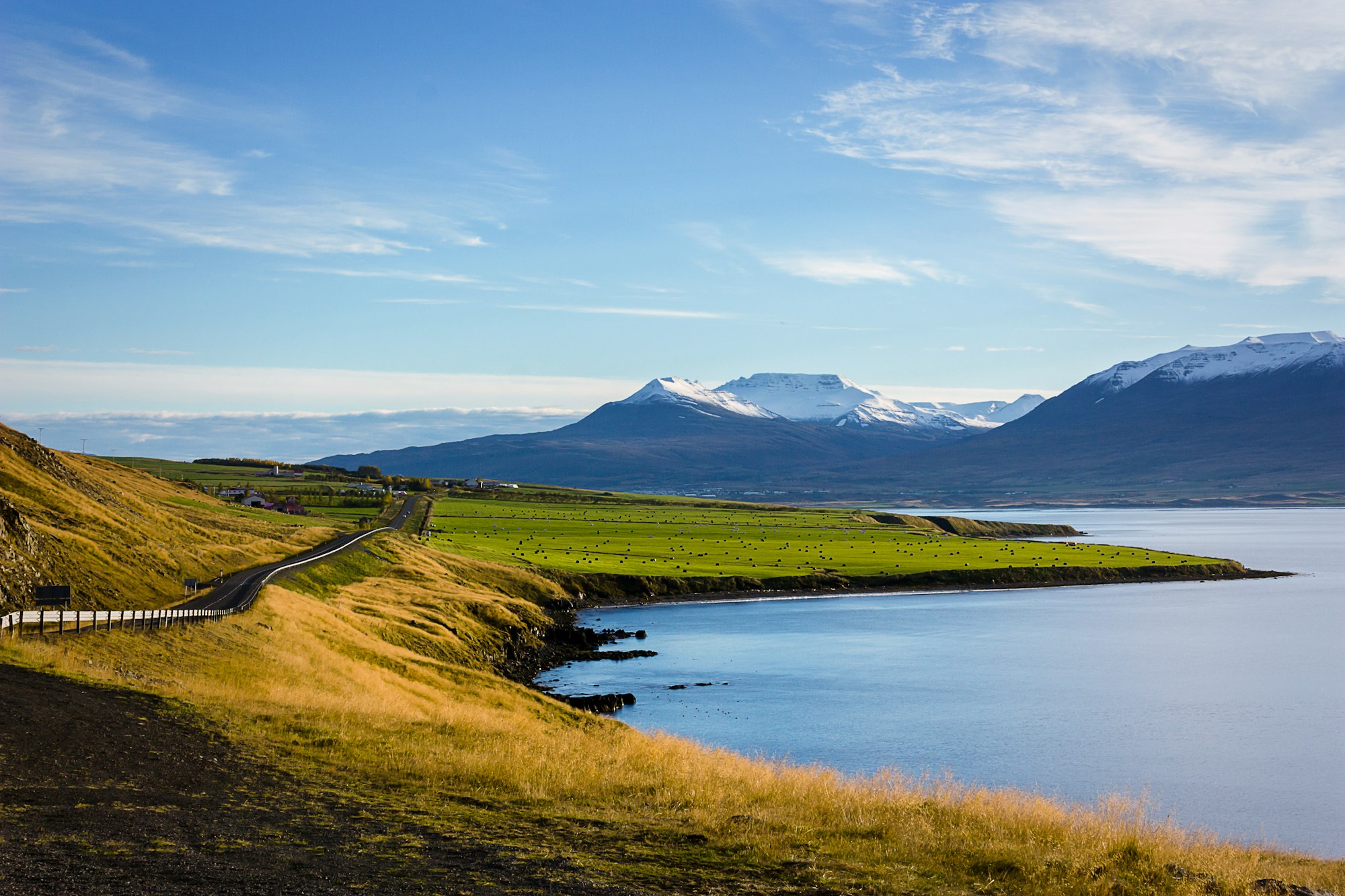
F-roads only open in summer, and never on a fixed date: the Vegagerðin (the roads administration) physically inspects each track before declaring it drivable. In 2026, as of 23 March, the entire highland network was still closed. The typical sequence that year: the F35 Kjölur and F347 Kerlingarfjöll first, in late May or early June, since neither has a major river crossing on its main route; the F208 to Landmannalaugar and the F225 and F249 towards Þórsmörk by mid or late June; then the most remote tracks, like the F26 Sprengisandur or the road to Askja, only in early or mid-July, according to Whattodo.is. The only reliable day-to-day source is umferdin.is — check it the morning you’re planning to drive a track, never the night before.
River crossings (the famous « vöð ») are excluded from every Icelandic insurance policy, without exception, even the most comprehensive ones, SafeTravel.is points out. The recommended technique: walk the crossing first if you can, find the widest and shallowest point, cross in first gear at a slow, steady pace without changing gear mid-water, aim slightly downstream from where you enter, and cross early in the morning, since river levels rise through the day as glacial melt feeds in. The cost of a river accident gives you a sense of what’s at stake: vehicle recovery between 500,000 and 2,000,000 ISK, a wrecked gearbox around 800,000 ISK, with the total reaching 2-3 million ISK — roughly €14,000-20,000, or about £12,000-£17,000 — according to Vetrarakstur.
Key points
- umferdin.is updates the status of 38 mountain roads roughly every five minutes
- No insurance policy covers river crossings, without exception
- Driving an F-road in a 2WD, or an uncleared 4×4, instantly voids the entire policy
3. Icelandic Wind: The Real Danger, Not the Snow
Danger number one isn’t the road — it’s the door
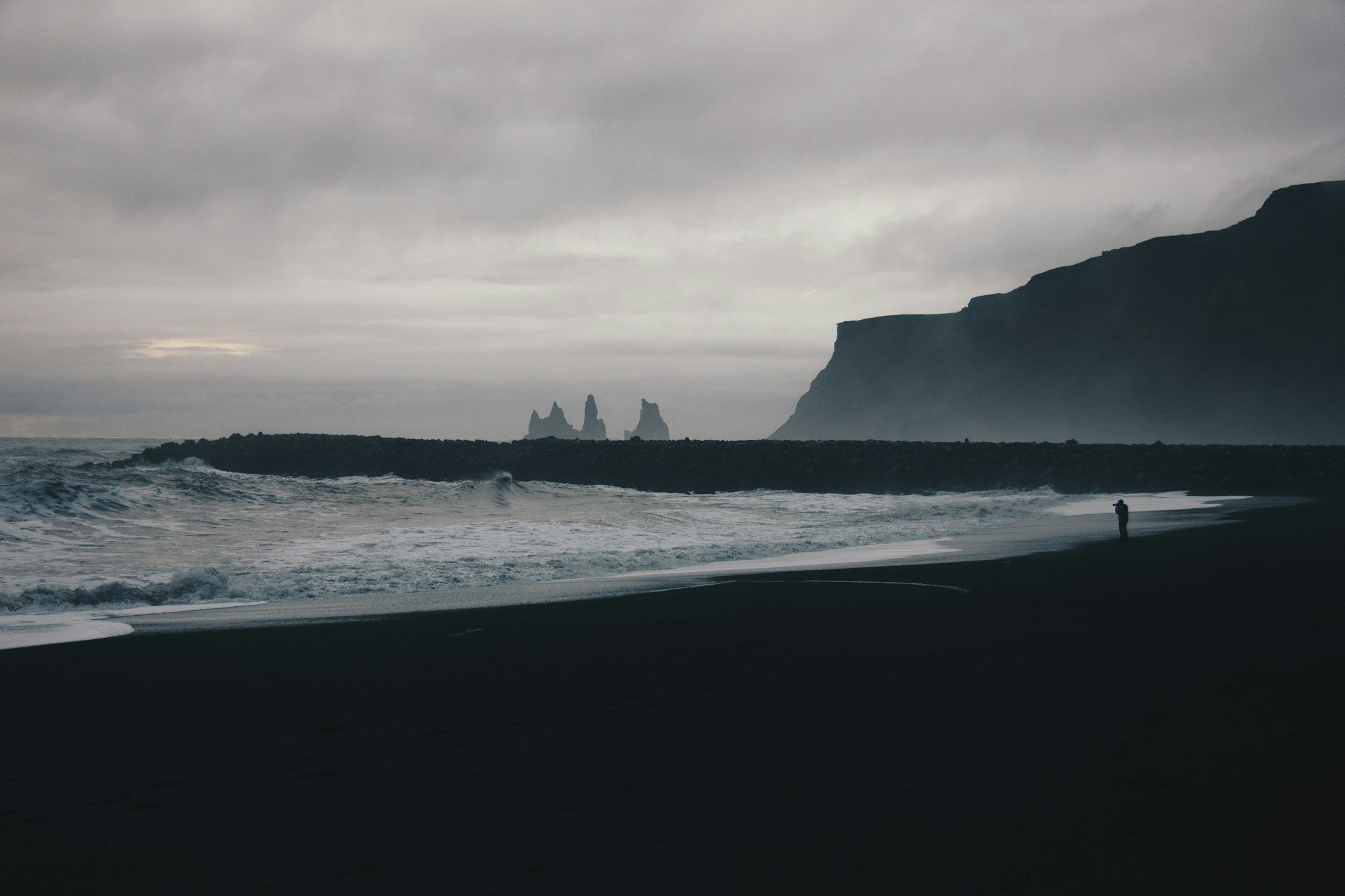
Iceland holds the record for the highest wind speed ever recorded in the country: 267.1 km/h at the Gagnheiði weather station, on 16 January 1995. A near-record, and more recent, gust was measured at 255.6 km/h at Hafnarfjall, north of Reykjavik, on 14 February 2020, during a 929 mbar Atlantic low amplified by a katabatic effect off the Skarðsheiði massif, according to Severe Weather Europe. Gusts above 80-100 km/h remain common even in the middle of summer, not just in winter.
The most common claim isn’t a driving accident but a door opened carelessly, which a gust slams back against its hinge, bending or even tearing it off within seconds: between €1,500 and €3,500 in repairs (roughly £1,300-£3,000), and it’s usually excluded from basic cover, according to Iceland Car Rental. Tall, long vehicles, campervans especially, are far more vulnerable to side gusts than a small car: a van can get pushed into the next lane by a gust a compact car shrugs off without any trouble.
Key points
- Park facing into the wind and open the door with both hands — one on the handle, one holding the door itself
- Fold in the wing mirrors if you’re parking somewhere exposed, and avoid ridgelines and completely open ground
- Check umferdin.is, vedur.is and safetravel.is every morning, never the night before
4. Gravel, Sand and Ash: The Cover the Counter Won’t Always Mention First
What basic CDW doesn’t cover
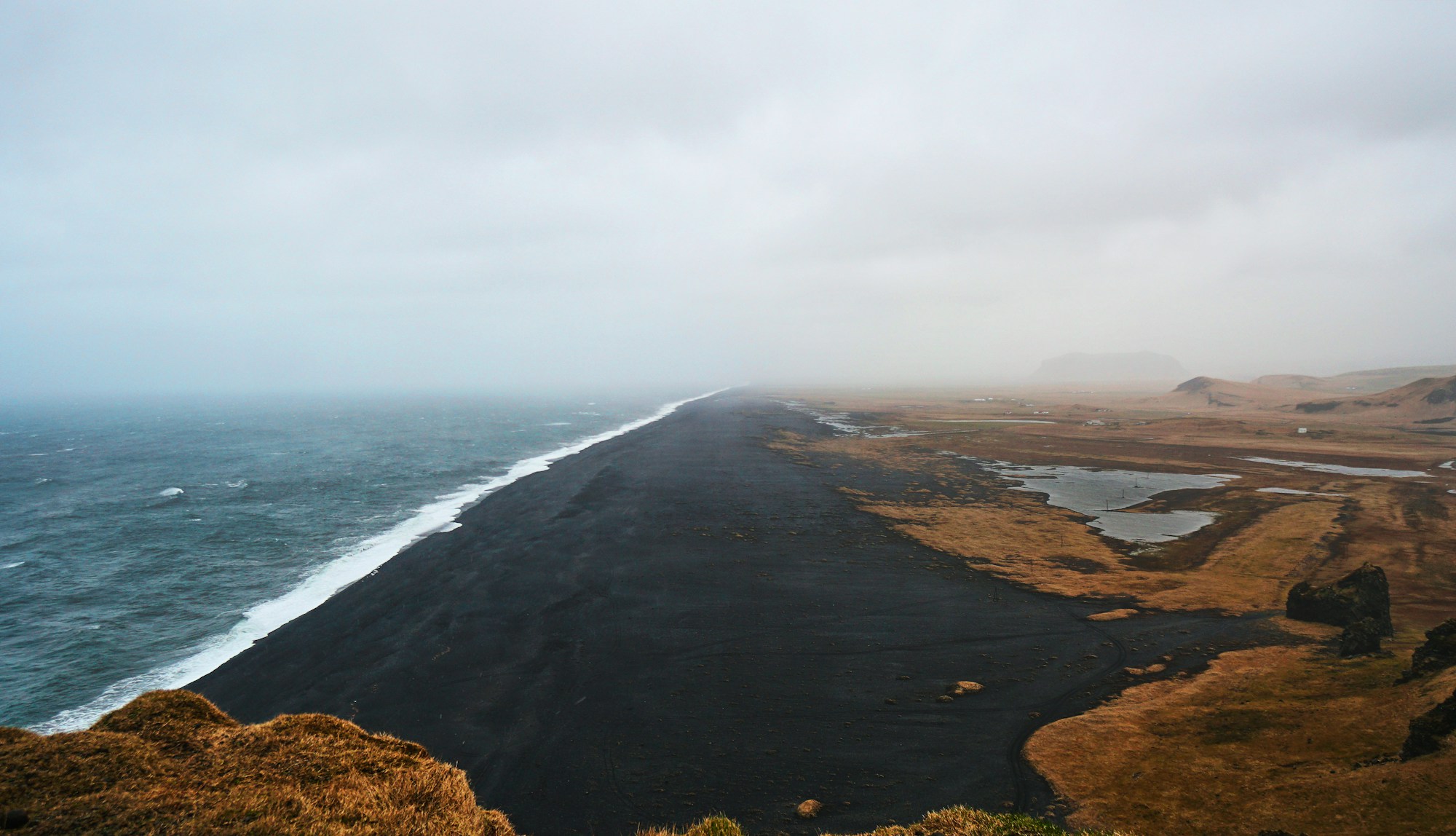
The basic cover (CDW, collision damage waiver) included in most rentals doesn’t cover gravel damage, wind damage, or sand and volcanic ash damage. Gravel Protection covers chips thrown up onto the windscreen, headlights and bodywork — one of the most common claims on Icelandic roads, including on ordinary stretches in the East and North. Replacing a windscreen costs between 70,000 and 200,000 ISK, according to Blue Car Rental.
Sand & Ash Protection (SAAP) becomes especially important between February and April, when melting snow exposes huge stretches of volcanic sand that strong winds throw up easily — a risk concentrated on the South Coast, according to Northbound. It caps out at around 90,000 ISK, while unprotected damage can reach 1,500,000 ISK. The volcanic activity that continues on and off on the Reykjanes peninsula, near Grindavík, doesn’t affect the Ring Road itself or Keflavík airport, but it does make this cover more worthwhile if you’re driving in the south-west. I followed the situation fairly closely on a previous trip, and covered it in full in my piece on tourist safety after the eruption.
Plenty of accounts describe heavy sales pressure at the counter to add extra cover, with prices that can double the daily rate if everything’s bolted on there rather than at booking. I always compare several companies before I go, insurance options already shown, using a comparison site like DiscoverCars, which checks agencies at Keflavík and offers free cancellation on most deals.
Key points
- Photograph and film the car in detail before you drive off, including the underside if you can
- Buy any extra cover online when you book — rates are noticeably better than at the counter
- A deposit of €500-5,000 (roughly £430-£4,300) or more, released 10-20 working days after you return the car
5. Petrol Stations, Automatic Pumps and Fuel Budget in 2026
Never let the tank drop below a quarter
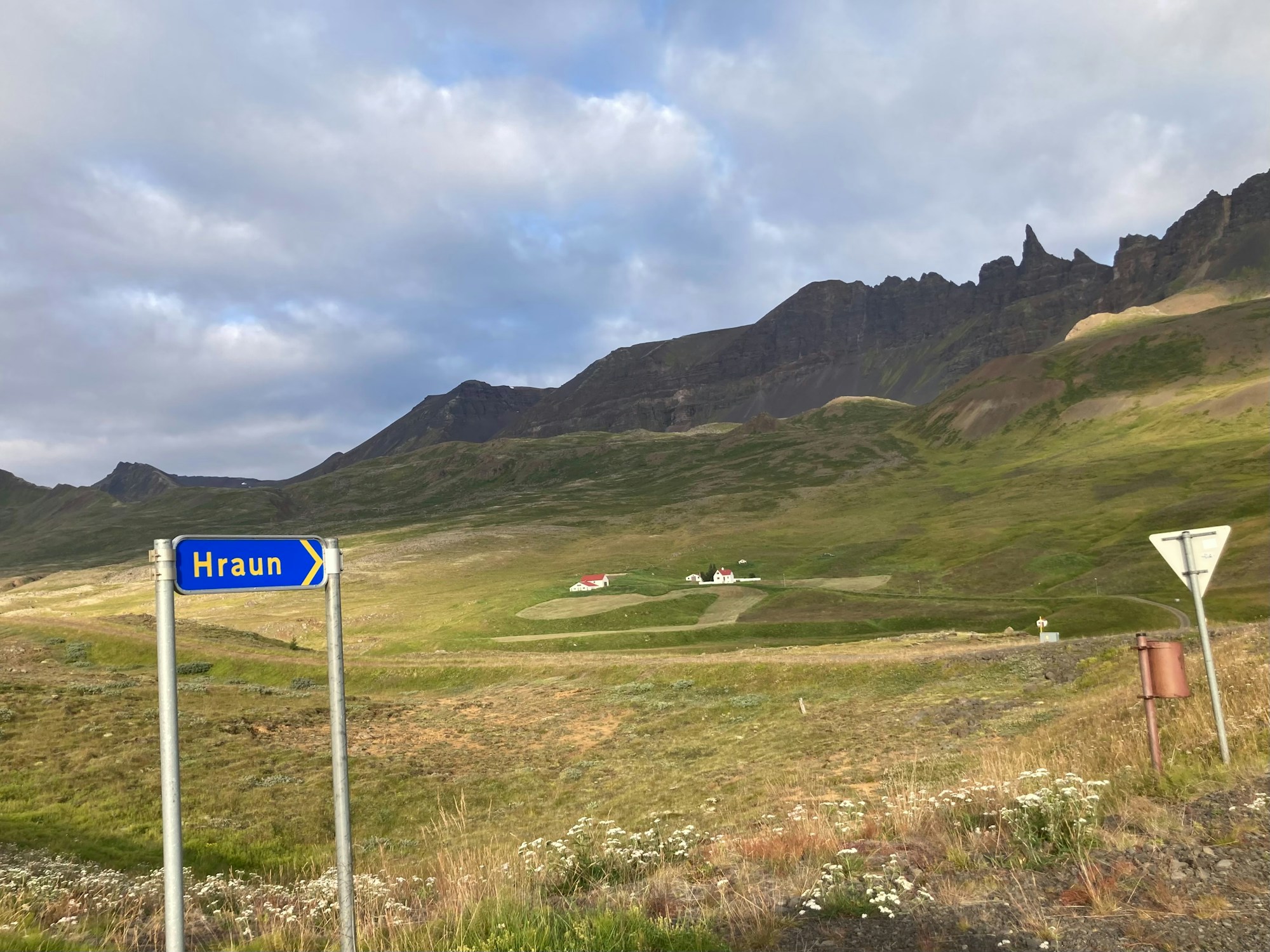
Iceland’s network (N1, Orkan, Olís, plus budget brands Costco and ÓB) is overwhelmingly self-service, 24 hours a day. The typical gap on the Ring Road runs 50-80 km, with a classic 100 km stretch between Höfn and Djúpivogur in the East Fjords; in the West Fjords or the highlands, that gap can stretch past 150-200 km with no fuel option at all, according to the Go Iceland guide. A simple rule I stick to every time: never let the tank drop below a quarter once you’re outside Reykjavik.
Automatic pumps need a chip card with a four-digit PIN. Signature cards, common in North America, often fail even with a backup PIN, since the signature remains the system’s main authentication method. The reliable fix: buy a prepaid card worth 5,000 or 10,000 ISK at a staffed station. Another classic mix-up: the green nozzle is petrol, the black one is diesel.
Since 1 January 2026, a mileage charge has replaced part of the old fuel tax, at a government rate of 6.95 ISK/km for private cars. Every rental company bills it differently: some as a flat rate of around 1,390-1,550 ISK a day, others by actual distance, which can climb to roughly 13,000 ISK for a full 1,500 km loop. Pump prices did drop in early January in return, though that needs a caveat: as of 6 September 2026, petrol was priced at 246 ISK/L and diesel at 277 ISK/L, up 17.3% since the end of June, according to DailyFuels Iceland. The country’s only toll, the Vaðlaheiðargöng tunnel near Akureyri, costs 1,500 ISK if paid within 3 hours of passing through, rising to 2,500 ISK after that; the Hvalfjörður tunnel, meanwhile, has been free since 2018.
Key points
- Fill up before any isolated stretch, never after
- Carry a prepaid card as backup if your bank card works by signature
- Ask the rental company directly whether the mileage charge is a flat rate or based on actual distance
6. What’s the Best Season for a First Ring Road Trip?
Summer, from June to August, is still the easiest time for a first full loop: the midnight sun stretches out your driving and sightseeing days, roads are in their best condition, and every F-road is potentially open. The flip side: it’s peak tourist season, with rental prices at their highest — August runs around 52% above the yearly average. In 2026, the pressure ratcheted up further around 12 August, when the total solar eclipse crossed the country: demand for vehicles, cars and especially campervans, climbed months in advance, and availability stayed tight into autumn for certain dates. I rounded up some worthwhile experiences for that exact day in a piece on the total solar eclipse of 12 August 2026 in Iceland.
May and September offer a good balance of price and crowds, at the cost of more unpredictable weather: rain, wind and sometimes snow can all show up within a few hours, and some F-roads are either not yet open or already closing again. Winter, from November to March, cuts daylight down to 4-6 hours depending on the month, with ice and snow common even on the Ring Road, and wind that, according to several local guides, remains the number one risk factor — more so than the snow itself. In exchange: the lowest prices of the year and the chance of the northern lights.
For a first trip, I’d recommend at least 7-10 days for the full loop, and driving anti-clockwise (heading south first), which puts the South Coast’s most iconic sights early in the trip and leaves a more relaxed pace for the rest. A stop at the Blue Lagoon or Sky Lagoon at the end of your stay, right by Keflavík, is still the best way to unwind before the flight home.
7. Seven Traps That Catch Out Foreign Drivers
Some of these are harmless, others cost a fortune. Here are the ones I’ve seen crop up most often, plus one very recent case that made headlines in Iceland in 2026.
- Off-road driving is strictly banned and punished. Fines range from 10,000 to 1,000,000 ISK depending on severity. In June 2026, two French tourists drove two Land Rover Defenders off-track in the Fjallabak nature reserve, near Mælifellssandur, to get around patches of snow, filmed it and posted it online: the case triggered rare national outrage and a first fine of 300,000 ISK, according to The Reykjavík Grapevine.
- Two-lane roundabouts work the opposite way to most countries. The inner lane has priority to exit; the outer lane has to give way. At some of the most touristy junctions, foreign drivers were involved in nearly two-thirds of recorded accidents, according to Reykjavik Cars.
- There are around 634 single-lane bridges in the country, 30 of them on the Ring Road alone, with 16 concentrated on the East Fjords stretch between Höfn and Egilsstaðir. The vehicle closest to the bridge has priority; if you’re not sure, stop or flash your headlights.
- Sheep roam completely free in summer, including on the roads, and their behaviour is unpredictable. Around 140 sheep die every year in a single district because drivers go too fast.
- Icelandic horses can cross or walk alongside the road even outside their designated paths: the warning sign shows a horse silhouette inside a red triangle.
- Three-digit secondary roads are often still gravel, even when they branch off a perfectly paved section of the Ring Road. Fine in a 2WD, but at a reduced speed.
- Dynamic signage, using digital rather than fixed signs, flags closures and alerts in real time — something drivers used to static signs can misread or simply overlook.
Frequently Asked Questions
Do you need a 4×4 to drive the Ring Road in Iceland?
No, not for a standard loop of Route 1 between May and September: a 2WD car is enough, since the Ring Road isn’t an F-road and is 95-98% paved. A 4×4 only becomes a legal requirement on F-roads, and it’s strongly recommended in winter, according to Northbound.
What is an F-road, and why is a 4×4 mandatory on it?
A road numbered with an « F » is a mountain track, usually unmaintained gravel, sometimes with river crossings, open only in summer depending on the snowmelt. Icelandic law requires a cleared 4×4 on these roads: driving one in a 2WD is an offence that instantly voids the vehicle’s insurance.
Does basic insurance cover gravel and wind damage?
No. Standard CDW usually excludes underbody damage, a windscreen cracked by gravel, and doors damaged by wind. Specific add-ons, Gravel Protection and Sand & Ash Protection, need to be bought separately to cover these real and frequent risks in Iceland.
What happens if you drive a rental car through a river?
River crossings are excluded from every insurance policy in Iceland, without exception. Any water-related damage is entirely the renter’s responsibility, with recovery and repair costs that can run into several million ISK.
How does priority work at Icelandic roundabouts?
Unlike most countries, the inner lane has priority to exit a two-lane roundabout, and the outer lane has to give way. This reversed rule is behind a disproportionate share of accidents involving foreign drivers.
How do you pay at an automatic petrol pump in Iceland?
You need a chip card with a four-digit PIN. Signature cards, common in North America, often fail, even with a backup PIN. The reliable fallback is to buy a prepaid card at a staffed station.
Does the 2026 mileage charge really push up the cost of a rental?
It adds a cost line, roughly 1,390-1,550 ISK a day depending on the company, or around €10-13 (£8.50-£11) a day. That increase is partly offset by the initial fuel tax cut on 1 January 2026, though fuel prices then climbed back up over the summer.
Sources
- SafeTravel.is — Official road safety and highland driving website
- Northbound — 2WD vs 4×4 guide and legal requirements for F-roads
- National Geographic — Overview of the Ring Road and its surface
- Whattodo.is — F-road opening calendar for 2026
- Severe Weather Europe — Extreme wind records and events in Iceland
- Blue Car Rental — Gravel protection and associated repair costs
- Northbound — Sand and volcanic ash protection
- Go Iceland — Petrol station guide and distances between pumps
- DailyFuels Iceland — 2026 fuel price tracker
- IceNews — 2026 mileage charge and billing details
- The Reykjavík Grapevine — French tourists off-road driving case, June 2026
- Reykjavik Cars — Priority rules at two-lane roundabouts
- Map of Iceland — Single-lane bridges and priority rules
Research and fact-checking carried out in early September 2026.

Plan your trip with Pixidia
Pixidia learns how you travel and helps you build a trip that truly fits you and everyone coming along.
Open the planner