
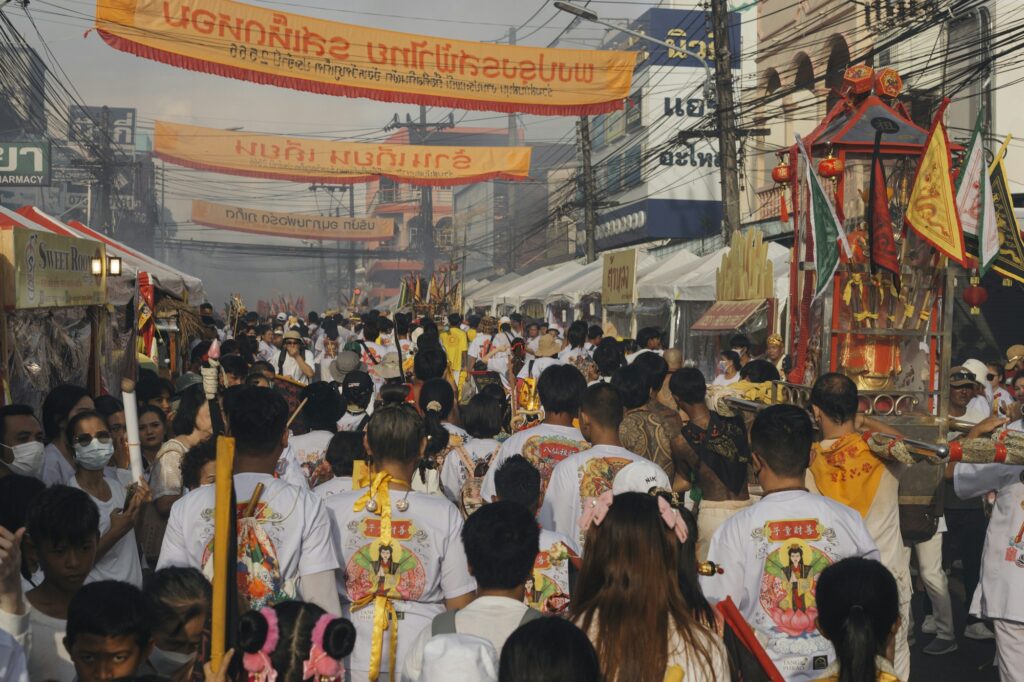
The Phuket Vegetarian Festival runs from 10 to 18 October 2026, preceded by the mast-raising ceremony on the evening of 9 October. Born in 1825 in the Kathu district, this Taoist ritual of Hokkien Chinese origin sees mediums known as mah song pierce their cheeks in trance, apparently without pain. More than 100,000 visitors flock to Phuket’s Old Town every year. Book accommodation in Talat Yai at least six weeks ahead – the best heritage stays fill up by August.
From 10 to 18 October 2026, Phuket’s Old Town switches into an entirely different mode. For nine days, the streets around the Chinese shrines fill with yellow flags announcing fully vegan food stalls, while mediums in trance pierce their cheeks in public to the sound of firecrackers. This guide covers the confirmed 2026 dates, the religious meaning behind the « jay » fast, what actually deserves caution on the ground, and how to plan a stay in the historic Talat Yai quarter.
1. Phuket Vegetarian Festival 2026: dates and full timeline
9 to 19 October 2026, the full calendar
According to the Tourism Authority of Thailand, the festival runs from 10 to 18 October 2026, preceded by the mast-raising ceremony (Go Teng) on the evening of 9 October. Closing night unfolds on 18-19 October, when processions converge on Saphan Hin point, where the Nine Emperor Gods are symbolically sent off just before midnight, according to The Thaiger. These dates follow the Chinese lunar calendar, so they shift every year. The 2025 bicentennial edition ran from 21 to 29 October – roughly ten days later than in 2026, a gap confirmed by an independent reading of the 2026 Chinese lunar calendar.
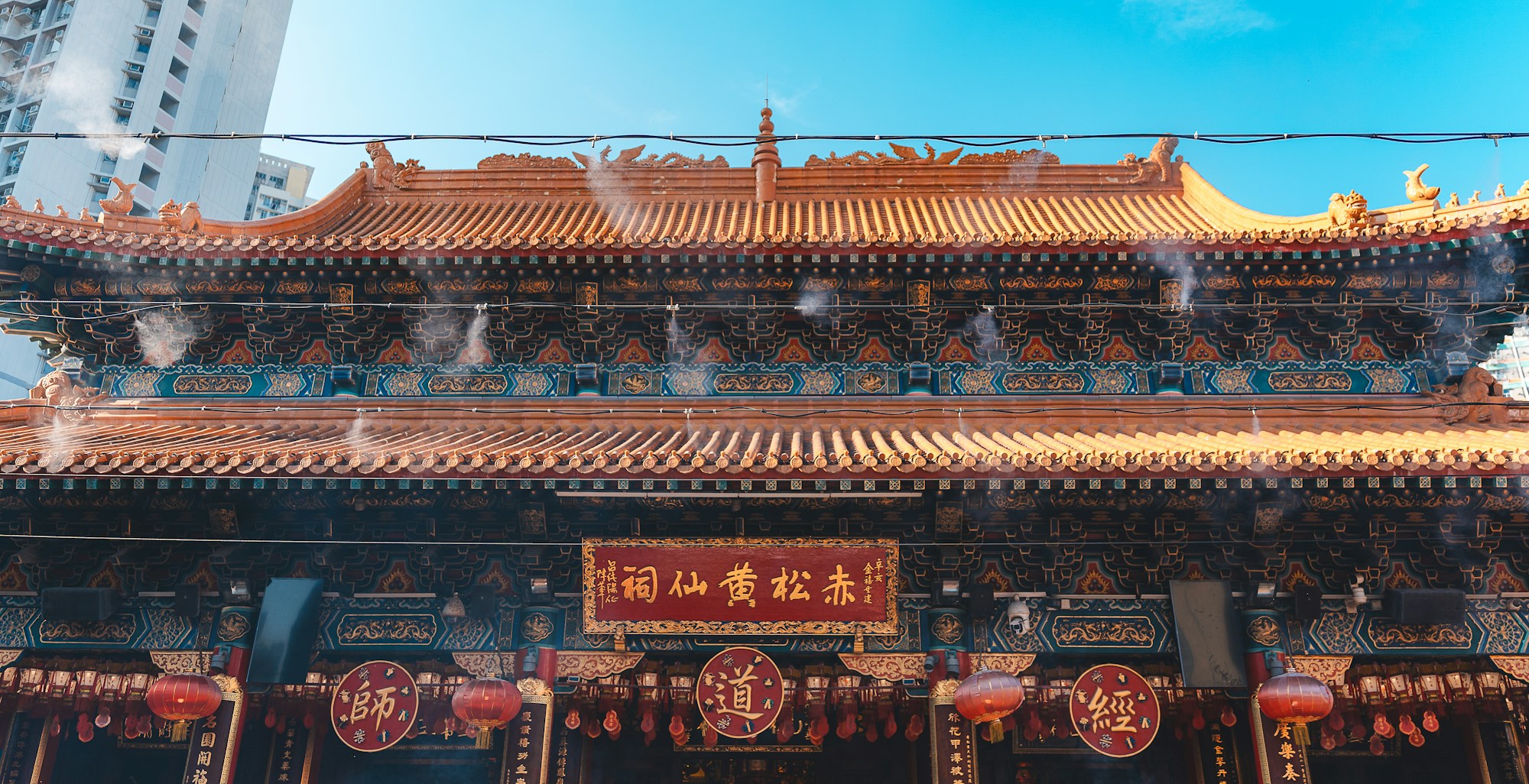
Each shrine (San Jao) runs its own procession at a fixed time, usually early morning. According to Phuket101, Naka Shrine opens proceedings on 11 October at 7:30am, followed by Sapam, Sam Kong, Ban Tha Rue, Bang Neow, Jui Tui and then Kathu, before the grand finale on 18 October at Sui Boon Tong Shrine and Saphan Hin. Phuket has somewhere between 39 and over 40 participating shrines depending on the year.
Highlights
- Free festival, open to everyone, run entirely by local shrine committees
- Morning rituals (piercings) from 5:30-6am, fire-walking in the evening around 8pm
- Night of 18-19 October: every procession converges on Saphan Hin
2. Where the festival comes from, and what the « jay » fast means
Origins of the festival and the meaning of the fast
The most widely told origin story dates back to 1825, in the tin-mining district of Kathu. According to Outlook Traveller and National Geographic, a Hokkien Chinese opera troupe from Fujian, brought in to entertain the tin miners, was struck by an epidemic (cholera by most accounts, malaria by others). The troupe blamed the outbreak on neglect of ancestor worship, and took up a strict nine-day fast with prayers to the Nine Emperor Gods (Kiu Ong Iah), as practised back home. The sickness receded, and locals kept the practice going every year since.
The jay (เจ) diet observed over these nine days is a strict vegan one: no meat, fish, eggs or dairy, and none of the five « pungent » vegetables (garlic, onion, chives, leeks, shallots), believed to stir up urges at odds with the purity being sought, according to Wikipedia. Ten traditional principles guide the practice: wearing white, abstaining from alcohol and sex, keeping strict physical and mental cleanliness, and using cooking utensils set aside solely for the occasion.
Highlights
- Jay diet: no animal products, none of the five pungent vegetables
- Full local name: Nine Emperor Gods Festival (Kiu Ong Iah)
- Listed as intangible cultural heritage of Thailand in 2018
3. The mah song: piercing, trance and fire-walking
Piercing, trance and fire-walking
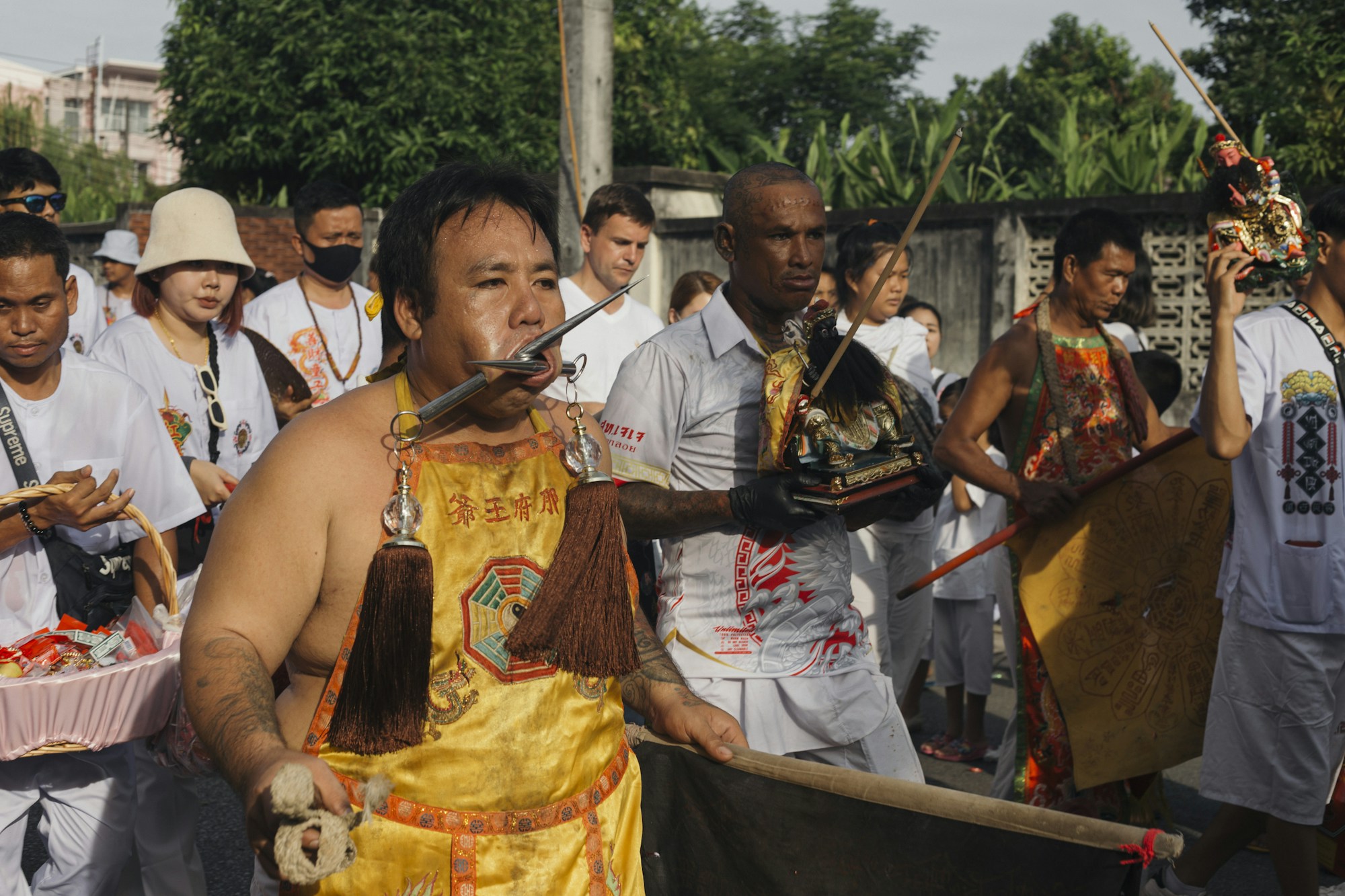
The term mah song (ม้าทรง) literally means « horse in trance »: the medium’s body becomes the mount temporarily ridden by the invoked deity. While possessed, they pierce their cheeks, tongue and sometimes other body parts with ritual objects – swords, traditional daggers, but also bicycle frames or saw blades that can protrude up to a metre either side of the face – according to the South China Morning Post.
Mediums show no visible sign of pain and bleed very little during piercing; their wounds are treated the following day with herbal remedies at the shrines. According to Piercings Works, this is documented in anthropological literature as a genuine state of religious trance that alters pain perception, not a staged performance. « On the morning of the procession, I’m always afraid of the piercing, but I feel no pain, » says Pai Siripohn, a medium quoted by National Geographic. Becoming a mah song requires registering in advance with your shrine, and is reserved for those considered to have a genuine spiritual bond with one of the invoked deities.
According to Katarocks, Kathu Shrine is known for the most intense medium rituals and the most spectacular fire-walking, Bang Neow for the drama of its rituals around a large statue of Guanyin, and Jui Tui for its atmosphere and sheer crowd density.
Highlights
- Piercings from 5:30-6am, fire-walking and blade-ladder climbs around 8pm
- Mediums register in advance – it’s never improvised
- Kathu, Bang Neow and Jui Tui: the three most intense shrines
4. Safety: what actually deserves caution
Contrary to what you’d assume, the main danger for an average visitor doesn’t come from the medium rituals – supervised by temple committees with medical tents on site – but from the firecrackers set off continuously, including through the night. According to Phuket101, clothing and shoes can get burned by sparks several metres from the procession.
What’s expected of you
- Long sleeves, trousers and closed shoes near processions
- Never touch a medium or block a procession’s path
- Avoid red, and even more so black, out of respect for the collective white
- Earplugs recommended for children and anyone sensitive to noise
The only widely documented fatal incident linked to the festival was a road accident in 2023 on Ranong Road, according to The Pattaya News: a driver who lost consciousness ploughed into stalls, killing one person and injuring seven. That’s a road traffic accident, not a ritual incident. Thailand remains rated « exercise normal precautions » by the US State Department, and the UK Foreign, Commonwealth and Development Office flags no specific warning linked to the festival.
For families with young children, it’s best to stick to the first three days of the festival (10-12 October), which are less intense, keep well back from the front of any procession, and deliberately skip the piercing ceremonies and closing night. Solid medical travel cover is still worth having – less because of the rituals themselves than the sheer crowd density; our 2026 travel insurance comparison breaks down the cover worth having for a Southeast Asia trip.
5. Where to stay and how to get around during the festival
Phuket Old Town (Talat Yai) remains the go-to base: it’s within walking distance of Jui Tui and Bang Neow shrines, as well as Thalang Road and Ranong Road, the epicentre of the food stalls. According to Trip.com, it’s worth booking at least six weeks ahead – the charming Sino-Portuguese shophouse stays fill up by August. Regularly mentioned options include The Memory at On On Hotel (a historic 1929 boutique property), Vapa Hotel, Hotel Midtown Ratsada and Novotel Phuket City Phokeethra, close to Jui Tui and Bang Neow.
Streets around the Old Town are partly or fully closed to traffic for several hours on every procession morning, typically 6am to 11am, according to The Phuket News. Ranong Road turns largely pedestrian in the afternoon and evening, becoming a giant street market. Walking or a rented scooter beats a car or taxi during procession hours.
From the airport, expect 350-450 THB for a metered official taxi (plus a 100 THB airport surcharge), 600-900 THB for a Grab, or 100 THB for the budget Smart Bus (roughly 1h30). Virgin Atlantic is actually launching a direct London Heathrow-Phuket route from 18 October 2026, a handy marker for placing the festival on the international travel calendar. On entry requirements, the « tourism only » visa exemption has been in force since 15 September 2026 for most Western passports, and the Digital Arrival Card (TDAC) remains mandatory and free for every entry, according to Tisland Travel.
Plenty of travellers combine the festival with a day trip to the Phi Phi Islands, 1h30-2h away by ferry, while keeping their base in Phuket for the evening processions. To compare Phuket with the other southern islands, our Phuket, Krabi or Koh Samui guide breaks down which traveller profile suits each one.
6. Jay cuisine: street food and where to eat it
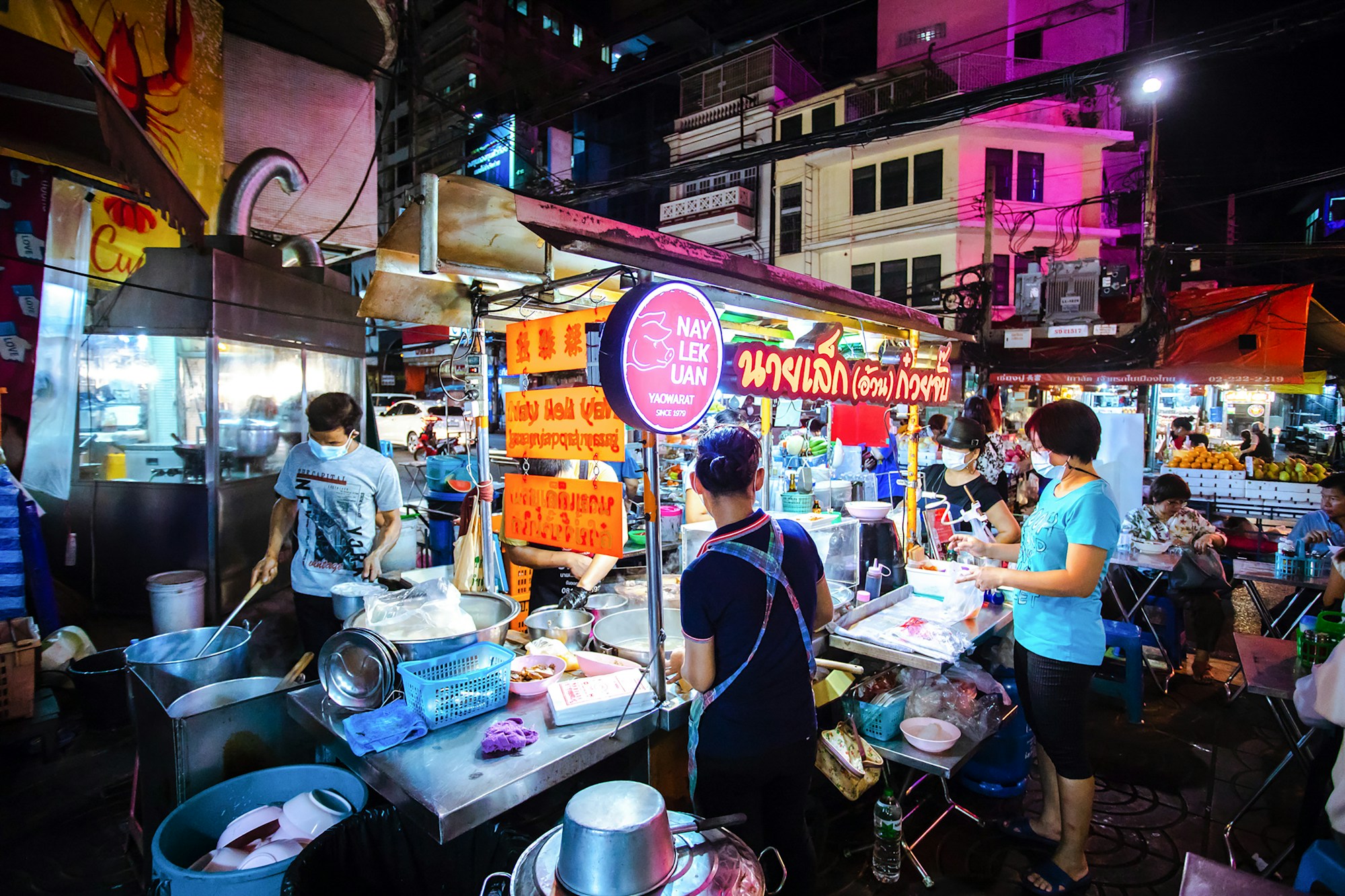
Yellow flags and signature dishes
Every stall or restaurant taking part in the festival flies a small yellow flag with red characters – the universal marker across the whole island for the nine days. According to Pipeaway, street dishes run 30-80 THB, a full three-course meal with a drink comes to 150-250 THB, and a full day of grazing across several stalls rarely tops 500 THB.
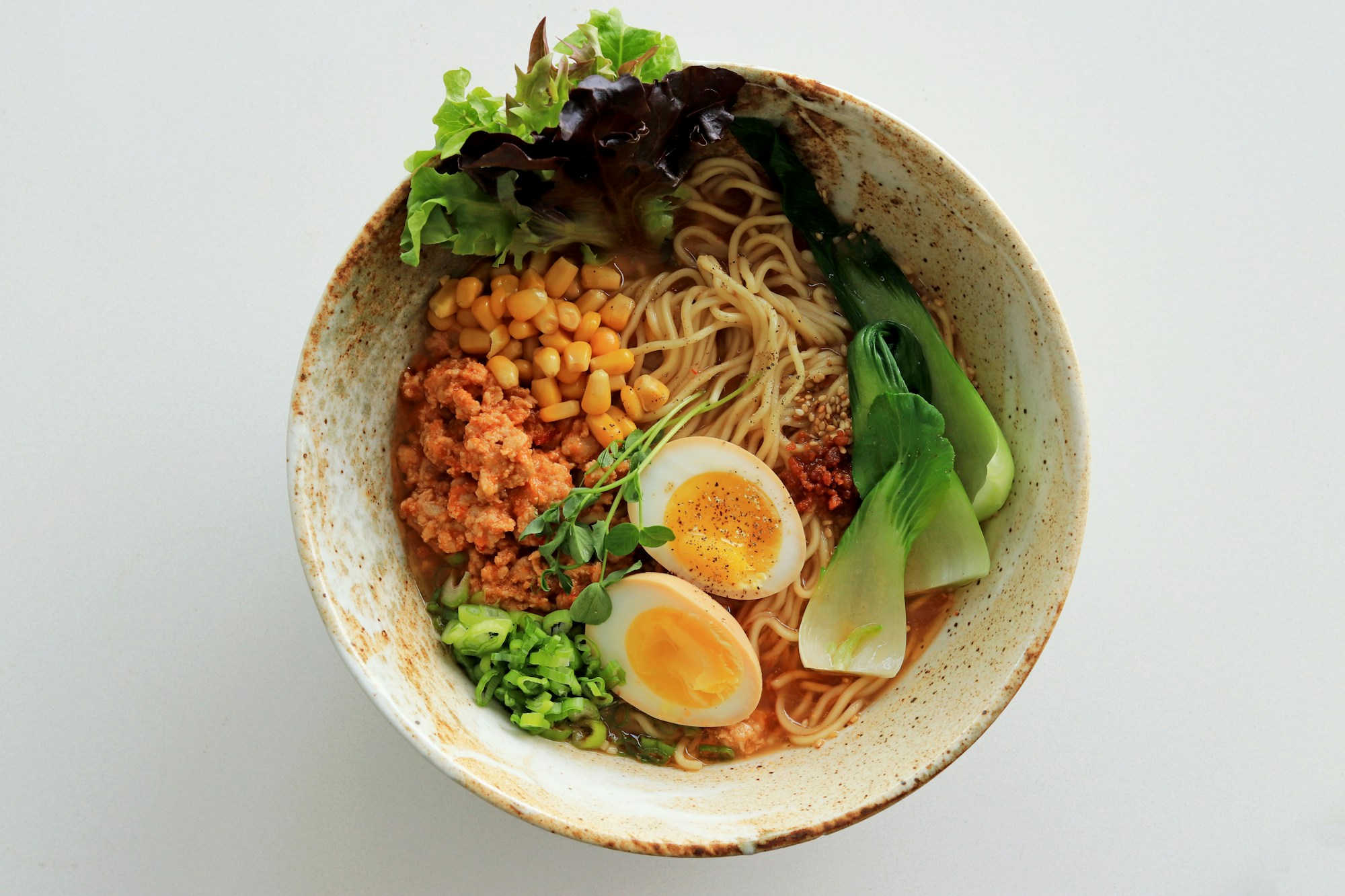
Signature dishes include Hokkien mee noodles (yellow noodles, tofu and plant-based « duck »), a pink Hokkien soup made with mushrooms mimicking pork, fried taro, oyster mushroom omelette, spring rolls, sticky rice khao lam cooked in bamboo, and sesame balls (jiandui). Ranong Road, which turns into a night market from 3pm to midnight, has the highest concentration of stalls; most only take cash, so carry small notes.
This culinary buzz fits into a wider recognition: Phuket has been a UNESCO Creative City of Gastronomy since 2015, the first in ASEAN to earn the title. A more urban, chaotic version of the same festival also takes place in Bangkok’s Chinatown, on Yaowarat Road, with only two or three lanes closed to traffic compared with entire streets in Phuket; our look at Bangkok’s street food scene gives a taste of that urban vibe.
Highlights
- Yellow flag with red characters: the universal marker of jay food stalls
- Ranong Road, a giant night market from 3pm to midnight
- A full day of tasting for under 500 THB
7. Peranakan identity: the Sino-Portuguese Old Town
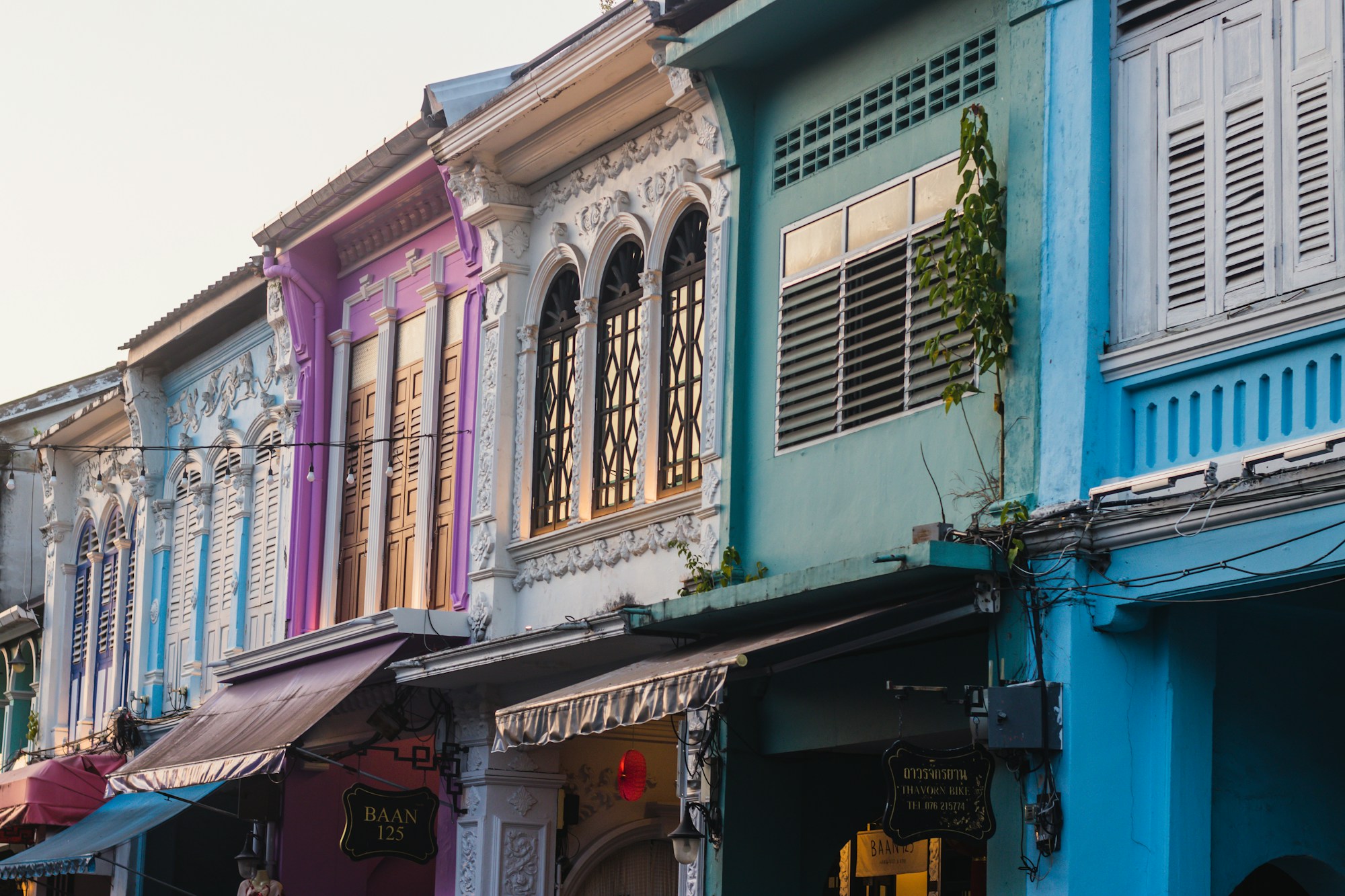
Architecture and baba identity
Around 75% of Phuket’s population is thought to descend from marriages between Chinese immigrants and local Thai women, commonly known as baba or peranakan, according to Phuket Index. This blended culture developed its own language (Baba Malay), a distinctive Sino-Portuguese architecture (Italian tiles, Portuguese shutters, Palladian columns) and a fusion cuisine, Nyonya food. The Chinpracha House (1903), which mixes Chinese lacquerware, Indonesian sarongs and Portuguese furniture, is the most cited example.
For peranakan families, the festival is a powerful marker of identity. « This festival keeps the whispers of our ancestors alive, » says a local resident quoted by National Geographic. It’s not an event built for tourists at all: it’s a living devotional practice, organised locally by each shrine’s committee, and recognised in 2018 as intangible cultural heritage of Thailand.
To explore this quarter outside festival dates, the Sunday Lard Yai market brings Thalang Road to life every Sunday from 4pm to 10pm, along the same street where several October processions pass through.
Highlights
- Sino-Portuguese architecture: century-old shophouses and pastel mansions
- Sunday Lard Yai market, Thalang Road, 4pm-10pm
- Phuket, a UNESCO Creative City of Gastronomy since 2015
Practical info for your trip
A local eSIM skips roaming fees and activates before you fly – handy for checking procession times in real time.
Thailand data plans to suit any tripSolid medical cover is worth having for a trip through dense crowds, even though the real risk comes from firecrackers more than the rituals themselves.
From $56 / 4 weeksFrequently asked questions
What are the exact dates of the Phuket Vegetarian Festival in 2026?
10 to 18 October 2026, preceded by the mast-raising ceremony on the evening of 9 October and closing with the final procession to Saphan Hin on the night of 18-19 October, according to the Tourism Authority of Thailand.
Is the festival dangerous for tourists?
The main real risk comes from firecrackers, which can burn clothing and skin close to the processions, not from the medium rituals themselves, which are supervised by the shrines. Thailand remains rated « exercise normal precautions » by both UK and US authorities.
Do you have to wear white to attend the festival?
No, it isn’t compulsory for a regular visitor, but it’s strongly encouraged out of respect, especially near the shrines. It’s best to avoid red and, even more so, black.
Can you photograph the piercing rituals?
Generally yes, asking permission where possible, without flash during ceremonies, and never touching a medium or their ritual instruments.
Is the festival suitable for children?
With some care: stick to the first three days (10-12 October), which are less intense, stay well back from the front of the procession, and deliberately skip the piercing ceremonies and closing night.
Where should you stay to experience the festival up close?
Phuket Old Town (Talat Yai), within walking distance of Thalang Road, Ranong Road and the Jui Tui and Bang Neow shrines. Book at least six weeks ahead.
Is the Vegetarian Festival connected to animal rights?
No, that’s a common misconception. It’s a Taoist spiritual purification festival where the vegan diet is a tool of personal discipline, with no link to Western animal-welfare ethics.
How much does a day on the ground cost?
Budget 150 to 250 THB for a full jay meal, and an overall daily budget of around 1,500 to 2,000 THB (roughly £34-£45) excluding premium accommodation.
Sources
- Tourism Authority of Thailand – official dates for the 2026 edition
- Phuket101 – detailed day-by-day calendar
- Kapook – Thai-language source, confirming 2026 dates
- National Geographic – medium rituals and peranakan identity
- Outlook Traveller – historical origins of the festival
- Wikipedia – Nine Emperor Gods Festival, religious context
- South China Morning Post – description of the ritual piercings
- Piercings Works – anthropological analysis of the trance state
- Katarocks – guide to the participating shrines
- The Pattaya News – 2023 road accident
- Travel.State.gov – official US risk rating for Thailand
- gov.uk – travel advice for UK nationals
- Pipeaway – jay cuisine, prices and signature dishes
- Trip.com – recommended stays in the Old Town
- The Phuket News – road closures during processions
- Tisland Travel – 2026 Thailand entry requirements
- Phuket Index – baba culture and peranakan identity
- Sonasia Holiday – the « Vegetarian Festival » name misconception
Research carried out on 18 September 2026.

Plan your trip with Pixidia
Pixidia learns how you like to travel and helps you build a trip that actually feels like you – and whoever’s coming with you.
Open the planner