
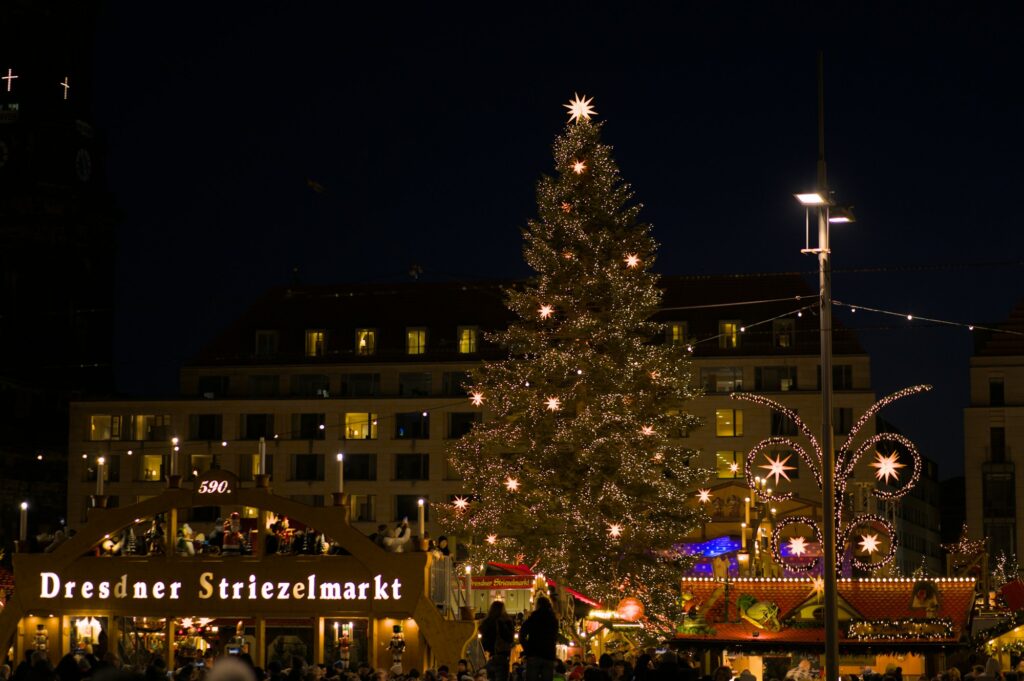
The Striezelmarkt in Dresden 2026 opens on Wednesday 25 November 2026 around 4 pm (4:30 pm according to another summary) and closes on Thursday 24 December 2026. Entry is free, and the market runs from 10 am to 9 pm, except on 24 December (10 am to 2 pm). The opening time is still to be confirmed on the City of Dresden’s page.
Checked on .
The Striezelmarkt calls itself Germany’s oldest documented Christmas market, and its 2026 edition opens on 25 November on Dresden’s Altmarkt. Free entry, a wooden pyramid, and Stollen protected by an EU designation: the market mixes history with a very popular festive crowd. This article separates what is announced for 2026 from what belongs to past editions. It then covers the calendar, the history, a realistic budget, trains from Berlin, Prague and Leipzig, a possible route and the pitfalls to avoid.
1. Dates, hours and opening day
The City of Dresden has announced the 2026 edition: it opens on Wednesday 25 November, closes on Thursday 24 December, and runs for thirty days on the Altmarkt. This is the 592nd edition, after the 591st in 2025 (summary of the City’s April 2026 press release, consulted on 11 October 2026). Up-to-date listings on foiresinfo.fr and ultimatechristmasmarkets.com give the same dates. The reference address is Altmarkt 2, 01067 Dresden, between the Kreuzkirche and the Kulturpalast, facing the Neues Rathaus.
On the first evening, the market opens around 4 pm. The ultimatechristmasmarkets.com listing says 4 pm, and a summary of the exhibitor call says 4:30 pm. We won’t pick one: check the exact time on the City of Dresden’s page the day before your visit. The illuminations switch on the next day, Thursday 26 November, according to ultimatechristmasmarkets.com. From 26 November to 23 December, the market opens every day from 10 am to 9 pm. On 24 December it closes at 2 pm, and it stays closed on 25 December.
| Moment | Date | Hours | Good to know |
|---|---|---|---|
| Opening | Wednesday 25 November | around 4 pm (4:30 pm according to another summary) | Time to be confirmed on the City of Dresden’s page |
| Illuminations | Thursday 26 November | not specified | Illuminations switched on that day |
| Main market | 26 November to 23 December | 10 am to 9 pm | Free entry |
| Stollenfest | Saturday 5 December | 2026 time not published | Parade and cutting of the Riesenstollen (2025: parade from around 11 am) |
| Closing | Thursday 24 December | 10 am to 2 pm | Closed on 25 December |
Source: ultimatechristmasmarkets.com and foiresinfo.fr, checked on 11 October 2026; dates relayed by the City of Dresden (summary of its April 2026 press release). The opening time on 25 November is still to be confirmed.
The Advent Sundays fall on 29 November and on 6, 13 and 20 December 2026. The Stollenfest takes place on the Saturday before the second Advent Sunday, which is 5 December. Visitors and guides consulted describe it as the busiest Saturday of the year. If you only come once, pick a weekday and the morning: Friday and Saturday evenings are the most crowded.
2. Why Dresden claims the oldest Christmas market
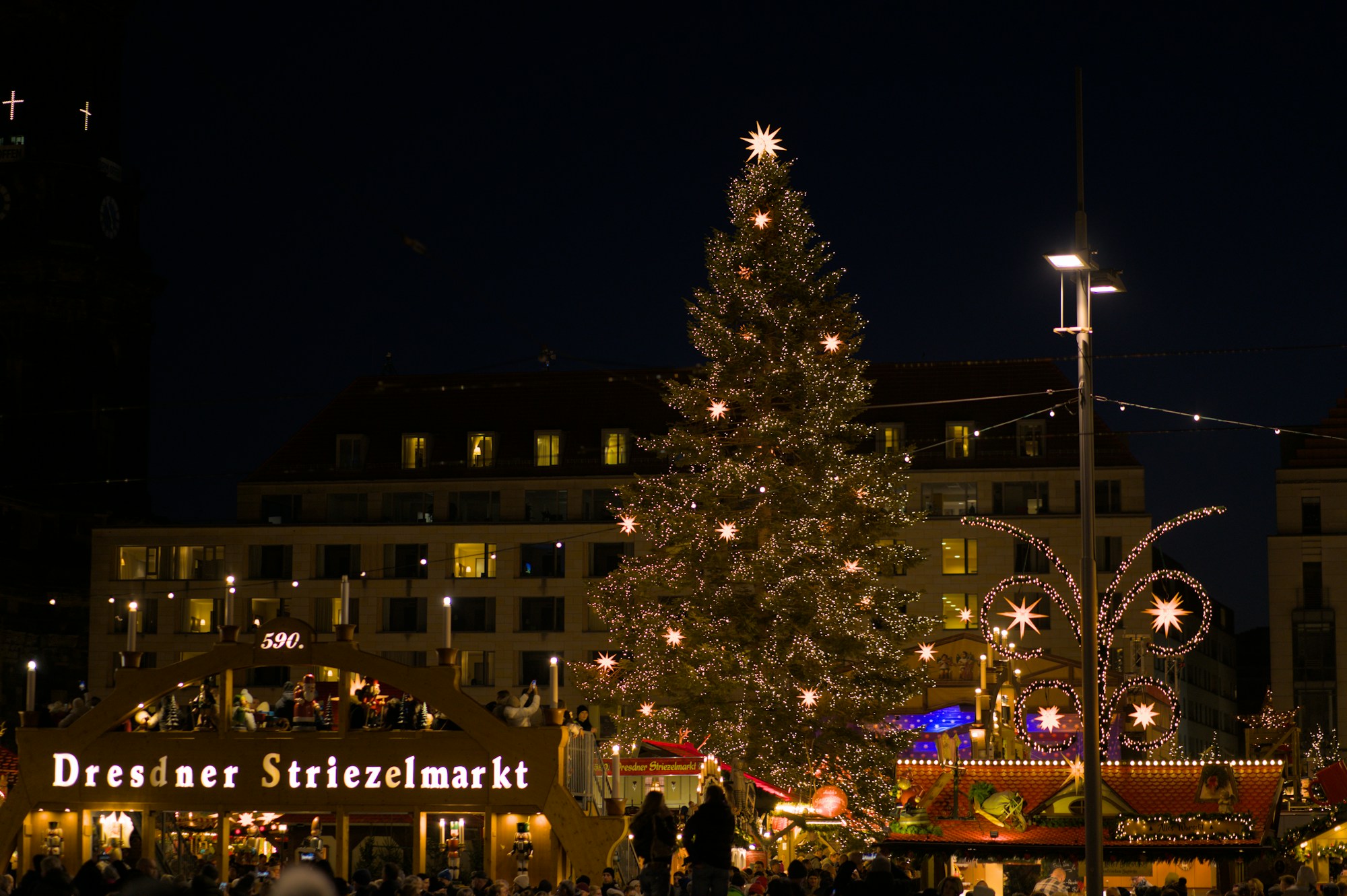
The Striezelmarkt, first recorded in 1434
The market is first mentioned in 1434. A document of that year authorised a one-day market on the Altmarkt, held just before Christmas and called ‘Striezelmontag’, under Elector Frederick II of Saxony. The name refers to an old Advent cake, the ancestor of Stollen. Sources do not agree on the exact etymology, so we don’t go into it here. The market later stretched until Christmas Eve. It was cancelled in 2020 and 2021, then returned to the Altmarkt in 2022.
The claim to be the ‘oldest’ needs a qualifier. Frankfurt is documented from 1393 and Bautzen cites a mention from 1384, but those markets are not presented as Christmas markets. Dresden’s claim therefore concerns the Christmas market specifically, not markets in general.
The market’s visual landmark is the Erzgebirge wooden pyramid at the centre of the Altmarkt, about 14.6 m tall. Measurements differ by a centimetre (14.61 or 14.62 m), hence the rounding. Around it, stalls sell Erzgebirge woodcraft and Advent decorations. A Sachsen Fernsehen report dated 9 April 2026 mentions 216 stalls for 263 applications. The City’s review of 23 December 2025 also cites 150,000 litres of hot drinks and 180,000 small cakes.
Highlights
- A first written mention in 1434, under Frederick II of Saxony.
- A wooden pyramid about 14.6 m tall at the centre of the Altmarkt.
- Erzgebirge craftspeople and Advent decorations, in a market with no entry fee.
If you arrive on the first day and want to understand the centre before letting the stalls take over, a two-hour walking tour (120 minutes according to the Viator listing) links the Altmarkt with the city’s history, led by Dr Fraser Macdonald (PhD). The price does not include paid entries: the listing lists them separately, namely the Dreikönigskirche (€5), the Residenzschloss (€14) and the Museum für Sächsische Volkskunst (€5).
3. Dresdner Stollen, a protected festive loaf
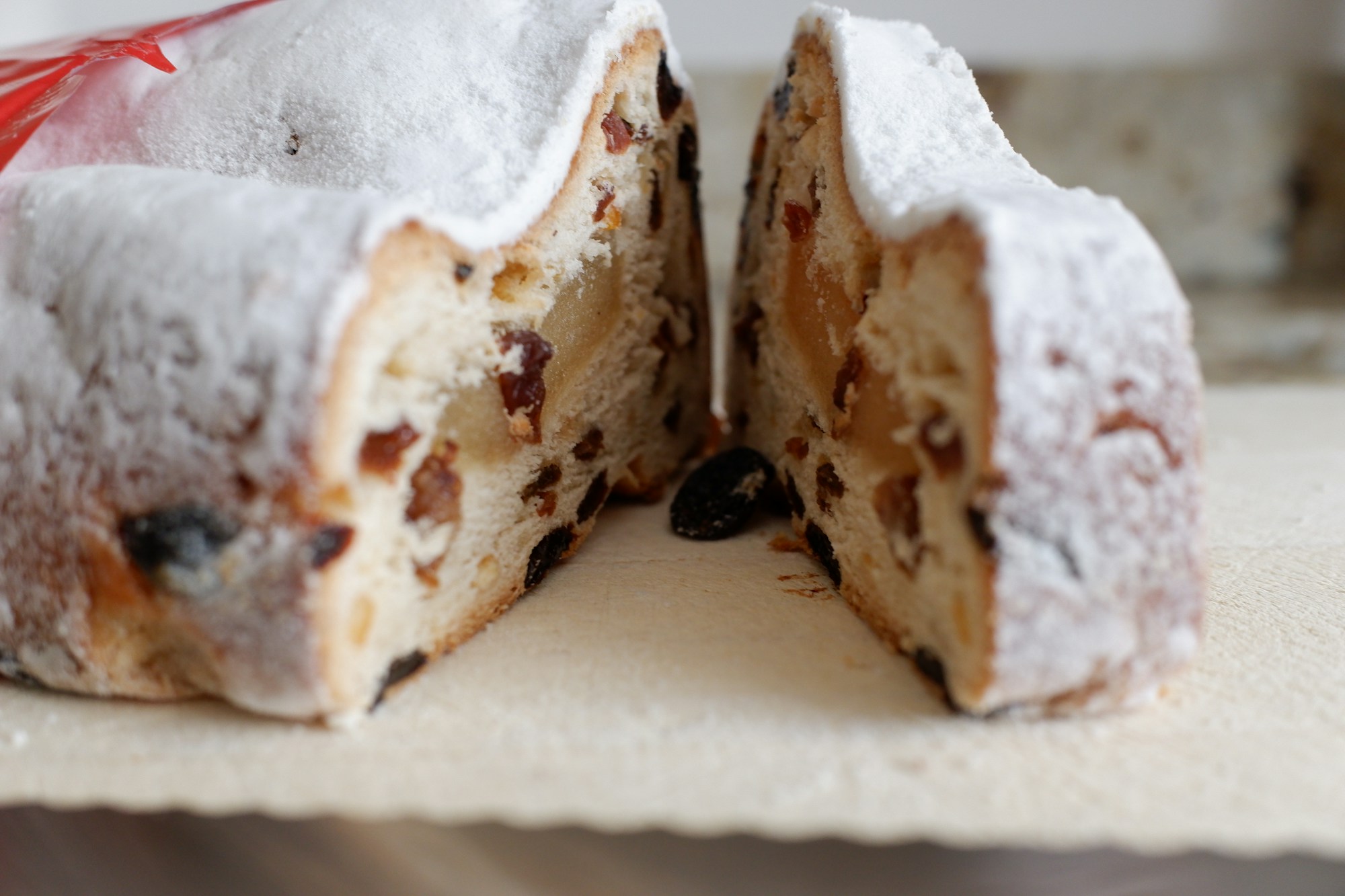
A pastry several centuries old
Stollen is a festive loaf studded with candied fruit and butter. It has its own history, separate from the market’s. According to the Schutzverband Dresdner Stollen association, the first mention of Dresden’s Stollen appears on an invoice from the Bartolomai hospital in 1474: it was a Lent pastry made from flour, yeast and water. A request to lift the ban on butter, the ‘Butterbrief’, dates from 1491 according to the same association (another source gives 1490).
The name ‘Dresdner Christstollen’ is protected. It is registered as a protected geographical indication under Regulation (EU) No 1098/2010 of 26 November 2010, published in the Official Journal on 27 November 2010 (European Commission, consulted on 11 October 2026). Only loaves bearing the association’s golden seal, made within the defined area, may use this name. The current status can be checked in the EU’s DOOR database. We did not re-check it for this article.
The recipe is tightly regulated. For 1 kg of flour, the association sets minimum amounts of ingredients, shown in the table below. A study by the Dresden University of Technology, published in 2019, expresses them as a percentage of the flour weight: 65% raisins, 50% butter, 20% candied peel and 15% almonds.
Highlights
- A name protected across the EU since 2010.
- A recipe with set minimums for butter and candied fruit.
- Around a hundred member bakers, according to the association.
| Ingredient | Minimum | Source |
|---|---|---|
| Raisins | 650 g | Schutzverband Dresdner Stollen |
| Butter | 500 g | Schutzverband Dresdner Stollen |
| Candied lemon peel | 200 g | Schutzverband Dresdner Stollen |
| Candied orange peel | 200 g | Schutzverband Dresdner Stollen |
| Almonds | 150 g | Schutzverband Dresdner Stollen |
Source: Schutzverband Dresdner Stollen e. V., checked on 11 October 2026; percentages: Dresden University of Technology (study published 8 November 2019).
4. Stollenfest and Riesenstollen, Saturday 5 December
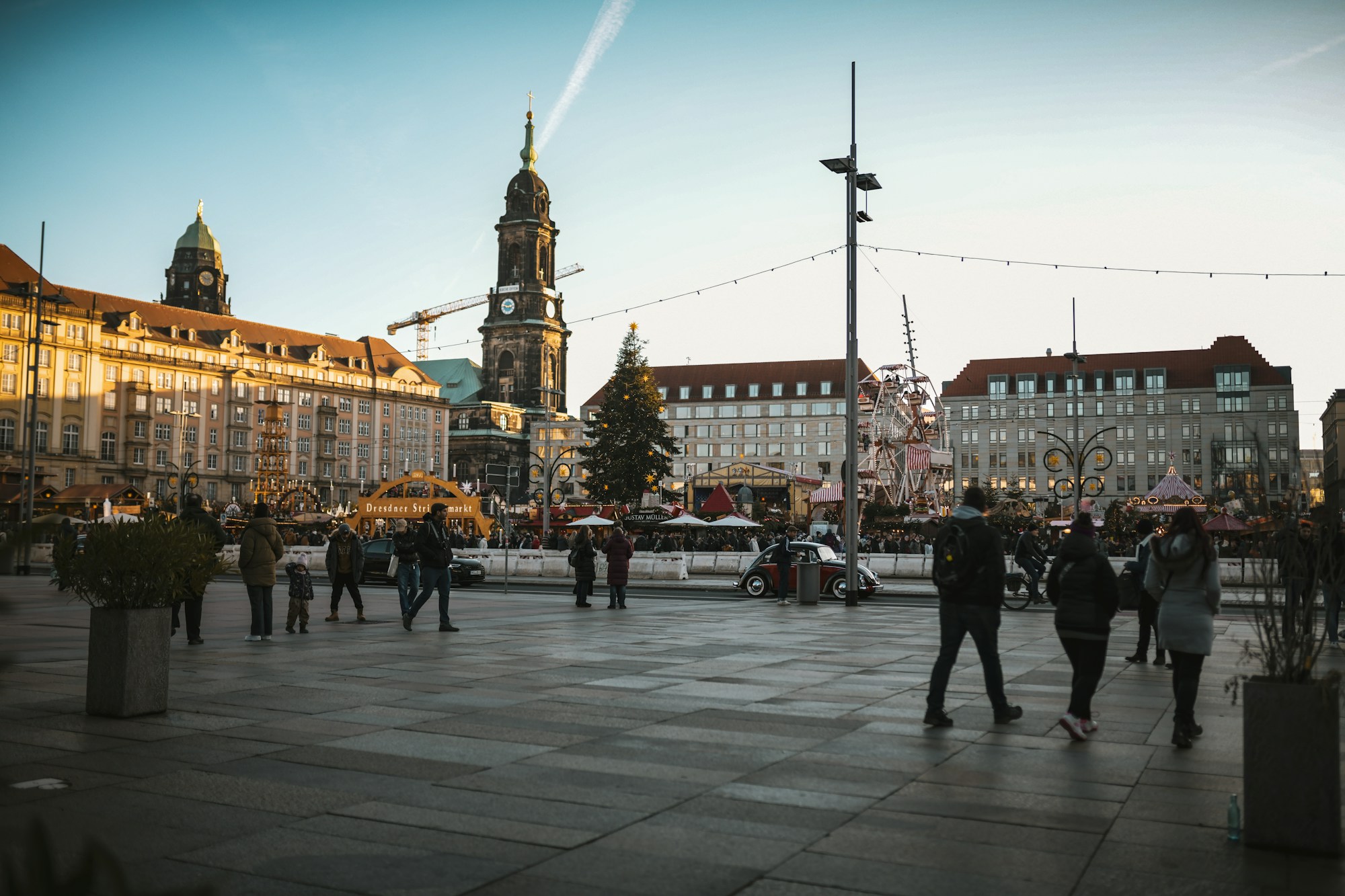
The great Stollen parade
The Stollenfest celebrates Stollen on the Saturday before the second Advent Sunday. The 2025 edition, the 30th, drew 65,000 people according to the organisers (evangelisch.de, consulted on 11 October 2026). The parade started from around 11 am, and the cutting of the Riesenstollen, the Anschnitt, took place around noon on the stage in front of the Kulturpalast. These are the 2025 times: the 2026 time had not been published when we checked.
The Riesenstollen weighed about 2 tonnes in 2025, according to evangelisch.de. The 2026 programme, relayed by festivalsindeutschland.de, announces a Stollen of more than 3 tonnes. We present this as an announced target, not an established fact. In 2025, the Riesenstollen sold for €10 per 500 g, or about €20 per kilo (calculated from that price, evangelisch.de).
Highlights
- The parade sets off from the historic centre.
- Saturday is, according to the visitors consulted, the busiest day of the year.
5. Budget: what the visit really costs
The visit itself costs nothing: entry is free (foiresinfo.fr and ultimatechristmasmarkets.com, checked on 11 October 2026). Your budget depends on what you spend and on transport. The table separates prices checked for 2026 from 2025 amounts, and flags the ones that remain indicative. The City had not published 2026 drink prices when we checked. All amounts are in euros.
| Item | Amount | Price year | Source |
|---|---|---|---|
| Market entry | free | 2026 | foiresinfo.fr, ultimatechristmasmarkets.com |
| Mulled wine (Glühwein) | about €5 per cup | 2025, indicative | Press (t-online.de, November 2025), unofficial figure |
| Cup deposit | not found for the standard cup; €5 for the numbered souvenir cup | 2025 | Exhibitor rules 2025 (summary) |
| Striezeltaler | 1 taler = €1; bag of 11 talers for €10 | 2026, presence to be confirmed on site | City of Dresden (talers page, search summary) |
| Riesenstollen | €10 per 500 g (about €20 per kilo) | 2025 | evangelisch.de |
| Sachsen-Ticket, 1 person, 2nd class | €35 (+ €8 per extra person; €67 for a group of up to 5) | 2026 | bahn.de and ADAC, table dated 8 October 2026 |
| Dresden day ticket (VVO) | about €9 | 2026, to be reconfirmed | ADAC, 2026 comparison |
| Ferris wheel (Riesenrad) | about €5 | undated, 2026 presence not confirmed | Travel blog (summary) |
Source: see the ‘Source’ column for each line; checked on 11 October 2026. Amounts marked 2025 or ‘to be reconfirmed’ are indicative.
Striezeltaler simplify small spending. One taler is worth one euro, and the City says exhibitors and rides accept them (summary of its page, consulted on 11 October 2026). Their presence in 2026 still needs confirming on site. A bag of 11 talers for €10 gives you one taler free: a small saving, but a real one if you plan several mulled wines.
Accommodation weighs more than the market does. Hotels in the centre raise their rates on Advent weekends, but we did not find a recent figure to measure this. On promotion, a 4-star hotel near the Frauenkirche was offered from €46 per person per night, without full date conditions (urlaubstracker.de, undated, to be checked). Booking early for Friday and Saturday nights remains the safest habit.
6. Getting to Dresden: train, plane and car
For visitors from abroad, the train is often simpler than flying. Direct flights from France are rare. Dresden-Klotzsche airport lies about 10 km north of the centre and connects by regional train to the two main stations. We did not find a reliable air fare for 2026. For journeys from France, the SNCF Christmas 2026 tickets guide gives the sales calendar.
| Journey | Indicative duration | Type of train | Source |
|---|---|---|---|
| Berlin Hbf to Dresden Hbf | 1 h 35 to 1 h 45 | ICE | Omio and a taxi provider (search summaries) |
| Prague to Dresden | 2 h 05 to 2 h 23 | railjet, EuroCity | Thetrainline (search summary) |
| Prague Florenc to Dresden | about 1 h 55 | Bus | Booking portal (search summary) |
| Leipzig Hbf to Dresden Hbf | about 1 h 02 | ICE | bahn.de, checked March 2026 |
Source: booking portals (Omio, Thetrainline) and bahn.de, checked on 11 October 2026. Durations vary by train. Check the arrival station (Dresden Hauptbahnhof or Dresden-Neustadt, depending on the service).
Two construction sites may disrupt the journey. In Berlin, the main station is under works from 14 June to 12 December 2026, and long-distance services still run in part (press). In Leipzig, the press reports works at the Hauptbahnhof that make some ICEs stop at Leipzig Messe. The end date has not been found.
On site, the Sachsen-Ticket is the most useful pass if you arrive from outside the city. It is valid on regional trains, the S-Bahn, trams and most buses in Saxony, Saxony-Anhalt and Thuringia, but not on ICE or IC trains: it therefore does not cover a journey from Berlin by ICE. It is valid Monday to Friday from 9 am until 3 am the next day, and from midnight at weekends, on public holidays, and on 24 and 31 December (bahn.de and ADAC, checked on 11 October 2026). The VVO network day ticket costs about €9 in 2026 according to ADAC, to be reconfirmed.
Several tram lines serve the Altmarkt, but the line numbers cited by our sources do not match. Check the line in the local operator’s app on the day, and plan to walk the last few minutes.
By car, allow about 2 to 3 hours from Berlin (195 km via the A13), about 2 hours from Prague (150 km via the D8) and about 1 hour from Leipzig (120 km via the A14), according to frenchmoments.eu (distances stable, page dated June 2025). Parking is saturated on Advent weekends. The underground car parks at Altmarkt, Altmarkt-Galerie and Pirnaischer Platz are the closest, according to an undated visitor guide. The train is still the simplest option. If your stay also takes in Prague, our article on Prague, Vienna and Budapest in early November helps you plan the rest of the route. For a trip continuing into Austria, our guide to the Salzburg Christmas market 2026 completes the itinerary.
7. A possible route and variants by traveller
The market runs for thirty days, and its hours change noticeably between weekdays, weekends and the last days of December. Here is a visit order based on the dates and hours above.
- Wednesday 25 November. Arrive before late afternoon if you want to see the opening. The market opens around 4 pm, and the time is still to be confirmed (4 pm or 4:30 pm).
- Thursday 26 November. A day for the stalls and decorations, from 10 am to 9 pm. Come back at nightfall for the illuminations, which are switched on that day.
- Saturday 5 December. Stollenfest: come early if you want to follow the parade from its start. Keep the evening for the illuminations on another day if the crowd puts you off.
- Thursday 24 December. Last market day, from 10 am to 2 pm only. Plan your visit for the morning.
For a family, entry being free, the budget goes on drinks and sweets. Visitors consulted describe weekday mornings as the calmest time to walk around with children.
On a small budget, the market costs nothing to enter. Stollen bought with the golden seal is the biggest expense to avoid if you want to keep spending tight. The Sachsen-Ticket (€35) does not cover the ICE journey from Berlin, but it can cover your regional travel on site.
For a first visit, keep two slots: the daytime for the stalls, the evening for the illuminations. It is the combination guides recommend most often.
For a visitor with reduced mobility, we found no accessibility information for the market. Check with the City of Dresden before you travel.
8. Pitfalls and on-the-ground advice
- Friday and Saturday evenings. These are the busiest times. Weekday mornings are the calmest, according to the visitors and guides consulted.
- Payment. The City says exhibitors accept Striezeltaler, but card payment is not confirmed for every stall. Keep some cash on you (guides’ recommendation, not an official one).
- The mulled wine cup. The drink is served in a deposit cup. Do not take it away without the seller’s agreement.
- Knives. Carrying knives at markets has been banned since the 2024 reform. The press mentions a fine of up to €10,000 (zdfheute.de).
- Checks. In 2025, vehicle access was closed at all of Dresden’s municipal markets. Sources differ on bag searches: evangelisch.de (22 November 2025) does not report them at the entrances, while web.de mentions checks. We cannot settle this. Bring a bag you can open easily, and do not carry a knife.
- Pickpockets. Guides speak of organised teams of 4 to 6 people. The situations cited: the crush around the mulled wine, a camera held up near the pyramid, and fake children’s collectors. This source is of low authority (tabiji.ai). The sensible habit is to carry your bag in front of you and your phone in an inside pocket.
- 24 December. The market closes at 2 pm. On 25 December it is closed.
- In an emergency, dial 110.
What other guides don’t tell you
Most guides focus on the market itself. Here are five facts we checked that are missing from, or wrong in, the guides we consulted, with their sources.
- ‘Dresdner Stollen’ has been an EU protected name since 27 November 2010. Regulation (EU) No 1098/2010 registered it. Guides talk about a Stollen made by Dresden’s bakers without mentioning this legal framework. European Commission, PGI page (consulted 11 October 2026).
- The Riesenstollen measured in 2025 weighed about 2 tonnes. The 3 tonnes announced concern the 2026 programme and remain an announced target. evangelisch.de (6 December 2025) and festivalsindeutschland.de (consulted 11 October 2026).
- Talers are the market’s currency, according to the City. One taler is worth one euro, and the City says exhibitors and rides accept them. The bag of 11 talers for €10 should be reconfirmed on site, as its 2026 availability is not confirmed. City of Dresden (summary of its page, checked 11 October 2026).
- Train times from Berlin and Prague are rarely given. Guides tend to focus on driving. From Berlin, the ICE takes about 1 h 35 to 1 h 45 according to Omio and a taxi provider. From Prague, the railjet takes about 2 h 05 to 2 h 23 according to Thetrainline.
- A 2025 listing gives the wrong dates for 2026. Visit Dresden Elbland announces ’24 November to 25 December’ on an old page. The 2026 calendar is the City’s: 25 November to 24 December. Visit Dresden Elbland (old page) and the summary of the City’s April 2026 press release.
Plan your stay
Stay connected from arrival and on the trip from Berlin or Prague, without a local SIM card. Plans vary by duration and data volume.
Prices depend on the plan you chooseTo cover the unexpected during your stay and your journeys, especially during a busy stretch like the end of Advent.
Price depends on duration and ageFrequently asked questions about the Striezelmarkt 2026
What are the dates of the Striezelmarkt Dresden 2026?
The Striezelmarkt 2026 runs from Wednesday 25 November to Thursday 24 December 2026, on Dresden’s Altmarkt. The dates are announced by the City of Dresden (summary of its April 2026 press release) and repeated by the up-to-date listings on foiresinfo.fr and ultimatechristmasmarkets.com, consulted on 11 October 2026. Guides that announce ’24 November to 25 December’ describe other editions.
Is the Striezelmarkt paid?
No. Entry to the Altmarkt market is free (foiresinfo.fr and ultimatechristmasmarkets.com, checked on 11 October 2026). You do need money for what you consume: mulled wine, Stollen, rides. Striezeltaler, at €1 each, cover small spending. The City says exhibitors accept them, but their presence in 2026 still needs confirming on site.
What are the market hours in 2026?
On Wednesday 25 November, the market opens around 4 pm. Another summary gives 4:30 pm, and the time still needs confirming on the City of Dresden’s page. From 26 November to 23 December, it opens every day from 10 am to 9 pm. On Thursday 24 December, it closes at 2 pm, and it stays closed on 25 December (ultimatechristmasmarkets.com, checked on 11 October 2026).
When is the Stollenfest 2026?
The Stollenfest 2026 takes place on Saturday 5 December 2026, the Saturday before the second Advent Sunday. It includes a parade and the cutting of the Riesenstollen on the Altmarkt. The time had not been published when we checked. In 2025, the parade started around 11 am and the Anschnitt took place around noon (evangelisch.de).
Can you pay by card at the Striezelmarkt?
According to the City, Striezeltaler are accepted by exhibitors and rides, but their presence in 2026 still needs confirming. For card payments, no official source we read guarantees it for every stall, so guides recommend carrying cash. Talers are sold in bags of 11 for €10, a price to be reconfirmed on site.
How much does mulled wine cost at the Striezelmarkt?
In 2025, the press reported around €5 per cup of mulled wine (Glühwein), an unofficial figure. The 2026 price had not been published when we checked. The standard cup deposit was not found, whereas a numbered souvenir cup from the 2025 edition was deposited for €5. Do not keep a cup without the seller’s agreement.
How do I get to Dresden from Berlin or Prague by train?
From Berlin, the ICE takes about 1 h 35 to 1 h 45. From Prague, the railjet takes about 2 h 05 to 2 h 23, and the bus from Florenc about 1 h 55. These durations come from booking portals and should be double-checked on bahn.de. Works at Berlin Hauptbahnhof run until 12 December 2026 and may disrupt the journey.
Is Dresdner Stollen protected?
Yes. The name ‘Dresdner Christstollen’ is a protected geographical indication of the European Union, registered under Regulation (EU) No 1098/2010 of 26 November 2010. Only loaves with the association’s golden seal, made in the defined area, may use this name. The current status can be checked in the EU’s DOOR database.
Sources
- City of Dresden, April 2026 press release: dates and edition (search summary, page not read directly)
- foiresinfo.fr, Striezelmarkt 2026 listing: dates, address, entry
- Ultimate Christmas Markets, Dresden: hours, illuminations
- Christmas Markets Germany, Dresden: dates and access
- Wikipedia (EN), Striezelmarkt: first mention in 1434
- European Commission, Dresdner Christstollen PGI: Regulation (EU) No 1098/2010
- Schutzverband Dresdner Stollen e. V.: history and recipe minimums
- evangelisch.de, Stollenfest 2025: attendance, 2025 Riesenstollen
- Festivals in Deutschland, Dresdner Striezelmarkt: 2026 programme
- Sachsen Fernsehen, call for exhibitors: stalls and applications
- ZDFheute, Christmas market security: knife-carrying reform (2024)
- French Moments, Dresden Christmas market: history and driving distances
- Visit Dresden Elbland, market page: outdated page, cited as a date error
Dates and amounts checked on 11 October 2026. Prices, availability and reviews of the Viator walking tour checked on Viator on 11 October 2026.
Plan your trip with Pixidia
Pixidia learns how you travel and helps you build a trip that truly fits you and everyone coming along.
Open the planner