
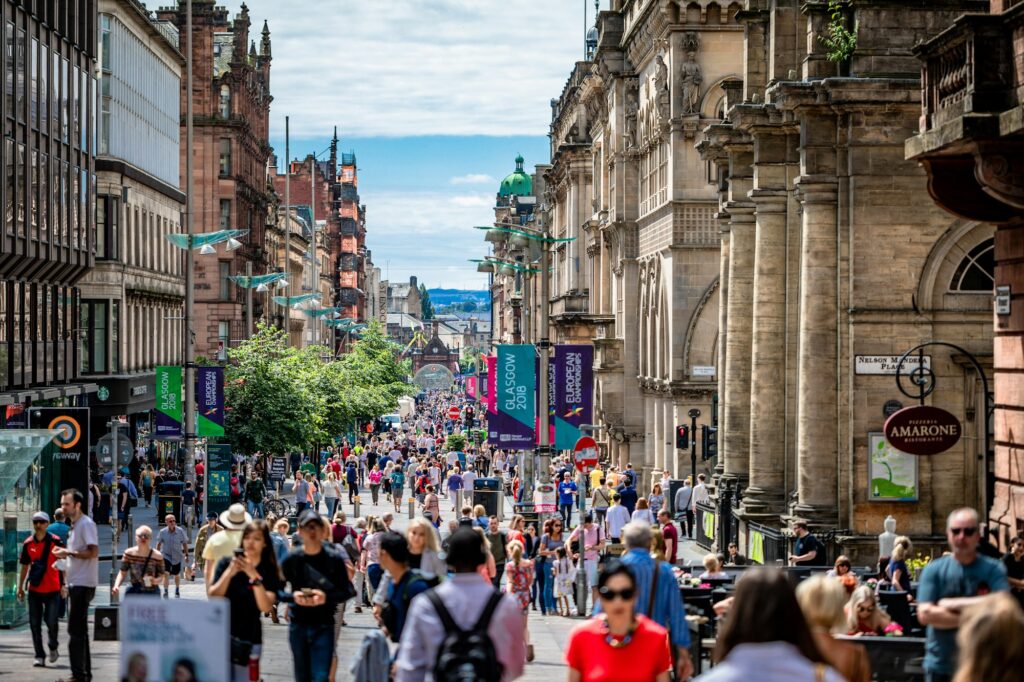
From 25 January 2027, Glasgow’s tourist tax is 5% of the accommodation price, excluding VAT, for every night of your stay, with no cap on the number of nights. For a room at £100 a night including VAT, that comes to about £4.17 per night if the property charges VAT.
Checked on against the official sources cited (VisitScotland, legislation.gov.uk, City of Edinburgh Council).
Glasgow is joining the Scottish cities that charge a tourist tax, and its rule is different from Edinburgh’s. Here, the tax does not stop after a few nights. Three points matter for your budget: the calculation is made excluding VAT, the tax is paid to the accommodation provider and not to the council, and the mandatory exemptions are few. This article separates what is established from what still needs confirming, and gives the calculations to run before you book.
1. What changes on 25 January 2027
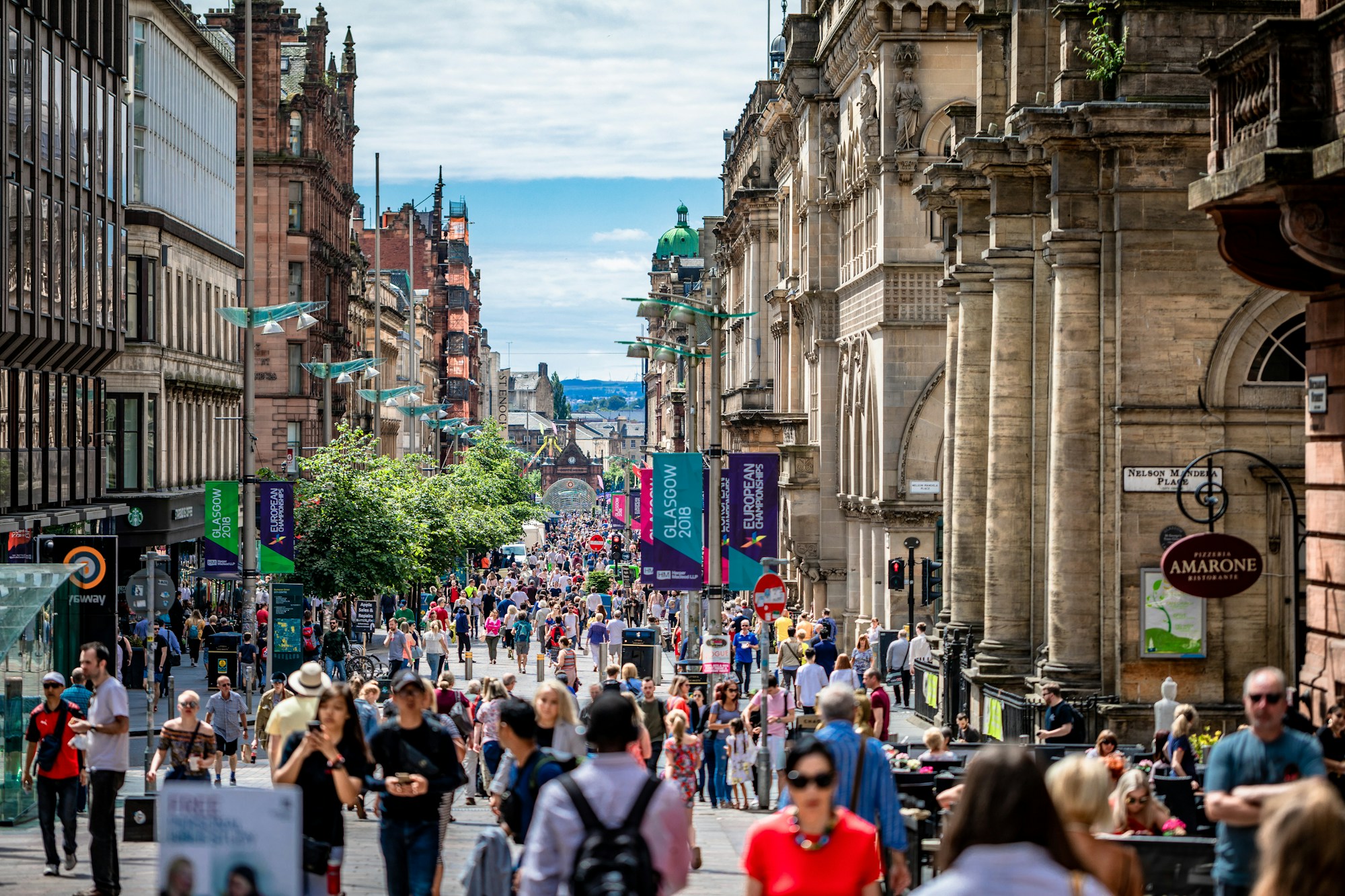
Glasgow: 5% of accommodation costs, no cap on nights
The city’s administration committee approved the principle on 19 June 2025, according to Roommaster and dramscotland.co.uk (article of 20 June 2025). VisitScotland, the national tourism agency, gives the rate and the start date: 5% of the accommodation cost from 25 January 2027 (page for local authorities, checked on 25 October 2026).
The rules at a glance
- The tax is charged on the accommodation price, not on extras.
- It applies to every night of your stay: Glasgow sets no cap.
- It covers hotels, hostels, B&Bs and self-catering lets.
- The provider collects it and pays it to the city. According to touristtaxes.com (a secondary source), returns are filed quarterly.
To scout the neighbourhoods before you choose where to stay, the 90-minute walking tour makes a good first outing. The amount of tax does not depend on the area: VisitScotland gives one rate of 5% for the whole city. The Viator check of 25 October 2026 finds departures on 73 days between 1 November 2026 and 31 January 2027, and none from 21 December to 8 January. Check the date when you book.
2. How much the tax will cost you: the calculation excluding VAT
The calculation takes three steps. Start with the nightly price. If the provider charges VAT, divide that price by 1.20 to get the base before VAT; if not, the base is the price you pay. Then apply 5%. For a room at £100 including VAT, the base is therefore £83.33 and the tax is £4.17 a night when VAT is charged. If it isn’t, the base is the price paid and the tax is £5 a night: this second case is a logical calculation from the rule, not a published amount. Some publications quote « £5 on £100 », which matches this second case. The rule before VAT is the one Edinburgh council applies, and touristtaxes.com says the same for Glasgow.
| Example | Tax if the provider charges VAT | Tax if the provider does not charge VAT |
|---|---|---|
| Room at £100, 2 nights | £8.33 | £10.00 |
| Room at £100, 3 nights | £12.50 | £15.00 |
| Room at £100, 7 nights | £29.17 | £35.00 |
| Room at £150, 2 nights | £12.50 | £15.00 |
| Room at £150, 3 nights | £18.75 | £22.50 |
| Room at £150, 7 nights | £43.75 | £52.50 |
Source: calculation based on the 5% rule before VAT, VisitScotland, checked on 25 October 2026. The « does not charge VAT » column is a logical calculation (base equal to the price paid), not a published amount. These are calculations, not figures published by the city: your final invoice is what counts.
The calculation is made per room and per night. With two rooms at £120 including VAT for 7 nights, at a provider that charges VAT, the base is £100 per room (120 ÷ 1.20) and the tax is £5 per room per night: 14 room-nights × £5 makes £70 for the stay.
A seven-night stay at £150 a night including VAT, with a provider that charges VAT, comes to £43.75 in tax. In Edinburgh, where the tax stops after the first five nights, the same stay would cost £31.25 (five nights at £6.25), according to the rule published by City of Edinburgh Council. The table below sets the known Scottish schemes side by side.
| Town | Rate | Start date | Night cap |
|---|---|---|---|
| Edinburgh | 5% excluding VAT | 24 July 2026 | 5 nights |
| Glasgow | 5% excluding VAT | 25 January 2027 | None |
| Aberdeen | 7% | 1 April 2027 | No cap noted |
| Stirling | 3% | June 2027 | 7 nights |
| West Dunbartonshire | 5% | 1 July 2027 | Not published |
Sources: VisitScotland, local authority page (Glasgow, Aberdeen, Stirling), City of Edinburgh Council and West Dunbartonshire Council, checked on 25 October 2026.
For a comparison with another European capital, see the tourist tax in Amsterdam in 2027.
3. Who pays, to whom and when
The tax is paid to the provider, not to the council
You don’t pay the tax to the council directly. The provider adds it to your bill or final invoice, collects it, and pays it on to the city. When the tax is collected (at booking, on arrival or on departure) is up to the provider. A professional guide (DWF, February 2026) describes this for Edinburgh. For Glasgow, the point is not published in the sources we read: ask your provider in writing. VisitScotland says the provider keeps 1.5% of the sums collected; the exact split has not been confirmed by the council. The provider stays liable to the council even when a platform takes the payment on its behalf, according to ICAS, the Institute of Chartered Accountants of Scotland.
- The tax appears on your final invoice or in the booking total, depending on the provider and the platform.
- According to touristtaxes.com (a secondary source), providers declare the tax every quarter; the filing deadline for Glasgow has not been confirmed.
- You have nothing to pay separately, unless you claim a refund for an exemption.
A press investigation into Edinburgh, undated, notes that some large platforms do not clearly say whether the tax is included in the price. Airbnb, for its part, says it shows its prices including tax. We found no official Booking.com or Airbnb page describing the rule for Glasgow, so check it on every booking.
4. What if you have already booked?
This is the question most likely to come up, and the one on which the sources still disagree. VisitScotland and the professional guides do not use the same booking date. The pages of Glasgow council could not be read on the search date. We therefore give no booking date: the rule depends on the payment date and on the council’s decision.
Three steps reduce the risk:
- Re-read your confirmation: if the tax is listed, note the amount due.
- Write to your provider to ask whether your stay will be taxed and on what basis: price before VAT or price paid.
- Keep your proof of payment and your final invoice, which will help if you need to dispute a charge.
If you cancel a taxed stay, the tax should be refunded to you, according to the VisitScotland FAQ (checked on 25 October 2026). Glasgow’s exact refund procedure still needs confirming with the council.
5. Who is exempt, and how to ask
The exemptions published for Glasgow are few. The table separates what a source confirms from what it does not. In every case, the council has the final say.
| Situation | Status | Procedure |
|---|---|---|
| People without a stable home, victims of domestic abuse, asylum seekers and refugees in temporary accommodation | Exempt (main residence) | Apply to the council, with supporting documents |
| Gypsy and Traveller sites | Exempt according to touristtaxes.com (secondary source); to be confirmed with the council | Apply to the council |
| Recipients of certain disability benefits | Exempt after refund | You pay, then claim a refund within the calendar month, with supporting documents |
| Students, business travellers, children, Glasgow residents | Not published for Glasgow | Ask the council for the rule before your stay |
Source: touristtaxes.com, Glasgow page (secondary source), and City of Edinburgh Council for the national list of benefits, checked on 25 October 2026.
In Edinburgh, people travelling on business are not exempt, according to a summary by Travelling for Business that we have not verified. Nothing of the kind is published for Glasgow in the sources we read, so don’t assume an exemption. For a family, the position for children also still needs confirming.
What other guides don’t tell you
The guides we consulted for this article often repeat the same figures. Five points, some of them from touristtaxes.com (a secondary source), change the calculation or the way you pay.
- The 5% rate applies before VAT. On £100 including VAT, the tax is £4.17 if the provider charges VAT, and £5 if it does not (a logical calculation, since the base is then the price paid). Edinburgh applies this rule and its council publishes it (checked on 25 October 2026); touristtaxes.com states it for Glasgow.
- The base excludes extras. Parking, meals, drinks and transport are not in the base, according to the official pages of West Dunbartonshire and Edinburgh (checked on 25 October 2026). Cleaning fees have not been settled for Glasgow: don’t assume they are included.
- Glasgow has no cap. Edinburgh stops at five nights and Stirling at seven. On a long stay, the gap shows up directly in your bill. Source: VisitScotland, local authority page, checked on 25 October 2026.
- Payment, more than booking, is what counts. According to an extract from the explanatory notes to the 2024 act, the question is about the payment date. Few of the guides we consulted go into it, so your booking date alone does not answer the question.
- The disability refund is a separate process. The beneficiary pays, then claims the refund from the council within the calendar month, with supporting documents. Few of the guides we consulted go into it. Sources: touristtaxes.com for Glasgow, and the list of exemptions from City of Edinburgh Council (checked on 25 October 2026).
Practical information before you go
Before you book, three checks are enough. Ask your provider whether the tax is included in the price or added to the bill, and from which date it will be charged. Check the total shown before you pay. Finally, keep your booking confirmation and your final invoice.
25 January 2027, the start date, falls in the middle of the Celtic Connections festival (14 to 31 January 2027, according to an extract from a VisitScotland search result, with no URL kept). A stay that starts before that date and ends after it should therefore be confirmed with your provider (see section 4). If your trip combines Glasgow and the capital, the guide to skip-the-line tickets for Edinburgh Castle helps you plan the day, and Loch Ness or Glencoe from Edinburgh sets out the options from the capital.
Want to be online as soon as you land in Glasgow without swapping your SIM card? An eSIM is the simplest option.
Mobile data from the moment you land, with no SIM swap. Plans vary by duration and data volume.
Price varies by planFrequently asked questions about Glasgow’s tourist tax
How much is Glasgow’s tourist tax in 2027?
From 25 January 2027, the tax is 5% of the accommodation price, excluding VAT. It is calculated on every night of your stay, with no cap, and collected by the provider. For a room at £100 a night including VAT, a provider that charges VAT collects about £4.17 a night. The rate is the one published by VisitScotland, checked on 25 October 2026.
Does Glasgow cap the tax after a few nights?
No. Edinburgh limits the tax to the first five nights and Stirling to the first seven, whereas Glasgow applies it to the whole stay, according to VisitScotland. At the same rate, a two-week stay therefore costs much more in Glasgow than in Edinburgh. The amount is calculated night by night, from the price of your accommodation before VAT.
How much do you pay for a room at £100 a night?
£4.17 a night if the provider charges VAT, and £5 if it does not. In the first case, the base is £83.33 before VAT and the tax comes to £8.33 for two nights. In the second, the base is the price paid: this is a logical calculation from the rule, not a published amount. These figures are calculations from the 5% rule before VAT, and your final invoice is what counts.
Who collects the tax and pays it to the council?
The provider. Hotel, hostel, B&B or self-catering: it adds the tax, collects it, pays it to the council and answers to the council for it. The traveller has no separate payment to make, except to claim an exemption. VisitScotland says the provider keeps 1.5% of the sums collected; the exact split has not been confirmed by the council. According to touristtaxes.com, providers file every quarter.
Are students and business travellers exempt?
Nothing confirms this for Glasgow. The exemptions published in the sources we read cover people without a stable home, victims of domestic abuse, asylum seekers, refugees in temporary accommodation and certain disability benefit recipients. According to touristtaxes.com (a secondary source), Gypsy and Traveller sites are also exempt, to be confirmed with the council. In Edinburgh, business travellers are not exempt, according to a summary by Travelling for Business that has not been verified. For a study or work stay in Glasgow, ask the council for the rule before you book.
Is a booking made before the start date taxed?
It depends on the payment date and on the council’s decision. The sources do not agree on which booking date applies: VisitScotland and the professional guides do not use the same one. We therefore give no date. Ask your provider in writing whether your stay will be taxed and on what basis, and keep your proof of payment.
Is the tax included in the displayed price?
The sources we read do not say whether platforms include it in the displayed price for Glasgow. Professional guides say the tax should be shown in the price at the time of booking, a point that comes from those guides and from the Edinburgh rule. Before you pay, compare the total including tax with the price of your accommodation. If the tax does not appear, ask for the amount before you arrive.
Can you get a refund if you cancel a taxed stay?
Yes, according to the VisitScotland FAQ: the tax on a cancelled stay must be refunded to the traveller. The exact Glasgow procedure could not be confirmed, because the council’s pages were not accessible. Ask your provider for the refund, with your cancellation confirmation.
Sources
- VisitScotland, visitor levy page (French version): Glasgow’s rate and start date (checked on 25 October 2026).
- VisitScotland, local authority page: rates, dates and night caps for each city (checked on 25 October 2026).
- VisitScotland, FAQ: refunds for cancelled stays and price display (checked on 25 October 2026).
- Visitor Levy (Scotland) Act 2024 (read in a previous session), amending act of 2026 (checked on 25 October 2026) and explanatory notes to the 2024 act (search result extract, not read in full).
- Roommaster, tourist tax in Glasgow: council decision of 19 June 2025, bookings and VAT (checked on 25 October 2026).
- dramscotland.co.uk, « Glasgow City Council gives visitor levy go-ahead » (20 June 2025): approval in principle (read in a previous session).
- DWF, « Edinburgh: are you ready for the visitor levy » (February 2026): when the tax is collected in Edinburgh (search result extract, no URL kept).
- Travelling for Business, summary of Edinburgh’s tax (business travel): search result extract, URL not kept, not verified.
- VisitScotland, « January » page (Celtic Connections): search result extract, URL not kept.
- gov.scot, local visitor levy: national framework and consultation of stakeholders (checked on 25 October 2026).
- City of Edinburgh Council, visitor levy: pre-VAT base, five-night cap, exemptions (checked on 25 October 2026).
- West Dunbartonshire Council, visitor levy: calculation base (checked on 25 October 2026).
- touristtaxes.com, Glasgow page (secondary source): exemptions and refund procedure (checked on 25 October 2026).
- ICAS, guide for accommodation providers: provider liability (checked on 25 October 2026).
The Glasgow City Council website could not be checked on the search date. Glasgow’s rules therefore rest on VisitScotland and on secondary sources: check them again before you travel.

Plan your trip with Pixidia
Pixidia learns how you travel and helps you build a trip that truly fits you and everyone coming along.
Open the planner