
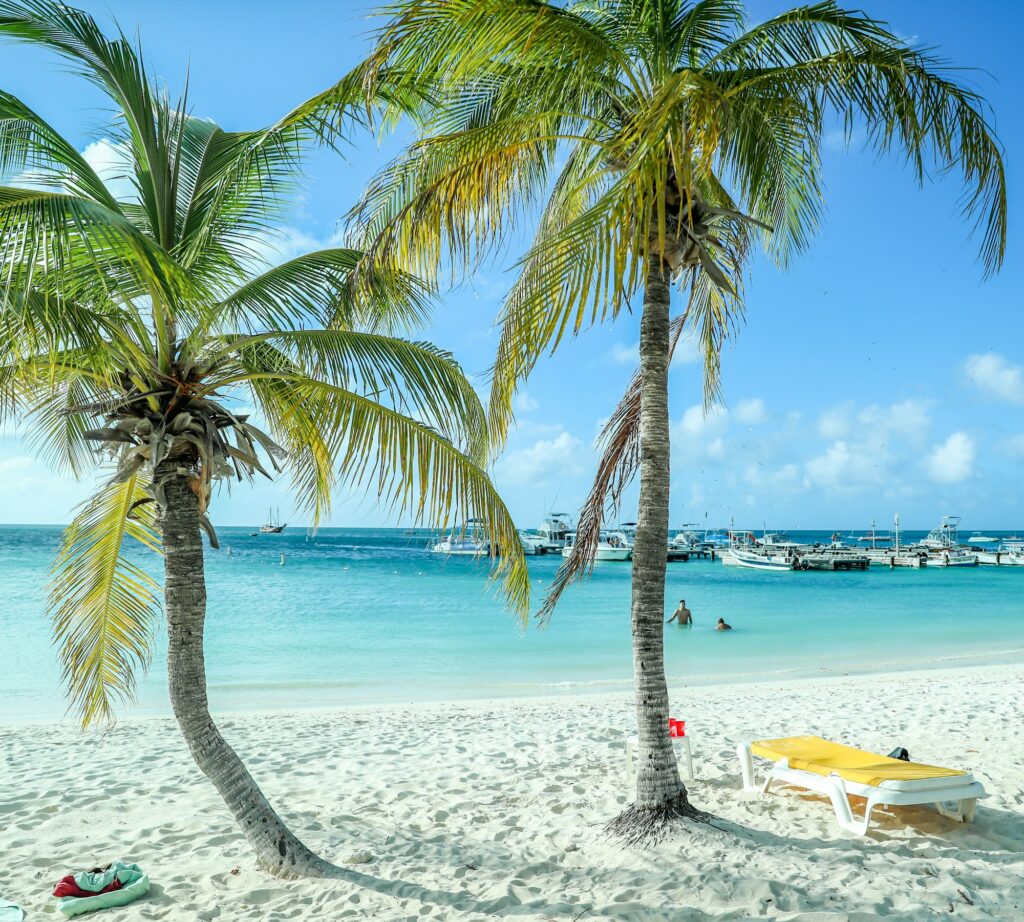
From December, most of the Caribbean enters its dry season, after the official end of the hurricane season on 30 November. In Aruba, the water sits around 28°C. Prices are lower from September to November, according to a commercial trend. November still carries a real risk: Lenny caused 17 direct deaths in 1999.
Checked on against the official sources cited (NHC, Visit Aruba, Guadeloupe tourist board).
When is the best time to visit the Caribbean after hurricane season? The answer depends on two questions that guides often blur: how much the trip costs, and what state the sea is in. This guide keeps them apart. The price percentages come from a commercial source, and the cyclone facts come from the reports of the US National Hurricane Center (NHC).
The phrase « hurricane season » covers three different things: an official calendar, a statistical average and real cases. Knowing that the season ends on 30 November tells you nothing about what happened on 18 November. We treat all three without mixing them up. The starting point is December to April, the dry season for most islands, with November as the transition month. Cancelling a trip in September is a different question, and it is not covered here.
1. December to April: Aruba’s high season begins after the cyclone season
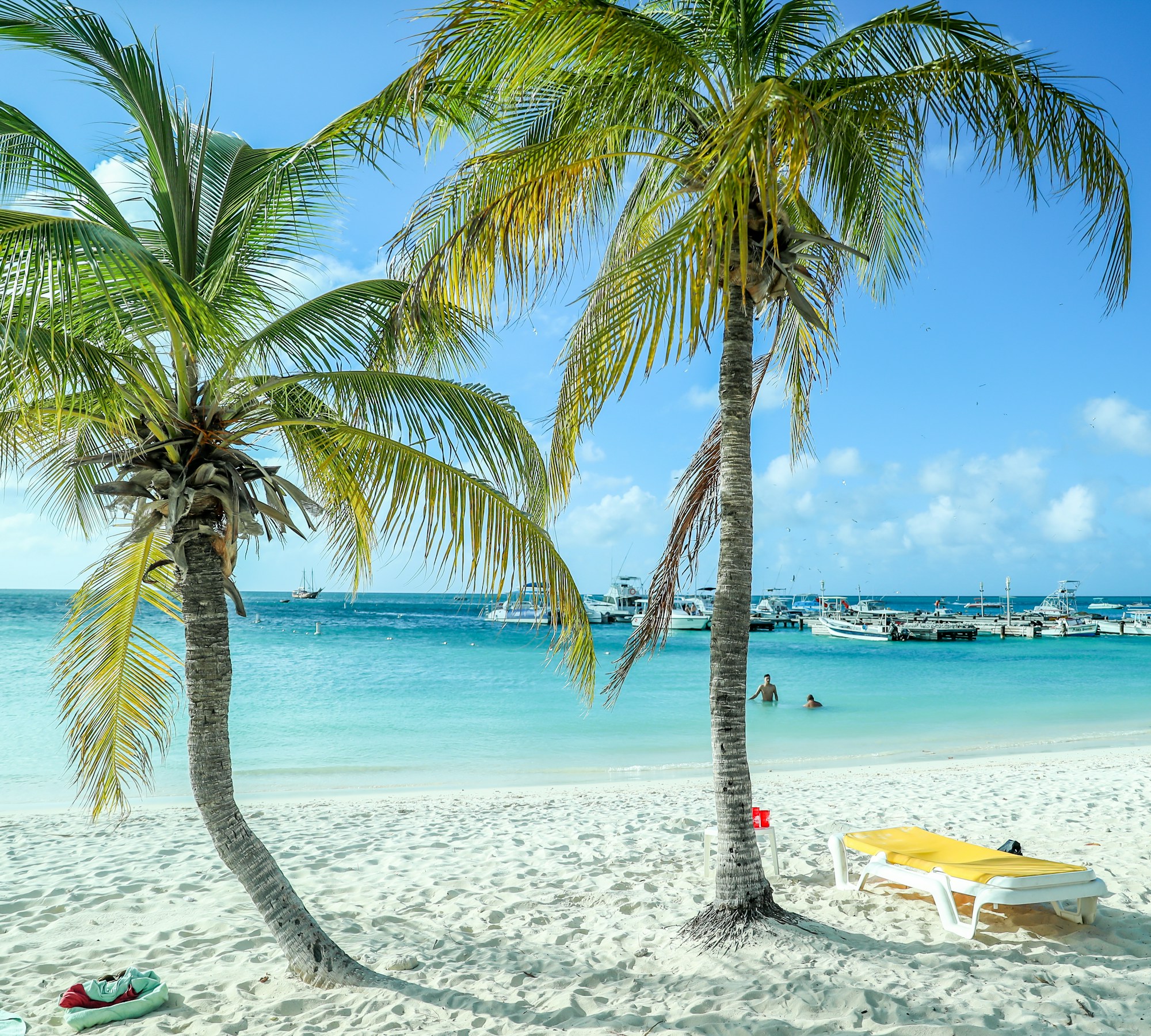
Aruba, outside the hurricane belt according to its tourist board
Aruba is the clearest case in this guide, because its official tourist board describes it as lying « far outside the hurricane belt ». Its high season runs from 16 December to 15 April, and its low season from 16 April to 15 December. The board also gives a sea temperature of around 28°C. One detail matters when you choose dates: according to the board, rain concentrates from October to January. December and January are therefore not the driest months on the island, despite what the phrase « dry season » suggests for the whole region. Visit Aruba, « when to travel » page, accessed 18 October 2026.
Highlights
- A high season that starts on 16 December, with water reported at around 28°C.
- An island its tourist board places outside the hurricane belt, a point that carries weight late in the season.
- Sea excursions you can book for a specific date, so you can compare the open days before you pay.
To check the warm sea for yourself, the most direct option is a guided swim. The excursion below, in Aruba, looks for sea turtles while snorkelling, in water around 28°C. It suits anyone who wants to see turtles on a private outing rather than in a group. The price does not change across the six dates checked (€81.49 per person), but not every date is necessarily open: check the day in the calendar before you pay. Price and dates come from the Viator API, checked on 18 October 2026.
2. Prices by month: a real drop, but not everywhere
Official sources do not publish prices by month. For prices by island, the only hotel and cruise figures we found are dated, and they are presented below as such. For the rest, what can be compared is relative trends. The hurricane season guide on caraibes.com, a commercial site, expresses each month against an annual baseline set at 100. We use it as an observed trend, not as an official fact.
| Month | Change against the annual baseline | Reading given by the source |
|---|---|---|
| January | +50 to +80% | Peak tourist season |
| February | +40 to +60% | Family peak |
| March | +30 to +50% | Visitor numbers easing |
| April | +20 to +40% | Prices falling |
| May | -20 to -30% | « Best value for money » |
| September | -30 to -50% | Hurricane peak |
| October | -30 to -40% | Risk « still high » in the first half of the month |
| November | -10 to -20% | Conditions « excellent » from the second half of the month |
Source: caraibes.com, hurricane season guide (commercial trend, not official), checked on 18 October 2026. July is left out, because the source’s text and its table contradict each other. For December, the same source gives the base level until the 20th, then +60 to +100% for Christmas and New Year’s Eve.
Three readings follow. First, prices rise mostly in late December: caraibes.com keeps the base level until 20 December, then applies +60 to +100% for Christmas and New Year’s Eve. In Aruba, the tourist board places the high season from 16 December. Second, November is a cheap month, but less so than September and October: the drop there is 10 to 20%, against 30 to 50% in September. Last, April is not a cheap month (+20 to +40%). The drop sets in during May, at -20 to -30%, which the same source presents as the best value for money.
Evaneos, a travel platform, also lists May, June and November among the quieter months, and describes October as a low season with very low prices and a wet-season risk. The two readings agree without confirming each other with figures: they give directions, not amounts. Evaneos, when to visit the Antilles, accessed 18 October 2026.
The Bes Reporter website, in an article on hotel prices, gives an average room rate for the first half of 2024: 517 USD in Aruba, 279 USD in Curaçao and 218 USD in Bonaire. These are older figures and say nothing about 2026 prices. They only give an idea of the gaps between islands. Bes Reporter, average hotel prices (2024), search result extract, checked on 18 October 2026.
On cruises, the agency Faim de Voyages advertises a week of full board from €349 per person, with promotions often available from June to October. The author does not date this starting price: treat it as a point of departure, not as a rate. Faim de Voyages, when to go to the Caribbean, accessed 18 October 2026.
For a budget, the most useful step is to compare the same accommodation on different dates, for example a week in November and a week in January, rather than hunting for one absolute price. The sources do not give today’s price, and a euro estimate with no date attached is worth nothing.
3. The sea: warm all year, with a peak in late summer
Water temperature changes little from one month to the next in the Caribbean. The sources we read put the water between 26 and 29°C overall, according to caraibes.com, a commercial source. The only water temperature published by a tourist board that we could read concerns Aruba, at around 28°C. For Martinique, a travel guide gives more than 28°C from July to October and at least 26°C in the dry season.
| Area | Sea water | Period | Source and status |
|---|---|---|---|
| Aruba | Around 28°C | All year | Visit Aruba, tourist board (official) |
| Caribbean, overall | 26 to 29°C | All year | caraibes.com (commercial) |
| ABC islands (Aruba, Bonaire, Curaçao) | 27 to 28°C | All year | caraibes.com (commercial) |
| Martinique | More than 28°C | July to October | Travel guide, search extract |
| Martinique | At least 26°C | Dry season | Travel guide, search extract |
| Northern coast of Cuba | Around 26°C | December | Data aggregator, to be read as a rough guide |
Source: Visit Aruba (tourist board) and caraibes.com (commercial), checked on 18 October 2026. The Martinique and Cuba rows come from guide and aggregator extracts, with no official page read.
What this means: December to April is not the warmest period for the water. According to the commercial sources, the peak falls in late summer, from July to September. Water temperature varies little from month to month, and no monthly figure is sourced. So the message « the sea stays warm » holds, without promising a winter peak.
For Guadeloupe, the tourist board gives a wet season from June to November and an air temperature that stays stable, around 27°C all year. Its climate page gives no sea temperature. Guadeloupe tourist board, climate page, accessed 18 October 2026.
4. French Antilles: the carême, the wet season and sargassum
In the French Antilles, the carême (the local name for the dry season) and the wet season do not start on exactly the same dates from one island to the next. For Martinique, a Météo-France presentation, reused by the Martinique rectorate in 2016, places the carême from mid-January to April, and the wet season from June to November. A travel guide starts it at the end of December. Both versions are compatible: keep December to April as the window, and know that the start varies by island.
The same presentation places the peak of the Lesser Antilles hurricane season between early August and early October. That peak falls before high season, but November remains the official end of the season. Martinique rectorate, Météo-France presentation (2016), accessed 18 October 2026.
Guadeloupe follows the same general calendar. Its tourist board places the wet season from June to November, with a cyclone-season peak from August to October. For Saint-Martin, a study based on the Saint-Barthélemy station gives an average air temperature of 25.5°C in February and 28.4°C in August and September, for an annual average of 26.9°C. Saint-Martin nature reserve, climate study, accessed 18 October 2026.
Two points set the French Antilles apart from the ABC islands. First, they lie directly in the path of cyclones tracking from the east, and the documented late-season cases involve them: Lenny caused deaths in Guadeloupe and Martinique in November 1999 (section 5). Second, sargassum is a concrete issue in 2026 (section 7). None of this means you should avoid these islands in December. It means you should check their bulletins before you book.
- Carême: December to April, with a start date that varies by island.
- Wet season: June to November, rainy season and cyclone season.
- Air temperature: around 27°C in Guadeloupe all year, according to the tourist board.
- Sea: more than 28°C from July to October in Martinique, at least 26°C in the dry season, according to a guide.
5. November: the official end of the season, with a risk that is not zero
The official Atlantic season ends on 30 November. Over the 1991-2020 period, the NHC gives an average date of 15 November for the 7th hurricane, and 19 November for the 14th named storm. These averages cover the whole Atlantic basin, not just the Caribbean, and they do not say whether any given island will be hit. NHC, Atlantic season climatology, accessed 18 October 2026.
November is therefore a transition month. Prices are lower than in high season, with a drop of 10 to 20% against the annual baseline according to caraibes.com. The risk has not gone away, though. Lenny caused 17 direct deaths between 13 and 23 November 1999: 9 in the Lesser Antilles (3 in Saint-Martin, 5 in Guadeloupe, 1 in Martinique), 6 at sea and 2 in Colombia. Its slow passage over Saint-Martin came on 18 November. Rafael hit Cuba as a Category 3 storm on 6 November 2024, and caused 2 direct deaths in Jamaica. The table below summarises these three documented cases, one of them in December.
| Event | Dates | Area hit | Direct deaths |
|---|---|---|---|
| Lenny (1999) | 13 to 23 November 1999 | Saint-Martin (slow passage on 18 November), Anguilla, Saint-Barthélemy, Antigua; victims in Guadeloupe (5) and Martinique (1) | 17 in total, 9 in the Lesser Antilles |
| Rafael (2024) | 4 to 8 November 2024 | Cuba (Category 3 landfall on 6 November), Jamaica | 2 in Jamaica |
| Odette (2003) | 4 to 9 December 2003 | Dominican Republic, Barahona peninsula (6 December) | 8 according to the NHC |
Source: NHC, Lenny report (revised version of 13 May 2026), NHC, Rafael report and NHC, Odette report, checked on 18 October 2026.
In practice, if you travel in November, two precautions reduce your exposure. The first is to favour the second half of the month, which the commercial source presents as calmer. The second is to read the cancellation terms before you pay, and to check whether a cancellation caused by a cyclone is covered.
If you are planning a trip in the middle of the cyclone season, our guide to hurricanes in the Caribbean and cancelling your trip is the right place to start.
6. December: a rare cyclone, but a documented one
December is the month guides mention least when they talk about cyclone risk, and it is also the rarest of the three months in this guide. Odette formed in the Caribbean Sea on 4 December 2003. It hit the Barahona peninsula in the Dominican Republic on 6 December, with 8 direct deaths according to the NHC. The report describes it as the first December tropical storm to form in the Caribbean Sea. A dispatch picked up by a specialist site gives 10 deaths; we use the NHC figure, which is the reference. NHC, Odette report, accessed 18 October 2026.
This case does not make a rule. It answers one specific question: December is not immune to a cyclone, even though the risk is low. A December booking should therefore be protected like a November one, through the cancellation terms and suitable insurance, rather than through the calendar alone.
7. Sargassum: a point to watch, with no assessment after August 2026
Sargassum is the least predictable part of this guide. Météo-France bulletins on sargassum in Guadeloupe do not come out every week: the ones we found for 2026 are dated 9 February, 16 March, 20 July and 17 August. According to a summary of the 17 August bulletin, the presence is heavy (« beaucoup d’algues », a lot of seaweed), particularly near Marie-Galante, with a low detection reliability of 2 out of 5 because of cloud cover. Météo-France bulletin of 17 August 2026, summary, checked on 18 October 2026.
In Martinique, the prefecture cited by the press counted 2,257.7 tonnes of sargassum collected since the start of the year, a figure fixed in early April. L’Info durable, on the 2026 season in the Antilles, accessed 18 October 2026.
We found no season review or forecast published after 17 August 2026. So we cannot say what sargassum will look like in December or January. On the eastern coast of the Dominican Republic, it affects Punta Cana and Bávaro sporadically since 2018, mainly from May to October, with possible arrivals from late March, according to caraibes.com. The northern coast, Samaná and Cap Cana, is little or not affected.
Pixidia tip: check the latest Météo-France bulletin before you leave, not the summer one. An August bulletin tells you nothing about January.
8. Other destinations: what we can say, and what we cannot
- ABC islands (Aruba, Bonaire, Curaçao). Aruba is the only official case in this guide (section 1). Curaçao’s official pages could not be read, and we have no official source for Bonaire. Commercial sources describe these islands as less exposed to cyclones, which does not mean risk-free. Caraibes.com gives 27 to 28°C for the water in these islands.
- Dominican Republic. We read no official Dominican source. The tourism sites consulted place the dry season from December to April. Odette hit the Barahona peninsula in December 2003 (section 6), and the eastern coast has sargassum (section 7).
- Yucatán, Cancún and the Riviera Maya. We have no official Mexican source. The aggregators consulted place the dry season from November to May. A general-interest article cites December among the most expensive months, especially the week before Christmas.
- Cuba. Rafael hit the northern coast in November 2024 (section 5), with a power outage. The water is given at around 26°C in December by an aggregator, to be read as a rough guide.
- Grenada. No Grenada-specific source was read here. The December to April window of the Lesser Antilles serves as a reference, to be checked for the island.
What other guides don’t tell you
The dated, documented end-of-season cases, Lenny, Rafael and Odette, are detailed in sections 5 and 6, with their NHC reports.
Practical information before you go
Cover is worth checking late in the season, when a cyclone can change a departure. Look at what is covered, what is excluded and how it works for your country of residence.
Prices depend on the plan and the length of coverFrequently asked questions
When should you go to the Caribbean after hurricane season?
The official Atlantic season runs from 1 June to 30 November, according to the NHC. For most islands the dry season starts in December, and high season runs from December to April, with dates that vary by island: in Aruba, from 16 December to 15 April. If price matters more than high season, look at November and May: caraibes.com shows drops of 10 to 20% and 20 to 30% against the annual baseline, whereas April stays at +20 to +40%.
Is November really cheaper?
Yes, but only moderately. According to caraibes.com, a commercial guide, November prices sit 10 to 20% below the annual baseline, against +50 to +80% in January. September and October are lower, at -30 to -50% and -30 to -40%. Evaneos lists November among the quieter months without quantifying the gap, and Faim de Voyages cites it among the more affordable months. No official source gives the price of a night in euros by island. To compare, take the same dates from one year to the next.
Can a hurricane hit the Caribbean in December?
It is rare, but it is documented. Odette hit the Barahona peninsula in the Dominican Republic on 6 December 2003, with 8 direct deaths according to the NHC. The report describes it as the first December tropical storm to form in the Caribbean Sea. The risk stays low, but it is not zero: check the cancellation terms before you book.
What is the water temperature in December?
The water temperature changes little from month to month, and no monthly figure is sourced. Caraibes.com gives 26 to 29°C for the Caribbean as a whole, a commercial source. Aruba reports around 28°C on its tourist board website. For the northern coast of Cuba, an aggregator gives around 26°C in December, to be read as a rough guide.
Is there sargassum from December to April?
Sargassum varies from one year to the next. On the eastern Dominican coast, it affects Punta Cana and Bávaro sporadically since 2018, with possible arrivals from late March and a presence mainly from May to October, according to caraibes.com. In Guadeloupe, a summary of the Météo-France bulletin of 17 August 2026 reports a lot of seaweed. We found no season review published after that date: check the latest Météo-France bulletin before you leave.
French Antilles or ABC islands at the end of the season?
Aruba is outside the hurricane belt according to its tourist board, which is official information. For Curaçao and Bonaire, we could not read an official source, and they are often cited as less exposed. The French Antilles remain exposed: Lenny, in 1999, caused deaths in Guadeloupe and Martinique. To choose, compare the dates of your stay with the dry season of each island.
Do you need travel insurance in November?
There is no official rule on this. Several commercial guides recommend insurance during the cyclone season, and caraibes.com advises it mostly for June to August, outside the ABC islands. For November, read the terms: check whether a cancellation caused by a cyclone is covered, and compare the cover of several insurers before you pay.
What is the dry season in the French Antilles?
The carême runs from December to April. For Martinique, a Météo-France presentation reused by the rectorate in 2016 starts it in mid-January, while a travel guide puts it at the end of December. The wet season runs from June to November. In Guadeloupe, the tourist board gives a wet season from June to November and an air temperature of around 27°C.
Sources
- NHC, Atlantic season climatology: season dates, 1991-2020 averages.
- NHC, Lenny report (AL161999): deaths and dates, revised version of 13 May 2026.
- NHC, Rafael report (AL182024): Cuba landfall and deaths in Jamaica.
- NHC, Odette report (AL202003): landfall in the Dominican Republic in December 2003.
- Visit Aruba, « when to travel »: position outside the hurricane belt, water, rain, high and low season.
- Visit Aruba, resorts: high and low season dates.
- Guadeloupe tourist board, climate: wet season, air temperature.
- caraibes.com, hurricane season guide: monthly price trends (commercial), water, sargassum.
- Evaneos, when to visit the Antilles: quieter months (commercial guide).
- Faim de Voyages, when to go to the Caribbean: more affordable months, cruise from €349 (undated starting price).
- Bes Reporter, average hotel prices (2024): average room rates for the first half of 2024, an earlier period.
- Saint-Martin nature reserve, climate study: monthly average air temperatures, Saint-Barthélemy station.
- Martinique rectorate, Météo-France presentation (2016): carême, wet season and cyclone peak.
- Météo-France, Guadeloupe sargassum bulletin of 17 August 2026: content read as a summary.
- L’Info durable, 2026 sargassum season: Martinique prefecture figures relayed by the press.
Sources accessed 18 October 2026. Extracts from travel guides, aggregators and commercial sites (Martinique, Cuba, 2024 hotels, cruises) are flagged in the text, with no official page read.
Plan your trip with Pixidia
Pixidia learns how you travel and helps you build a trip that truly fits you and everyone coming along.
Open the planner