
Gozan no Okuribi 2026 takes place on Sunday 16 August in Kyoto, with the first fire, the Daimonji, lit at exactly 8pm. Four more bonfires blaze one after another on the mountains ringing the city, roughly five minutes apart. Public viewpoints, like the Kamogawa Delta, are free to access, but the best spots fill up from late afternoon onwards. A little-known detail: the city’s outdoor lights switch off from 7:50 to 8:50pm for the occasion. Book your Kyoto accommodation several months ahead — hotel rates climb 30 to 50% during the Obon period.
Every year on 16 August, five enormous bonfires light up the mountains ringing Kyoto to send the spirits of ancestors back to the afterlife. Gozan no Okuribi, often reduced to its most famous fire, the Daimonji, closes out the Obon period in a hush that’s largely preserved: no fireworks, no food stalls at the lighting sites, and even the city’s lights switching off for the duration. Here’s what you need to know to experience this evening in Kyoto in 2026: timings for the five fires, where to watch them, the real story behind the floating lanterns (which aren’t on the Kamo river), and the mistakes to avoid.
Gozan no Okuribi 2026: date, timings and the five fires to know
Five bonfires to bid farewell to the ancestors
Gozan no Okuribi (五山送り火, literally « the farewell fires of the five mountains ») is the ritual that closes the Obon period each year, the Buddhist festival honouring ancestors celebrated from 13 to 16 August. Strictly speaking, the term « Daimonji » refers to the first and most famous of the five fires, the one that traces the character 大 (« great »), but it’s often used to mean the whole ceremony, including in Japan itself, according to Wikipedia.
For 2026, the date is confirmed without ambiguity by the city’s official tourism board: kyoto.travel and its Japanese-language edition, ja.kyoto.travel, agree that the Daimonji is lit at 8pm on Sunday 16 August. Unlike festivals set by a lunar calendar, Gozan no Okuribi has a traditionally fixed date every year, so this isn’t an event at risk of shifting. The principle is « rain or shine » (雨天決行): the ceremony goes ahead even in the rain, and no full cancellation has been recorded in more than sixty years, other than during the Second World War.
The five fires are lit in this order, roughly five minutes apart, each one burning for around thirty minutes:
| Fire | Mountain / district | Lit at |
|---|---|---|
| Daimonji (大) | Nyoigatake, Higashiyama | 8:00pm |
| Myō-Hō (妙・法) | Matsugasaki | 8:05pm |
| Funagata (船形) | Nishi-Kamo | 8:10pm |
| Hidari Daimonji (左大文字) | Daikitayama | 8:15pm |
| Toriigata (鳥居形) | Sagano | 8:20pm |
The Daimonji alone is made up of three strokes measuring 80, 160 and 120 metres across the mountainside, according to Japan Experience. The whole spectacle runs from 8pm to around 8:50pm, with the moment when all five bonfires are burning at once — for anyone with a clear enough view — falling around 8:30pm.
Highlights
- A fixed date every year, with no risk of a calendar-related postponement
- The full ceremony lasts around fifty minutes, from 8pm to 8:50pm
- Free access to the vast majority of public viewpoints
The meaning of the ritual: why five fires, and since when?
A Buddhist farewell whose exact origin is still debated
According to Obon belief, the spirits of ancestors return to the world of the living from 13 to 16 August; Gozan no Okuribi sees them back to the afterlife by the light of the flames, according to the Japan National Tourism Organization. The ritual’s exact origin isn’t settled: one theory credits the Buddhist monk Kūkai (Heian period, 794-1185), another the shogun Ashikaga Yoshimasa in the mid-Muromachi period. The oldest document attesting to the practice is a court noble’s diary dated 1603, according to consolidated research on the subject. The current form is thought to have taken shape somewhere between the mid-Muromachi and mid-Edo periods, with no single authoritative record.
A little-known fact: originally ten mountains were set ablaze, cut down to just five after 1868 (the Meiji era), according to research by the University of Kyoto, whose own rooftops happen to offer a viewpoint popular with students. Since 1983, Gozan no Okuribi has been designated an Intangible Folk Cultural Property by the city of Kyoto. It isn’t run by the municipality but by a federation of five separate community associations, the Gozan Okuribi Rengōkai, one per fire. Some families carry an almost hereditary duty of cutting the wood and stacking the bundles on the slopes, in the depths of winter.
Be careful not to confuse this event with the Nara Daimonji Okuribi, a similarly-named ceremony held the evening before (15 August) on Mount Wakakusa in Nara, dedicated to war dead: in 2019, a false rumour that the Kyoto fire had been cancelled spread online after confusion with restrictions affecting the Nara event, according to the Kyoto Shimbun. If the solemn mood of the Daimonji appeals to you, the Gion Matsuri, a month earlier, shows a much more festive side of Kyoto in summer.
Highlights
- Designated an Intangible Folk Cultural Property of Kyoto since 1983
- Number of mountains cut from 10 to 5 after 1868, a fact rarely mentioned
- Run by community associations, not by the municipality
Where to watch the fires: Kamogawa, Yoshida-jinja and alternative spots
The Kamogawa Delta, the most popular viewpoint
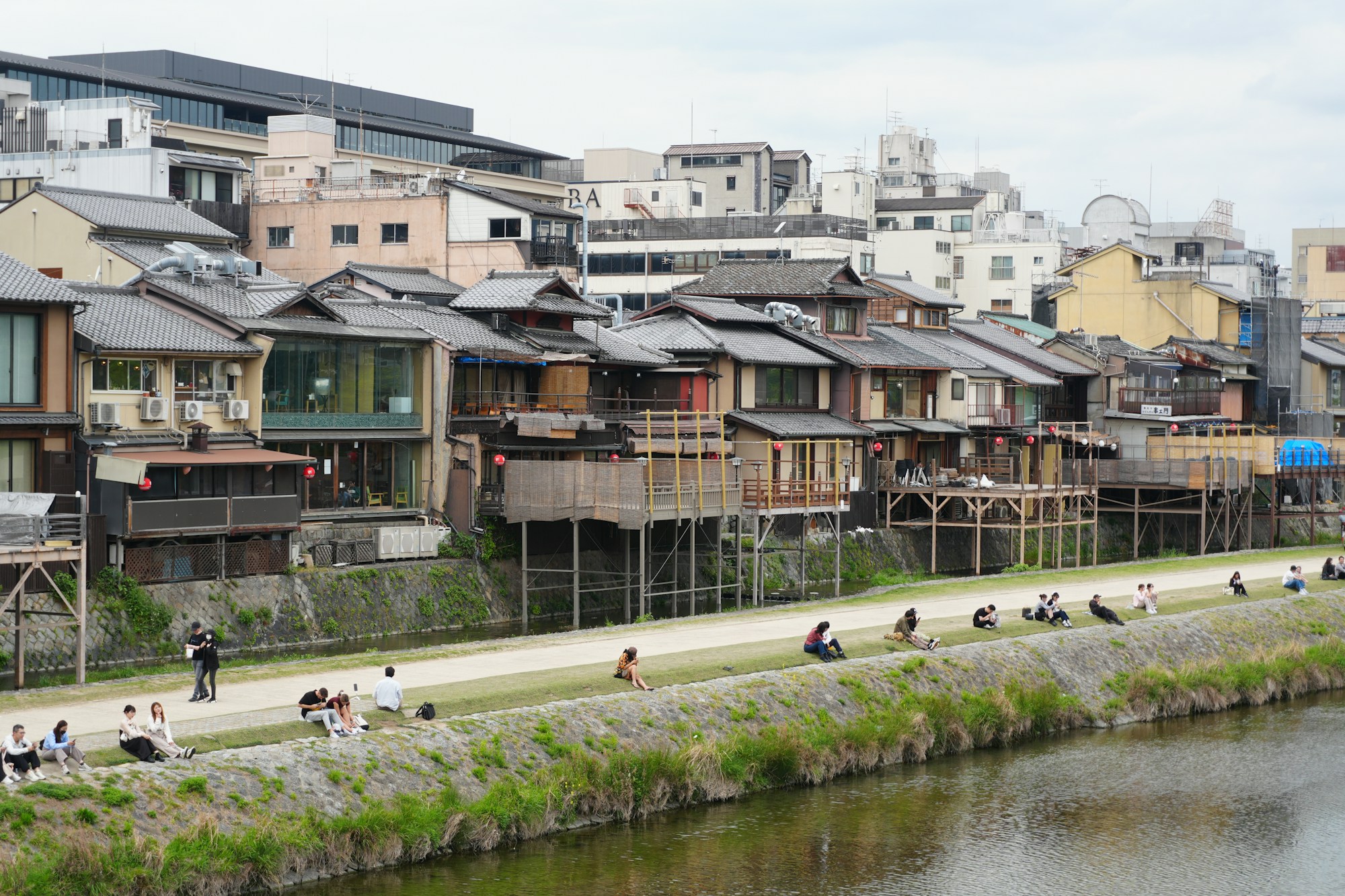
The easiest public viewpoint to reach is still the Kamogawa river delta, right in front of Demachiyanagi Station (Keihan line), with a clear view of the Daimonji, according to Kanpai. It’s also the area described as « packed by late afternoon », with spot-claiming starting several hours before the fires are lit. For a similar view with fewer crowds, the clearing behind Yoshida-jinja shrine, close to Kyoto University, is an alternative cited by locals, according to No Tourists Japan.
Seeing all five fires from a single spot is difficult in practice. Funaoka-yama Park lets you spot up to four out of five (everything except the Toriigata), according to 2ponderful.com, though the area is poorly lit after dark. The Kyoto Imperial Palace Park (Kyoto Gyoen), which is free, offers a calmer, more family-friendly setting to watch the Daimonji and the Hidari Daimonji. On the paid side, hotel rooftops charge anywhere from a few thousand to over 30,000 yen per person: the Westin Miyako Kyoto, for example, offers a view of four of the five fires from 20,900 yen including tax at the member rate, with booking recommended two to four months ahead. The Kyoto Tower observation deck adjusts its hours specifically for the day (10am-6:30pm, last entry 6pm) to sell dedicated evening tickets.
A detail rarely highlighted: during the hour of the ceremony, all the city’s outdoor lights switch off, from 7:50 to 8:50pm, except in the Yamashina and Fushimi districts, to preserve the ceremonial atmosphere and keep the fires visible. Once the bonfires die down, public transport gets severely congested between 8:50 and 10pm: it’s best to leave your viewpoint before 7pm, or otherwise wait twenty to thirty minutes on the spot to let the crowds thin out.
Highlights
- Funaoka-yama, free, lets you see up to 4 of the 5 fires
- The whole city goes dark for an hour, a genuinely unique moment
- Kyoto Gyoen, calmer, works well for a family outing
The floating lanterns are not on the Kamo: head to Arashiyama and Lake Hirosawa
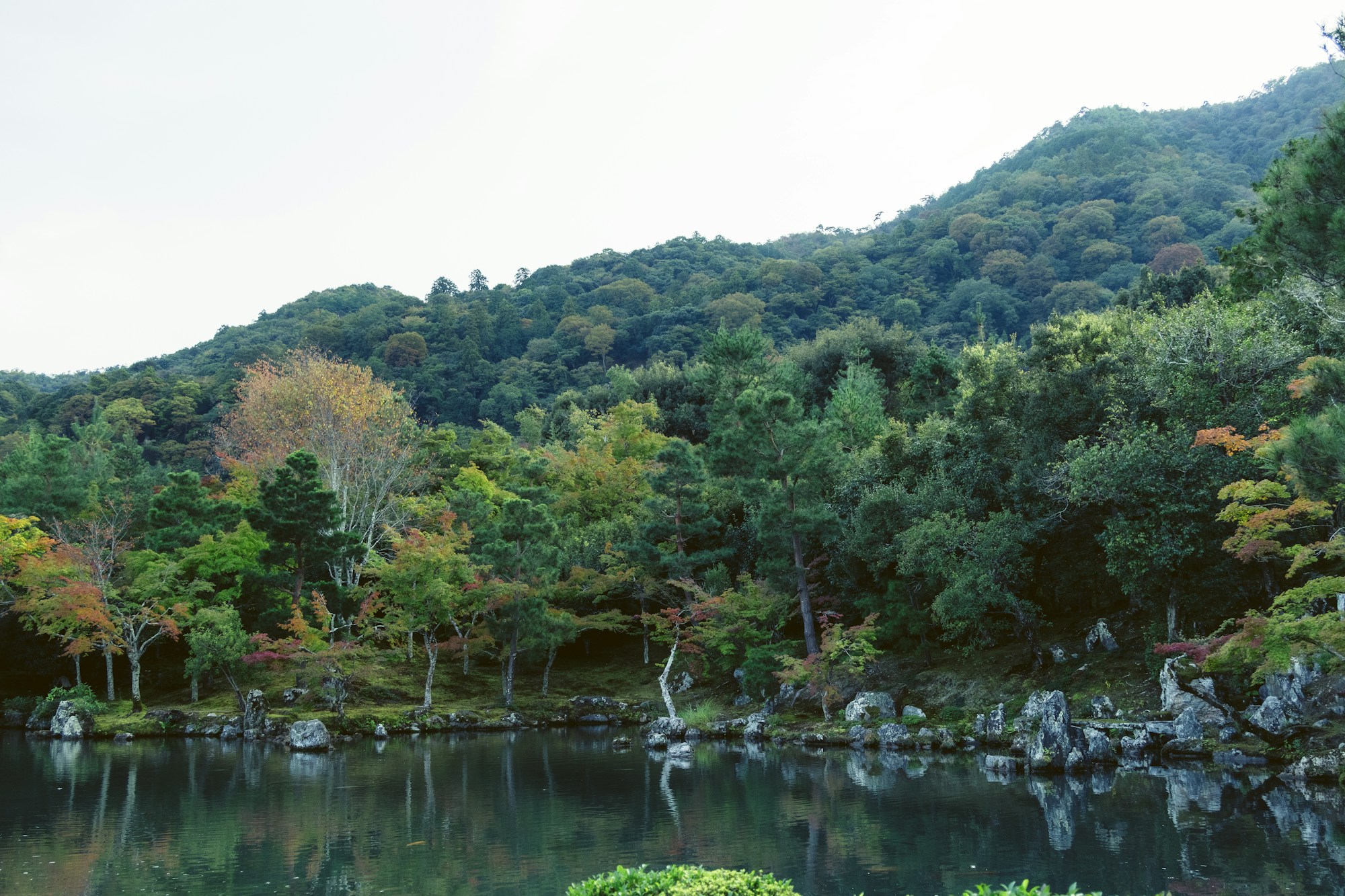
Two toro nagashi ceremonies, west of Kyoto
One mix-up comes up again and again: the floating-lantern tradition (toro nagashi) associated with this evening does not take place on the Kamo river. Both ceremonies are held to the west of the city, in the Arashiyama-Sagano area, according to Matcha and the Kyoto Shimbun.
At Arashiyama, lanterns are set on the Katsura river from Nakanoshima Park, at the eastern end of Togetsukyo Bridge, between 7pm and 9pm, for around 1,700 yen per lantern. This ceremony, started in 1949 to honour the dead of the Second World War, also lets you catch the Toriigata blazing in the distance. At Lake Hirosawa, near Henjō-ji temple, the Henjoji Toro Nagashi ceremony costs around 1,000 yen per lantern (orders accepted up to 15 August) and peaks around 8:20pm, when the multicoloured lanterns float on the water at the same time as the Toriigata catches light, a combination described as the most photogenic by accounts gathered on site. It’s a 7-minute walk from the Yamagoe bus stop.
Both sites work well as a « double bill »: watch a fire, the Toriigata for example, then head to one of the two lantern ceremonies, since both run at the same time, between 7pm and 9pm, in the same part of the city.
Highlights
- Two separate sites, neither on the Kamo river despite what you sometimes read
- At Hirosawa, the peak around 8:20pm combines the lanterns with the Toriigata in the background
- Both ceremonies also honour the dead of the Second World War
Budget, transport and heat: what to plan for
Most of the evening costs nothing: the only expense is gomagi, cedar-wood prayer sticks on which you write a wish, priced between 300 and 400 yen depending on the collecting temple, with the funds going towards maintaining the mountains. To reach the area, take bus 5, 17 or 100 from Kyoto Station (30 to 40 minutes), or the private Keihan line to Demachiyanagi, the closest stop to the most popular viewpoint.
Kyoto has only around 60,000 hotel rooms, against 180,000 in Osaka: the squeeze is real during Obon (13-16 August), with documented rate increases of 30 to 50%, sometimes more at the most sought-after properties. Booking 3 to 6 months ahead is recommended for a stay built around 16 August; sleeping in Osaka and doing the trip as a day return is a valid alternative. A new accommodation tax came into effect on 1 March 2026, with a 5-tier scale running from 200 yen (for stays under 6,000 yen a night) up to 10,000 yen per person per night at the top end: the full details of these changes are in our guide to what’s changed for tourists in Japan in 2026.
Budget roughly 10,000 to 15,000 yen per person per day (about €65-100) for a comfortable trip, including accommodation, meals and local transport. Flight prices from London to Kansai vary hugely depending on when you search: it’s better to work with a wide range than a single figure, and to track fares several months ahead. On the weather front, August is Kyoto’s hottest month, with highs around 30-35°C and humidity that lingers in the basin the city sits in: Japan issues official heat alerts whenever a high-risk index is forecast, and Kyoto opens air-conditioned shelters during the most intense spells.
Highlights
- Gomagi (300-400 yen) let you write a wish and support the upkeep of the mountains
- The shoulder weeks (8-12 and 17-21 August) come with noticeably cheaper hotel rates
- Kiyomizu-dera runs a special night illumination on 14, 15 and 16 August
An evening to experience with restraint, and how to extend your stay
Kyoto broke its tourism record in 2025, with 62.8 million visitors, including 12.7 million from overseas, according to consolidated press coverage. This over-tourism backdrop feeds into the city’s Kyoto Traveler’s Promise charter: don’t drop cigarette butts on the ground, don’t board buses with large suitcases, take your rubbish with you, favour local businesses. At the Gozan no Okuribi sites themselves, this restraint takes on a particular meaning: no entertainment, no food stalls, and practices like offering sake in the flames’ reflection or writing gomagi remain spiritual acts, not just a photo opportunity, as several travellers who have attended the ceremony year after year point out.
The total number of people who turn out for Gozan no Okuribi is hard to pin down precisely: estimates vary widely by source, from 28,000 to over 100,000 spectators across all areas combined, with no single official figure. Since 16 August 2026 falls on a Sunday, several local sources expect heavier crowds than in years when the event lands on a weekday, as visitors are free to stay the night without a working day to get back for the next morning.
To extend the stay, the Higashiyama district, the richest in temples and preserved historic streets, is well suited to exploring on foot between Kiyomizu-dera and Gion. Food lovers will enjoy our 48-hour Kyoto-Osaka foodie itinerary, or a private cooking class in Kyoto to take a little of that know-how home. Fans of Japanese fire festivals might also want to note the Kurama Fire Festival, a procession of giant torches on 22 October in Kurama village on the city’s outskirts: a very different experience, active rather than contemplative, but one that extends the same fascination with ritual fire.
Practical info for your Kyoto trip
Stay connected the moment you land at Kansai Airport, without hunting for a local SIM card: set up in minutes, compatible with Japan’s KDDI and SoftBank networks.
Data plans from a few eurosNomad Insurance covers medical care, baggage and trip disruption for your stay in Japan, with short-trip plans that suit an evening spent standing in the crowds and the summer heat.
From $56 / 4 weeksFrequently asked questions
What is the exact date of Gozan no Okuribi 2026?
Sunday 16 August 2026, with the first fire, the Daimonji, lit at exactly 8pm. This date is confirmed by the official Kyoto city tourism board and doesn’t shift from year to year, unlike festivals set by a lunar calendar. Source: kyoto.travel.
Can the event be cancelled if it rains?
No. The « rain or shine » principle applies: the ceremony goes ahead even in the rain. The last partial postponement dates back to 1963, after an exceptional flood, and no full cancellation has been recorded in more than sixty years, other than during the Second World War.
Do you have to pay to attend Gozan no Okuribi?
No, access to public viewpoints (the banks of the Kamogawa, parks, streets) is entirely free. Only the premium options (hotel rooftops, restaurants, the Kyoto Tower observation deck) are paid, ranging from a few thousand to over 30,000 yen per person.
Can you see all five fires from a single spot?
It’s difficult in practice. Funaoka-yama Park lets you spot up to four out of five (everything except the Toriigata), but most ground-level viewpoints only offer a view of one or two bonfires. Only high-floor hotel options offer something close to a complete view.
Do the floating lanterns take place on the Kamo river?
No, that’s a common mix-up. The two toro nagashi ceremonies are held to the west of the city: at Arashiyama, on the Katsura river near Togetsukyo Bridge, and at Lake Hirosawa, near Henjō-ji temple. Both run from 7pm to 9pm, alongside the fires. Source: Matcha.
How long does the ceremony last, and how do you avoid getting stuck in the crowds afterwards?
About fifty minutes in total, from 8pm to 8:50pm, with each fire individually burning for around thirty minutes. Allow for a full evening with travel time, from around 6:30pm to 10:30pm. Public transport gets congested between 8:50 and 10pm: leave before 7pm, or wait twenty to thirty minutes after the fires go out to let the crowds thin out.
Do you need to book accommodation well ahead for this date?
Yes, 3 to 6 months ahead is recommended: rates climb 30 to 50% during the Obon period (13-16 August). Staying in Osaka, which has far more hotel rooms, and doing the trip as a day return remains a workable alternative.
Are Gozan no Okuribi and Daimonji the same thing?
Strictly speaking, « Daimonji » refers to the first and most famous of the five fires, the one that traces the character 大 (« great »). It’s often used, including in Japan, to mean the whole ceremony, whose full official name is Gozan no Okuribi.
Sources
- Kyoto City Tourism Association (JP): official 2026 dates and timings
- Kyoto Travel (EN): official overview of the event
- Kyoto Travel: news and measures from the 2025 edition
- Japan National Tourism Organization: meaning and symbolism of Obon
- Wikipedia: history and terminology of Gozan no Okuribi
- University of Kyoto: history and the link to the campus
- Gozan Okuribi Rengōkai: the official organising association
- Kanpai: best viewpoints
- bigkarasu.com: history of postponements and cancellations
- Kyoto Shimbun: the false cancellation rumour of 2019
- Matcha: toro nagashi ceremonies across Japan
- Kyoto Shimbun (EN): the floating lanterns at Lake Hirosawa
- 2ponderful.com: comparison of viewpoints
- No Tourists Japan: the view from Yoshida-jinja shrine
- Japan Experience: the dimensions of the Daimonji
- The Star: 2025 tourism attendance record
- SoraNews24: over-tourism and visitor fatigue
- Candeo Hotels: the new accommodation tax scale
- Kyoto Traveler’s Promise: the official responsible-tourism charter
- Kiyomizu-dera: special mid-August night illumination
- JRailPass: connections from Kansai Airport
- Medium: a first-hand account of the evening’s contemplative spirit
Research conducted on 6 August 2026.

Plan your trip with Pixidia
Pixidia learns how you travel and helps you build a trip that truly fits you and everyone coming along.
Open the planner