

Oktoberfest 2026 runs September 19 to October 4 at Munich’s Theresienwiese, welcoming an estimated six million visitors to the 191st edition of the festival — often searched online as « Octoberfest 2026. » Mass (1L) beer prices are estimated at €15.00 to €16.50 across the 14 main tents, entry is free, and a full day runs €100–€260 depending on style. With the festival now underway (day 4 of 16, having opened September 19), guaranteed-seat tables for the remaining weekends — September 26–27 and the October 3–4 closing weekend — are already fully booked. Check for late-cancellation releases, or plan around the ~25% of unreserved seats available in every tent by arriving before 10am on weekdays, or before 9am on weekends.
Oktoberfest 2026 runs from September 19 to October 4 at Munich’s Theresienwiese. The world’s largest folk festival welcomes around six million visitors each year for 16 days of Bavarian beer, traditional food, and centuries-old customs. This ultimate guide covers everything you need to plan your trip: the 14 main beer tents with their unique characteristics, table reservation strategies, updated 2026 prices, accommodation tips, and a detailed budget breakdown.
- Dates 2026: September 19 – October 4, 2026 (16 days)
- Estimated Mass (1L beer) price 2026: €15.00 to €16.50
- Average daily budget: €100 to €260 per person depending on spending style
- Total attendance: ~6 million visitors every year
- Number of tents: 14 large + 21 small + the Oide Wiesn
- Site entry: completely free (€4 for the Oide Wiesn)
Oktoberfest 2026: dates, hours, and key events
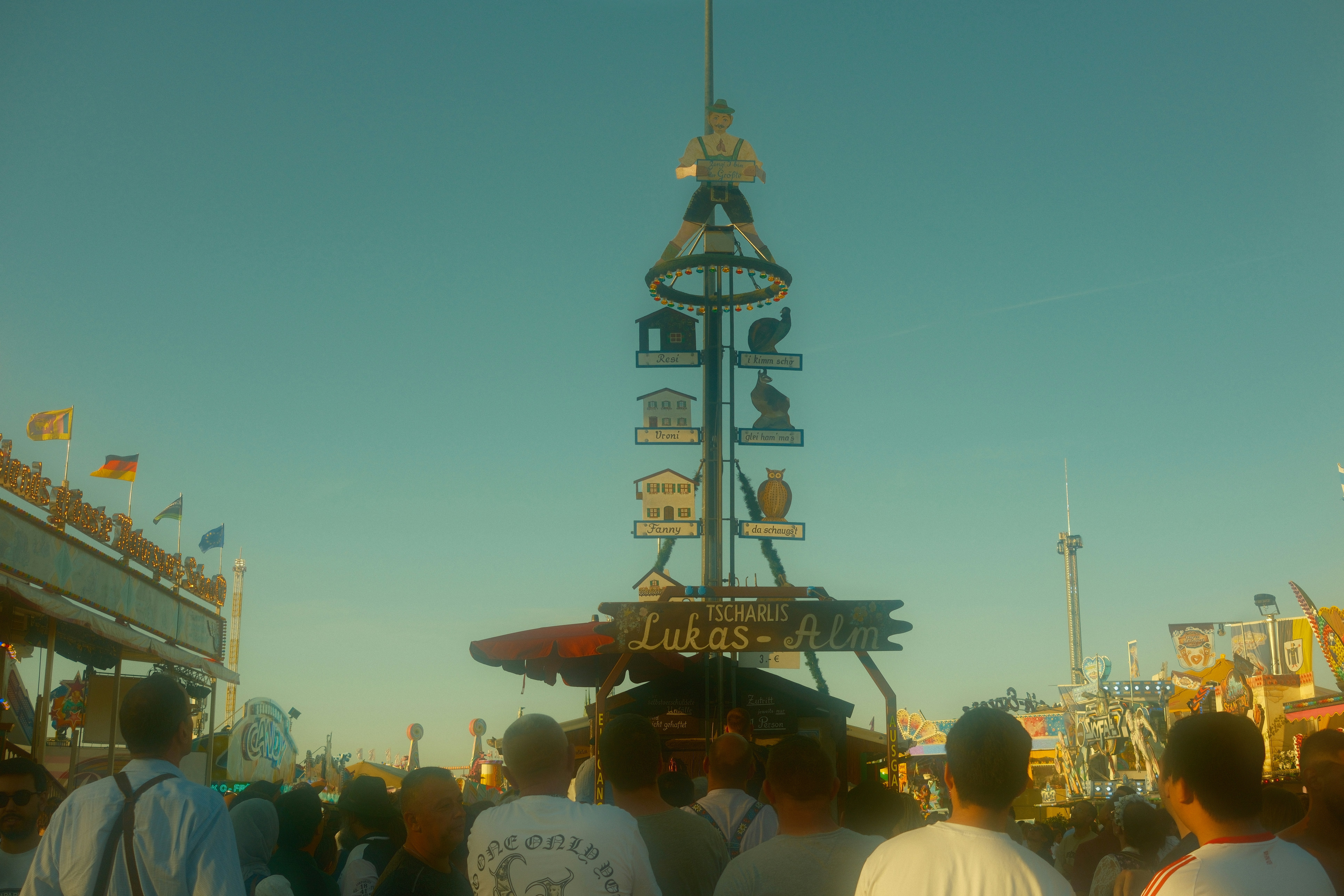
The festival at a glance
The 191st Oktoberfest takes place from Saturday, September 19, to Sunday, October 4, 2026, on the Theresienwiese, Munich’s iconic 42-hectare fairground. On the first Saturday, tents open at 9am. Beer is only served after the famous « O’zapft is! » ceremony at exactly 12 noon, when the Mayor of Munich taps the first keg in the Schottenhamel tent.
On subsequent days, tents open at 10am on weekdays and 9am on weekends. Last call for beer is at 10:30pm, and tents close at 11:30pm. Two exceptions: the Käfer Wiesn-Schänke and Kufflers Weinzelt stay open until 1am.
- Saturday, Sept 19 — Opening day: grand parade at 11am, Mayor taps first barrel at noon
- Sunday, Sept 27 — Grand traditional costume parade with ~10,000 participants
- Sunday, Oct 4 — Closing day with cannon salute at noon beneath the Bavaria statue
The 14 main beer tents at Oktoberfest
Oktoberfest 2026 features 14 large tents (Festhallen) and 21 smaller ones. Each has its own atmosphere, designated brewery, and distinct clientele. Only six Munich breweries are authorized to serve beer: Augustiner, Hofbräu, Löwenbräu, Paulaner, Spaten, and Hacker-Pschorr.
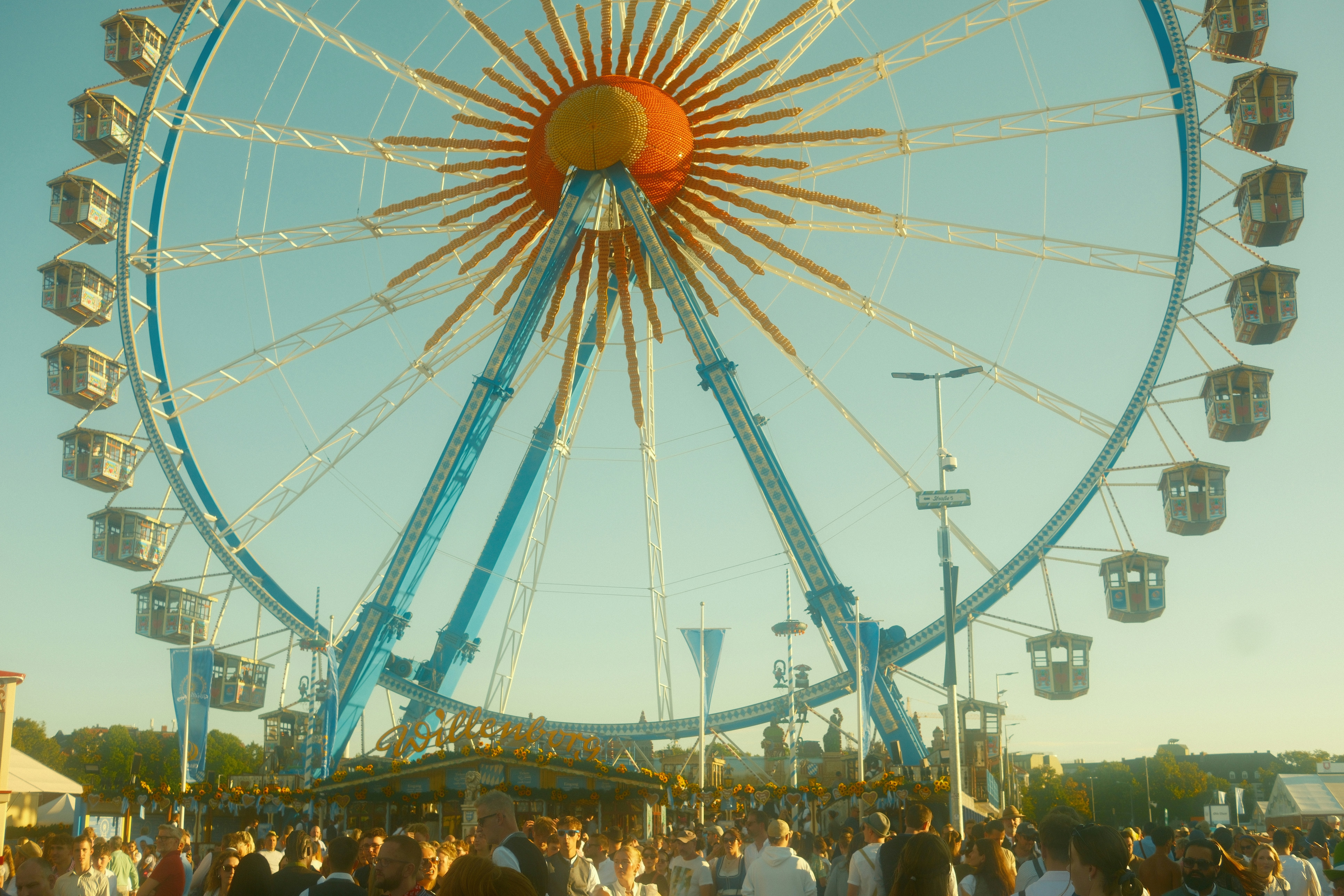
Schottenhamel — The opening ceremony tent
Founded in 1867, the oldest tent and home to the official opening ceremony. With 6,000 indoor seats and 4,000 in the beer garden, it serves Spaten beer. Known as the « student tent, » the unreserved section fills early with young Munich locals.
- This is where at exactly noon on Sept 19, the Mayor taps the first keg
- Young, local atmosphere — great for meeting Munichois
- Reservations opened in January 2026 and peak weekend/evening slots are now largely full — check for late-cancellation releases or aim for one of the unreserved seats
Hofbräu-Festzelt — The most international
The largest tent at Oktoberfest with nearly 10,000 seats: 6,018 seated and 1,000 standing inside, plus 3,022 outdoors. The only tent with a permanent standing area. It attracts the highest proportion of international visitors and offers the liveliest — and loudest — atmosphere at the festival.
- Perfect for first-time visitors thanks to its open, international atmosphere
- Standing area means you can get in even without a reservation during the day
- Live music all day, bench dancing guaranteed
- Watch your belongings in the crowded standing area
Augustiner-Festhalle — The locals’ choice
Munich locals’ favorite tent. Its unique claim to fame: Augustiner is the only tent serving beer from wooden barrels (Holzfässer) rather than steel tanks, giving the beer a distinctive carbonation and temperature. Dancing on benches is prohibited, and the atmosphere is noticeably more authentic.
- Cheapest beer at the entire festival — and arguably the best
- Authentic Bavarian atmosphere, far from the tourist masses
- No bench dancing — enjoy the music and conversation instead
- Reservations even rarer than other tents — arrive early
Hacker-Festzelt — Heaven of Bavaria
Nicknamed « Himmel der Bayern » (Heaven of Bavaria), this tent stands out for its trompe-l’oeil ceiling painted to look like a blue sky dotted with clouds, creating the illusion of being outdoors. Measuring 90.5 × 43 meters, its atmosphere sits between the touristy energy of Hofbräu and the authentic local vibe of Augustiner.
- Most spectacular interior décor of the entire festival
- Good compromise between international and local atmosphere
- Ideal for photography enthusiasts and visual ambiance seekers
Other notable tents
Paulaner Festzelt (Winzerer Fähndl) — The largest by total capacity (~10,900 visitors). A 26-meter tower topped with a rotating Paulaner stein makes it one of the festival’s most recognizable landmarks. New operator in 2026: Lorenz Stiftl.
Armbrustschützenzelt — Founded 1895, hosts the annual German Crossbow Championship (5,830 indoor seats, Paulaner beer). One of the most welcoming tents for first-timers.
Löwenbräu-Festzelt — Recognizable by its mechanical roaring lion at the entrance. Electric atmosphere, one of the liveliest tents. Löwenbräu beer.
Ochsenbraterei — Famous for its spit-roasted oxen since 1881 (5,900 indoor seats, Spaten beer). A life-size ox statue stands outside.
Fischer-Vroni — One of the smallest (3,080 seats), famous for Steckerlfisch (grilled fish on a wooden skewer). Augustiner beer. A hidden gem.
Käfer Wiesn-Schänke — Permanent log cabin-style structure, more intimate and upscale. Open until 1am. The VIP and celebrity hotspot.
The Oide Wiesn: Oktoberfest’s best-kept secret
The Oide Wiesn (« old Oktoberfest » in Bavarian) is the most overlooked destination for foreign visitors yet the most authentic part of the festival. For just €4 entry, you access a space dedicated to Bavarian traditions with brass band music, folk dances, and historic rides at €1.50 each.
Reservations and table bookings: the complete guide
How reservations work
Reservations are only available for complete tables of 8 to 10 people depending on the tent. Individual seat reservations are not possible. Each reservation requires pre-paid consumption vouchers — typically 2 Mass (liters) of beer + half a chicken per person. For a table of 10, expect €400–€600 in pre-paid vouchers.
2026 Reservation timeline
- December 2025 – March 2026: Tents begin accepting reservation requests (dates vary by tent)
- January – April 2026: Best window for weekday slots and some evening reservations
- From May–June 2026: Prime slots (evenings and weekends) are typically fully booked
Finding a seat without a reservation
Good news: at least 25% of seats in every large tent cannot be reserved. On weekends, 40% of seats are unreserved until 3pm, then 25% after. To maximize your chances, arrive before 10am on weekdays or before 9am on weekends.
Complete Oktoberfest 2026 budget guide
- Augustiner-Festhalle (cheapest): ~€15.00 per Mass (est. 2026)
- Ochsenbraterei, Hacker-Festzelt: ~€15.40–€15.60
- Hofbräu-Festzelt: ~€15.80
- Armbrustschützenzelt (most expensive): ~€16.00
- Kufflers Weinzelt (wine/champagne): ~€18–€19 per glass
- Non-alcoholic drinks: ~€11–€12 per liter
- Food (half chicken, Schweinshaxe): €12–€20
Daily budget by profile
| Expense | Budget | Mid-range | Comfort |
|---|---|---|---|
| Festival entry | Free | Free | Free |
| Transport (MVV) | €5–€7 | €5–€7 | €25 (taxi) |
| Beer (2–3 Mass) | €30–€32 | €46–€48 | €60–€65 |
| Food | €12–€18 | €25–€35 | €50–€80 |
| Rides & attractions | €0 | €15–€25 | €25–€40 |
| Souvenirs | €0 | €10–€20 | €30–€50 |
| Daily total | €50–€60 | €100–€135 | €190–€260 |
Where to stay for Oktoberfest 2026
Best neighborhoods to stay in Munich
Theresienwiese / Hauptbahnhof — Under 15 minutes’ walk from the festival. The most convenient but also the most expensive area. Recommended: Hotel Cocoon Theresienwiese (6 min walk), Hotel Pension Haydn (5 min).
Sendlinger Tor / Marienplatz — Historic city centre, 20–25 minutes on foot or 2 metro stops. Good balance between festival access and exploring Munich.
- Airbnb / shared apartments: Split costs by 3–4. Target neighborhoods 2–3 U-Bahn stops from the venue.
- Augsburg (30 min by train): Prices half as much. With the Bayern-Ticket, transport remains affordable.
- Rosenheim or Garmisch-Partenkirchen: Even more economical options for tight budgets.
Traditional costumes: dirndl and lederhosen
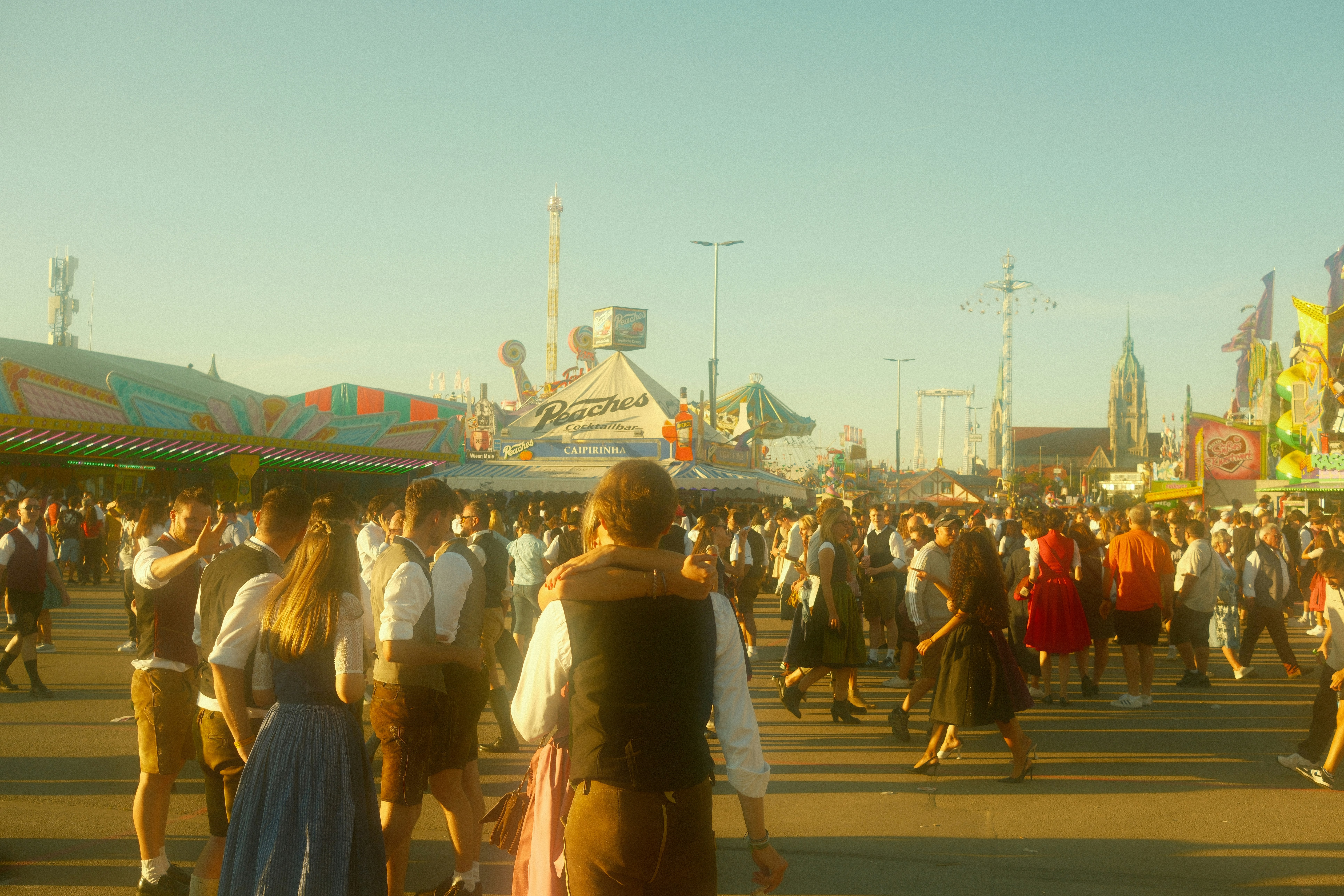
Over 90% of revelers in the tents wear a dirndl or lederhosen. What you wear at Oktoberfest directly affects your experience: in traditional costume, you’re part of the atmosphere; in regular clothes, you’re watching from the outside.
The dirndl (women)
The traditional dirndl consists of a fitted bodice, a high-waist skirt, a blouse, and a decorative apron. The apron bow secret: tied on the left = single, on the right = taken, in the center = virgin, at the back = widow or waitress. 2026 trends favor pastel tones and lightweight fabrics.
The lederhosen (men)
Worn with a checked or white shirt, Trachten socks, Haferl shoes, and suspenders. A good leather lederhosen costs between €100 and €3,000 depending on quality. Best Munich shops: Lodenfrey (Maffeistrasse), Angermaier Trachten (Kaufingerstrasse).
Getting to Oktoberfest
Driving to Oktoberfest is strongly discouraged — no visitor parking is available at Theresienwiese. The best option: take the U4 (green) or U5 (yellow) metro line directly to Theresienwiese station. The Hauptbahnhof (main station) is 15 minutes’ walk. From Munich Airport, take the S1 or S8 (~45 minutes).
See the Paris–Berlin–Prague train itineraryFAQ — Frequently asked questions about Oktoberfest 2026
Is entry to Oktoberfest free?
Yes, entry to Oktoberfest and into the beer tents is completely free. No ticket is required. Only the Oide Wiesn (historic section) charges a €4 entry fee.
How much will a beer cost at Oktoberfest 2026?
The City of Munich traditionally confirms official Mass prices each June, based on brewery costs and the previous year’s rates (2025: €14.50–€15.80 per Mass). Our €15.00–€16.50 estimate for 2026 reflects that trend across the 14 main tents. Augustiner-Festhalle remains traditionally the cheapest option.
Is it too late to book a table for Oktoberfest 2026?
Not entirely, but expect very limited choices now that the festival is underway (it opened September 19). Guaranteed-seat tables for the remaining weekends — September 26–27 and the October 3–4 closing weekend — are essentially sold out in the 14 main tents. Your best options are late-cancellation table releases, weekday reservations, or arriving early — before 10am on weekdays, before 9am on weekends — to claim one of the roughly 25% of unreserved seats available in every tent.
Can you get into a tent without a reservation?
Yes — it’s actually the norm. Most visitors arrive without reservations. At least 25% of seats in each tent cannot be reserved (40% on weekends before 3pm). Arrive early on weekdays for the best chance of finding a seat.
Which tent is best for a first-time Oktoberfest visitor?
For foreign visitors, Hofbräu-Festzelt and Löwenbräu are most popular thanks to their lively, open atmosphere. For a more authentic experience, try Augustiner-Festhalle (locals’ choice, beer from wooden barrels). Families should consider the Oide Wiesn for its calmer atmosphere.
Do I need to wear a dirndl or lederhosen?
Not mandatory, but strongly recommended. Over 90% of revelers wear traditional Bavarian costume. Wearing one helps you blend in and interact naturally with fellow visitors. Budget €150–€400 for a quality purchase, or €50–€80 for a day rental in Munich.
Is it spelled « Oktoberfest » or « Octoberfest » 2026?
The official German name is « Oktoberfest » (with a K), but it’s very commonly typed as « Octoberfest » in English searches and everyday conversation. Both refer to the same festival on Munich’s Theresienwiese, running September 19 to October 4, 2026 — so you’ll find the same 14 beer tents and dates whichever spelling you use.
How do I get from Munich Airport to Oktoberfest?
Take the S1 or S8 suburban train from Munich Airport into the city center (around 45 minutes), then switch to the U4 or U5 subway line, which runs directly to the Theresienwiese station at the festival grounds. Driving is strongly discouraged, since no visitor parking is available on site.