
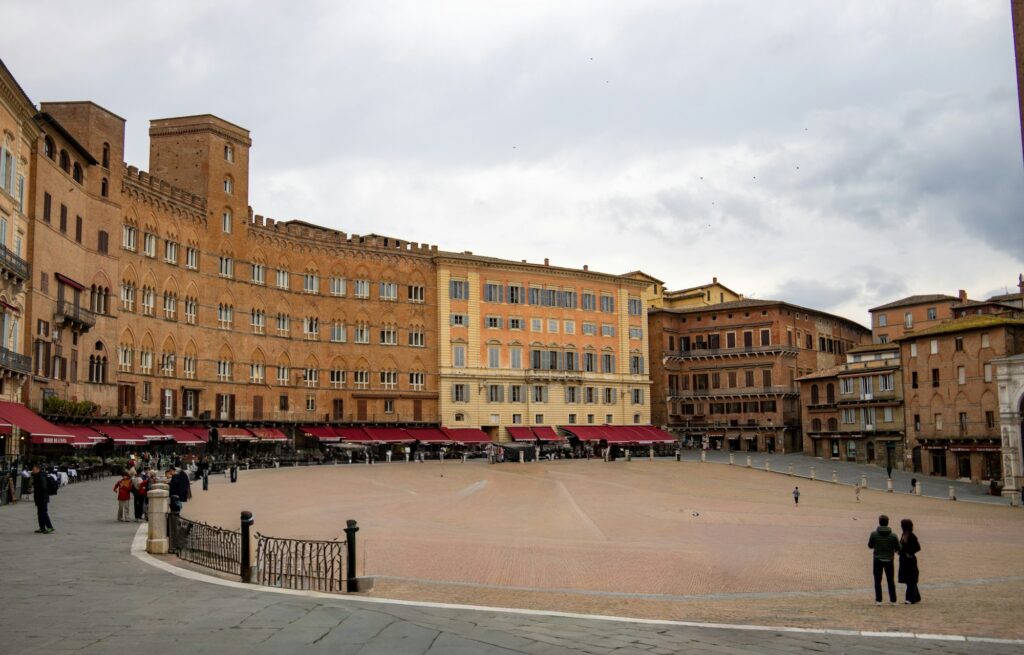
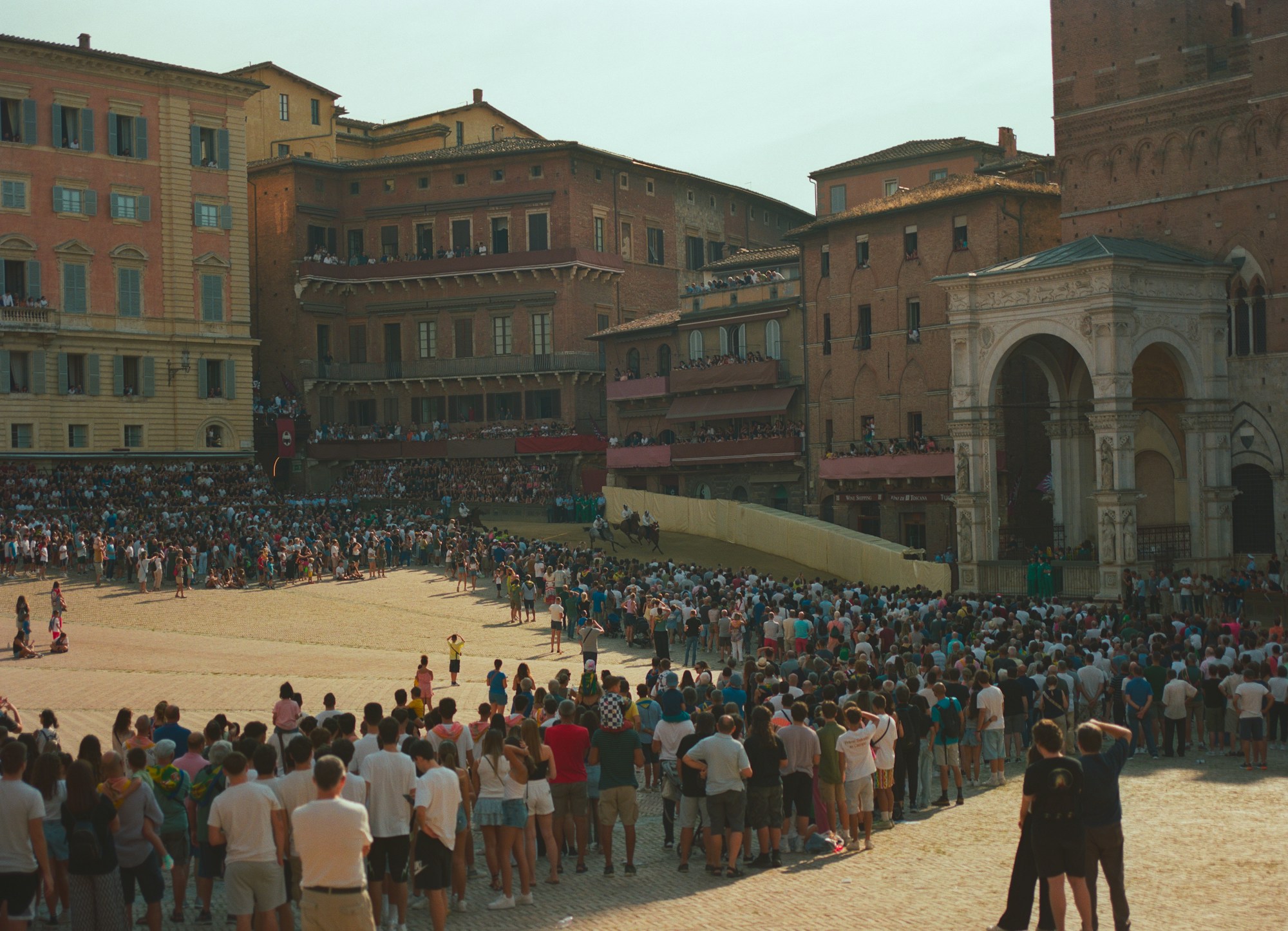
The Palio di Siena 2026 takes place on Thursday 2 July 2026 on the Piazza del Campo in Siena, Tuscany. Ten contrade compete: Onda, Civetta, Giraffa, Leocorno, Aquila, Torre, Bruco, Drago, Valdimontone and Oca, drawn by lot on 31 May 2026. The race lasts around 90 seconds and starts at approximately 7:30 pm. To watch for free, arrive on the square before 10 am. Paid balcony tickets cost between €460 and €1,000 and need to be booked 12 to 18 months in advance.
Ninety seconds, ten horses, ten neighbourhoods that have despised each other for centuries. The Palio di Siena isn’t a horse race — it’s all-out war, declared once a year in one of Europe’s most beautiful squares. In 2026, the 31 May draw has thrown two historic rivalries into the same race: Civetta vs Leocorno, and Oca vs Torre — the most explosive feud in Sienese history. The Nicchio, disqualified for disciplinary incidents, is absent for the first time in years, adding extra tension to an already exceptional edition. Here’s everything you need to know to understand, plan and experience the Palio on 2 July 2026.
1. Origins and history: 370 years of organised civil war
The birth of the modern Palio
According to visitsiena.it, the first races on the Piazza del Campo date back to the early 17th century, when Ferdinand I’s ban on bullfighting (1590) pushed the contrade to compete differently. 2 July 1652 marks the official birth of the Palio alla tonda — the round race we know today. In 1729, an edict by Violante Beatrice of Bavaria permanently fixed the boundaries of the 17 contrade and banned any merging or creation of new ones: that number has never changed.
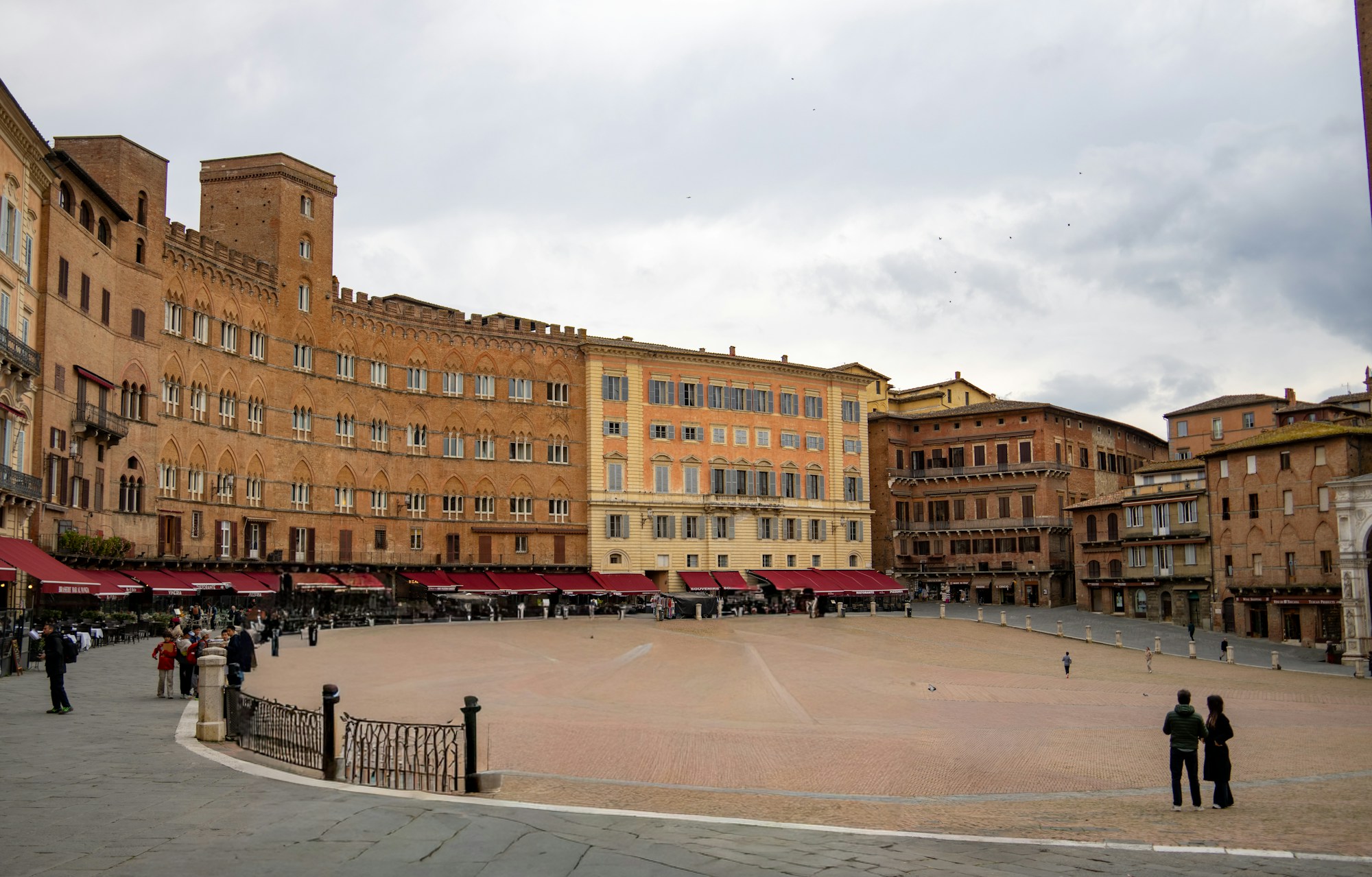
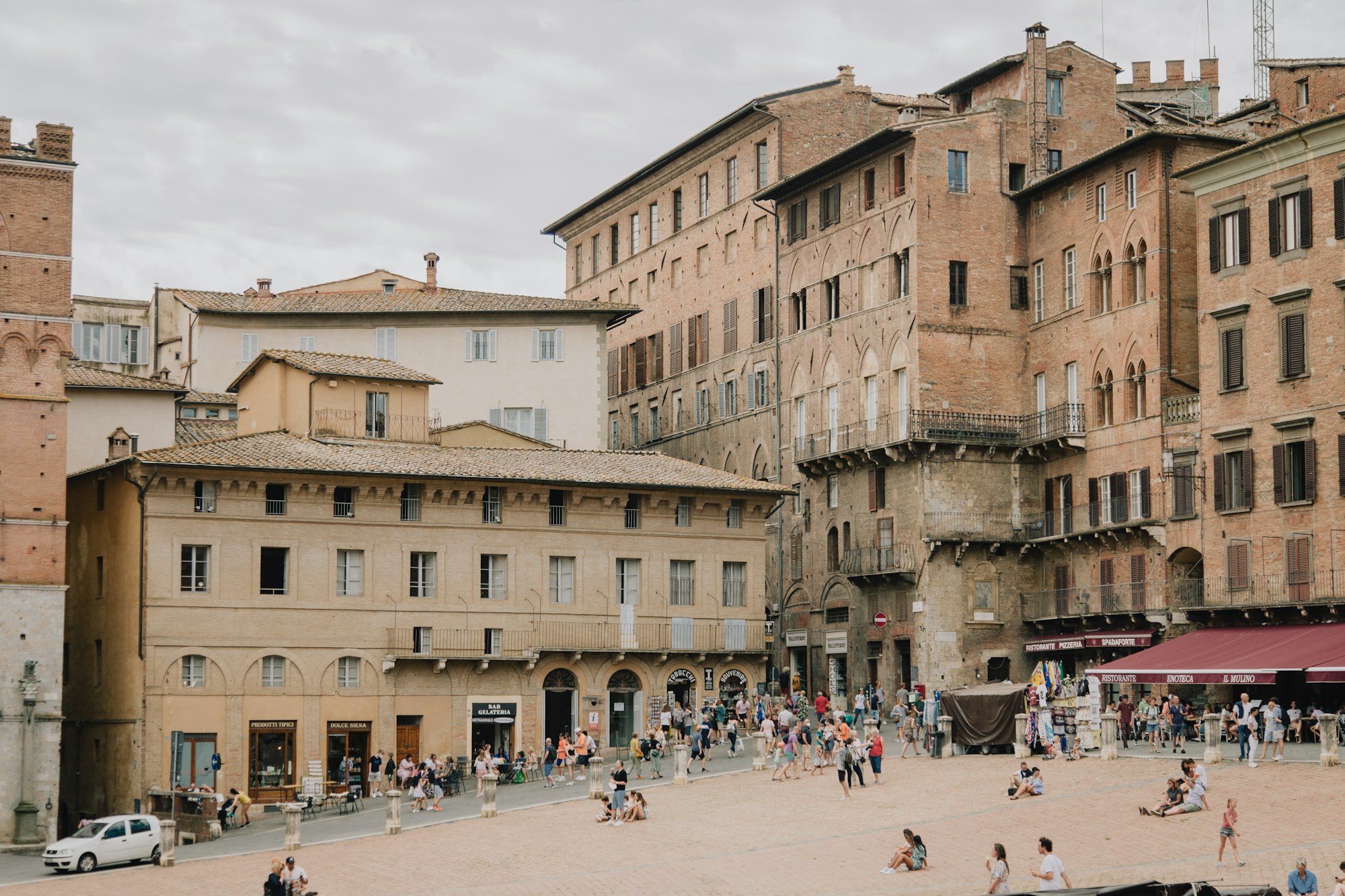
The Piazza del Campo itself is an urban masterpiece. Its shell-shaped layout spans 333 metres in circumference, paved with red herringbone bricks divided into 9 sections by white travertine strips — representing the nine successive governments of the medieval city. The entire historic centre was inscribed as a UNESCO World Heritage Site in 1995. On race day, the square’s paving is covered with volcanic tufa — a dirt track laid over stone.
The Palio is run twice a year: on 2 July (Palio di Provenzano), dedicated to the Madonna of Provenzano, and on 16 August (Palio dell’Assunta), dedicated to the Assumption. Of the 17 contrade, only 10 take part in each edition: 7 by right (those that didn’t run the previous edition of that Palio) and 3 drawn by lot.
Key facts
- 90-second race, 3 laps of the Piazza del Campo (~1 km)
- One absolute rule: you can’t grab a rival horse’s reins
- A riderless horse (cavallo scosso) can still win — it happened in August 2023
- The winner receives a drappellone: a unique hand-painted silk banner
2. The 17 contrade and their centuries-old rivalries
An identity for life — before you even have a name
In Siena, you’re born into a contrada before you have a name. According to thepalio.eu, the contradaiolo baptism takes place at the neighbourhood fountain (fontanina): the newborn receives a handkerchief in their contrada’s colours, marking a lifelong allegiance. Each contrada operates like a tiny elected republic — with a prior, council, treasury, church (where the horse is blessed before every Palio), stables and kitchens. The largest organise communal dinners for 3,000 people.
Official rivalries are at the heart of strategy: a contrada never allies with its sworn enemy and will actively work to make it lose, even at the cost of its own victory. According to ilpalio.org, the oldest rivalry pits Oca (Goose) against Torre (Tower), born around 1559 out of economic conflicts — marked in the 17th century by clashes that caused deaths. The last attempt at reconciliation in the 20th century failed.
The great rivalries (all present in July 2026)
- Oca vs Torre — the most explosive: Oca (67 total wins) vs Torre (45 wins, last in 2015). Since the legendary 1961 incident involving 43 stolen geese, the hatred is absolute
- Civetta vs Leocorno — born in the 1960s, with a slight edge to Leocorno (34 wins vs 31 for Civetta)
- Chiocciola vs Tartuca — medieval territorial antagonism between neighbours in the Terzo di Città
- Istrice vs Lupa — the two most « aristocratic » contrade of the Terzo di Camollia
- Aquila vs Pantera — the rivalry of the great predators (eagle and panther), a historic competition of honour
3. Palio di Siena 2026: the key facts for the 2 July race
The 10 contrade drawn on 31 May 2026
The draw (estrazione) took place on 31 May 2026 at 7 pm at the Palazzo Comunale, in the presence of Mayor Nicoletta Fabio and the captains of all 17 contrade. According to sienafree.it, the ten contrade qualifying for 2 July are:
| Status | Contrade | Note |
|---|---|---|
| By right | Onda, Civetta, Giraffa, Leocorno, Aquila, Torre | 6 instead of 7 (Nicchio disqualified) |
| Drawn by lot | Bruco, Drago, Valdimontone, Oca | 4 instead of 3 |
Notable: Nicchio is absent after accumulating three disciplinary strikes following an incident with Valdimontone. It’s a rare event in Palio history.
Jockeys to watch
According to La Nazione, the « valzer delle monte » (merry-go-round of mounts) is in full swing. Final assignments won’t be confirmed until after the tratta on 29 June, but the most talked-about names are:
- Tittia (Giovanni Atzeni) — 11 wins, record-holder of the 21st century, defending champion July 2025 (Oca / Diodoro). Highly sought-after, expected on the Leocorno or Oca side
- Scompiglio (Jonatan Bartoletti) — 5 wins, expected for Civetta aboard Benitos
- Gingillo (Giuseppe Zedde) — 4 wins, defending champion August 2025 (Valdimontone / Anda e Bola), possible return on the Valdimontone side
The 2026 drappellone: St Francis of Assisi
According to Artribune, the 2 July silk banner is painted by Ismaele Nones, born in 1992 in Trento and trained at the Venice Academy of Fine Arts. The theme chosen by the Comune is the 800th anniversary of the death of St Francis of Assisi (who died on 3 October 1226) — a meaningful choice: Francis stayed in Siena in spring 1226 and there dictated his « Testament of Siena », a key spiritual document for the Franciscan order.
4. How to attend the Palio di Siena 2026: programme and practicalities
Full programme from 29 June to 2 July 2026
According to thepalio.eu, Palio week begins well before race day. The prove (six trial runs under identical conditions to the main race) take place over the three days beforehand — a lesser-known but excellent alternative for visitors who’d rather not stand for hours in the midday heat.
| Date | Time | Event |
|---|---|---|
| 29 June | 7:30 am | Tratta — horse draw (Piazza del Campo) |
| 29 June | 7:45 pm | 1st prova (trial run) |
| 30 June | 9:00 am | 2nd prova |
| 30 June | 7:45 pm | 3rd prova |
| 1 July | 9:00 am | 4th prova |
| 1 July | 7:45 pm | Prova Generale (full dress rehearsal) |
| 2 July | 9:00 am | Provaccia (final rehearsal) |
| 2 July | ~3:00 pm | Horse blessing in each contrada’s church |
| 2 July | 5:00 pm | Corteo Storico — historical procession (~2 hrs) |
| 2 July | ~7:30 pm | La Carriera — the race |
The horse blessing: « Vai e torna vincitore »
One of the most intense moments of the day. At around 3 pm, each contrada’s horse is led to the neighbourhood church to be blessed by the priest. According to visitsiena.it, the priest speaks the words that have become legendary: « Vai e torna vincitore » — « Go and come back a winner. » If the horse defecates inside the church, it’s considered a good omen.
Free standing or paid balcony?
According to tuscanteam.com, two options exist:
- Centre of the square (free): the palco dei cani is entirely free, but barriers close at around 3:30 pm. Arrive before 10 am for a decent position. You’ll stand in 32°C heat with no way out — but it’s unforgettable
- Seated balcony (Mossa position): €690/person, direct view of the starting line
- Standing balcony (Mossa): €460/person
- Private apartment balcony: up to €1,000/person, depending on position
Balcony bookings go through paliodisiena.tickets, ideally 6 to 12 months ahead. By late May 2026, some positions were already sold out for July.
La Cena della Prova Generale
After the general rehearsal on 1 July (7:45 pm), each participating contrada transforms its alleyways into an open-air dining room. These communal dinners — the Cena delle contrade — are normally reserved for residents, but some agencies (Jacopo della Torre, Tuscan Team) offer places to visitors for around €285 per person.
5. Controversy: the animal welfare debate
A real debate, with real measures in place
The Palio is subject to sustained criticism from animal protection organisations. According to International Horse Protection, in July 2022, five of the ten competing horses were injured — one seriously. The Italian Animal Rights League (LAV) recorded 48 horse deaths between 1970 and 2007. A study published in PubMed covering 72 years (1946-2018) noted that in 96.1% of races, at least one jockey fell, and in 43.4% of falls the jockey was taken to A&E.
Defenders of the Palio point to several measures. Since the 1990s, the Comune di Siena has introduced: strict selection of 144 horses by a veterinary commission each March, pre- and post-race examinations for every prova, protective mattresses at dangerous corners (San Martino, Casato), doping bans with blood tests, and since 2022, preventive exclusion of horses deemed unfit even after being drawn. In 2026, 144 horses were selected during the March trials at Pian delle Fornaci.
Sociologist Silvano Cammarota, writing in The Conversation, analyses the Palio as a « regulated conflict structured as a game » — a unique model for managing urban antagonism that has helped Siena maintain remarkable social cohesion for three centuries. International pressure from organisations such as PETA remains real, but has yet to result in structural reform.
6. Siena beyond the Palio: what else deserves your attention
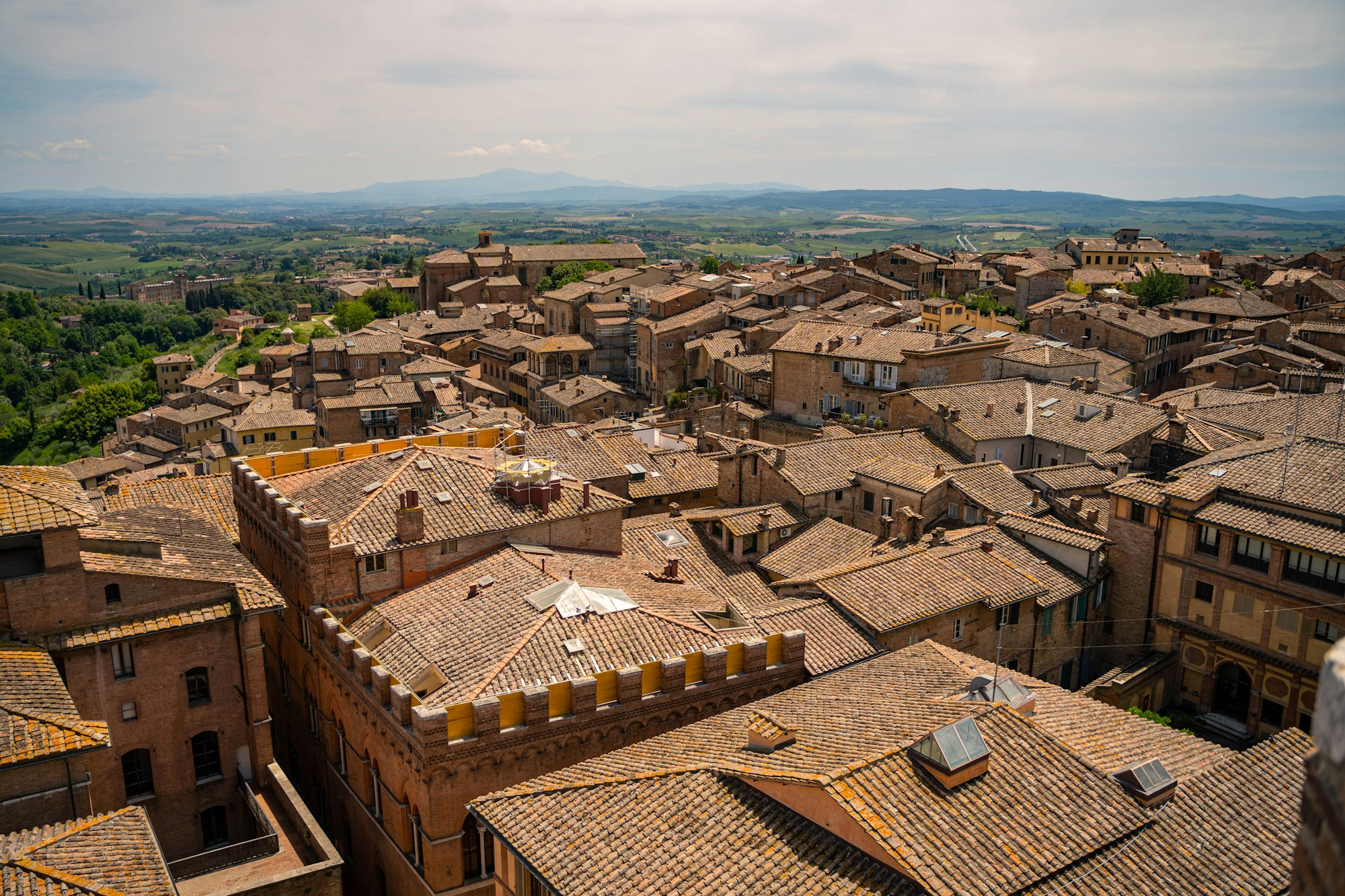
Siena is one of Europe’s best-preserved medieval cities. The entire historic centre is a UNESCO World Heritage Site. Beyond the Palio, here are the must-sees:
- Siena Cathedral (Duomo): Gothic cathedral in black-and-white marble, with works by Donatello, Michelangelo and Pinturicchio. The Piccolomini Library inside contains some of the brightest frescoes of the Tuscan Renaissance
- Torre del Mangia: 102 metres tall, around 400 steps, exceptional panorama over the Campo and Sienese countryside (~€10). Allow 30 minutes for the climb
- Santa Maria della Scala: a medieval pilgrim hospital, now a museum — one of Europe’s oldest, with 15th-century frescoes depicting hospital life
- Sienese cuisine: pici al aglione, medieval panforte, ricciarelli IGP, Brunello di Montalcino (40 km away) and Vernaccia di San Gimignano (30 km)
To plan a Siena and Tuscany itinerary, explore our personalised Tuscany itineraries — with accommodation, transport and food stops tailored to your pace. If you’re combining Siena with other cities in the region, our Italy destinations guide covers all the essentials and best seasonal itineraries.
7. Getting there: flights, trains and accommodation
Getting to Siena from the UK
The easiest way from the UK is to fly into Pisa (Galileo Galilei Airport) — served from London Gatwick by easyJet (13 flights/week) and from London Stansted and Luton by Ryanair, with flights from around £50. The journey from Pisa to Siena takes around 1h40 by bus or 2h by train with a change at Florence. Florence Airport (Amerigo Vespucci) is a solid alternative, served from London Gatwick by Vueling. Once you’re in Florence, the Autolinee Toscane bus from Autostazione takes 1h15 to Siena (€7-17). The Trenitalia train from Santa Maria Novella takes 1h34 (€9-22). From Rome, allow 3-4 hours by train with a change, or take a direct Flixbus. Driving? The Fortezza-Stadio car park (~800 spaces, €20 on race day) is your best bet near the historic centre.
Search for the best-value flights from London to Pisa or Florence on Aviasales — prices tend to rise sharply 3-4 weeks before the Palio.
Accommodation: the 12-to-18-month rule
According to racingbreaks.com, hotels within Siena’s walls need to be booked 12 to 18 months in advance for Palio nights. Prices triple compared to normal nights (€250-500/night for mid-range, up to €1,000 for the Grand Hotel Continental). If you’re reading this close to the date, consider Florence as a base, an agriturismo in the Tuscan hills, or a village within 20 km of Siena.
Connected the moment you land in Pisa or Florence. Europe or Italy eSIM in seconds — no physical SIM swap needed.
From €4.50Nomad Insurance: global coverage from $56/4 weeks. Medical, cancellation and baggage cover for your Tuscany trip. 10% off via our link.
From $56 / 4 weeksFrequently asked questions
When exactly is the Palio di Siena 2026?
The Palio di Siena 2026 (Palio di Provenzano) takes place on Thursday 2 July 2026 on the Piazza del Campo. The race starts at approximately 7:30 pm. Preparation week begins on 29 June with the tratta (horse draw). A second Palio (Palio dell’Assunta) is scheduled for 16 August 2026. Source: ilpalio.siena.it.
Can you watch the Palio di Siena for free?
Yes. The centre of the Piazza del Campo (the « palco dei cani ») is entirely free. You’ll need to arrive very early on 2 July — ideally before 10 am — as barriers close at around 3:30 pm and once you’re inside you can’t leave until the race ends. Bring water, a hat and sunscreen (around 32°C in July). Children under 10, dogs and glass bottles aren’t allowed in the central zone. Source: tuscanteam.com.
Which contrade are running in the Palio di Siena on 2 July 2026?
The ten contrade drawn on 31 May 2026 are: Onda, Civetta, Giraffa, Leocorno, Aquila, Torre (by right) and Bruco, Drago, Valdimontone, Oca (drawn by lot). Nicchio is absent due to a disciplinary disqualification — an unusual event in Palio history. The race will feature two historic rivalry face-offs: Civetta vs Leocorno, and Oca vs Torre. Source: sienafree.it.
How much do Palio di Siena 2026 tickets cost?
Free standing in the centre costs nothing — but requires arriving very early. Paid options vary by position: €460 for a standing balcony at the starting line (Mossa), €690 for a seated balcony, up to €1,000 for a private apartment. Book through paliodisiena.tickets, ideally 12 to 18 months ahead. Some positions were already sold out by July 2026. Source: tuscanteam.com.
How do you get from Florence to Siena for the Palio?
The Autolinee Toscane bus from Florence Autostazione is the best option: 1h15 journey for €7-17. The Trenitalia train from Santa Maria Novella takes 1h34 (€9-22). On race day, reinforced services run. By car, the Fortezza-Stadio car park (~800 spaces, €20 on race day) is the recommended option close to the historic centre. Source: rome2rio.com.
Why is Nicchio absent from the Palio di Siena in July 2026?
The Nicchio (Seashell) contrada was disqualified after accumulating three disciplinary strikes linked to an incident with rival contrada Valdimontone in a previous Palio. The disqualification bars them from competing in July 2026 — a rare and notable event in Palio history. Source: gazzettadisiena.it.
What is the drappellone and what’s the 2026 theme?
The drappellone is a hand-painted silk banner (~3 × 1.5 m) — the only prize awarded to the winning contrada, then displayed in its museum. For 2 July 2026, it’s painted by Ismaele Nones (born 1992 in Trento, trained at the Venice Academy of Fine Arts). The theme is the 800th anniversary of the death of St Francis of Assisi (died 1226) — Francis had stayed in Siena in spring 1226 and there dictated his « Testament of Siena ». Source: Artribune.
Sources
- ilpalio.siena.it — Official website of the Comune di Siena, Palio di Provenzano 2026
- sienafree.it — Contrade drawn for July 2026
- sienaitalytours.com — Draw of 31 May 2026
- thepalio.eu — Full Palio timetable
- visitsiena.it — History of the Palio and horse blessing
- Artribune — Ismaele Nones, artist of the July 2026 drappellone
- tuscanteam.com — 2026 balcony ticket prices
- ilpalio.org — Historic Oca-Torre rivalry
- ilpalio.org — Civetta-Leocorno rivalry
- PubMed — Study on injuries at the Palio di Siena (1946-2018)
- The Conversation — Sociological analysis of the Palio
- rome2rio.com — Florence to Siena transport options
- La Nazione — Jockeys tipped for July 2026
- UNESCO — Siena historic centre World Heritage listing
- easyJet — Flights London Gatwick to Pisa
Research conducted 8 June 2026 — data updated from official primary sources.
Plan your Siena trip for the Palio 2026
Tuscany has far more to explore around the Palio — San Gimignano, Montepulciano, the Val d’Orcia, the thermal baths at Saturnia. Let Pixidia build your bespoke itinerary.
Explore Tuscany itineraries