

From 3 April 2026, day-trippers visiting Venice on weekends will need to pay between €5 and €10 to enter the historic centre. The tax returns for its third year with 60 taxed days — six more than in 2025. Exact dates, amounts, mandatory QR code, exemptions, €300 fines in case of inspection: here is everything you need to know before you go, and above all, 5 legal ways to avoid or reduce the fee.
Venice tourist tax 2026 — quick answer
From 3 April 2026, day-trippers visiting Venice’s historic centre on weekends pay €5 (booked 4+ days ahead) or €10 (last-minute) between 8:30 AM and 4:00 PM. The fee applies on exactly 60 days from April to July — six more than in 2025. Every visitor, including exempted ones, must register online at cda.veneziaunica.it and carry a QR code to avoid a fine of up to €300. Children under 14 and overnight guests are exempt at no cost. The best strategy to pay nothing: visit on a Monday–Thursday, arrive before 8:30 AM, or stay at least one night in the city.
1. Why does Venice charge visitors?
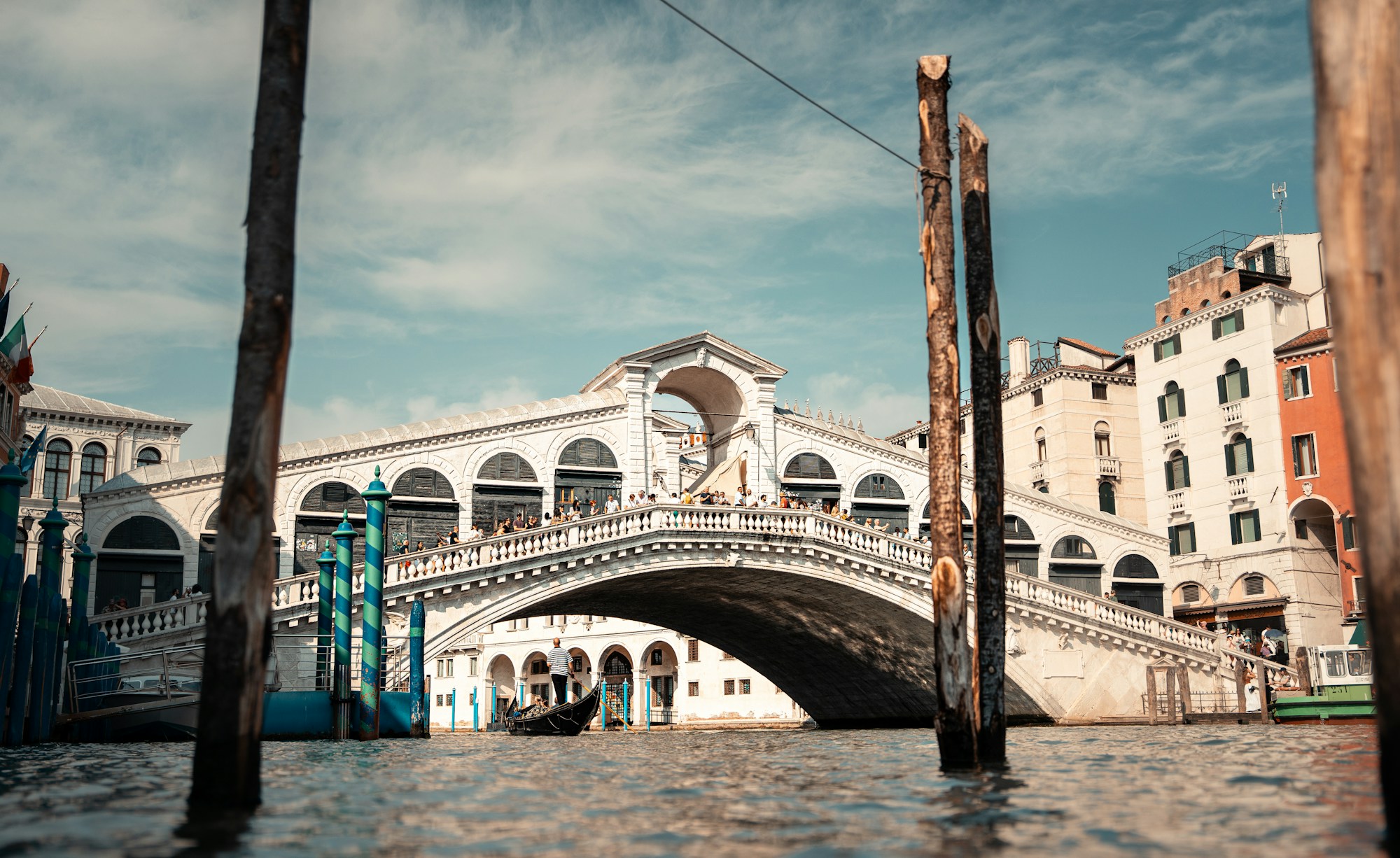
The Contributo di Accesso a Venezia
Venice welcomes nearly 30 million visitors per year, 70% of whom are day-trippers who leave the same evening without staying overnight. These visitors represent the majority of tourist flows but contribute marginally to the local economy. According to E-Venise.com, waste management alone costs the city €41 million per year — a burden borne almost entirely by its 50,000 residents.
This is the context in which the access fee was born, officially introduced as a pilot scheme in 2024, renewed in 2025, and now made permanent with adjustments in 2026. Its official name: Contributo di Accesso a Venezia. This is not an admission ticket like a museum, but a mandatory financial contribution for day-trippers entering the Città Antica (the historic centre) during peak hours.
What changed in 2026
- 60 taxed days (vs 54 in 2025): more weekends in June and July
- €10 rate for last-minute bookings (less than 4 days in advance)
- Fridays included in most taxed weeks
- Zone still limited to historic centre only (islands are exempt)
2. The complete 2026 calendar: which days are taxed?
In 2026, the day-tripper fee applies on 60 days, Friday to Sunday (and some public holidays) between April and July. Here is the official calendar as published by the City of Venice, reported by Euronews:
April 2026
3, 4, 5 (Easter weekend), 6 (Easter Monday), 10, 11, 12, 17, 18, 19, 24, 25 (Liberation Day), 26, 27, 28, 29, 30
May 2026
1 (Labour Day), 2, 3, 8, 9, 10, 15, 16, 17, 22, 23, 24, 29, 30, 31
June 2026
1, 2, 3, 4, 5, 6, 7, 12, 13, 14, 19, 20, 21, 26, 27, 28
July 2026
3, 4, 5, 10, 11, 12, 17, 18, 19, 24, 25, 26
3. How much does it cost? 2026 amounts
According to Tour Leader Venice, the 2026 pricing works on a simple principle: plan ahead or pay more.
- €5 per person if booked at least 4 days in advance
- €10 per person if booked less than 4 days before your visit
- Children under 14: exempt, no payment required
- Tourists staying overnight in Venice: €0 (exempt, but QR code still mandatory)
4. How to pay? The QR code step by step
Whether you are a paying visitor or exempt, you must register and obtain a personalised QR code before your visit. This code may be checked at seven access points around the city, including Santa Lucia station. According to Le Routard, checks are random and can take place anywhere in the historic centre.
The official procedure
- Go to cda.veneziaunica.it (available in English)
- Select your visit date
- Indicate your status: paying day-tripper, overnight guest, or exempt
- Pay online (credit card or PayPal)
- Receive your QR code by email
5. Who is exempt? The complete list
According to E-Venise.com, the following categories are exempt from payment — but must still obtain a free exemption QR code:
- Venice residents and their relatives up to 3rd degree
- Tourists staying in Venice (hotel, B&B, apartment) for at least one night
- Students enrolled at a Venice school or university
- Children under 14
- People with disabilities and their companions
- Workers and professionals visiting Venice for work purposes
- Persons with medical appointments or hospitalisation
- Participants in official sporting events
- Property owners in Venice (Italian or foreign)
6. 5 legal ways to avoid (or reduce) the fee
✅ Strategy 1: Stay overnight in Venice — the most effective
The best way to avoid the day-tripper fee is simply not to be a day-tripper. By spending at least one night in Venice, you are fully exempt. You pay the city tax instead (€3–5/night) but gain far more: Venice almost empty at dawn, the lit-up quays after midnight — an experience day visitors will never know. According to The Traveler, this strategy is unanimously recommended by local guides.
✅ Strategy 2: Arrive before 8:30 AM or leave after 4:00 PM
The fee only applies from 8:30 AM to 4:00 PM. By arriving early (6:00–8:15 AM), you visit Venice almost empty: the Campanile, the Bridge of Sighs, St Mark’s Square… with no queues at all. You can then retreat to the islands between 8:30 AM and 4:00 PM, and return to the city for sunset, freely. Source: Ou-et-Quand.net.
✅ Strategy 3: Visit on a non-taxed day
Venice only taxes day-trippers on 60 days out of 365. Mondays to Thursdays outside public holidays remain free. And the entire August–March period is tax-free. These days are also often less crowded — a double advantage. Source: Ulysse.com.
✅ Strategy 4: Book at least 4 days in advance
If you must visit on a taxed day, simply book your QR code at least 4 days ahead: you will pay €5 instead of €10. This 50% saving is automatic on the official platform. For a family of 4 adults, that is €20 saved — enough to cover a vaporetto ride.
✅ Strategy 5: Explore the exempt islands
The lagoon islands (Murano, Burano, Torcello, Lido, Sant’Erasmo, Pellestrina) are not subject to the fee, nor are transit zones (Santa Lucia station, Piazzale Roma, the port). You can reach them directly from the mainland or stations without passing through the historic centre. Source: Le Routard.
7. 2024–2025 results: is the fee actually working?
After two years of testing, the results are nuanced. According to Euronews, the average daily number of visitors paying the fee was 13,046 in 2025 versus 16,676 in 2024 — a slight drop that coincides with a broader regional trend. The city acknowledged that this also reflects a general decline recorded by the regional statistics office.
The record day remains Friday, 2 May 2025 with 24,951 visitors paying the fee — more than half the resident population in a single day. The fee generated over €5 million in 2025, according to The Traveler. In 2026, with doubled rates for late bookings, the city targets €25–30 million in annual revenue.
8. Alternative #1: The secret islands of the lagoon (zero fee)
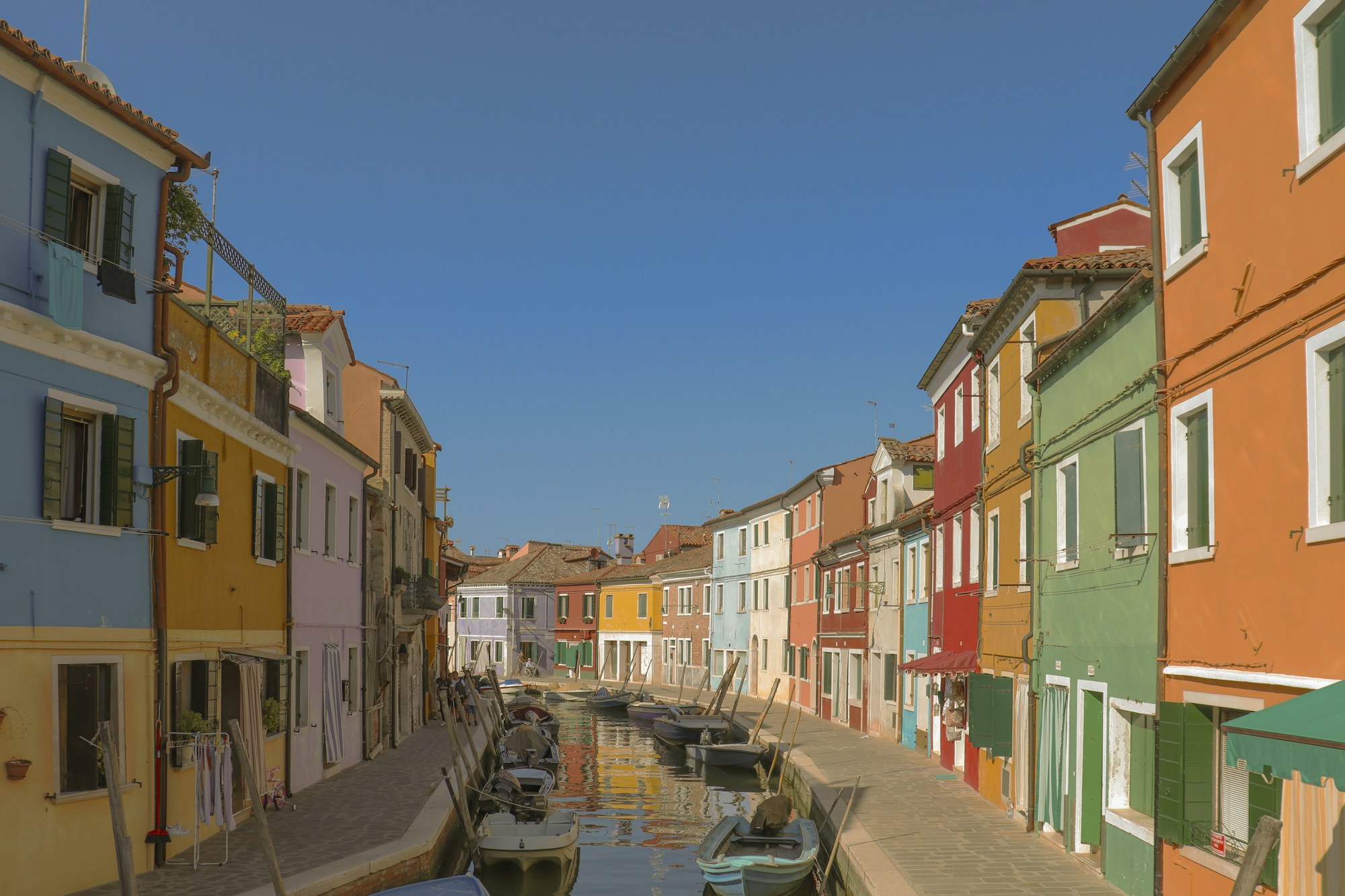
Burano, Murano, Torcello, Sant’Erasmo…
The minor islands of the lagoon represent the hidden face of the Veneto. According to Venice Visit Pass, these islands offer tranquillity and authenticity: market gardens on Sant’Erasmo, vineyards and silent monasteries on San Francesco del Deserto, the multicoloured houses of Burano that look like a painting. None are subject to the access fee, and all are reachable by vaporetto.
Must-see islands
- Burano: the famous colourful houses, traditional lace-making, lively canals
- Murano: the world capital of blown glass, workshops open to visitors
- Torcello: the oldest inhabited island in the lagoon, Byzantine mosaics and absolute silence
- Sant’Erasmo: Venice’s « garden island », Venetian artichokes and vineyards as far as the eye can see
- Pellestrina: a long strip of land ideal for cycling, wild beaches and local fishermen
9. Alternative #2: Chioggia, the « little Venice » without the crowds or the fee
At the southern end of the lagoon, Chioggia is an authentic fishing town crossed by the Vena canal, populated by Italians who fish, cook and live — far from luxury hotels and mask sellers. Accessible by ferry from Venice (30 minutes from Piazzale Roma) or by road from the mainland.
Its morning fish market is one of the richest in northern Italy. Its trattorias serve lagoon seafood prepared with the day’s catch. The Gothic Venetian architecture of Via Corso del Popolo evokes the Serenissima — without the crowds or the prices.
10. Alternative #3: Treviso and the Prosecco Road
Just 30 km north of Venice, Treviso has its own canals, medieval arcades and a lively covered market. According to Italianismo, the Veneto region is paradoxically the most visited in Italy, but its hidden treasures see almost no foreign tourists.
Treviso is also the birthplace of tiramisù and radicchio di Treviso. From the city, the Prosecco and Wines of Conegliano Valdobbiadene Hills Route (UNESCO-listed since 2019) leads through breathtaking terraced vineyard landscapes — completely off the tourist radar.
11. Alternative #4: Ljubljana, the Adriatic’s green rival

Ljubljana, Slovenia
Just 3 hours from Venice by train, Ljubljana is often called « the little green Venice ». Romantic canals, pedestrian bridges, a fully car-free city centre, cafés and terraces along the Ljubljanica river… All in a human-scale European capital, without crowds, and at prices well below Venice. Source: VoyagesPirates.fr.
- Zero tourist entry fee
- European Green Capital 2016: fully pedestrianised centre, cars banned
- Accommodation prices 30–40% lower than Venice
- Gateway to Lake Bled, the Julian Alps and the Slovenian Adriatic coast
12. What does the collected money fund?
According to E-Venise.com, the revenues are directly reinvested in costs that residents were bearing alone:
- Waste management: €41 million per year to manage the waste of 30 million tourists
- Masegni maintenance: the stone paving worn by millions of footsteps
- Bridge repairs: Venice has 435 bridges requiring constant upkeep
- Quay and waterfront maintenance: the fondamenta lining canals face constant erosion
- Cultural heritage preservation and local public transport funding
13. Venice in the context of European tourist taxes 2026
Venice is not an isolated case. According to Observatoire de l’Europe, many European destinations have tightened or introduced tourist taxes in 2026:
- Amsterdam: 12.5% hotel tax + VAT raised from 9% to 21% → ~33.5% total tax on accommodation
- Barcelona: municipal surcharge raised from €4 to €5 per person/night, with planned increases to €8 by 2029
- Venice: €5–10 per day-tripper, unique worldwide: the only city to specifically tax same-day visitors
- Bali (Indonesia): $10 fee since 2024 for all foreign visitors
Practical information for your trip to Venice
Nomad Insurance: global coverage from $56/4 weeks. 10% off via our link. Perfect for Italy and beyond.
From $56 / 4 weeksStay connected as soon as you land in Venice. Instant activation, no physical SIM needed.
From €4.50Frequently asked questions about Venice’s 2026 tourist tax
If I stop in transit at Santa Lucia station, do I have to pay the fee?
No — transport zones (Piazzale Roma, Santa Lucia station, Stazione Marittima, San Basilio, Tronchetto) are exempt as long as you stay there. But as soon as you enter the Città Antica during the 8:30 AM–4:00 PM window on a taxed day, the fee applies. A rail transit without leaving the station does not require payment. Source: WeonCruise.
Does the fee apply if I only visit Murano or Burano?
No. In 2026, the fee is limited to Venice’s historic centre and does not include the lagoon islands (Murano, Burano, Torcello, Lido, Sant’Erasmo, Pellestrina). If you take a vaporetto directly from Punta Sabbioni or Treporti to those islands, without ever entering the historic centre, you have nothing to pay or register. Source: E-Venise.com.
What happens if I can’t make it to Venice on my booked day?
The official Venezia Unica portal (cda.veneziaunica.it) allows you to cancel your pass and receive a full refund, provided you cancel before the day of the visit. Do not let the pass expire without cancelling — you will not be refunded after the date. Source: WeonCruise.
Has the fee actually reduced visitor numbers in Venice?
Partially. In 2025, the daily average of paying visitors dropped from 16,676 (2024) to 13,046 — a 22% decrease, but one that coincides with a broader regional trend. The fee has more of a flow management and tracking effect than a drastic reduction. It mainly softened the worst peaks on the busiest weekends. Source: Euronews.
Do my children also need to pay the fee?
No. Children under 14 are completely exempt from paying the fee. They do not need a specific QR code. Only visitors aged 14 and over are subject to the access contribution. Source: E-Venise.com.
Can I pay the fee on the day of my visit?
Yes, but at the higher rate of €10 (versus €5 if booked at least 4 days ahead). Payment is possible via the official website, WhatsApp, or affiliated tobacco shops (Punto LIS logo). Booking in advance is strongly recommended to halve the cost. Source: Observatoire de l’Europe.
What is the best time to visit Venice without paying the fee?
The entire August–March period is fee-free. October and November offer a golden, misty Venice perfect for romantic walks without queues. Outside that window, Mondays to Thursdays outside public holidays from April to July remain free. And whatever the date, you can visit freely before 8:30 AM or after 4:00 PM. Source: Ou-et-Quand.net.
Will the fee increase in future years?
The trend is clearly towards gradual expansion. Local authorities have announced they will assess 2026 results before deciding on adjustments for 2027. The increase to €10 for last-minute bookings in 2026 is already a strong signal. Other European cities (Barcelona, Amsterdam) are following a similar trajectory of gradual increases. Source: Travel and Tour World.
Is it worth booking a guided tour in Venice to make the most of a taxed day visit?
Yes — especially on taxed days when you are already paying the €5–10 entry fee. A guided tour helps you cover the city efficiently during the 8:30 AM–4:00 PM window while avoiding the worst bottlenecks at St Mark’s Basilica and the Doge’s Palace. Private walking tours with a local guide start from around €60 per group and typically include skip-the-line access to one or two monuments, which alone can save 45–90 minutes of queuing. For island day trips (Murano, Burano, Torcello), a guided boat tour is particularly practical as it handles the vaporetto logistics and adds context to the glassblowing workshops and lace-making heritage that independent visitors often miss.
How much money will Venice’s 2026 access fee raise?
The fee generated over €5 million in 2025. For 2026, with the new €10 rate for last-minute bookings and six additional taxed days, Venice’s authorities are targeting €25–30 million in annual revenue, separate from the overnight city tax. The money is earmarked for waste management, bridge and pavement upkeep, and public transport. Source: The Traveler.
Sources
- Euronews — Venice daytripper fee to return in 2026: official dates and 2025 statistics
- E-Venise.com — Venice Access Fee 2026: full regulations and exemptions
- Tour Leader Venice — Venice Access Fee 2026 Explained
- Lonely Planet — The Venice Access Fee in 2026
- The Traveler — Venice Day-Tripper Fee: 2025 Results & 2026 Plans
- WeonCruise — Venice Access Fee 2026: Cruise Day Trippers Guide
- Untold Italy — Venice Tourist Tax: Latest Information
- Travel and Tour World — Venice Takes Bold Steps in 2026
Research conducted on 24 March 2026. Updated August 2026.
Ready to plan your Italian adventure?
Venice or its alternatives — the Dolomites, the Amalfi Coast, Tuscany… Discover our complete itineraries to explore Italy at the best price and off the beaten track.
Explore all itineraries