
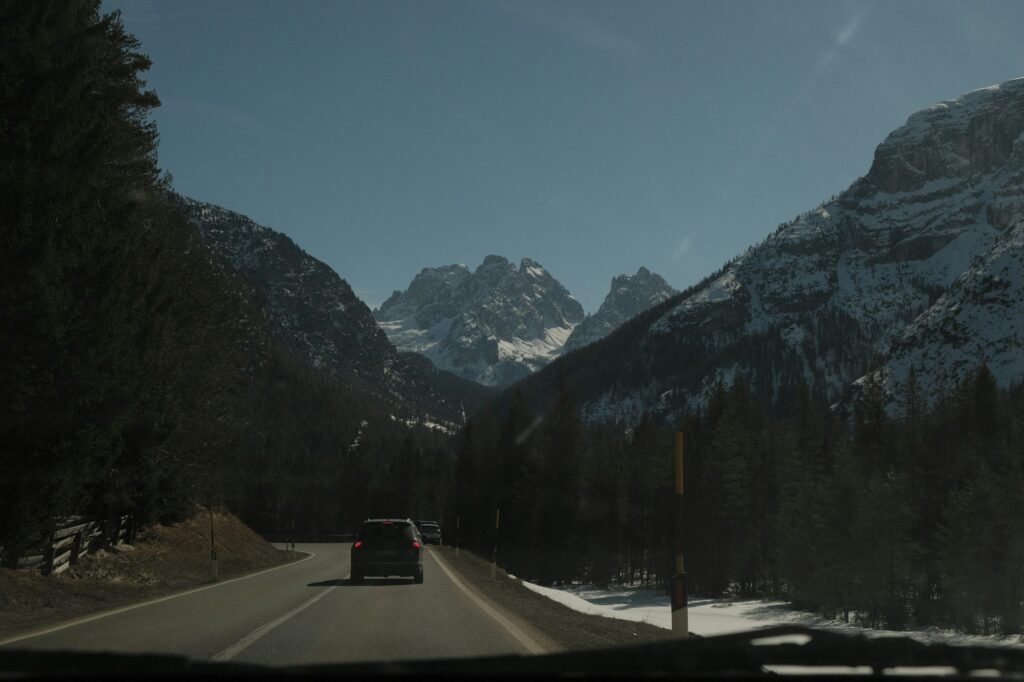
In Italy, the reference period for winter tyres runs from 15 November 2026 to 15 April 2027, but the obligation only applies to road sections marked by a sign. M+S marking is enough, with no 3PMSF needed. Outside built-up areas, the fine for non-compliance is €87 to €344. Aosta Valley starts on 15 October according to Touring.be, to be confirmed.
Checked on against the texts we read and the dated press cited at the end of the article.
Driving to Milan or Turin this winter and wondering whether your tyres are enough? The national reference period runs from 15 November to 15 April, but it only applies to sections that are signposted. The Brenner is the only route with dates confirmed by two matching sources. This article goes through the official texts we could read and the dated press, zone by zone, and flags the points that are not settled yet.
Alpine passes: where the rule really matters
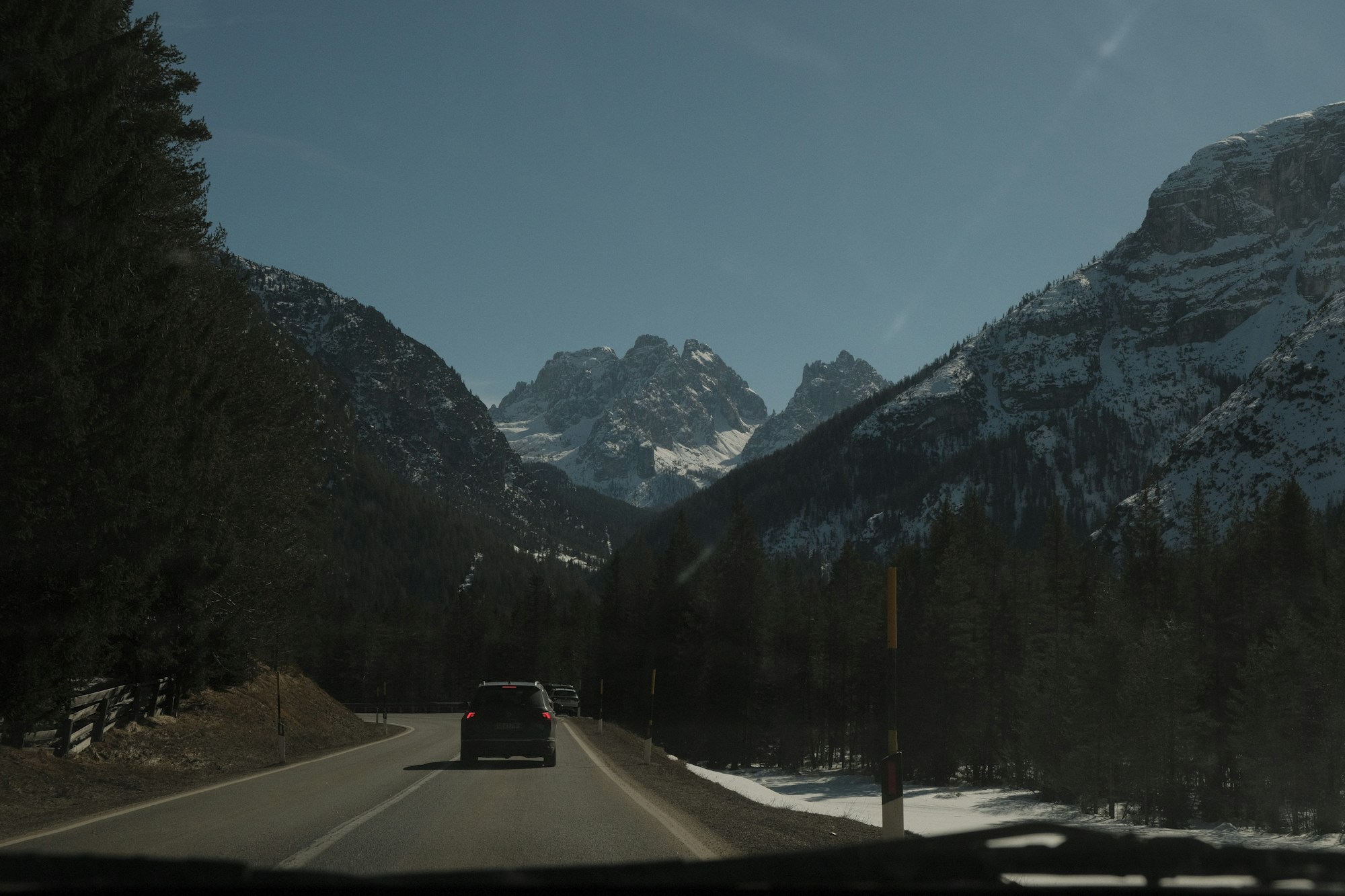
The Brenner (A22) is the only route with dates confirmed by two matching sources. There, the obligation runs from 15 November to 15 April: winter tyres or chains on board, depending on the section signposted (European Consumer Centre, updated 22 October 2026).
In Aosta Valley, the period starts earlier. According to Touring.be (updated 16 September 2025), it runs from 15 October to 15 April. These dates have not been confirmed for 2026-2027: we could not consult the annual notice from ANAS. Check the signs on site.
The Mont-Blanc tunnel falls under a separate French rule: winter or snow tyres from 1 November to 31 March, according to our secondary sources. The ATMB winter service publishes a dedicated document. We could not check its rule on chains, so read it before you cross.
What changes by section
- Brenner (A22): 15 November to 15 April, winter tyres or chains on board.
- Aosta Valley: 15 October to 15 April according to Touring.be (2025), 2026-2027 dates not confirmed.
- Some ASPI sections: from 1 November 2026, according to Sky TG24, a single source for now.
- Mont-Blanc tunnel: secondary French rule, to be confirmed with the operator.
A reference period, not a general obligation
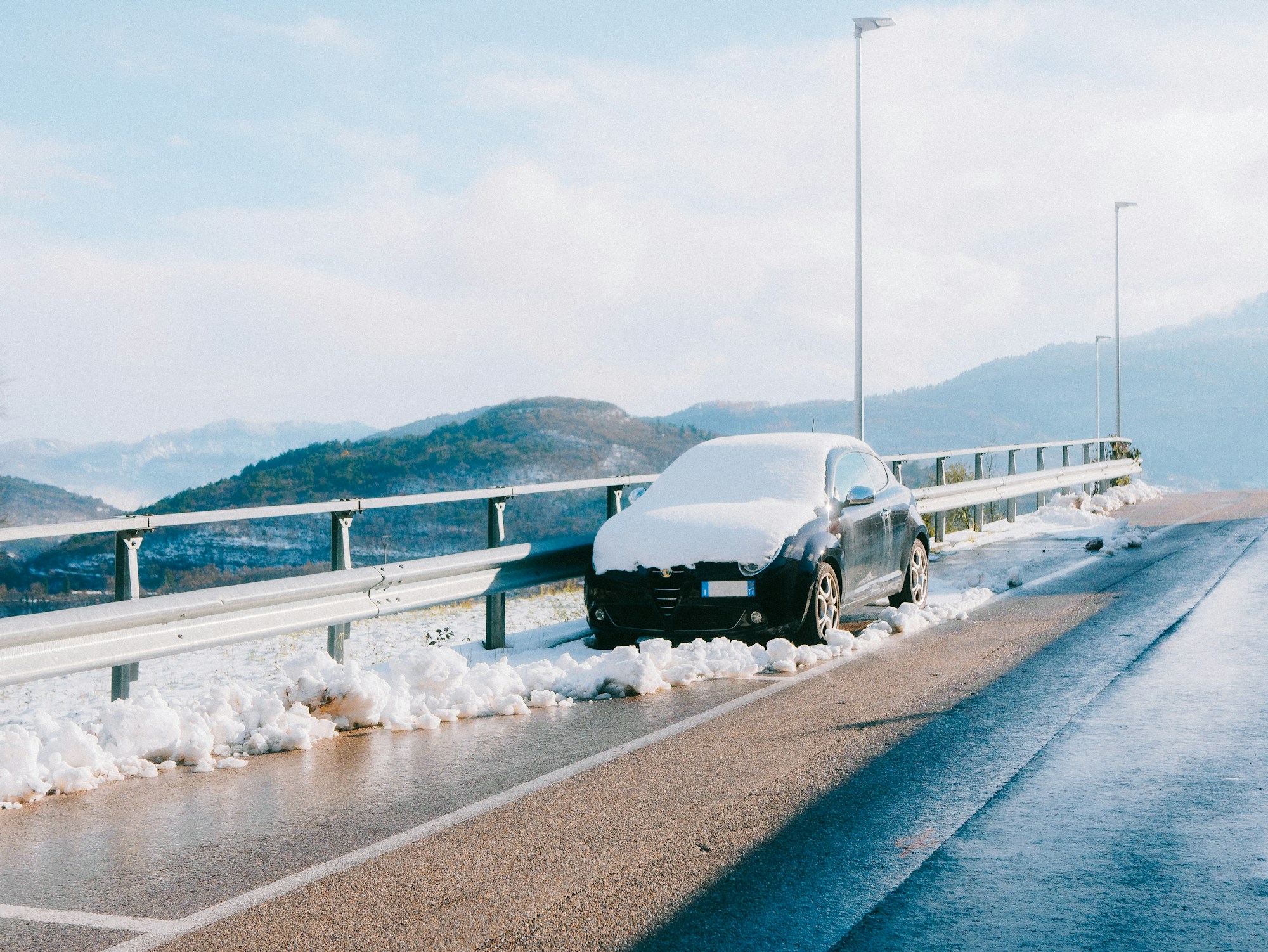
Two things that many guides mix up need separating. The first is the reference period: the Ministry of Transport directive of 16 January 2013 (protocol RU/1580) sets it from 15 November to 15 April. The second is the actual obligation, which only exists on the sections where an authority has ordered it and put up a sign.
The Highway Code states this in Article 6, paragraph 4, letter e: the road manager issues the ordinance, and vertical signage makes it visible. On your route, equipment is therefore required where the sign requires it, and only there.
Two calendar exceptions appear in our press sources: Aosta Valley, which starts on 15 October according to Touring.be (2025, not confirmed for 2026-2027), and some ASPI sections, from 1 November 2026, according to Sky TG24 (single source). The table below sums up what our sources let us state, zone by zone.
| Zone or network | Period | Condition | Source |
|---|---|---|---|
| Italy, reference period | 15 November to 15 April | Signposted sections only | MIT directive of 16 January 2013 |
| Aosta Valley | 15 October to 15 April | Chains or winter tyres | Touring.be (16 September 2025); 2026-2027 dates not confirmed |
| A1 ASPI (certain sections, Direttissima) | From 1 November 2026 | ASPI ordinance | Sky TG24 (20 October 2026), single source |
| A22 Brenner | 15 November to 15 April | Winter tyres or chains on board | European Consumer Centre (22 October 2026) |
| Sardinia, mountain roads (SS 131, SS 389) | 1 December to 15 March (2025-2026 season) | Mountain sections | Fleet Magazine (secondary source, not opened for this check) |
| Lombardy, provinces | 1 or 15 November to 31 March (2025-2026 season) | Provincial ordinances | Valtellina Mobile (secondary source, not opened for this check) |
Source: European Consumer Centre, MIT directive of 16 January 2013, Touring.be, checked on 23 October 2026. The Sardinian and Lombard lines cover the 2025-2026 season: start dates differ between sources. For Sicily, one source gives 15 November to 15 April, but we found no ordinance.
Which motorways? A list that changes from one season to the next
Several operators are involved: ASPI, Autostrada dei Fiori, Milano Serravalle, Autovie Venete and Autostrada del Brennero, plus SITAF for the Fréjus tunnel. Their sections are not fixed once and for all. They depend on annual ordinances, and not all of them had been published for 2026-2027 when we checked.
The most recent case concerns ASPI. According to Sky TG24 (20 October 2026), some A1 sections, including the Direttissima, will be subject to the obligation from 1 November 2026. This is a single source that we could not cross-check against the text of the ordinance. Treat this date as an alert to confirm on the sign, not as an official timetable.
For the Fréjus tunnel and the SITAF route, the ordinance is annual and we did not find its 2026-2027 dates. The same goes for Autostrada dei Fiori, Milano Serravalle and Autovie Venete. The only route with dates from two matching sources remains the Brenner.
For Veneto, we found no ordinance in our sources: the A4 Milan-Venice should be checked on the signs. For the Dolomites, the municipality of Bolzano applies, according to Eurocampings (23 September 2025), the period from 15 November to 15 April, under an ordinance cited without a date (no. 1318) that we could not date for 2026-2027. For Trentino, we have not settled whether the obligation applies by signposted section or on all roads. For the Dolomite passes (Stelvio, Pordoi, Sella), we checked no dates and publish none.
| Section or network | Period 2026-2027 | Verification status |
|---|---|---|
| A22 Brenner | 15 November to 15 April | Dated, two matching sources |
| Aosta Valley | 15 October to 15 April (Touring.be, 2025; not confirmed for 2026-2027) | Dated by one source (Touring.be); ANAS notice not consulted |
| A1 ASPI, Direttissima | From 1 November 2026 | Single source (Sky TG24, 20 October 2026) |
| SITAF, Fréjus tunnel | Annual ordinance | 2026-2027 dates not found; on-board condition dated 15 October 2025 |
| Autostrada dei Fiori, Milano Serravalle, Autovie Venete | Not published | Dates not found |
| Dolomites, municipality of Bolzano | 15 November to 15 April (Eurocampings, 2025; not dated for 2026-2027) | Not dated for 2026-2027 (Eurocampings, 2025) |
| Trentino | Not settled | By signposted section or on all roads: not settled |
| Sicily and Veneto | No ordinance | No ordinance found in our sources |
Source: Sky TG24, Touring.be, Eurocampings, European Consumer Centre, checked on 23 October 2026.
How to check before you leave
In the week you leave, check the website of each operator on your route, then look at the signs at the entrance to mountain sections. The sign is the reference: it shows the obligation actually in force on the section, not a calendar published in advance.
Winter tyres, four-season tyres, chains: what is allowed
When a section is subject to the obligation, the law does not require one single type of equipment. You can drive on winter tyres or four-season tyres marked M+S, with chains on board, or with approved snow socks. 3PMSF is not required in Italy, and M+S is enough, according to Sky TG24. Several French guides nevertheless present it as a legal requirement.
Chains and snow socks
Chains and snow socks must comply with standard UNI EN 16662-1:2020, under the Ministry of Transport decree of 23 February 2023 (Sicurauto, December 2025). The date of publication in the Official Journal varies between sources, from 16 to 23 March 2023. We do not use it, because it has no effect on what you need to carry. Chains must be fitted at least to the driven wheels (Sky TG24), and Touring.be gives a maximum speed of 50 km/h with chains.
Four tyres or two?
Touring.be requires the marking on all four wheels, whereas the daily Il Sole 24 Ore speaks of a recommendation. The point is not settled. If you travel on four-season tyres, fit them on all four wheels: that is the choice that won’t leave you open to any argument at the roadside.
Tread depth
The legal minimum tread depth is 1.6 mm (Sky TG24). On snow, the same outlet recommends 3 to 4 mm. That margin is what really matters for safety, not the threshold set by law.
| Equipment | Standard or status | Indicative price | Source (date) |
|---|---|---|---|
| Winter tyres or four-season tyres with M+S marking | Admitted on signposted sections | Not checked | Sky TG24 (20 October 2026) |
| Textile snow socks, size XL | UNI EN 16662-1:2020 | €33.18 (list price €41.99) | Autoblog (15 January 2026) |
| Winter supplement on a rental, one week | Vehicle equipped by the renter, according to Altroconsumo | About €75 (one renter) | MotorBox (date not stated) |
Source: Sky TG24, Autoblog, Altroconsumo and MotorBox, consulted on 23 October 2026. Prices are indications taken from sellers or a renter, not guaranteed rates.
The speed index trap
This is the most technical point, and the one guides skim over. According to Sky TG24 (20 October 2026), a winter tyre must meet the speed index shown on the registration document, unless an exemption applies. The same outlet cites an exemption for the period from 15 October 2026 to 15 May 2027, based on a 2014 ministerial circular that tolerates a Q index, i.e. 160 km/h. We could not open this circular (no. 1049 of 17 January 2014): the tolerance is reported from the press.
Outside that window, that is from 16 May to 15 October, a winter tyre whose index is lower than the one on the registration document is banned, according to Profile.be and the European Consumer Centre (updated 22 October 2026). If you keep your winter tyres for a summer trip, this rule applies to you.
The size of the fine is the second tricky point. Sky TG24 cites €430 to €1,731 for a non-compliant index outside an exemption, with the registration document withdrawn. Other summaries give similar but different amounts (€422 to €1,697, €419 to €1,682): the amount is disputed, and we have not checked it against any law text we read.
Fines and points: what is confirmed and what isn’t
Three penalties are documented in the texts and press we consulted. Outside built-up areas, failing to fit required equipment is punished with €87 to €344 (Article 6, paragraph 14 of the Highway Code). Inside built-up areas, the fine is €42 to €173 (Article 7). In both cases, the officer can prohibit you from continuing your journey until the vehicle complies (Article 192, paragraph 3, according to Sicurauto, 14 October 2026).
| Offence | Article | Amount | Additional measure |
|---|---|---|---|
| Failure to equip outside built-up areas | Article 6, paragraph 14 | €87 to €344 | Possible ban on continuing the journey (Article 192, paragraph 3) |
| Failure to equip inside built-up areas | Article 7 | €42 to €173 | Possible ban (Article 192, paragraph 3) |
| Non-compliant speed index, outside an exemption | Article 78 | €430 to €1,731 (amount disputed) | Withdrawal of the registration document |
| Withdrawal of licence points | Not confirmed | Not confirmed | No official source read |
Source: Highway Code, Article 6 (ACI), ACI, 6 October 2026, Sky TG24, 20 October 2026, Sicurauto, 14 October 2026, checked on 23 October 2026.
On driving licence points, be careful. Guides cite 3 or 10 points, but no official text we read provides for that deduction for this offence. So we do not write that figure.
According to ANSA and Sky TG24 (press of 14 and 15 October 2026), the Council of Ministers approved a draft decree on 13 October 2026 reforming the penalties of the Highway Code. We could not open these articles or the approved draft: only an earlier draft, published by Il Fatto Quotidiano in September, was read. This text is not in force, and no entry date is confirmed in our sources. To our knowledge, the press does not attribute any change to winter tyres to it.
Motorbikes, rental cars and foreign-registered vehicles
Motorbikes and mopeds
They are excluded from the standard obligation. The 2013 directive and Sky TG24 state that they only travel on the sections concerned when there is no snow or ice. Outside those conditions, the rule offers the rider no protection: on snow, caution must come first.
Car hire
According to Altroconsumo, a 2014 decision by the Italian competition authority (AGCM) requires that the vehicle be supplied equipped, without charging it as an option. We could not read this decision. One renter charged a winter supplement of about €75 for one week (MotorBox, date not stated). Read the contract before you sign, and ask in writing what the price includes.
Foreign-registered vehicles
Profile.be, consulted on 23 October 2026, states that the rules cover vehicles registered outside Italy. We found no official text that sets up a separate regime, nor any example of a penalty applied to a foreign vehicle. The safe approach is therefore to apply the rule to your car, whatever its plates.
What other guides don’t tell you
The points below are checked against the text of the Highway Code or against the dated press we could open. They sometimes differ from what circulates on French pages on the subject.
- The obligation is not automatic. The Highway Code refers to an ordinance from the road operator, not a general rule: without a sign, there is no obligation on that section. Highway Code, Article 6 (ACI) (consulted 23 October 2026).
- The fine outside built-up areas is €87 to €344. Guides show lower ranges (€41 to €338, or €80 to €318 according to an older version). Article 6, paragraph 14 (ACI) (consulted 23 October 2026).
- No points deduction is officially confirmed. The official texts we read do not provide for a licence points deduction for this offence, and the figures of 3 or 10 points circulate without a reference. Highway Code, Article 6 (ACI) (consulted 23 October 2026).
- 3PMSF is not a legal requirement. M+S is enough in Italy, while several French guides present the alpine symbol as mandatory. Sky TG24, 20 October 2026 (consulted 23 October 2026).
- The legal basis is a 2013 directive that few people cite. The Ministry of Transport directive of 16 January 2013 (protocol RU/1580) sets the reference period and excludes motorbikes. Reproduction of the directive on Patente.it (consulted 23 October 2026).
Preparing the trip: a seven-step method
Here is the sequence we recommend for a trip between November and April, step by step.
- List the sections of your route that cross a pass, a tunnel or a mountain road.
- Check each section on its operator’s website the week you leave, then note the announced dates.
- Check the M+S marking on your tyres, or the presence of chains or snow socks certified to UNI EN 16662-1:2020.
- Measure the tread depth: 1.6 mm is the legal minimum, 3 to 4 mm for driving on snow.
- Compare your tyres’ speed index with the entry on your registration document.
- Keep chains or snow socks on board, even if your tyres comply: a signposted section can come up without warning.
- Check the condition of the pass with the operator or manager the evening before you cross.
An example: Paris to Turin via the Fréjus
For a trip from Paris to Turin through the Fréjus tunnel, SITAF states that on signposted sections, vehicles must carry chains or winter tyres ready to fit (SITAF page, updated 15 October 2025). We did not find the 2026-2027 dates of this obligation: the sign at the entrance is what counts. If your route goes through the Mont-Blanc tunnel or Aosta Valley, the period already starts on 15 October, according to Touring.be (2025). In that case, having equipment on board from 15 October is the safest choice.
Variations by profile
Travelling with family
Snow socks take up little room in the boot. Fit them once in your driveway before you leave, so you don’t discover how they work on a snowy verge.
Tight budget
An approved textile snow sock in size XL was listed at €33.18 on Amazon.it (Autoblog, January 2026), against a list price of €41.99. If you only drive in the mountains occasionally, four-season tyres marked M+S save you buying a second set of tyres. For a single trip, one renter charged about €75 for the week for an equipped vehicle (MotorBox, date not stated).
First time in the Alps
If you can, choose a route that crosses the fewest passes. Check the state of the pass with the operator or manager the evening before you cross. Set off early in the morning and leave a time margin, especially at the end of the day.
Practical information for driving in Italy this winter
- Fréjus tunnel (SITAF): chains on board or winter tyres ready to fit on signposted sections, according to the SITAF page updated 15 October 2025. 2026-2027 dates not published in our sources.
- Mont-Blanc tunnel, French side: winter or snow tyres from 1 November to 31 March according to our secondary sources. To be confirmed with ATMB before you cross.
- Aosta Valley: 15 October to 15 April according to Touring.be (2025). 2026-2027 dates not confirmed.
- Before you leave: check the website of each operator on your route the week you leave, then look at the sign at the entrance to every mountain section.
Frequently asked questions about winter tyres in Italy
What are the winter tyre dates in Italy for 2026-2027?
The national reference period runs from 15 November 2026 to 15 April 2027, but it only applies to signposted sections. Aosta Valley starts earlier, on 15 October, according to Touring.be (2025), with no confirmation for 2026-2027. Some ASPI sections, including the A1 Direttissima, could be affected from 1 November 2026 according to Sky TG24, a single source for now. Check the sign before each mountain section.
Which motorways are affected?
The Brenner (A22) is the only route with dates from two matching sources: 15 November to 15 April. Other operators, such as ASPI, Autostrada dei Fiori, Milano Serravalle, Autovie Venete, or SITAF for the Fréjus, publish ordinances that change each season. We did not find their 2026-2027 dates. Check each operator’s website the week you leave.
Are four-season tyres enough?
M+S marking is enough in principle, on signposted sections, and 3PMSF is not required in Italy, according to Sky TG24 of 20 October 2026. Touring.be requires the marking on all four tyres, whereas Il Sole 24 Ore speaks of a recommendation: the point is not settled. Fitting all four wheels avoids any argument at the roadside.
Do I need 3PMSF tyres to drive in Italy?
No. M+S is enough, according to Sky TG24, which states that the 3PMSF symbol is not mandatory in Italy. Several French guides nevertheless present it as a legal requirement. A 3PMSF tyre remains a good choice on snow, but it does not replace checking the rule that applies to your section.
Can I replace winter tyres with chains or snow socks?
Yes, on signposted sections, provided they comply with UNI EN 16662-1:2020 and suit your tyres. Chains must be fitted at least to the driven wheels, according to Sky TG24, with a maximum speed of 50 km/h according to Touring.be. An approved textile snow sock in size XL was listed at €33.18 on Amazon.it (Autoblog, January 2026).
What fine can I face for non-compliance?
Outside built-up areas, the range is €87 to €344 (Article 6, paragraph 14 of the Highway Code). Inside built-up areas, it is €42 to €173 (Article 7). A non-compliant speed index, outside an exemption, falls under Article 78 with withdrawal of the registration document; the amount given by Sky TG24, €430 to €1,731, is disputed. No official source we read confirms a points deduction.
Are motorbikes and scooters affected?
Not by the standard obligation. According to the 2013 ministerial directive and Sky TG24, they only travel on the sections concerned when there is no snow or ice. The rule does not make a two-wheeler winter-ready: on snow, caution must come before the text.
Are summer tyres allowed with chains?
Yes, if approved chains or socks are on board and compatible with your tyres. They must be fitted at least to the driven wheels, according to Sky TG24, and speed is limited to 50 km/h with chains according to Touring.be. Without winter equipment on board, a summer tyre does not meet the obligation on a signposted section.
Sources consulted
- Highway Code, Article 6 (ACI): official text of the article on winter equipment, consulted 23 October 2026.
- Ministry of Transport directive of 16 January 2013 (protocol RU/1580), reproduced on Patente.it: reference period and exclusion of motorbikes, consulted 23 October 2026.
- ACI, L’Automobile, 6 October 2026: amounts in built-up areas.
- Sky TG24, 20 October 2026: 3PMSF, M+S, tread depth, speed index exemption, ASPI timetable.
- Sicurauto, 14 October 2026: Article 192, paragraph 3, power to prohibit continuing the journey.
- ANSA, 14 October 2026: Council of Ministers approval of the draft reform, page not opened for this check.
- Il Fatto Quotidiano, 3 September 2026: earlier draft reform, the only text of the reform we read.
- Touring.be, Italy: winter tyres and snow chains: Aosta Valley dates, speed with chains, updated 16 September 2025.
- European Consumer Centre, winter tyres: Brenner dates and summer rule, updated 22 October 2026.
- Sicurauto, snow socks: UNI EN 16662-1:2020 standard and 2023 decree, December 2025.
- Eurocampings, winter tyre rules in Italy and France: cross-check of the Brenner and Bolzano dates, 23 September 2025.
- Profile.be, Italy and tyres: application to foreign-registered vehicles and summer window, consulted 23 October 2026.
- Fleet Magazine, 2025-2026 dates: Sardinian dates, page not opened for this check.
- Valtellina Mobile, Lombardy 2025-2026: provincial ordinances, page not opened for this check.
- Autoblog, 15 January 2026: price of an approved XL textile sock, search extract.
- Altroconsumo: vehicle equipped by the renter, search extract.
- MotorBox, winter supplement from a renter: date not stated, search extract.
- ATMB, Mont-Blanc tunnel winter service: orientation document, chain rule not verified.
Research and checks carried out on 23 October 2026. Operators’ rules can change from one season to the next: check the sign before each section.

Plan your trip with Pixidia
Pixidia learns how you travel and helps you build a trip that truly fits you and everyone coming along.
Open the planner