
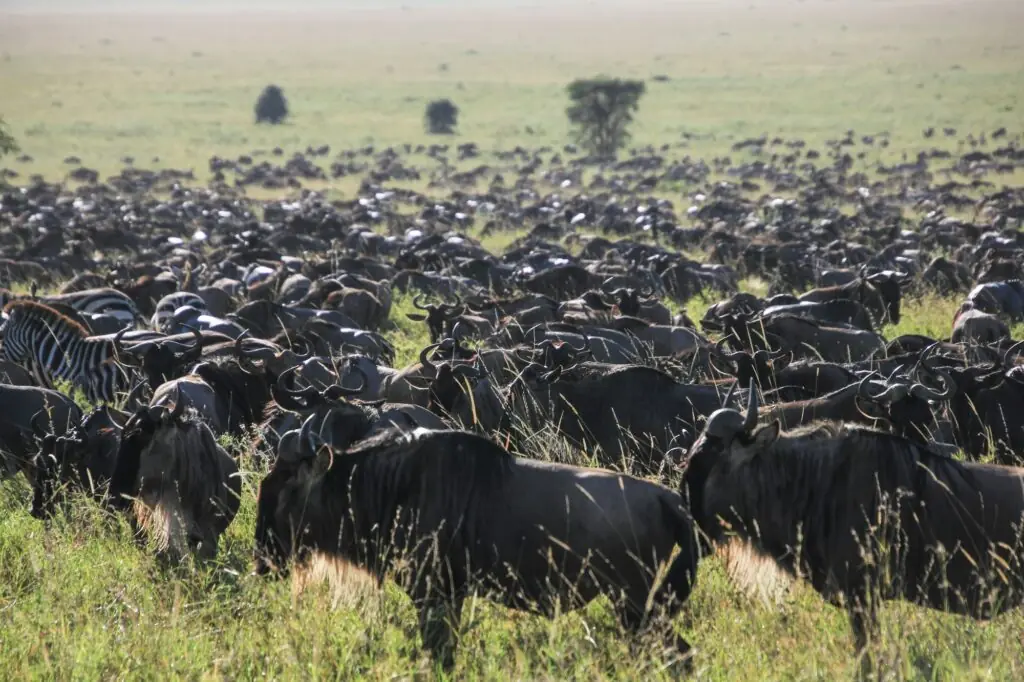
Wildebeest in Ndutu give birth from December to March, with a peak from mid-January to late February according to operators. No official date is published for 2027: the window shifts with autumn rains and from year to year, and the figure of 8,000 births a day often quoted is not sourced.
Checked on against the official sources cited: entry rules and formalities from government sites; birth dates and prices from operators and the press, flagged as such.
Every year, wildebeest from the southern Serengeti give birth on the Ndutu plains. According to operators and the press, the season runs from December to March. This article separates what is established (conservation area conduct rules, entry formalities listed by the UK’s Foreign, Commonwealth & Development Office) from what remains an estimate (the peak, birth counts, unconfirmed prices).
1. Where wildebeest give birth: the Ndutu plains
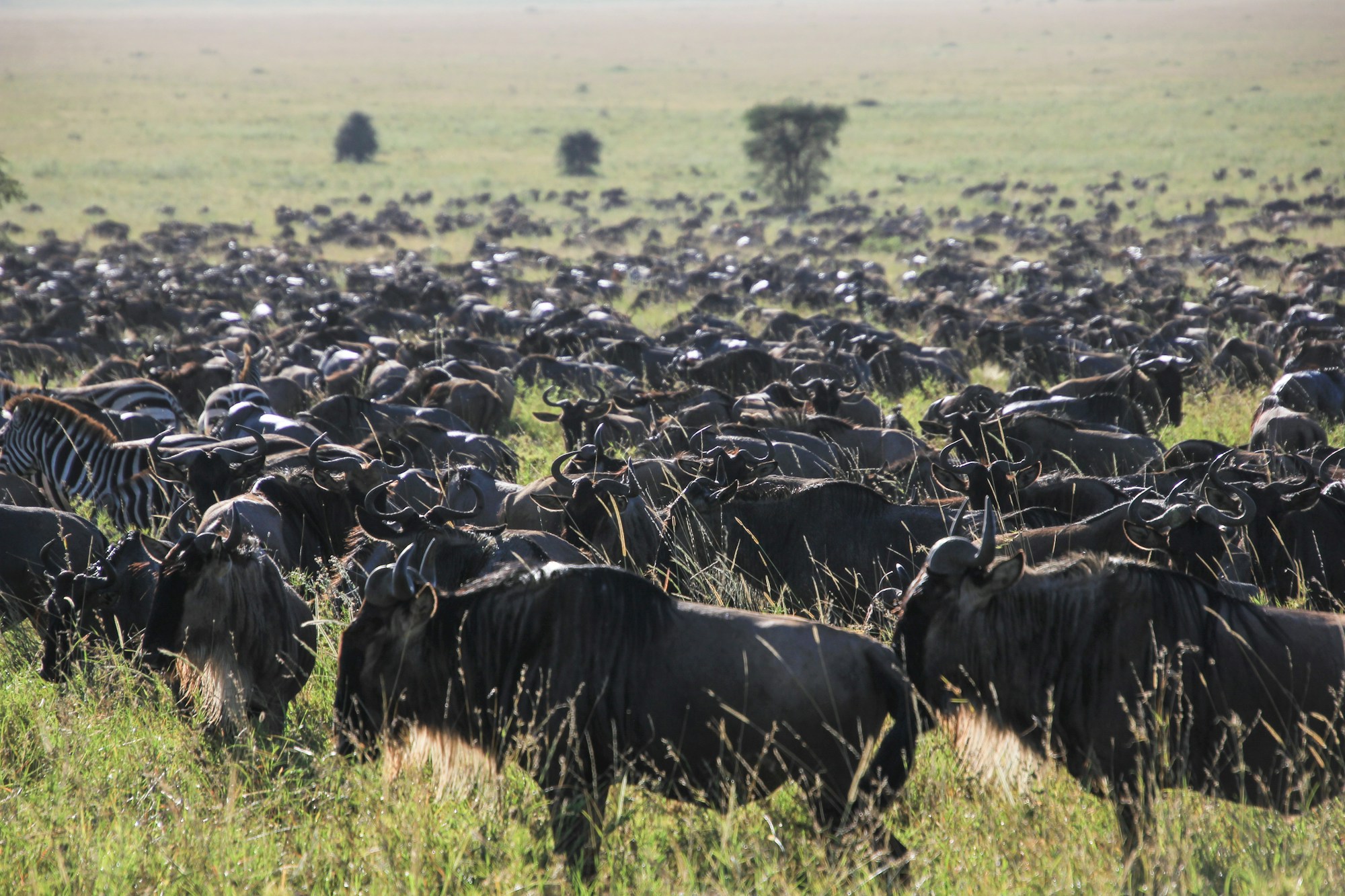
Ndutu, between the Serengeti and the Ngorongoro
Ndutu is a plain of short grass in the south of the Serengeti, straddling the Ngorongoro Conservation Area (NCA) and Serengeti National Park. The name « Ndutu Conservation Area » does not refer to a separate entity: the Ndutu plains lie within the NCA. Volcanic-ash soils and low vegetation make it easy to spot herds and predators from a distance. Horizon Guides describes the landscape and gives the December to March window; ndutugreenexplorers widens it to late November and identifies late January to late February as the most reliable peak.
Highlights
- An open plain where the young stay visible from the track.
- An area straddling the NCA and the Serengeti, so two sets of entry fees apply.
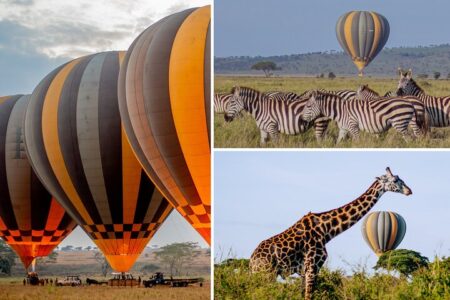
A hot-air balloon flight over the Serengeti is listed below. Its price and dates are not checked in this article.
2. When: the calving window
According to Doublesens, herds reach the southern Serengeti around mid-December and stay until mid-March. Calving spreads from December to March, with a peak from mid-January to late February according to operator guides. The Daily News, in an article dated 9 February 2026, puts the start at late January rather than December. February sees the most births according to the ndutugreenexplorers guide, updated 30 September 2026, and according to Cheetah Safaris, which also mentions a little calving in April. To see Ndutu within the full route of the herds, our guide to the 2026 Serengeti Great Migration covers each stage of the season.
No official start or end date exists, which is why the dates below are ranges, to be read « depending on the year ».
| Source | Type | Announced window | Peak | Page date |
|---|---|---|---|---|
| Horizon Guides | Operator | December to March | Mid-January to late February | Undated (© 2026) |
| Daily News via AllAfrica | Press | Late January to March | Not specified | 9 February 2026 |
| Cheetah Safaris | Operator | January to March, a little April | February | Undated (© 2026) |
| Labaafrica | Operator | January to February | Not specified | 28 October 2024 |
| ndutugreenexplorers | Operator | Late November-December to March | Late January to late February | 30 September 2026 |
| Doublesens | Operator | Mid-December to mid-March | January to mid-March | Undated (© 2026) |
| National Geographic | Press | January to April (text) | Not specified | 28 April 2026 |
Source: Horizon Guides, Daily News via AllAfrica, ndutugreenexplorers, Cheetah Safaris, National Geographic, checked on 19 November 2026.
3. Why this window: rains and synchrony
According to ndutugreenexplorers, the short rains of November and December make grass grow on the Ndutu plains, and calving follows that fresh grass.
The concentration also owes something to synchrony. In 2018, Calabrese and co-authors published a study in Scientific Reports proposing that males’ rutting calls synchronise reproduction among female Serengeti wildebeest. In the experiment, two groups of five females were compared: the group exposed to recordings of rutting calls was more than three times as synchronous in its expected mating timing as the control group. The sample is small, and the authors’ summary says the calls « could explain » the synchrony, without fully explaining it. We could not read the full text, which is available through the journal.
Open plains, where the young are visible, also attract predators: lions, cheetahs, leopards and hyenas. The guides describing frequent hunting scenes give no numerical series for Ndutu.
4. How many calves: the figures and their limits
The most repeated figure appears on almost every operator site: around 8,000 births a day at the peak. The same number shows up on other sites without a source. The seasonal total ranges from « hundreds of thousands » to « around 500,000 » calves. The highest daily peak would be 9,000 newborns, according to the Daily News, with no primary source.
These numbers do not add up. 8,000 births a day for two to three weeks gives between 112,000 and 168,000 calves, not 400,000 to 500,000. Reaching 500,000 at 8,000 a day would take about 62 days. Labaafrica also claims more than half a million births in « two to three weeks », which would mean 24,000 to 36,000 births a day, three to four times the figure the same site gives elsewhere.
When you read these numbers, keep one simple rule: describe the daily peak as « several thousand a day, according to operators », and the total as « hundreds of thousands of calves over the season ». None of the pages we read (the TANAPA homepage, the NCA rules) gives a birth count.
National Geographic cites up to 1.3 million wildebeest for the migration, citing the journal Science. That total covers the whole migration, not the births.
| Figure | Source | Status | Note |
|---|---|---|---|
| Around 8,000 births a day at the peak | Several operators | Estimated, unsourced | Repeated everywhere |
| Up to 9,000 a day | Daily News, 9 February 2026 | Estimated, unsourced | Highest figure cited |
| Around 500,000 calves per season | Daily News, Cheetah Safaris, Labaafrica | Estimated, unsourced | Consistent with about two months at 8,000 a day |
| 400,000 to 500,000 in two to three weeks | Labaafrica | Contradictory | Inconsistent with 8,000 a day |
| Up to 1.3 million wildebeest | National Geographic, citing Science | Cited | Total for the migration, not births |
Source: Horizon Guides, Labaafrica, Cheetah Safaris, Daily News via AllAfrica, checked on 19 November 2026.
5. The 2027 season: what the forecasts say
No official forecast gives the calving date for January to March 2027. Weather services do publish outlooks for late 2026, and those matter for the season that follows. The ICPAC regional climate centre, in its GHACOF74 statement of 18 August 2026, gives a probability above 90% of exceeding 400 mm of rain for October to December 2026 in several areas, and up to 50% above the historical climate in western Tanzania and around Lake Victoria.
The World Meteorological Organization, in its statement of 19 August 2026, judges the start of the rainy season more likely early to normal across most of Tanzania, and expects El Niño to strengthen by the end of the year. The Tanzania Meteorological Authority had already flagged a possible El Niño between October and December in a 25 May 2026 notice. Its August forecast, which we could not open in full, points to normal to above-normal rain in the north and east, intensifying in November and extending into January 2027.
| Forecast | Source | Date | Status |
|---|---|---|---|
| Possible El Niño between October and December 2026 | Tanzania Meteorological Authority | 25 May 2026 | Official announcement |
| Rainfall above normal in the west and around Lake Victoria, up to 50% above climate | ICPAC, GHACOF74 | 18 August 2026 | Statement |
| Early to normal start of the rains most likely across most of Tanzania | WMO | 19 August 2026 | Statement |
| Normal to above-normal rain, extending into January 2027 | TMA, August forecast | August 2026 | Cited, not opened |
| January to March 2027 | No official forecast | Not available | To come |
Source: ICPAC, GHACOF74, WMO, AllAfrica, TMA, checked on 19 November 2026.
What this changes comes down to two points. Autumn rains determine the fresh grass, and a late or very heavy downpour can scatter herds to the north, according to ndutugreenexplorers and National Geographic. El Niño, for its part, is a factor for the year, not a forecast of a date: on its own it does not tell us whether calving in 2027 will come earlier or later.
Tracks are a separate risk. An undated press article from The Citizen reports Serengeti roads damaged by rain, and end-of-season tracks can be difficult, with no precise date given.
6. Entry formalities and budget: what changed in autumn 2026
Entry formalities changed between October and November 2026. Since 1 October, every foreign visitor must take out local travel insurance of USD 44 per person, even if already insured. The FCDO travel advice confirms that the insurance is mandatory and that it is bought from the NIC for the mainland and the ZIC for Zanzibar. The USD 44 amount comes from the French Foreign Ministry page, updated 12 November 2026; the FCDO page gives no amount. Since 17 October 2026, every traveller must complete the online health form on the Afyamsafiri platform before departure or on arrival. The FCDO also reports heightened screening for travellers from high-risk regions and affected countries, following the Ebola outbreak in the Democratic Republic of the Congo, and temperature checks at all points of entry.
The visa is applied for online, on the official immigration.go.tz portal, which we could not open during research. According to the FCDO, a single-entry tourist visa can be obtained on arrival at the main entry points, but a multiple-entry visa cannot. The FCDO also advises applying for an e-visa before you travel, and says the visa can no longer be obtained from the Tanzanian High Commission in London. The USD 50 figure most often quoted for a single entry is not confirmed on any official Tanzanian site. The passport must be valid for six months after arrival, with at least one blank page.
On yellow fever, the rule we found is as follows: a certificate is required for a traveller over one year old arriving from a country with a transmission risk, or who has spent more than 12 hours in the airport of such a country. The FCDO page does not cover transit, and neither the FCDO page nor the French ministry page we read names the UK or France as a risk country. Check the list linked from the FCDO entry-requirements page before you travel.
For park entry fees, the most consistent figure we found is an operator’s rate for the NCA: USD 60 for a non-resident adult, excluding VAT, or USD 70.80 with 18% VAT. Confirm this on the NCA site before you finalise a budget. The Serengeti National Park rates do not appear on any official page we read.
| Item | Amount or rule | Source | Status |
|---|---|---|---|
| NCA, non-resident adult | USD 60 excluding VAT, or USD 70.80 per 24 h | Operator (ngorongorocratertanzania.org) | To confirm with the NCA |
| NCA, child aged 5 to 15 | USD 20 excluding VAT, or USD 23.60 | Operator | To confirm with the NCA |
| NCA, vehicle registered abroad | USD 40 to 300 excluding VAT, depending on unladen weight | Operator | Disputed by comparison sites (USD 200 and 295) |
| Serengeti National Park, non-resident adult | About USD 83 per 24 h | Comparison sites | Not confirmed |
| Single-entry tourist visa | USD 50, the figure most often quoted | Comparison sites | Not confirmed |
| Local travel insurance | USD 44 per person, mandatory since 1 October 2026 | FCDO (obligation); French Foreign Ministry (amount) | Obligation confirmed; amount from one source |
| Afyamsafiri health form | Online before departure or on arrival; heightened screening from 17 October 2026 | French Foreign Ministry | Confirmed |
Source: FCDO, Tanzania entry requirements, checked on 19 November 2026; French Foreign Ministry, Tanzania (updated 12 November 2026) for the insurance amount.
For the budget, here is where each item stands: insurance of USD 44 (obligation confirmed by the FCDO, amount from the French ministry); NCA entry of USD 70.80 per 24 h for a non-resident adult (operator rate, to confirm with the NCA); visa of USD 50 (comparison sites, not confirmed); Serengeti park entry of about USD 83 per 24 h (comparison sites, not confirmed); camps and lodges, for which no 2027 rate could be sourced: ask the operators.
7. Conduct rules and the conservation area
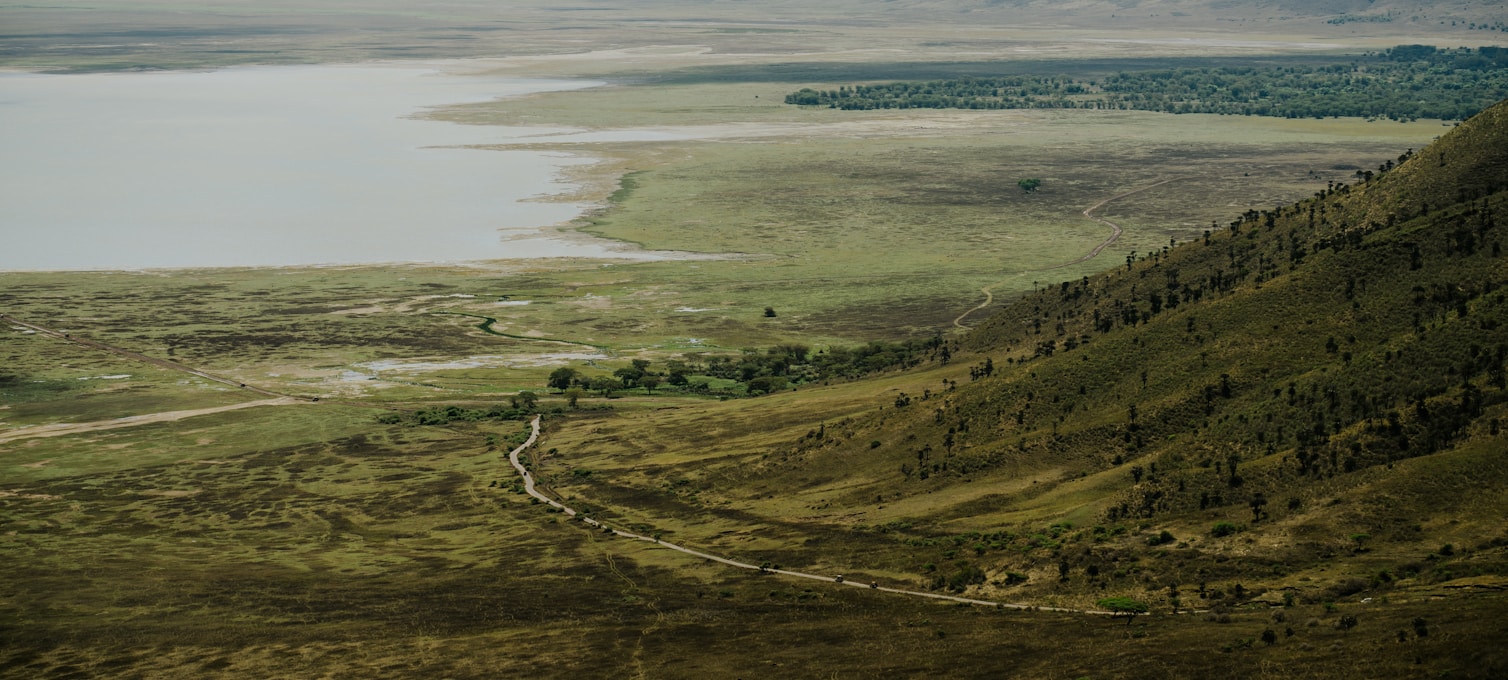
What the NCA requires of visitors
The Ngorongoro Conservation Area rules, consulted on 19 November 2026, leave no room for doubt. Visitors must stay on authorised roads and tracks, and off-road driving is banned. A licensed guide is mandatory for visitors to the crater and to Oldupai. The speed limit is 25 km/h, and no more than five vehicles may gather around an animal or a kill. The text of the rules gives no update date.
Highlights
- Off-road driving is banned, including when approaching the young.
- The limit of five vehicles around a kill is the only numerical rule on viewing distance.
- According to a 2024 summary, which we did not open, up to 600 vehicles a day would circulate at some points in the Serengeti.
Congestion is being tracked. A summary of the 2024 TAWIRI study, which we could not open, links up to 600 vehicles a day to heavy congestion at the Serengeti’s passage points, and mentions zones with an extra fee, one of them including Ndutu. We could not confirm that this fee applies to Ndutu. It does not change the conduct rules.
Road works are also moving ahead. The NCA plans to upgrade the 52 km Endulen-Ndutu road for all-year access. The announcement is dated 27 February 2026 and gives no construction timetable.
8. The conservation area: a controversy to know about
The Ngorongoro conservation area, where the Ndutu plains lie, is a UNESCO World Heritage site and home to Maasai communities. The Tanzanian government calls the relocation « voluntary »; human rights organisations dispute that it is voluntary and denounce evictions. In a statement reported by The Citizen on 28 July 2024, the government said the relocation is voluntary, participatory and transparent.
9. What other guides don’t tell you
The points below are established by an official or administrative source read on 19 November 2026. The operator guides we consulted for this article leave them out, or contradict them.
- Off-road driving is banned in the conservation area. The official rule says visitors must stay on authorised roads and tracks. A widespread claim says off-road driving is tolerated with a certified guide, which the text does not say. NCA rules (consulted 19 November 2026).
- No more than five vehicles may surround an animal or a kill. This is the only numerical rule on distance and vehicle numbers, and none of the guides we read mentions it. NCA rules (consulted 19 November 2026).
- Local travel insurance has been mandatory since 1 October 2026. It costs USD 44 per person and applies even to travellers who already have cover. FCDO, Tanzania entry requirements (consulted 19 November 2026) for the obligation; French Foreign Ministry for the amount (updated 12 November 2026).
- The Afyamsafiri health form and heightened screening have applied since 17 October 2026. They follow the Ebola outbreak in the DRC, and none of the birth guides we read mentions them. French Foreign Ministry, Tanzania (consulted 19 November 2026).
- According to the FCDO, the on-arrival visa is only available for a single entry. A multiple-entry visa cannot be obtained on arrival. FCDO, Tanzania entry requirements (consulted 19 November 2026).
- None of the pages we read gives a daily birth count. Neither the TANAPA homepage nor the NCA rules give this figure, and 8,000 births a day over two to three weeks does not produce 400,000 to 500,000 calves. TANAPA, homepage (consulted 19 November 2026, no birth figure).
10. Access and accommodation for the season
Kilimanjaro (JRO) remains the usual arrival airport. We have not checked flight schedules or connections on the airlines’ own sites, including for London departures, and no source confirms the road time from Arusha to Ndutu. The table below sums up what is known for the 2025-2026 season and what has not yet been published for 2027. If you are still choosing between Tanzania and Kenya for a first safari, the East Africa Safari 2026 guide compares the two countries.
| Item | Information | Source | Date |
|---|---|---|---|
| TAASA camp at Ndutu | 1 December 2025 to 31 March 2026 | ATTA | 1 December 2025 |
| TAASA camp at Grumeti | 1 May to 22 June 2026, after Ndutu | ATTA | 1 April 2026 |
| Ndutu Wilderness Camp (Wild Frontiers) | Reopens 15 December 2025 | ATTA | 2 December 2025 |
| Endulen-Ndutu road | 52 km, upgrade announced for all-year access | ATTA | 27 February 2026 |
| Accommodation for 2027 | No opening published to date | Operators | 19 November 2026 |
Source: ATTA, TAASA Migration Camp, ATTA, Wild Frontiers, ATTA, Endulen-Ndutu road, checked on 19 November 2026.
Frequently asked questions
When do wildebeest give birth in Ndutu?
From December to March, with a peak from mid-January to late February according to operators. Horizon Guides gives this window, and the Daily News, in an article dated 9 February 2026, puts the start at late January. No date is official: the window changes with the rains and from year to year, which is why no exact date can be guaranteed for 2027.
How many wildebeest are born each day?
Operators announce around 8,000 births a day at the peak, with a highest figure cited of 9,000. No official source confirms this number, and the seasonal totals in circulation do not match that rate: 8,000 a day for two to three weeks gives 112,000 to 168,000 calves. Present the figure as an operator estimate.
When is the wildebeest migration in Tanzania?
Calving takes place from December to March in the southern Serengeti and at Ndutu. In late April, according to the Labaafrica guide, herds start moving back west through the park. The migration does not follow a fixed date: the autumn and early-year rains decide when the herds are in each area.
Can you drive off-road at Ndutu to get a better view?
No. The Ngorongoro Conservation Area rules ban off-road driving and require you to stay on authorised roads and tracks. A licensed guide is mandatory in the crater and at Oldupai, the speed limit is 25 km/h, and no more than five vehicles may surround an animal or a kill. Read the full text of the rules before you go.
Do you need insurance to enter Tanzania?
Yes, since 1 October 2026. Local travel insurance of USD 44 per person is mandatory, even for travellers who already have cover. It is bought from the NIC for the mainland. The FCDO travel advice confirms the obligation, and the amount comes from the French Foreign Ministry page, updated 12 November 2026.
How much does entry to the Ngorongoro conservation area cost?
One operator quotes USD 60 for a non-resident adult, excluding VAT, or USD 70.80 with 18% VAT, for a 24-hour period. This rate has not been confirmed on the official NCA site. Vehicles registered abroad pay an extra fee based on their weight, and the amounts quoted by comparison sites differ: check before you budget.
Will El Niño change the calving date in 2027?
No forecast says so yet. The WMO, in its 19 August 2026 statement, expects an early to normal start to the rains across most of Tanzania, and El Niño is expected to strengthen through the end of the year. Forecasts for January to March 2027 are still incomplete, and none links El Niño to a specific calving date.
Should you book far in advance?
No opening date for the 2027 camps has been published yet. Ask operators for the confirmed opening date before you commit to dates. The booking lead times quoted on operator sites are not sourced.
Sources
- Horizon Guides, Calving season in Ndutu Plains : calving window and description of the plains, read 19 November 2026
- ndutugreenexplorers, Ndutu calving season guide : most reliable window and effect of the rains, updated 30 September 2026
- Daily News via AllAfrica, Witnessing the Serengeti calving season : window and unsourced birth figures, 9 February 2026
- Doublesens, the wildebeest Great Migration in Tanzania : migration calendar and location of Ndutu
- Cheetah Safaris, wildebeest calving season : February peak, unsourced figures
- Labaafrica, la saison des naissances des gnous : herds moving west, published 28 October 2024
- National Geographic, wildebeest and the Serengeti : total for the migration, dispersal depending on rain, 28 April 2026
- Calabrese et al., Male rutting calls synchronize reproduction in Serengeti wildebeest, Scientific Reports : summary read, full text not consulted, 2018
- ICPAC, GHACOF74 statement : forecasts for October to December 2026, 18 August 2026
- WMO, El Niño impacts Greater Horn of Africa : start of the rainy season, 19 August 2026
- AllAfrica, TMA announces a possible El Niño : notice of 25 May 2026, published 26 May 2026
- Ngorongoro Conservation Area, conduct rules : off-road driving, guide, speed and distance to animals, no update date
- Ngorongoro Conservation Area, rates (operator page) : entry fees, to confirm with the NCA
- FCDO, Tanzania entry requirements : insurance obligation, health form, visa and passport rules, checked 19 November 2026
- French Foreign Ministry, Tanzania : insurance amount (USD 44), updated 12 November 2026
- TANAPA, homepage : no rates and no birth figures
- AllAfrica, Maasai demonstration of 21 April 2026 : position of rights organisations
- The Citizen, Tanzania defends decision on Ngorongoro resettlement : government position, 28 July 2024
- ATTA, TAASA Migration Camp : 2025-2026 camp dates, 1 December 2025
Research carried out on 19 November 2026

Plan your trip with Pixidia
Pixidia learns how you travel and helps you build a trip that truly fits you and everyone coming along.
Open the planner