

From 1 January 2027, the Dutch flight tax (vliegbelasting) depends on the final destination: €31.04, €49.87 or €59.43 per passenger departing from a Dutch airport. These amounts have not yet been passed by the Eerste Kamer, the Dutch upper house. The long-haul band is €59.43 if the amendment is adopted, €74.81 without it.
Checked on against the official sources cited (Belastingdienst, Rijksoverheid, explanatory memorandum Kamerstuk 36 815).
For a traveller flying from Amsterdam to Paris, the planned rise is €0.79 per passenger in 2027. The vliegbelasting goes from €30.25 to €31.04 on that route, but what changes most is its logic: it now depends on the destination country. This article sets out, with figures and sources, what each passenger pays and what is still open as of 24 November 2026.
1. What changes on 1 January 2027
Today the vliegbelasting (also called vliegtaks) is a single flat amount. In 2026 it costs €30.25 per passenger boarding at a Dutch airport, whether the flight goes to Paris, Istanbul or New York. That single amount is being replaced by a rate that varies with the destination country.
The reform is called the “Wet differentiatie vliegbelasting” (the act differentiating the flight tax). According to the Eerste Kamer’s file, the Tweede Kamer (lower house) passed it on 27 November 2025, and the Eerste Kamer (upper house) on 16 December 2025. It was published in the Staatsblad on 23 December 2025, as Stb. 2025, 446. The differentiated rates take effect on 1 January 2027.
The 2027 amounts themselves (€31.04, €49.87 and €59.43) come from the 2027 budget bill, the Belastingplan 2027, filed on 15 September 2026. The bill replaces the long-haul band of €74.81 planned at first with €59.43. The Tweede Kamer approved it in mid-November 2026: on 12 November according to the parliamentary file, on 13 November according to the government. The Eerste Kamer had not yet voted at the date of this article.
Here is the timeline as it appears in the sources we checked on 24 November 2026:
- 27 November 2025: the Tweede Kamer adopts the Wet differentiatie (Eerste Kamer file).
- 16 December 2025: the Eerste Kamer adopts it, same source.
- 23 December 2025: published in the Staatsblad, Stb. 2025, 446.
- 1 January 2026: single rate of €30.25 per passenger.
- 15 September 2026: the Belastingplan 2027 is filed, setting the long-haul band at €59.43.
- 12 or 13 November 2026: approved by the Tweede Kamer (the date depends on the source).
- 1 January 2027: destination-based rates take effect.
- 1 January 2030: higher rates for aircraft with 19 seats or fewer (amounts not published in the texts we read).
A note on method: we could not read the text of the published law, as the Staatsblad PDF was not usable. The points below therefore rest on the Dutch tax authority’s page (Belastingdienst), on the explanatory memorandum to the bill (Kamerstuk 36 815, nr. 3) and on government pages. Each figure is dated and sourced.
2. The rates: 2026, 2027 draft and base amount
Three sets of figures circulate online, and many guides mix them up. The rate in force in 2026 is €30.25. The €29.40 figure, often shown as the current rate, is in fact a base amount at 2025 price levels, set by Article 77 of the law. The 2027 amounts are a proposal, not an approved rate.
| Band | Example destinations | 2026 in force | 2027 draft | 2027 without amendment | 2025 base amount |
|---|---|---|---|---|---|
| Short (Annex A) | EU countries, Canary Islands, Madeira, Azores, Dutch Caribbean | €30.25 | €31.04 | €31.04 | €29.40 |
| Medium (Annex B) | Türkiye, Egypt, Morocco, Tunisia, Dubai, Israel, Georgia, Cape Verde | €30.25 | €49.87 | €49.87 | €47.24 |
| Long (other states) | Thailand, United States, Suriname, Indonesia, Mexico, rest of the world | €30.25 | €59.43 | €74.81 | €70.86 |
| Unknown destination or private flight | Default rate under Article 77 | €30.25 | not confirmed | not confirmed | €70.86 |
Source: Belastingdienst, flight tax page (2026 rate), Rijksoverheid, cabinet plans (2027 draft) and explanatory memorandum, Kamerstuk 36 815 nr. 3 (base amounts), checked on 24 November 2026.
Read line by line, the 2027 draft gives these changes from 2026. Short band: €31.04, up €0.79 per passenger. Medium band: €49.87, up €19.62. Long band: €59.43 if the amendment is adopted, up €29.18. Without the amendment, the long band would stay at €74.81, up €44.56 on 2026.
One question the sources do not settle is indexation. The explanatory memorandum says the draft amounts already take account of indexation for 2026, but it does not detail how the 2027 amounts were calculated. Several calculations are arithmetically possible, and none is confirmed. So we use the euro changes as published, not a percentage of indexation attributed to the law.
The charge is per passenger, not per ticket. A booking for two adults and two children aged two or over therefore counts four times. A child under two pays nothing.
3. Who pays: the destination country, not the distance
The band does not depend on the airline or on the real flight distance. It depends on the country of the final destination. Every country appears in one of two legal annexes: Annex A (short band), Annex B (medium band), or neither (long band). The explanatory memorandum says the straight-line distance between Amsterdam and each state’s capital was used as a guide when drawing up these lists. So the destination is a country, and distance was only a tool in building the lists.
For a traveller from the UK or France, the practical result is simple. All EU member states are in the short band: a flight from Amsterdam to Paris, Lisbon or Madrid costs only €0.79 more in 2027. Destinations outside the EU depend on the lists. Türkiye, Egypt, Morocco, Dubai or Israel are in the medium band. Thailand, the United States, Indonesia or Mexico are in the long band.
A few cases surprise people and need explaining. The Dutch Caribbean islands (Aruba, Bonaire, Curaçao, Saba, Sint Eustatius and Sint Maarten) are in Annex A, so in the short band, even though they are very far from the European Netherlands. The explanatory memorandum bases this on the constitutional and societal ties of these territories with the Netherlands, not on distance. The Canary Islands, Madeira and the Azores are also in the short band, like the other EU outermost regions. By contrast, Tunisia is in Annex B, which may surprise anyone looking at a map. The list is the legal reference; distance was only a guide.
Two cases remain open. The United Kingdom is a European state, but whether it sits in Annex A or Annex B is not confirmed in the pages we read. If you are flying from Amsterdam to London, that is the open point that matters most to you: check the annex before you assume anything. Gibraltar, Akrotiri and Dhekelia are placed in Annex A by the summary of a parliamentary letter dated 9 July 2026. That summary was not confirmed by the explanatory memorandum.
Finally, if the final destination cannot be determined, or for a private flight, the law applies the highest Article 77 rate (€70.86 at 2025 prices). On a single ticket, the final destination is printed on the ticket.

Amsterdam, where the tax starts
The return to the Netherlands costs nothing: the tax applies only to flights that take off from a Dutch airport. A trip from Paris to Amsterdam and back to France is therefore taxed once, on the leg that leaves Schiphol.
The transfer into the city is a separate cost: it is not part of the tax, which covers only the departing flight.
Key takeaways
- The tax is due on departures from a Dutch airport, whichever airline operates the flight.
- The amount depends on the final destination country, not on the flight distance.
- All EU member states are in the short band.

For the rest of your stay in Amsterdam, the Netherlands page on Pixidia and the Amsterdam weekend itinerary for five are good starting points.
4. Flying from Schiphol: what the tax changes on the ground
Amsterdam Schiphol handles most Dutch traffic. According to a summary of a CBS (Statistics Netherlands) release, the Dutch airports welcomed 78.4 million passengers in 2025, about 88% of them at Schiphol (CBS, 2026/07, summary consulted on 24 November 2026). The tax applies to each of these departures, whichever airline operates them, Dutch or foreign.
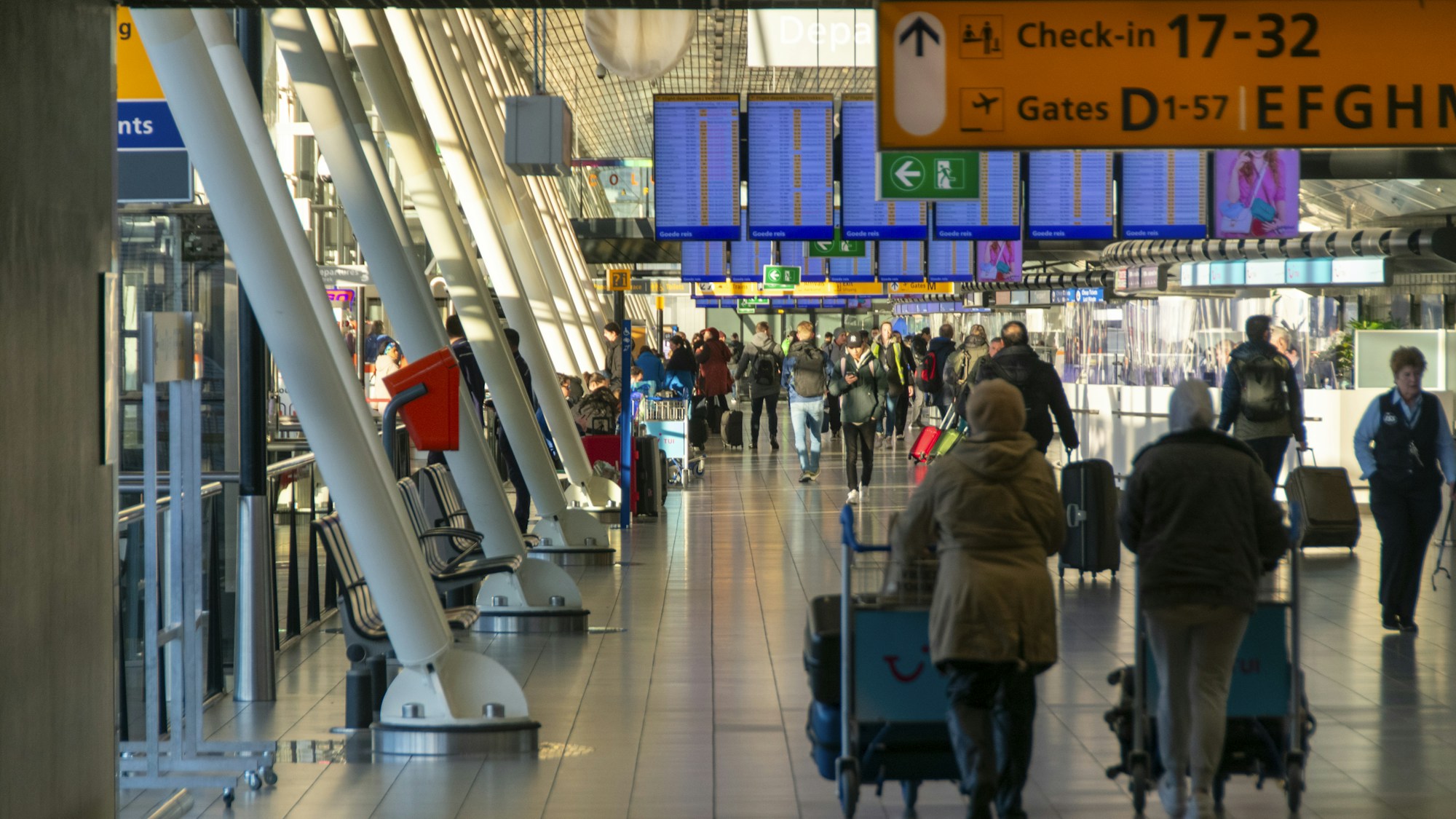
Amsterdam Schiphol, the airport where the tax applies
Departures from Schiphol are taxed whichever airline operates the flight, including flights run by a foreign carrier. The only useful question is whether the flight leaves the Netherlands.
Key takeaways
- Schiphol departures are taxed, whichever airline operates the flight.
- The transfer to the airport is not part of the tax.
5. Children, crew and connections: who doesn’t pay
Several cases are exempt, and the Belastingdienst describes them concretely. A child under two travels free. From the age of two, the child pays the full rate. Crew members are not counted. A passenger who simply changes planes at a Dutch airport on a single ticket is not counted either. Finally, a flight that does not leave the Netherlands does not pay the Dutch tax, including the return flight to the Netherlands.
Connections need a precise explanation, as they are the most common source of error. There are two situations:
- Single ticket, one booking. A passenger who changes planes at Schiphol and continues on the same ticket is not counted for the departure from Amsterdam. On a ticket Paris, Amsterdam then Bangkok, the tax does not apply to the connecting leg.
- Two separate tickets. Each flight is assessed on its own. A flight leaving Amsterdam for a destination is taxed according to the band of that destination, even if you bought the first leg somewhere else.
Before comparing two itineraries, check whether you have a single ticket or two separate bookings. With two tickets, the flight leaving Amsterdam is taxed according to its destination band: up to €59.43 per passenger in the long band if the amendment is adopted, or €74.81 without it.
For a family of four (two adults and two children aged two or over), a one-way departure from Amsterdam costs €121 in 2026. That rises to €124.16 in the short band, up €3.16. In the medium band the bill reaches €199.48, up €78.48 on 2026. In the long band it reaches €237.72 with the amendment, or €299.24 without it.
| Band | 2026 | 2027 draft | 2027 without amendment |
|---|---|---|---|
| Short (European Union) | €121.00 | €124.16 | €124.16 |
| Medium (Türkiye, Egypt, Morocco, Dubai) | €121.00 | €199.48 | €199.48 |
| Long (Thailand, United States, Mexico) | €121.00 | €237.72 | €299.24 |
Calculation based on the amounts published by the Belastingdienst and the Dutch government, checked on 24 November 2026. A child under two is exempt and is not included in this calculation.
6. Neighbouring airports: Germany, Belgium and Eindhoven
Some travellers consider departing from a neighbouring airport to avoid the Dutch tax. That is your decision, but the comparison needs to be precise. It does not account for the trip to the border, the ticket price or other taxes. A neighbouring airport is not cheaper by default.
Weeze and Düsseldorf (Germany). Since 1 July 2026, the German flight tax is reduced to €13.03 (short band), €33.01 (medium band) and €59.43 (long band). The German band depends on the flight distance. The federal government page we read does not give the kilometre thresholds, so from that source alone a traveller cannot tell which band applies to their destination. The reform was adopted by the Bundestag on 21 May 2026, then by the Bundesrat on 12 June 2026.
| German band | Before 1 July 2026 | Since 1 July 2026 |
|---|---|---|
| Short | €15.53 | €13.03 |
| Medium | €39.34 | €33.01 |
| Long | €70.83 | €59.43 |
Source: Bundesregierung, reduction of the air transport tax, checked on 24 November 2026. The German bands do not map exactly onto the Dutch ones, so the comparison is indicative.
Brussels and Charleroi (Belgium). The Belgian tax for 2027 is not settled. Accountancy van Morgen reports €7 per passenger for flights over 500 km from 2027, while a VRT NWS article, read as a summary, mentions €10 for long-haul flights. We therefore do not put a figure on the 2027 Belgian tax until an official source settles it.
Eindhoven. Eindhoven is a Dutch airport, so the Dutch tax applies to every departure there. But its single runway is closed from 1 February 2027 to mid-July 2027 for a full rebuild. No commercial flight operates during that period. The airport announces a reopening on 19 July 2027, and Transavia on 18 July. Transavia is moving its flights to Weeze and Maastricht-Aachen, according to the Transavia page we consulted (announcement summary, not opened in detail).
| Airport | Country | Applicable tax | Key point |
|---|---|---|---|
| Amsterdam Schiphol | Netherlands | Dutch tax, band depends on destination | Open all year |
| Eindhoven | Netherlands | Dutch tax | Runway closed from 1 February to mid-July 2027 |
| Rotterdam The Hague | Netherlands | Dutch tax | No specific date confirmed |
| Maastricht-Aachen | Netherlands | Dutch tax | Ryanair announced its withdrawal on 26 October 2025 (company statement, source of interest) |
| Weeze | Germany | German tax | No change linked to the Dutch reform |
| Düsseldorf | Germany | German tax | No change linked to the Dutch reform |
| Brussels Zaventem, Charleroi | Belgium | Belgian tax | 2027 amount not settled |
Sources: Eindhoven Airport, runway closure FAQ, Belastingdienst and Bundesregierung, checked on 24 November 2026.
7. Why the long band falls, and who challenges the tax
The government justifies cutting the long band from €74.81 to €59.43 by aligning it with the German rate for long-haul flights (Rijksoverheid, consulted 24 November 2026). The short and medium bands do not change from the original bill.
The industry wants further changes. KLM welcomed the cut in the long band and calls for the short and medium bands to be aligned with Germany (business.gov.nl, consulted 24 November 2026). On 19 May 2026, ANVR, the Dutch association of travel agencies, and several players (KLM, TUI, Corendon, Transavia) launched the “Gelijke Vliegtaks” (equal flight tax) campaign, calling for alignment with neighbouring countries (Euronews, 19 May 2026).
The figures put forward by this campaign are not verified. According to its organisers, a long-haul ticket would rise from €30 to €72, and a family of four would pay more than €190 for Türkiye, against about €40 from Belgium. We do not repeat them as facts.
On impact, an updated impact study, cited in the summary of a letter to parliament from October 2026, expects a limited effect: around 0.1% of passengers in the scope studied, with volumes at Eindhoven and Schiphol almost unchanged. This summary has not been checked against the full text: read it as an indication, not a measurement.
8. What is still unconfirmed as of 24 November 2026
Several points are still open. We list them so you don’t take them as settled.
- The Eerste Kamer vote on the Belastingplan 2027: no date was found in the sources consulted. The 2027 amounts remain a draft until that vote.
- Publication in the Staatsblad of the 2027 budget after the vote: date not confirmed.
- The band for the United Kingdom (Annex A or B), and that of Gibraltar, Akrotiri and Dhekelia, given by a summary not confirmed in the memorandum.
- The 2027 rate for an unknown destination: no source we read gives a figure.
- 2027 indexation: the memorandum does not detail how the 2027 amounts were calculated.
- Amounts for aircraft with 19 seats or fewer from 2030: not published in the texts consulted.
- The 2027 Belgian tax: figures differ between sources. We do not put a figure on it.
- France’s air ticket solidarity tax (TSBA): no confirmed 2027 amount in the sources consulted, so we do not compare it figure by figure.
- The reopening date of Eindhoven: 19 July 2027 according to the airport, 18 July according to Transavia.
What other guides don’t tell you
Five points are missing from most articles online, or are stated inaccurately there. Each rests on an official source checked on 24 November 2026.
- The current rate is €30.25, not €29.40. The €29.40 figure is the 2025 base amount under Article 77; it is not the 2026 rate, which is €30.25 for all destinations. Belastingdienst, flight tax (consulted 24 November 2026).
- The €59.43 long band is not final. It has been approved by the Tweede Kamer but not yet voted by the Eerste Kamer; without the amendment it would be €74.81. Rijksoverheid, cabinet plans (consulted 24 November 2026).
- The Dutch Caribbean pays the short rate because of constitutional ties, not distance. The explanatory memorandum bases this choice on the constitutional and societal ties of these territories with the European Netherlands. Explanatory memorandum, Kamerstuk 36 815 nr. 3, section 2.1.3 (consulted 24 November 2026).
- Small aircraft will pay more from 2030. Aircraft with 19 seats or fewer, mainly business and private aviation, are affected. The amounts are not published in the texts consulted. Business.gov.nl, amendment (consulted 24 November 2026).
- Two separate tickets: each flight is assessed on its own. A passenger who changes planes on a single ticket is not counted at the Amsterdam departure. With two separate tickets, only the flight leaving the Netherlands is taxed, once. Belastingdienst (consulted 24 November 2026).
Practical info before you book
The band is read from the country where the ticket ends. The airline makes no difference: if the flight leaves Schiphol, the Dutch tax applies.
They pay nothing. From the age of two they pay the full rate. Include them in your family budget before comparing prices.
A single ticket with a connection in Amsterdam is not taxed on the connecting leg. With two separate tickets, each flight is assessed on its own: only the flight leaving the Netherlands is taxed. Compare both options before you buy.
The runway is closed from February to mid-July 2027. Transavia says it is moving its flights to Weeze and Maastricht-Aachen, according to its page as consulted in summary form.
Frequently asked questions
How much will a flight from Schiphol cost in tax in 2027?
It depends on the final destination. The draft sets €31.04 for an EU country, €49.87 for a medium-band destination (Türkiye, Egypt, Morocco, Dubai) and €59.43 for long-band destinations, if the amendment is adopted. Without it, the long band would be €74.81. The 2026 rate is €30.25, and the 2027 amounts have not yet been voted. Source: Rijksoverheid, consulted 24 November 2026.
What is the rate for a flight from Schiphol to Paris, Lisbon or Madrid?
It is the short band: €31.04 per passenger in 2027, against €30.25 in 2026, so €0.79 more. All EU countries are in this band, France, Spain and Portugal included. The amount remains a draft until the Eerste Kamer votes. 2026 rate: Belastingdienst; 2027 draft: Rijksoverheid, both consulted 24 November 2026.
Does the Dutch tax apply if I fly from Paris with a connection in Amsterdam?
It depends on the ticket. On a single ticket that runs through to the final destination, a passenger who simply changes planes at Schiphol is not counted. If you buy two separate tickets, the flight leaving Amsterdam is taxed according to the band of its destination. The 24-hour rule mentioned in some summaries is not confirmed by the tax authority. Source: Belastingdienst, consulted 24 November 2026.
Do I pay the Dutch tax if I fly from Eindhoven or Weeze?
Eindhoven is a Dutch airport, so the tax applies to each departure there. But its runway is closed from 1 February to mid-July 2027, and no commercial flight operates in that period. Weeze is in Germany: the German tax applies, €13.03, €33.01 or €59.43 per passenger since 1 July 2026. Sources: Eindhoven Airport and Bundesregierung, consulted 24 November 2026.
Does a child under two pay the vliegbelasting?
No. A child under two travels free, including on a flight leaving a Dutch airport. From the age of two, the child pays the full rate, like an adult, and so counts in the total per passenger. For a family with two children aged two or over, the calculation covers four people. This rule is described by the Belastingdienst, consulted 24 November 2026.
Does a ticket bought in 2026 for a 2027 flight cost €30.25 or the 2027 rate?
No text consulted settles this specific case. The rule described by the Belastingdienst applies at the time of departure, so the rate for the year of departure should apply. That is a reading, not a certainty. Check the amount the airline shows at the time of booking. Source: Belastingdienst, consulted 24 November 2026.
Sources
- Belastingdienst, flight tax : 2026 rate, exemptions, connection rule, Dutch airports.
- Explanatory memorandum, Kamerstuk 36 815 nr. 3 : Article 77 base amounts, the destination criterion, the Dutch Caribbean.
- Rijksoverheid, cabinet plans for the flight tax : 2027 draft, long band at €59.43, approval by the Tweede Kamer.
- Business.gov.nl, amendment on long-haul flights : €74.81 without the amendment, aircraft with 19 seats or fewer.
- Ondernemersplein, tax increase : publication of the law and entry into force on 1 January 2027.
- Eerste Kamer, file 36 815 (Wet differentiatie) : adoption dates, summary.
- Eerste Kamer, file 37 022 (Belastingplan 2027) : filing and status of the 2027 budget, summary.
- Bundesregierung, reduction of the air transport tax : German rates since 1 July 2026.
- Eindhoven Airport, runway closure FAQ : closure and reopening dates.
- Accountancy van Morgen, comparison with Belgium and Germany (15 October 2026) : press source, Belgian figure not confirmed.
Sources checked on 24 November 2026. The 2027 amounts are drafts: to be rechecked after the Eerste Kamer vote.

Plan your trip with Pixidia
Pixidia learns how you travel and helps you build a trip that truly fits you and everyone coming along.
Open the planner