
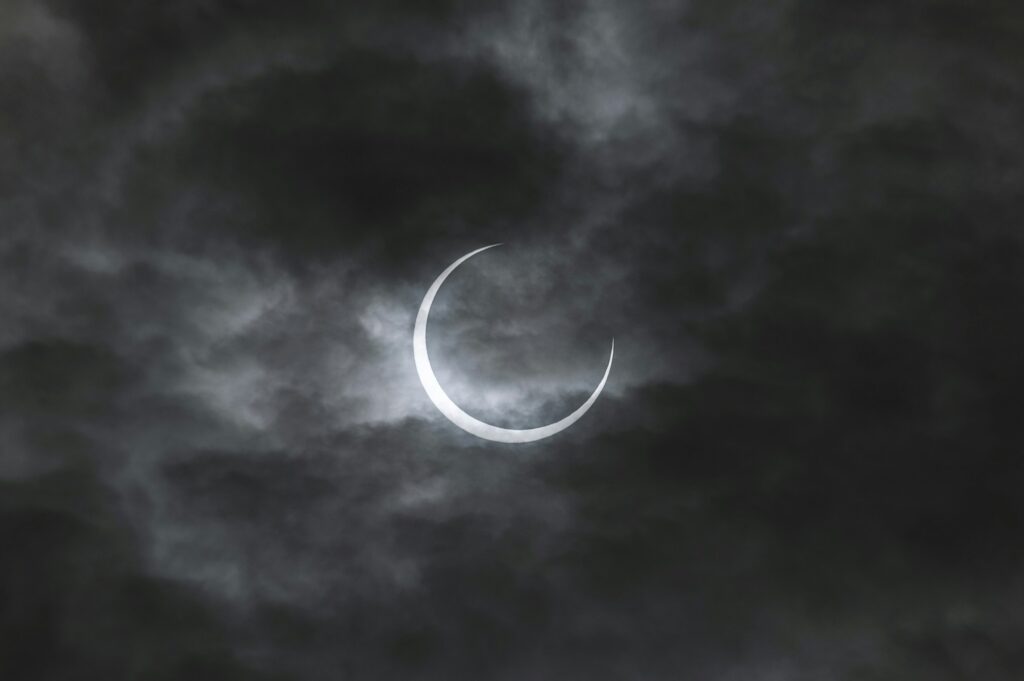
On 6 February 2027, the ring of fire is visible in southern Chile, Argentine Patagonia and the Uruguayan coast. In Esquel it lasts 7 min 31 s, around 11:56 am (UTC−3). In Punta del Este it lasts 5 min 36 s.
Checked on against NASA and the sources cited below.
On 6 February 2027, the ring of fire crosses three countries, but not all the places articles name. The annular band does not pass through Santa Cruz, Tierra del Fuego or Magallanes: those regions only see a partial eclipse. This guide shows where to stand in the band, at what time, what the sources say about logistics and eye safety, and what nobody can know yet, ten weeks before the event.
1. The annular band: where the ring really passes
The ring isn’t visible everywhere the eclipse is. NASA gives the annular band a width of 281.5 km. The path starts in the South Pacific, crosses southern Chile and Argentine Patagonia, runs along the Uruguayan coast, then heads out over the South Atlantic. NASA’s path page puts the maximum at 15:59:35 UT, off southern Brazil, which is about 1 pm local time in Argentina and Uruguay.
For a UK traveller, the useful question isn’t « can I see the eclipse? » but « in which town does the ring last, and at what time? » The table answers that for the towns most often mentioned. Times are in UTC−3, the time zone of Argentina and Uruguay for the whole period.
| Place | Country | Partial start | Maximum | Partial end | Annularity |
|---|---|---|---|---|---|
| Esquel | Argentina (Chubut) | 10:23 am | 11:56 am (Sun at 52°) | 1:35 pm | 7 min 31 s |
| Viedma | Argentina (Río Negro) | 10:34 am | 12:13 pm (Sun at 60°) | 1:54 pm | about 7 min |
| Futaleufú | Chile (Los Lagos) | not published | about 11:55 am | not published | 11:51 am to 11:59 am (about 7 min 30 s) |
| Punta del Este | Uruguay (Maldonado) | not published | 12:38 pm (86.1% obscured) | not published | 5 min 36 s (12:35 pm to 12:41 pm) |
| Montevideo | Uruguay | not published | 12:36 pm (85.6% obscured) | not published | none, partial eclipse only |
| Buenos Aires (city) | Argentina | about 10:46 am | 12:31 pm (about 82% obscured) | not published | none, partial eclipse only |
Source: solar-eclipse.info (Esquel), suncastapp.com (Viedma), Partirou (Punta del Este and Montevideo), Orbital Radar (Buenos Aires), The Clinic and a third-party calculator (Futaleufú), checked on 25 November 2026. « Not published » means none of these sources gives the value.
Three areas stand out. Chubut and Río Negro form the Argentine part of the band, with Esquel, Trevelin and Viedma. Southern Chile, from Chiloé to Chaitén and Futaleufú, is the most dramatic axis, but also the hardest to reach. The south-east coast of Uruguay, around Punta del Este and Rocha, has a shorter annularity and less tourist coverage in the sources consulted. Outside the band, Magallanes and Tierra del Fuego only see a partial eclipse: Punta Arenas about 60%, Ushuaia about 53%, according to Orbital Radar, the only source for these figures.
Don’t confuse this with the total eclipse of 2 August 2027, visible from Spain according to Euronews: our article on the solar eclipse of 2 August 2027 in Luxor covers it.
2. Uruguay: the ring over the Maldonado and Rocha coast
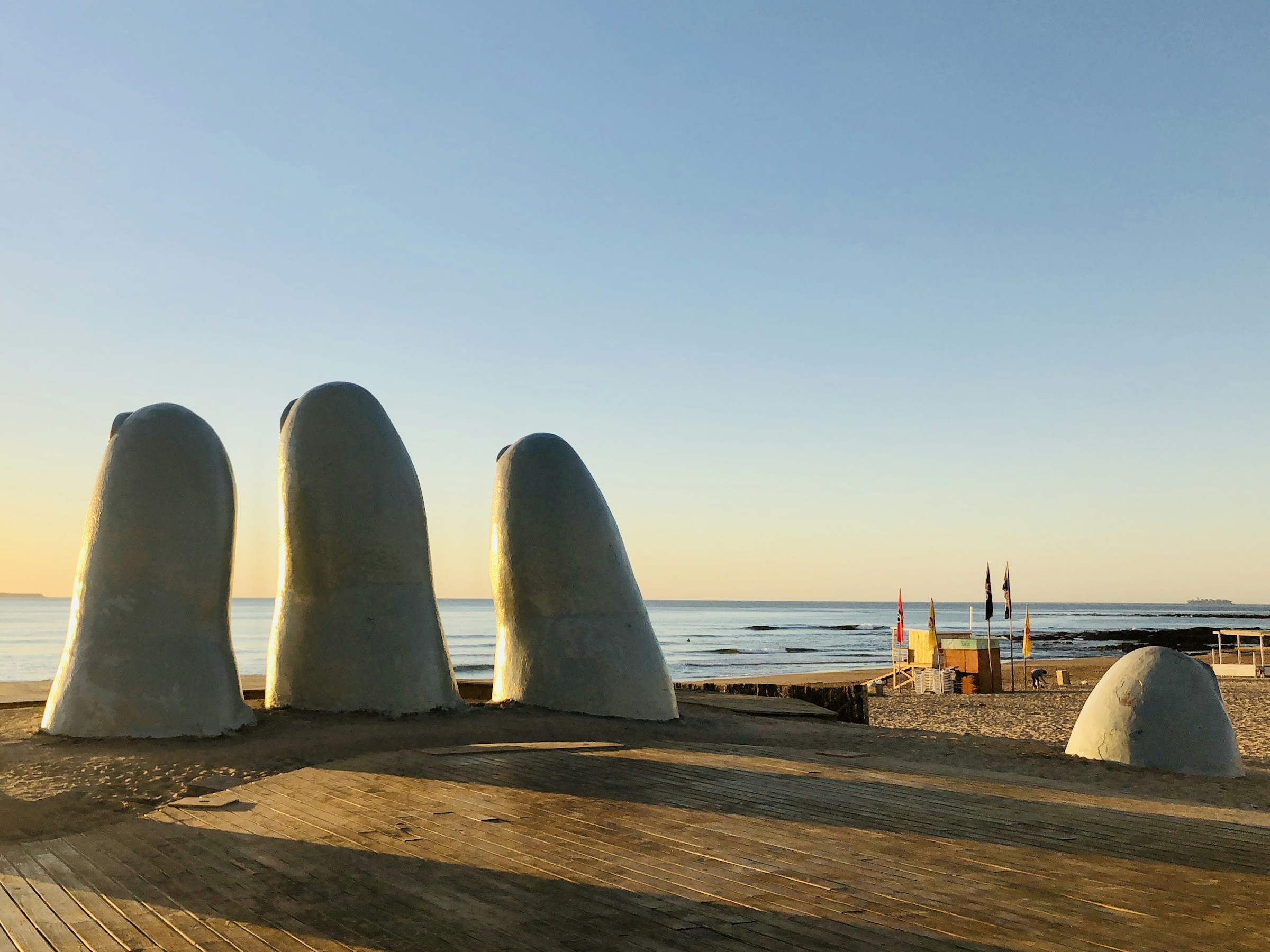
Punta del Este and the south-east coast
According to Partirou, the maximum at Punta del Este falls at 12:38:44 pm, with 86.1% of the Sun covered, and the annularity runs from 12:35:56 pm to 12:41:32 pm. The rest of the coast, from Maldonado to Rocha, is in the band: Piriápolis and La Paloma according to theeclipse.app, Costa Azul and Punta del Diablo according to third-party calculators. These towns don’t get figures here: check their times before you choose a viewing spot.
The weak point is cloud cover. Solar-eclipse.info gives an average cloud cover of about 53% for Punta del Este on that date. That’s a climate average, not a forecast: no reliable forecast exists ten weeks out, and no official Uruguayan communication (the Dirección Nacional de Meteorología, Udelar, the city council) has been found so far.
Highlights
- An annularity of 5 min 36 s at Punta del Este, against 7 min 51 s at the centre of the band
- Montevideo nearby, in a partial eclipse of 85.6%, if you’d rather sleep in the capital
The guided tour below is a city tour with sunset at Casapueblo. Viator lists it at 3:00 pm on 6 February 2027, a date checked on 25 November 2026. It doesn’t cover the eclipse, which ends around 12:41 pm: it’s a way to extend the day in Punta del Este, not to see the ring.
3. Argentina: Esquel, Trevelin, Viedma and the Río Negro coast
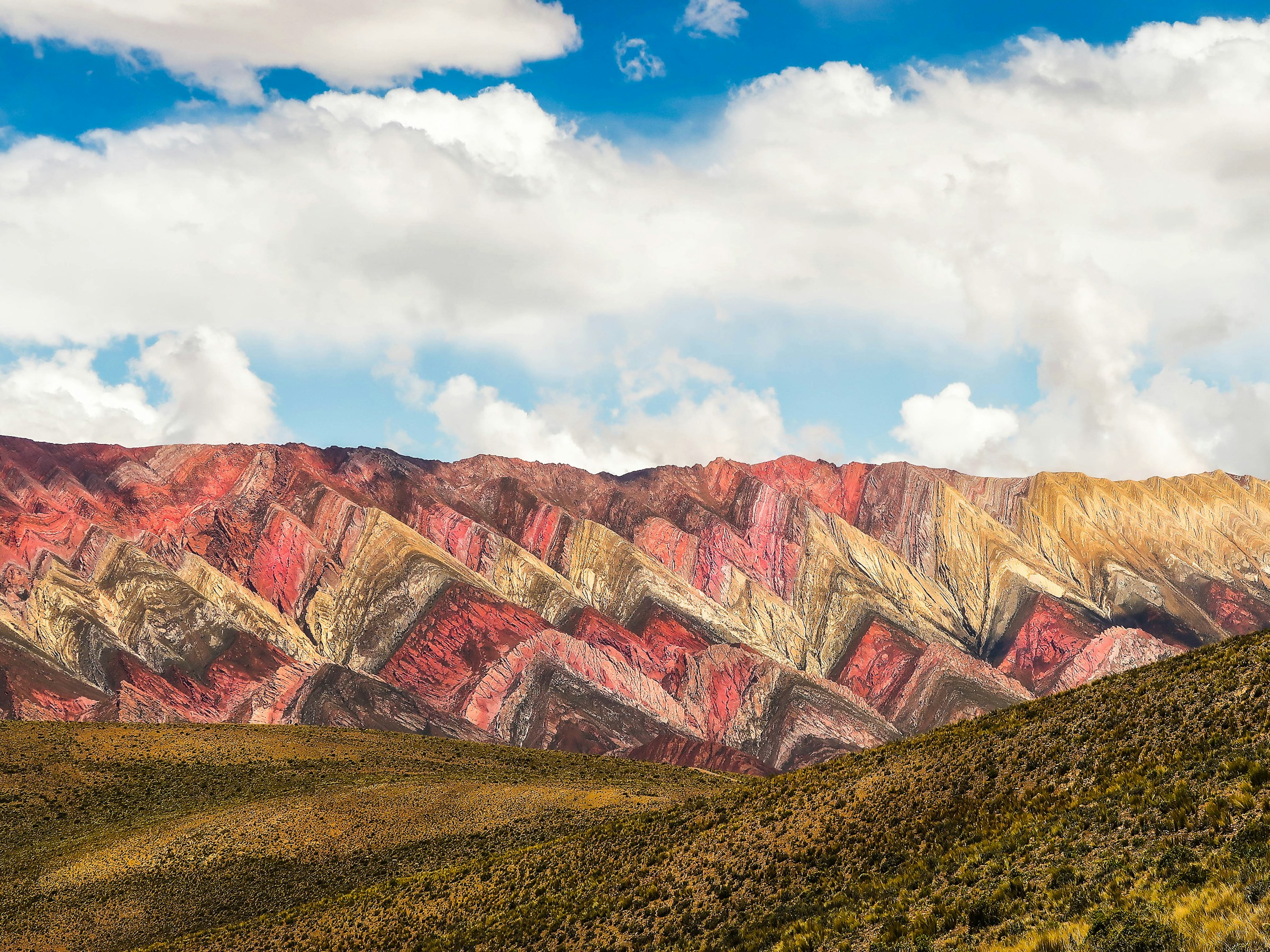
Esquel and Trevelin, on the central axis
Orbital Radar and solar-eclipse.info put the maximum at Esquel at 11:56 am (UTC−3), with an annularity of 7 min 31 s and the Sun 52° up. The partial phase starts at 10:23 am and ends at 1:35 pm. Esquel is also the town the Argentine press mentions most, calling it the best place in the world to see the eclipse: that’s promotional wording, and it hasn’t been verified.
Trevelin, a village founded in 1891 by Welsh settlers, sits at the centre of the band according to the Chubut press. More than six astronomy camps are announced there, with toilets, meals and EV charging. No prices are published, so this article quotes none.
Los Alerces National Park, near Esquel and Trevelin, is another point of interest. The official page from the Administration of National Parks says access is paid year-round, that provincial route 71 crosses the park (its condition needs checking), and that weather alerts should be read before a visit. It gives no fee and no distance between gates, so none are listed here.
Further north, Viedma has its maximum at 12:13 pm and the Sun at 60°, for an annularity of about 7 minutes. On 29 September 2026 the Río Negro provincial government published a programme for 6 February: activities at Playas Doradas, Viedma, Las Grutas and El Bolsón, and a swimming race at Las Grutas. The day falls on the carnival weekend.
Getting there is patchier. Aerolíneas Argentinas announces a direct Buenos Aires (AEP) to Esquel flight from March 2027, at an undated, indicative fare (Despegar). A weekly Córdoba to Esquel service runs, arriving on Thursdays (Diario Jornada, June 2026). The Trelew to Esquel bus, about nine hours, is listed by aggregators for the operator Vía Tac, unverified with the operator itself. From Paris, a comparison site (ou-et-quand.net) shows an average of about €1,151 return to Buenos Aires in February 2027 (range €750 to €1,650): that’s not an airline fare.
Highlights
- Esquel: on the central axis, with an annularity of 7 min 31 s and a maximum at 11:56 am
- Trevelin: a Welsh heritage, with astronomy camps announced
- Viedma: a provincial capital with a dated public programme
4. Chile: Los Lagos and Aysén, the most dramatic axis and the most stretched
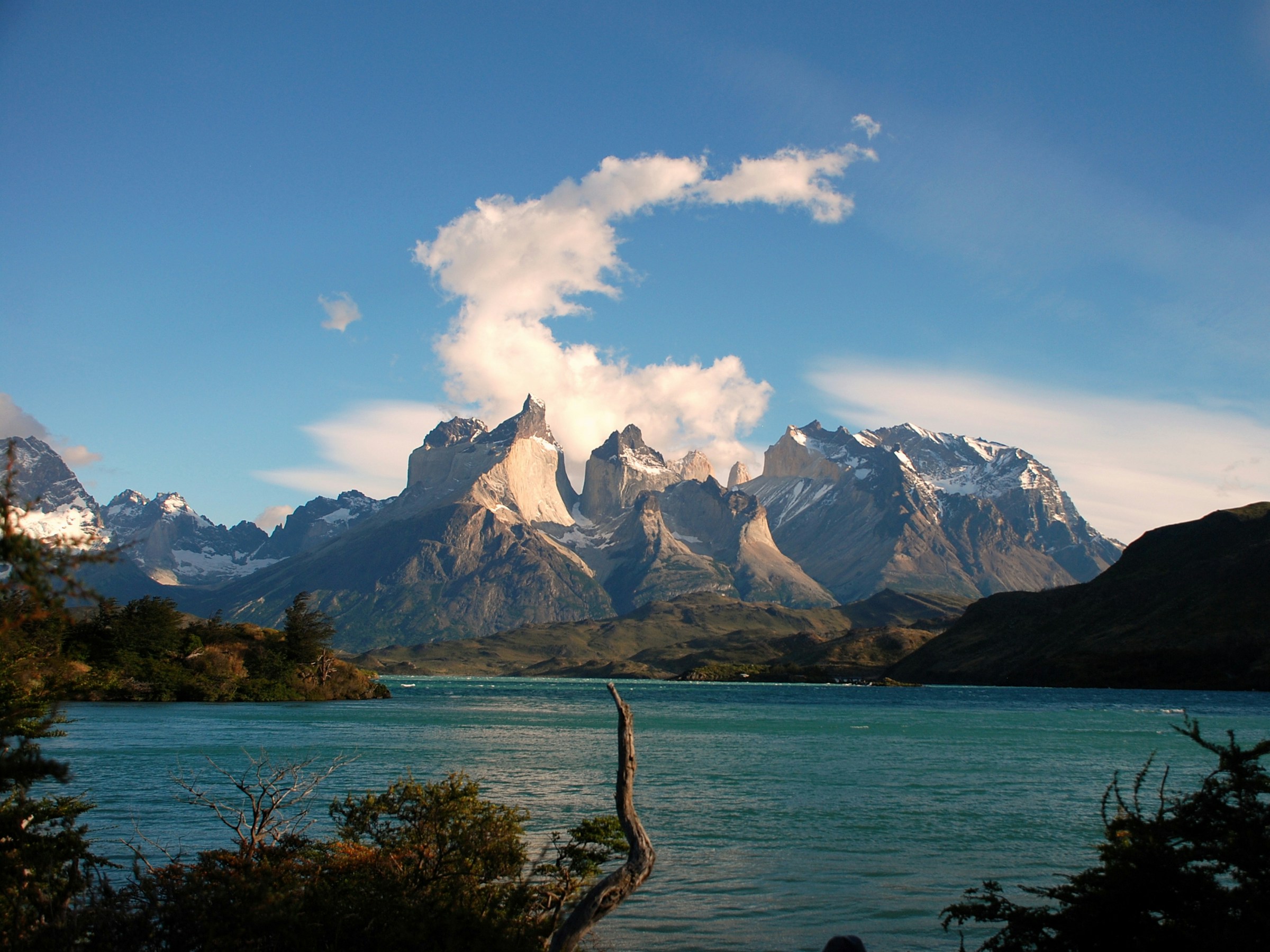
Futaleufú, on the central line
The central line passes over Chiloé, the Guaitecas archipelago (NASA cites Melinka), Hornopirén, Chaitén, Futaleufú and Pumalín park. Third-party calculators put the ring at Chaitén between 11:50:58 am and 11:58:29 am. According to The Clinic, Futaleufú is « exactly on the central line »: a journalistic claim, but one that fits these calculations.
The Clinic reported on 14 September 2026 that the 400 formal beds in this commune of about 3,000 residents were already sold out. The mayor puts visitor numbers at 20,000 to 30,000, and the presidential delegate for Los Lagos expects stays of four to five days. These are self-reported figures, not checked by an independent source, but they all point the same way: logistics will be the real constraint.
The regional Science office (Seremi de Ciencia) for Los Lagos, quoted by The Clinic, gives 86% darkness in the maximum zone, against 20% in Arica. Meganoticias gives 96%: that second figure seems to measure something else, so it isn’t used here.
For access, the routes described by aggregators run through Puerto Montt, then the Hornopirén to Caleta Gonzalo ferry, then about 150 km of road to Chaitén. The Puerto Montt to Futaleufú bus, three to four hours according to one aggregator, is unverified. No official 2026-2027 ferry timetable has been found, nor any ferry or bus fare for February 2027. A non-official guide recommends booking vehicle space on the ferry in advance.
The Carretera Austral is being paved, and the press reported a national paving plan on 23 May 2026. Weather in Chilean Patagonia is also contradictory across sources: between 70 and 86 mm of rain in February at Puerto Montt.
Highlights
- An annularity of about 7 min 30 s at Futaleufú, according to third-party calculators
- A sky that tends to clear when an anticyclonic ridge settles over Aysén, according to Meteored
5. Buenos Aires and the south of the province: the edge, not the ring
Buenos Aires, the capital, doesn’t see the ring. The eclipse there is partial, at about 82%, with a maximum at 12:31 pm and the Sun at 69° (Orbital Radar, checked on 25 November 2026). This needs to be clear: plenty of mainstream articles suggest otherwise, and a city visit won’t get you the ring.
Further south, Buenos Aires province lies on the edge of the band. Bahía Blanca is given an annularity of 3 min 55 s, 4 min 16 s or 4 min 32 s depending on the source. The figure isn’t settled, so cross-check it before you choose a town. Mar del Plata and Necochea are described as on the edge or inside the band, according to Infobae and Elonce.
Infobae has internal inconsistencies (San Antonio Oeste is given two different times in the same table), so its times aren’t used without cross-checking. Press articles that date the eclipse to 2 October 2027 or to 7 February are wrong: NASA, Wikipedia, Partirou and Cronista all give 6 February 2027.
6. Watching safely without burning your eyes
NASA asks for glasses that meet ISO 12312-2 for the whole visible phase of the Sun, including during annularity. Sunglasses don’t protect your eyes, however dark they are. The NASA text consulted was written for the 2023 eclipse, and the ISO 12312-2 standard is still the reference for the whole visible phase. No 2026-2027 guidance from Argentina, Chile or Uruguay has been found so far: the Chilean recommendations available date from 2019.
| Option | Compliant? | Note |
|---|---|---|
| ISO 12312-2 glasses | Yes | required for the whole visible phase |
| ISO 12312-2 handheld viewer | Yes | same requirement as glasses |
| Sunglasses, however dark | No | they do not protect your eyes |
| Indirect projection (pinhole, screen) | Yes | no direct look at the Sun |
| Dedicated filter for a camera or telescope | Yes, if the filter is made for it | glasses are not suitable for optics |
| Welding glass, shade 12 or higher | Not verified | mentioned as a stopgap in Chile, not to be repeated without medical advice |
Source: NASA, safe eclipse viewing, checked on 25 November 2026. The welding glass line comes from a Chilean labour authority, not from an ophthalmology opinion.
Watch out for counterfeits. Fakes copy the logo and text of legitimate makers. Check the « EN ISO 12312-2:2015 » marking on the product itself, and throw away any pair that is scratched or torn. Counterfeit sellers have been documented since the 2024 eclipse, notably by Amazon and the AAS.
7. The sky: what we can say and what we can’t
No reliable forecast exists ten weeks out. The data below are climatologies, averages calculated over several years. They help compare places, not decide on the day.
| Place | Figure | Nature | Source |
|---|---|---|---|
| Esquel | 45% average cloud cover on 6 February | average | solar-eclipse.info |
| Esquel | about 4.3 rainy days in February, at the airport | climatology | WeatherSpark |
| Esquel | gusts of 37 knots at the airport, annual average of 9 knots | annual statistic | Windfinder |
| Punta del Este | 53% average cloud cover | average | solar-eclipse.info |
| Puerto Montt | 70 to 86 mm of rain in February, depending on the source | conflicting data | climatestotravel, weather2travel |
Source: solar-eclipse.info and the climate sites cited, checked on 25 November 2026. These figures are not forecasts for 6 February 2027.
The most reliable factor remains the position of the anticyclones. Meteored Chile explains that an anticyclonic ridge settling over Aysén favours clear skies in Patagonia. It’s a qualitative trend, read a few days ahead, not ten weeks ahead. The wind is stronger on the eastern side and on the plains than in the valleys, and inland afternoons often cloud over through convection. Yet the shadow reaches the centre of the band well before that change can be read: the maximum at Esquel is at 11:56 am.
What other guides don’t tell you
The points below come from official or local sources consulted on 25 November 2026. The Infobae and Cronista EN articles, and the Partirou page, read for this research, don’t give all of them, or don’t give them in this detail.
- Río Negro has a public programme. Activities at Playas Doradas, Viedma, Las Grutas and El Bolsón, and a swimming race at Las Grutas on 6 February, according to the provincial government (published 29 September 2026). Gobierno de Río Negro (checked on 25 November 2026).
- Los Alerces is a paid park, with a road to check. Access is paid year-round, provincial route 71 crosses the park, and its weather alerts should be read before a visit. Administration of National Parks (checked on 25 November 2026).
- A British passport holder doesn’t need a visa for a short stay. No visa is needed for Argentina, Chile or Uruguay for up to 90 days, according to the FCDO. FCDO, Argentina, Chile and Uruguay (checked on 25 November 2026).
- Optics have their own rules. Glasses don’t protect a camera, binoculars or a telescope: you need a filter made for the optics, or an indirect projection. NASA, eclipse safety (checked on 25 November 2026).
- The 86% figure for Chile comes from a regional authority. The Seremi de Ciencia for Los Lagos gave it, as reported by The Clinic on 14 September 2026. Meganoticias gives a different figure, with no clear attribution. The Clinic (checked on 25 November 2026).
Entry, time zone and accommodation
For a short stay, no visa is needed in Argentina, Chile or Uruguay: up to 90 days in each country, according to the FCDO. The passport rules differ from one country to the next, so check the table below.
UTC−3 in Argentina and Uruguay for the whole period. In mainland Chile, UTC−3 stays in force until the clock change in April 2027, according to the Chilean press (Meganoticias).
Futaleufú’s 400 formal beds were sold out in September 2026. Viedma advises booking early. No verified rate for 6 February 2027 has been found, so none is published here.
| Country | Visa for a short stay | Stay without visa | Passport rule |
|---|---|---|---|
| Argentina | No | up to 90 days | valid for the whole stay |
| Chile | No | up to 90 days | expiry date after the day you leave Chile |
| Uruguay | No | up to 90 days | valid for the whole stay, with at least one blank page |
Source: FCDO, Argentina, Chile and Uruguay entry requirements, checked on 25 November 2026. The pages show no last-updated date, so check the rules again shortly before you travel.
Frequently asked questions about the annular eclipse of 6 February 2027
What date and time is the 2027 annular eclipse?
It takes place on Saturday 6 February 2027. NASA puts the maximum at 15:59:35 UT, off southern Brazil, about 1 pm local time in Argentina and Uruguay. The ring lasts 7 min 51 s at the centre of the band, which NASA gives as 281.5 km wide. Source: NASA, checked on 25 November 2026.
Where can I see the ring in Argentina?
In Chubut, at Esquel and Trevelin, on the central axis, with an annularity of 7 min 31 s at Esquel. In Río Negro, at Viedma, with an annularity of about 7 minutes. On the edge, in southern Buenos Aires province, at Bahía Blanca and Mar del Plata, with less stable durations. Buenos Aires, the capital, is not in the band. Source: suncastapp, checked on 25 November 2026.
Can I see the ring from Buenos Aires?
No. In Buenos Aires the eclipse is partial, at about 82%, with a maximum at 12:31 pm local time and the Sun at 69°. To see the ring you need to leave the capital and get into the band, in northern Patagonia or on the Uruguayan coast. Source: Orbital Radar, checked on 25 November 2026.
Do I need glasses during the annular phase?
Yes, always, for the whole visible phase of the Sun, including during annularity. You need glasses or a viewer that meet ISO 12312-2, not sunglasses. Cameras, binoculars and telescopes need a dedicated filter. Source: NASA, checked on 25 November 2026; this text was written for the 2023 eclipse.
Will the sky be clear?
Nobody can say ten weeks out. The available data are averages: about 45% cloud cover at Esquel and 53% at Punta del Este for 6 February. An anticyclonic ridge settling over Aysén favours clear skies in Patagonia, but that trend is read a few days before the event. Source: solar-eclipse.info, checked on 25 November 2026.
Can I sleep in Futaleufú without a booking?
Very probably not. The Chilean press reports that the commune’s 400 formal beds were sold out as early as 14 September 2026, and the authorities are considering arrangements with Argentine communes to spread visitors. No verified rate is available. Source: The Clinic, checked on 25 November 2026.
Do I need a visa for Argentina, Chile or Uruguay?
Will the eclipse be visible in Uruguay?
Yes, as a ring on the south-east coast, from Maldonado to Rocha. Punta del Este has an annularity of about 5 min 36 s, between 12:35 pm and 12:41 pm (Partirou), and Montevideo sees a partial eclipse at 85.6%. Piriápolis and La Paloma are in the band according to theeclipse.app; Costa Azul and Punta del Diablo appear in third-party calculators, with no figures given here. Source: Partirou, checked on 25 November 2026; theeclipse.app, third-party calculator.
Sources
- NASA GSFC, path of the 6 February 2027 annular eclipse : date, maximum, width of the band, duration
- NASA, safe eclipse viewing : eye safety rules
- FCDO, Argentina, entry requirements : visa, length of stay and passport rule
- FCDO, Chile, entry requirements : visa, length of stay and passport rule
- FCDO, Uruguay, entry requirements : visa, length of stay and passport rule
- Gobierno de Río Negro, 6 February programme : activities published 29 September 2026
- Administration of National Parks, Los Alerces : access and road
- solar-eclipse.info, Esquel : local times and average cloud cover
- suncastapp, Viedma : local times for Viedma
- Partirou, 6 February 2027 eclipse page : Punta del Este and Montevideo
- theeclipse.app, Uruguay : third-party calculator, coastal towns of Uruguay
- Orbital Radar, Buenos Aires : partial eclipse of about 82%
- The Clinic, Futaleufú : accommodation and the figure from the Seremi de Ciencia for Los Lagos (14 September 2026)
- Cronista EN, date confirmation : published 12 November 2026
- Meteored Chile : anticyclonic trend toward Aysén (qualitative trend)
Research carried out on 25 November 2026. The pages cited were consulted on that date unless stated otherwise. Third-party calculators and the press are identified as such in the text.

Plan your trip with Pixidia
Pixidia learns how you travel and helps you build a trip that truly fits you and everyone coming along.
Open the planner