
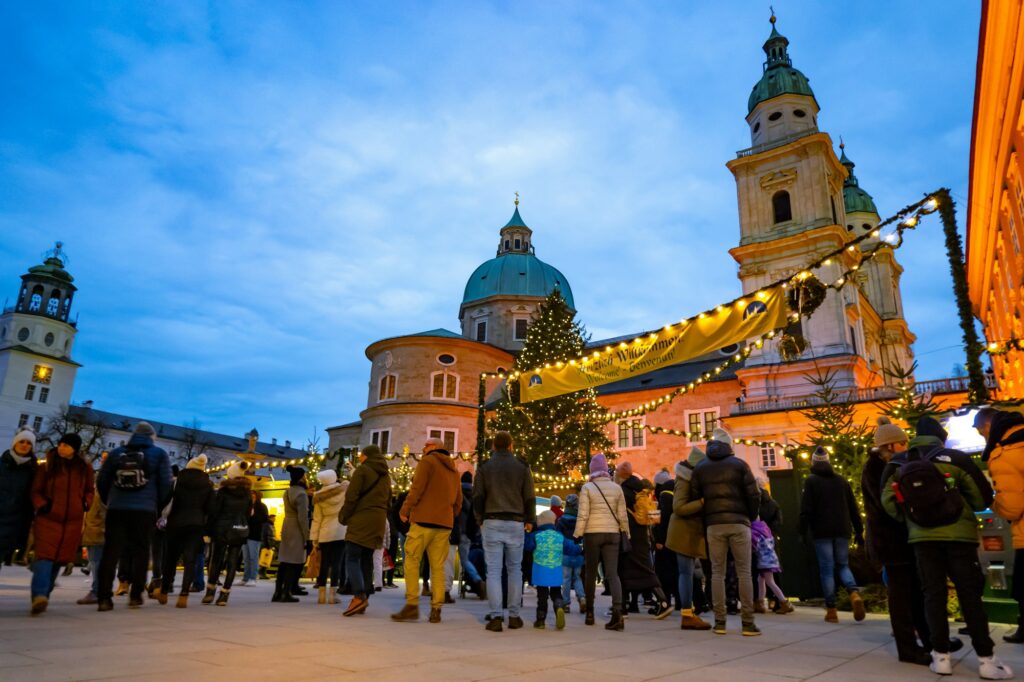
The Salzburg Christmas Market opens on Thursday 19 November 2026 at 10:00 and closes on Friday 1 January 2027 at 18:00. The Krampus parades fall on Saturday 5 December at 18:30 in the market, and on Sunday 6 December at 15:30 for children; the Perchtenlauf goes ahead on Monday 21 December at 13:00. No entry fee is reported for the market squares. The Advent concerts, however, need booking in advance. For a first visit, go on a weekday late in the afternoon: weekends and 5 December are the busiest.
When night falls early in December, brass rings out from the towers on the Residenzplatz and choirs sing in front of the cathedral. The Salzburg Christmas Market runs for six weeks, from 19 November to 1 January, and it is about more than chalets and mulled wine. The Krampus parades, the Mozarteum concerts and the traditions of the Alpine Advent make it a destination of its own, one that needs a little planning. Here is what is confirmed for 2026, what still needs checking, and how to plan a two- or three-day visit around the city.
Salzburg Christmas Market: Domplatz, Residenzplatz and the fortress
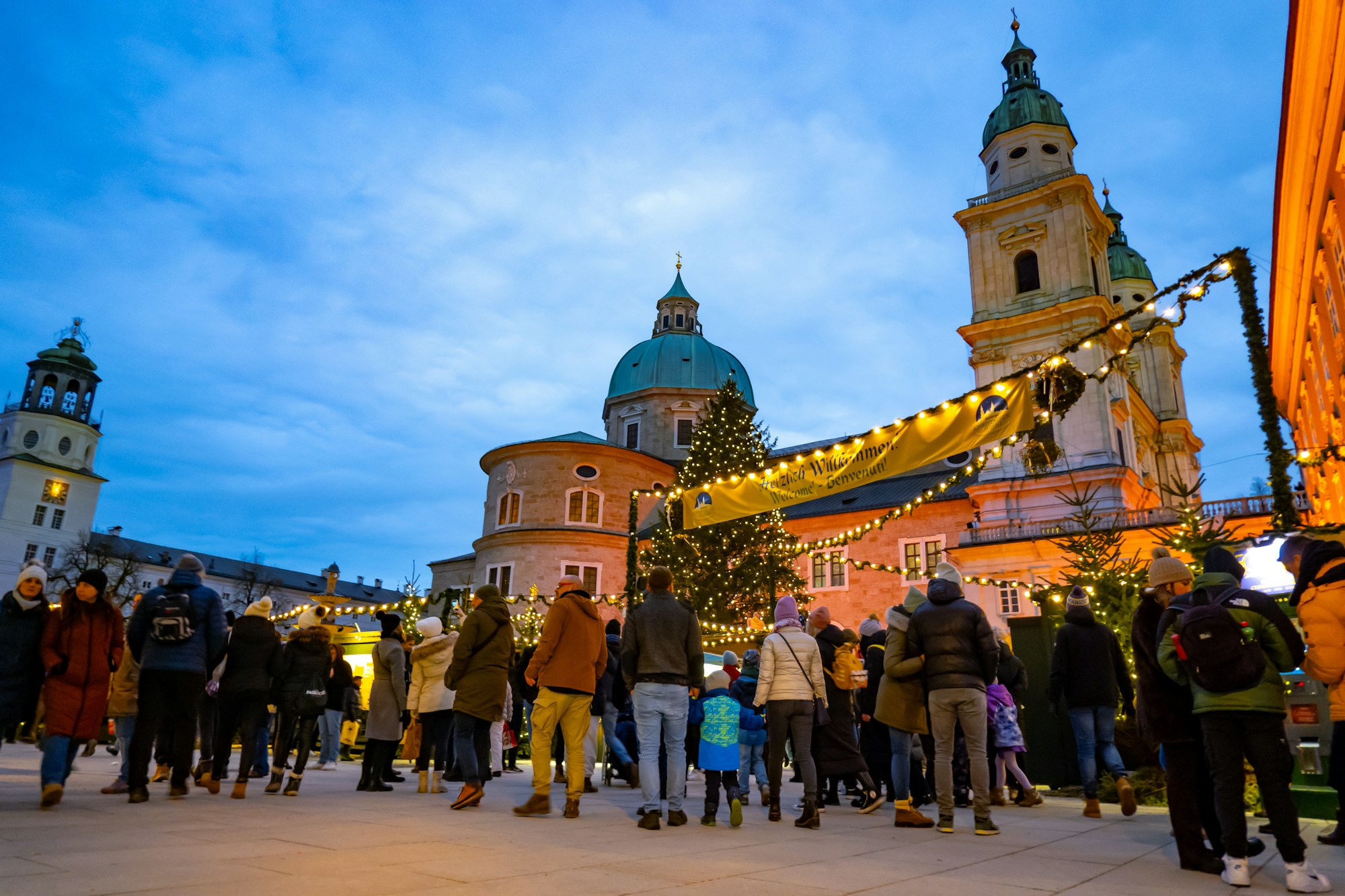
Domplatz and Residenzplatz, at the foot of the fortress
The market fills two squares in the centre of the old town, a UNESCO World Heritage site since 1996. On the Domplatz, the Marienstatue serves as a landmark, and the chalets line up all the way to the cathedral. The Residenzplatz, more open, hosts the brass towers and the concerts, with the Residenz as a backdrop. Since the extension of 2003, both squares can be walked in one pedestrian zone.
The current form of the market dates from 1974, set up at the foot of Hohensalzburg Fortress. The stalls sell crafts, decorations, sweet treats and hot drinks. Allow at least two hours for a first visit, and longer if you stop to listen to a choir.
Highlights
- A cathedral and a fortress in the same frame, visible from the stalls
- Choirs in front of the Dom and brass on the Residenzplatz in the evening
- A market within walking distance of the station, fifteen to twenty minutes on foot
To take a little of this tradition home, a 90-minute small-group class teaches you to bake Austrian Christmas biscuits and an apple strudel, with lunch included. It suits families with children, and it fits neatly into Advent.
Dates and hours for 2026: what’s confirmed
The market opens on Thursday 19 November 2026 at 10:00 and closes on Friday 1 January 2027 at 18:00. The 19th comes from the organiser and the tourist office: a local paper gives the 20th, but the official date is the one to rely on. The daily timetable follows the Salzburg Tourismus listing:
| Day | Market hours |
|---|---|
| Monday to Thursday | 10:00 to 20:30 |
| Friday | 10:00 to 21:00 |
| Saturday | 09:00 to 21:00 |
| Sunday and public holidays | 09:00 to 20:30 |
| Tuesday 8 December (Immaculate Conception) | 09:00 to 20:30 |
| Thursday 24 December (Christmas Eve) | 09:00 to 15:00 |
| Friday 25 and Saturday 26 December | 11:00 to 18:00 |
| 27 to 30 December | 10:00 to 20:30 |
| Thursday 31 December | Stalls from 10:00, closing 18:00 at the earliest; food served until 01:00 |
| Friday 1 January 2027 | 11:00 to 18:00 |
For 31 December, the official listing separates the stalls, which close at 18:00 at the earliest, from the food service, which runs until 01:00. One listing aggregator gives 10:00 to 01:00 for the whole market: go with the official version, the only one to spell out both services.
The market stays open on Tuesday 8 December, the Feast of the Immaculate Conception and a public holiday in Austria, with Sunday hours. Shops in the centre open case by case, depending on the business.
Krampus and Perchten: four events not to mix up
The Krampus is a figure from Alpine tradition who accompanies Saint Nicholas. He wears a carved wooden mask, heavy fur and large bells, and is said to chase away the evil spirits of winter. The Perchten, more tied to the solstice and to the Rauhnächte between Christmas and Epiphany, belong to a related tradition. The urban parades you see today are more recent than these traditions, but they borrow their codes.
Salzburg’s Advent programme has four events, and two of them fall on the same evening:
- Saturday 5 December, 17:30: Falkenpass Krampuslauf in the Altstadt. The route leaves from the Festspielhaus, passes the Bürgerspitalplatz, the Getreidegasse and the Alter Markt, then returns to the Festspielhaus. This parade is not the market’s.
- Saturday 5 December, 18:30: the Krampus pass through the market, with invited groups.
- Sunday 6 December, 15:30: Nikolo and Krampus for children, the gentlest moment of the series.
- Monday 21 December, 13:00: Perchtenlauf on the market, marking the first Rauhnacht.
The two 5 December parades are easy to confuse: one is organised in the Altstadt by the Falkenpass, the other takes place in the market. If you only want to see one, pick Sunday 6 December for the children, or Saturday at 18:30 for the evening atmosphere. No price is announced for these parades.
Advent concerts: Adventsingen, Mozart’s Requiem and the fortress
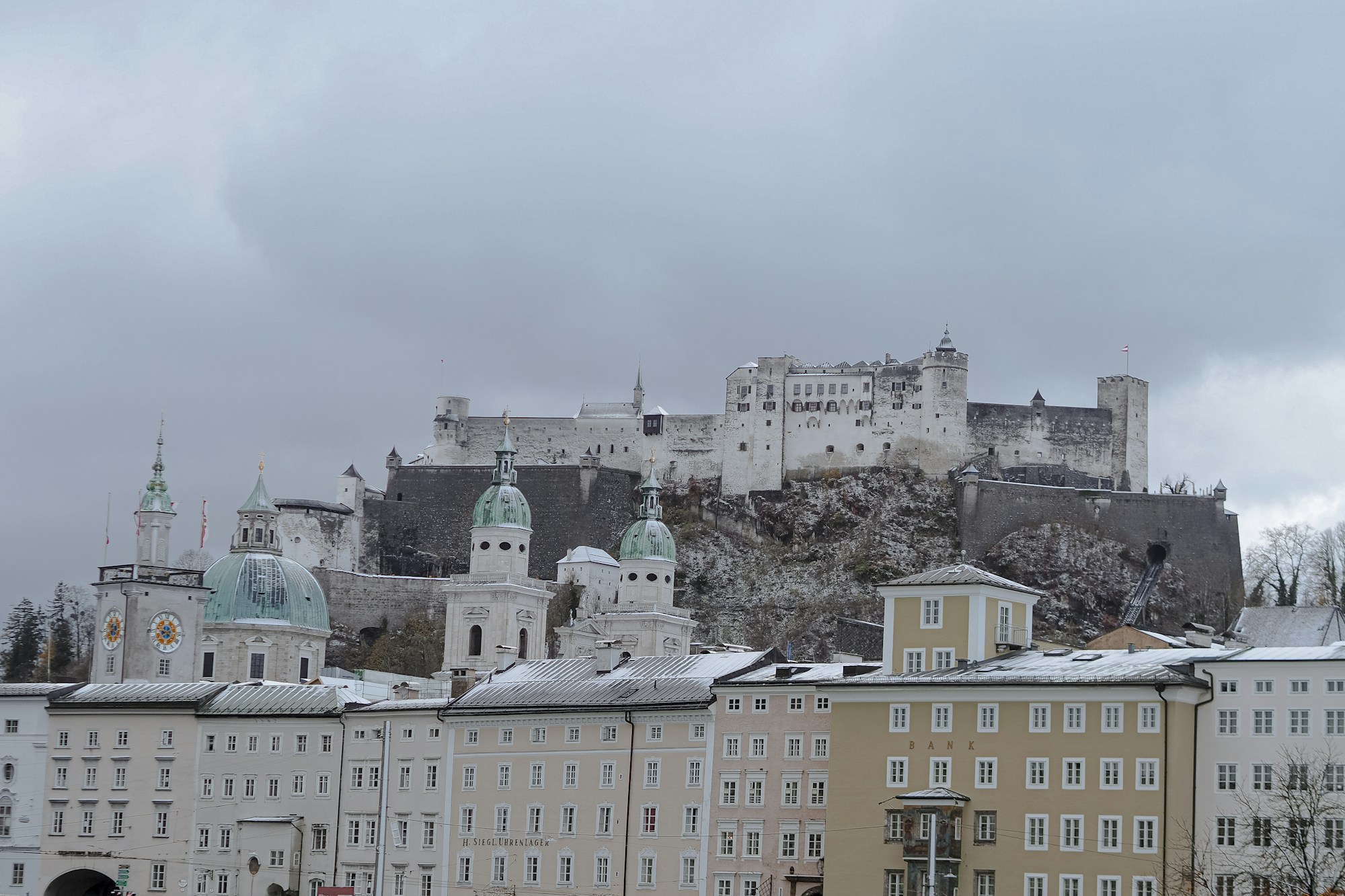
Music through Advent
Salzburg makes music a central part of its Advent. The Mozarteum, the fortress, St Andrew’s church and the Grand Festival each have their own programme, and several venues sold out in previous years. Book early for the dates you want, and check times on each venue’s website, as the listings don’t always agree.
- Salzburger Adventsingen: 13 performances from 27 November to 13 December 2026 at the Großes Festspielhaus (Hofstallgasse 1), for the 80th anniversary of the programme ‘Das große Geheimnis’. 2026 prices are not published in the sources we checked: confirm them with the venue.
- Mozart Requiem: Saturday 5 December at 19:00 at the Mozarteum (Grosser Saal), with the Mozarteumorchester Salzburg and the Bachchor under Trevor Pinnock. Seats cost €45 to €95 according to mozarteum.at, and €30 for pillar or accessible seats.
- Original Salzburger Advent: St Andrew’s church, near the Mirabellplatz, on 28 November at 18:30, 6 December at 16:00 and 12 December at 18:30.
- Advent concerts at the fortress: from Saturday 21 November at 18:00, then a series running until 29 December.
- Turmblasen on the Residenzplatz: brass from the towers on 25 November at 18:00, then on 6 and 13 December at 18:30. Times to be reconfirmed in December.
- Salzburger HirtenAdvent: 4, 5, 6, 8, 11, 12 and 13 December in the university’s Grande aula. Prices are on the official programme.
The Mozart dinner concert at the Stiftskulinarium of St Peter’s, at 19:30, features arias from Mozart’s operas. Drinks are not included. The 2026 dates vary between listings: confirm them before you book, and ask the venue for the price directly.
Stalls, Marktordnung and controversy: a reform still pending
On 5 October 2026, the Stadtsenat, the city’s executive, adopted a new Marktordnung, the market regulations. It is due to take effect on 1 November, subject to a vote by the city council, which had not yet taken place when we did our research. According to the press, the Christkindlmarkt, the Mirabellplatz market and the fortress market could stay open until 1 January, and the Sterngarten until 6 January. The organiser’s calendar remains the reference for your visit.
The debate focuses mainly on how stalls are allocated. One local paper counts 96 pitches, and applications are submitted before 30 June. The Verein, the organiser, selects exhibitors against a set of criteria. The NEOS party’s Lukas Rupsch calls for more transparency, the Bürgerliste (Ingeborg Haller) has for years criticised how hard it is for newcomers to apply, and the Verein’s president, Wolfgang Haider, defends the system. A 2019 review found the procedure was correct, and the city now announces a review of the allocation.
For a visitor, the impact shows in the aisles: some exhibitors change from one year to the next, and the offer feels more stable to regulars. The controversy does not change the visit, but it explains that impression.
A history that starts with the Tandlmarkt in 1491
The market likes to present itself as one of the oldest in the city. The verifiable history starts with the Tandlmarkt, a market for trinkets (Tand), recorded in 1491 on the cathedral square according to local historical sources. In the 17th century it was called the Nikolaimarkt, the Saint Nicholas market. Between 1903 and the early 1930s, it shrank to the edges of the cathedral arcades.
The current form dates from 1974, set up at the foot of the fortress on the Domplatz. The Residenzplatz was added in 2003. In 2024 the organiser celebrated 50 years of this form, and the 2025 edition was the 51st.
Mulled wine, punch and Mozartkugel: budgeting for treats
Mulled wine (Glühwein) and spiced berry punch are the market’s drinks. Prices are not uniform. In 2025, one stall charged €5.50 a cup plus a €4 deposit, another €4.50 plus deposit, and the berry punch cost a little more. 2026 prices are not published in the sources we consulted: for your first cup, use the 2025 benchmark, roughly €9.50 including the deposit, and check prices on the day.
The Mozartkugel, a ball of marzipan and nougat coated in chocolate, takes the composer’s name. It was created in 1890 by Salzburg confectioner Paul Fürst, according to the story published by the Fürst house, which also records a gold medal at the 1905 Paris World Exhibition. That account comes from the company that sells the sweet, so we report it without judging how original the recipe is.
Carry some cash, as small stalls do not always take cards. This comes from guidebooks and should be checked on the spot.
As a rough planning figure, allow €40 to €60 per person per day at the market, covering meals, drinks and transport, and excluding accommodation and concert tickets. This is a planning benchmark, not a price.
Getting there: entry rules, train and car
Entry rules depend on your nationality, so check them before you book. The research behind this guide covered French nationals only: for them, a tourist stay needs no visa, and a valid national identity card or passport is enough. The EES does not apply to EU nationals, and ETIAS does not apply to French nationals either. British travellers should check the UK government’s travel advice for Austria before they go: we have not verified the current entry requirements for UK passport holders in this guide.
There is no direct train between Paris and Salzburg. Routes go through Munich (TGV or ICE to Munich, then a regional train or ICE to Salzburg), through Stuttgart or Mannheim, or via Zurich. Journey times vary with the connection, and we have not checked every timetable, so confirm them when you book. Tickets sell in advance: our guide to SNCF tickets for Christmas 2026 explains the sales opening. If you are travelling from the UK, this guide does not cover those routes, so check the rail operators’ timetables directly.
By car, Austrian motorways require a vignette bought before you enter the network. Central parking is limited and expensive: use a car park on the outskirts and walk or take the bus into the old town. 2026 prices are not checked here.
By air, Salzburg W.A. Mozart Airport is linked to several European hubs, and a bus or taxi takes you into the centre. Journey times are not checked here.
Where to stay: Advent packages and handy areas
Many visitors stay two or three nights, and rooms fill fast on Advent weekends. Book as early as you can, especially for Friday and Saturday. The following packages, published for Advent 2026, often bundle a concert ticket:
- Glanz und Zauber des Advent 2026 (salzburg.info): two nights with an Adventsingen ticket and a Christkindlpass, from €458 per person in a double room at a 4-star hotel, and €475 at 5 stars, Friday to Sunday.
- Festlicher Advent in Salzburg 2026 (salzburg.info): from €495 per person at 4 stars, Friday to Sunday, with an Advent menu in a restaurant in the old town.
- Advent Magic 2026 (Elixhauser Wirt, a hotel outside the centre): two nights from €498 per person, with breakfast, dinner, an Adventsingen ticket and transfer. The tourist tax and the €2-per-night mobility fee are extra.
These packages are bundled offers, not room rates, so don’t compare them with an average price. Without a package, the old town and the station area are the most convenient. The main station is fifteen to twenty minutes on foot from the historic centre. Bus lines 1, 2, 3, 5 and 6 connect the station to the Altstadt in about ten minutes, according to the sources we consulted.
For a calmer stay, look for accommodation near the Mirabellplatz or the station: the Domplatz is about ten minutes on foot from the Mirabellplatz. Accommodation outside the centre is cheaper, but the bus back after an evening parade takes time.
Weather, families and safety: getting the visit right
In December, daytime highs hover around 3 to 4°C, and lows drop to between -2 and -4°C. The sun shines for only about two hours a day on average, and night falls early: the evening parades are easy to see, but the days are short. Snow is not guaranteed in the city, and the market can be visited in any weather.
The dense areas, such as the Domplatz and the Getreidegasse on Saturday evenings, attract pickpockets, as at other major European markets. Keep your bag in front of you and your phone in a zipped pocket.
Children are often the first to feel fear of the Krampus. Prepare them before the parade, put them at the front, hold their hand, and respect it if they don’t want to get close. The Nikolo on Sunday 6 December at 15:30 is the gentlest moment of the programme.
With a pushchair the market is still manageable, but the cobbles and crowds make it hard at peak times. For a wheelchair, step-free access to the fortress is not confirmed. The Mozarteum offers accessible seats at €30, according to mozarteum.at.
Alternatives: Hellbrunn, Mirabellplatz and Mattsee
The centre is enough for a day, but it fills up at weekends. Three alternatives are worth the trip if you want more calm or a different atmosphere:
- Hellbrunn: the Hellbrunner Adventzauber, marking its 25th anniversary, runs from 19 November to 24 December at the palace, outside the centre. Opening hours listed by salzburg.info run Tuesday to Friday from 13:00 to 20:00, and Saturdays, Sundays and public holidays from 10:00 to 20:00. Check the closing day and the entry fee on the official site.
- Mirabellplatz: a calmer market, ten minutes on foot from the Domplatz, near the Mirabell gardens. Hours vary between sources: confirm them before you go.
- Mattsee: a Krampuslauf is announced for Monday 7 December at 18:00, about thirty minutes’ drive away. It is a possible day trip, to be confirmed with the municipality.
Away from the market, the Weihnachtsmuseum (Christmas museum) occupies Mozartplatz 2, above the Café Glockenspiel. Its 2026 hours are not confirmed here: check them before you visit. A winter ice rink is listed on the Mozartplatz, with hours also to be checked. Mozart’s birthplace, Getreidegasse 9, is about five minutes on foot from the Domplatz.
If you are visiting several markets, our guides to the Nuremberg Christmas market and the Strasbourg Christmas market will help you compare the calendars. For a wider trip, Prague, Vienna and Budapest in early November reads well alongside, before the markets fill with tourists.
Practical info for your stay
Activate a data plan before you leave: no SIM card to hunt for at the station, and your tickets, timetables and bookings stay within reach from the moment you land.
Plans and prices by duration, on the partner’s siteOutdoor markets, icy cobbles and train journeys with connections: travel insurance covers the surprises that happen far from home.
Rates by duration and cover, on the partner’s siteFrequently asked questions about the Salzburg Christmas market
When does the Salzburg Christmas market open in 2026?
The Salzburger Christkindlmarkt opens on Thursday 19 November 2026 at 10:00 and closes on Friday 1 January 2027 at 18:00. The 19th comes from the organiser and the tourist office; a local paper gave the 20th. Hours vary by day: on Saturdays the market runs from 09:00 to 21:00, and on Sundays from 09:00 to 20:30. On 31 December the stalls close at 18:00 at the earliest, and food service runs until 01:00.
When does the Krampus parade in the market start?
The Krampus parade in the market takes place on Saturday 5 December 2026 at 18:30. The same evening, a separate race organised by the Falkenpass leaves the Altstadt at 17:30 along a route from the Festspielhaus. On Sunday 6 December at 15:30, Nikolo and the Krampus come for children. No price is announced for these parades, and the programme may change: reconfirm the time the week before.
How much does mulled wine cost at the Salzburg market?
2026 prices were not published in the sources consulted when this guide was written. In 2025, one stall charged €5.50 a cup plus a €4 deposit, another €4.50 plus deposit, and berry punch cost a little more. As a benchmark, the first cup comes to about €9.50 including the deposit, to be checked on the day.
Do you need a visa to visit Salzburg?
Visa rules depend on your nationality. For French nationals, the research found that no visa is needed for a tourist stay, and a valid identity card or passport is enough. The EES does not apply to EU nationals, and ETIAS does not apply to French nationals. British travellers should check the UK government’s travel advice for Austria before they go, as those entry rules are not verified in this guide.
Is the Salzburg Christmas market free to enter?
No entry fee is reported for the Domplatz and Residenzplatz squares in the sources we consulted. Your drinks, meals and purchases are paid for at the stalls. Several nearby venues do charge, however: the Hellbrunn palace, the Requiem at the Mozarteum, the Adventsingen and the Mozart dinner concert. Check prices directly with each venue.
When is the best time to avoid the crowds?
Monday to Thursday, early in the morning or late in the afternoon, are the quietest slots. Friday and Saturday evenings, the first Advent weekend and 5 December, with the parades, draw the biggest crowds. The first days, 19 to 22 November, are usually calmer. For a parade, arrive about thirty minutes early to get a good spot.
How long does it take to walk from the station to the market?
From the main station, allow fifteen to twenty minutes on foot to the historic centre. With luggage, allow more. Bus lines 1, 2, 3, 5 and 6 connect the station to the Altstadt. One aggregator gives a much longer trip, around 37 minutes: check the Salzburger Verkehrsverbund map before you set off.
Sources
- Salzburger Christkindlmarkt, salzburg.info: dates, hours and locations of the market
- Salzburger Christkindlmarkt, organiser’s website: opening and programme
- Krampus and Perchten, salzburg.info: traditions and 2026 parades
- Mozart Requiem, Mozarteum Salzburg: date, cast and tickets
- Salzburg24, Marktordnung and stall review: governance, October 2026
- Salzburg24, 2025 mulled wine prices: price benchmarks from the last season
- UK government travel advice, Austria: entry requirements and travel advice to check before you go
- Seat61, trains from Salzburg: rail routes to and from Salzburg
Research carried out on 9 October 2026. Hours and prices can change: check the official sites before you travel.

Plan your trip with Pixidia
Pixidia learns how you travel and helps you build a trip that truly fits you and everyone coming along.
Open the planner