
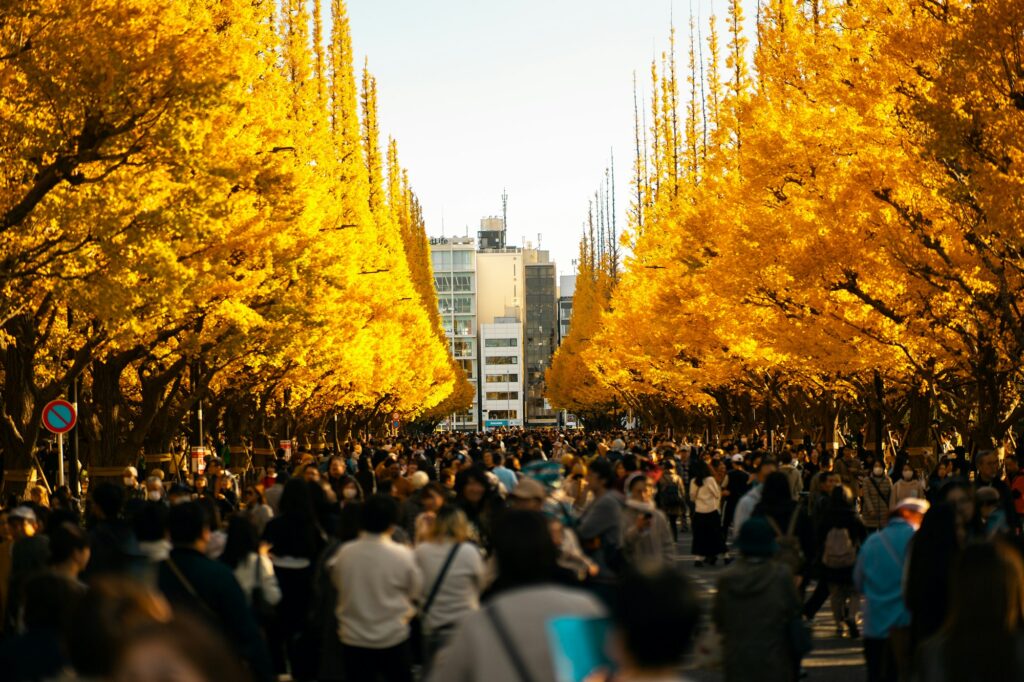
In Tokyo, maples should peak around 29 November 2026 and ginkgoes around 26 November, according to the Nihon Kishō (JMC) forecast relayed in September. The 28 November date you often see is an average. Koishikawa Korakuen lights up from 13 to 24 November.
Checked on against the official sources cited (Tokyo Metropolitan Parks Association, Ministry of the Environment, JNTO) and the JMC forecast relayed by Jorudan and nippon.com.
In Tokyo, the peak falls around late November: ginkgoes around 26 November, maples around 29 November (JMC forecast 2026). In Japan, momiji (紅葉) is the red of maple leaves, ichō (黄葉) the yellow of ginkgoes, and koyō (紅葉狩り) the outing to go and see them. Here are the sourced 2026 dates, the evening illuminations, the prices and the traps that cost you a whole day: Shinjuku Gyoen’s closed Monday, the still-green October, and an Icho Namiki illumination that nobody has announced.
1. Icho Namiki: the ginkgo avenue of Meiji Jingu Gaien
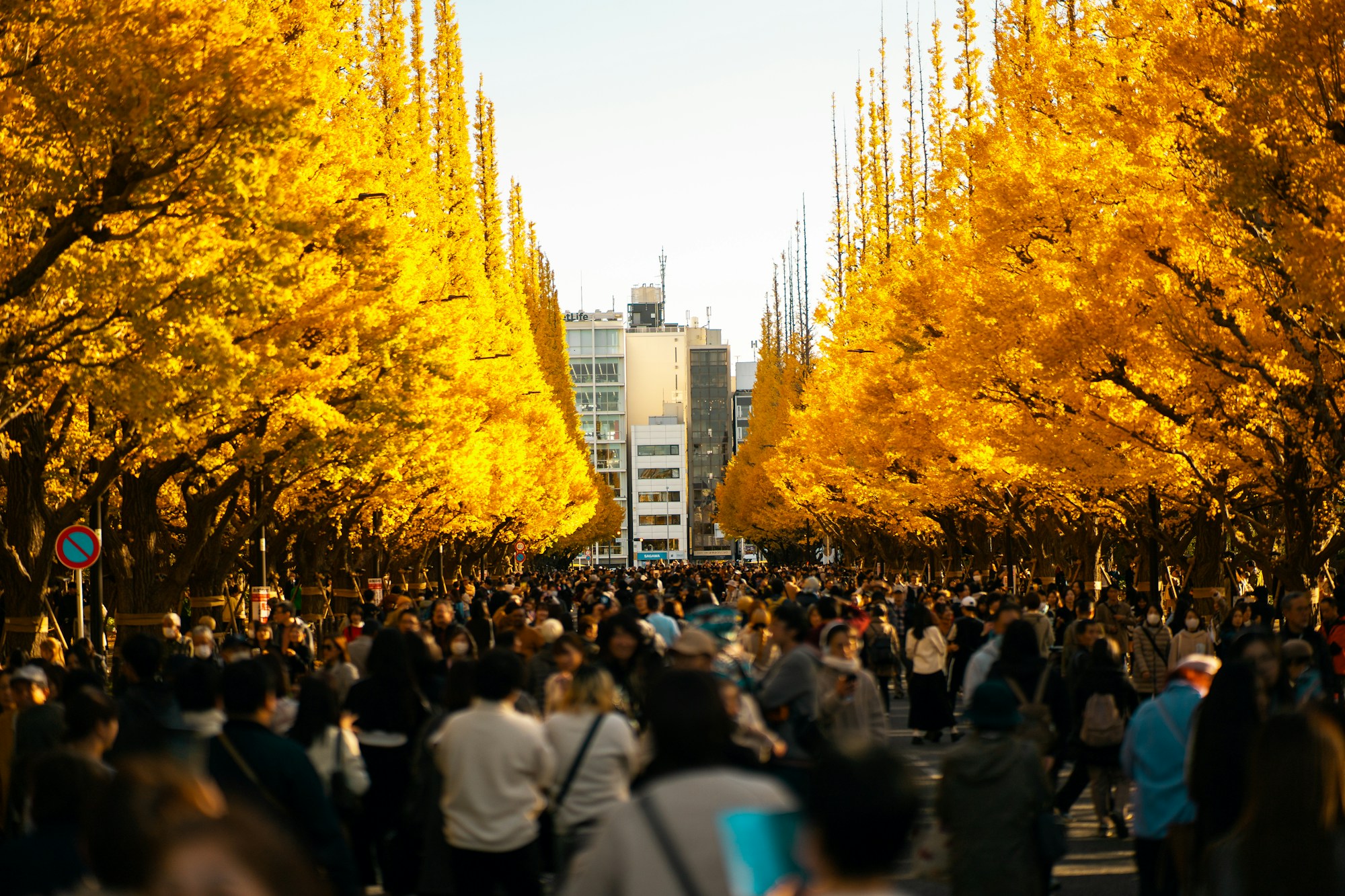
Meiji Jingu Gaien: four rows of ginkgoes in late November
The ginkgo avenue in the outer garden of Meiji Jingu is one of the most photographed autumn scenes in Tokyo. According to japan-guide, the window runs from late November to early December. The Nihon Kishō (JMC) forecast puts the ginkgo peak around 26 November, a date that nippon.com repeated on 5 September 2026.
For 2026, the shrine has announced no illumination for this ginkgo avenue: its list of announcements mentions neither lights nor dates (shrine website, checked on 23 October 2026). The 2025 illumination, which ran from 22 to 30 November from 4:30 pm to 7:30 pm, is still a reference, but its dates carry no weight for this year.
Highlights
- Four rows of ginkgoes along the main avenue, a layout the City of Tokyo asks to keep
- The avenue is one block from Aoyama-Itchōme station, according to japan-guide
2. Koishikawa Korakuen: the evening illumination from 13 to 24 November
This is the most reliable event of the season, since the official page of the garden’s manager gives the 2026 dates, hours and prices. The garden opens in the evening under the name “Shinzan Kōyō” (深山光葉), from Friday 13 to Tuesday 24 November, from 6 pm to 9 pm, with a last entry at 8 pm (official page of the garden’s manager, checked on 23 October 2026).
The direction of travel matters: you enter through the West Gate and leave through the East Gate. The ticket costs ¥1,000 in advance online, until 11:59 pm on 12 November, through 7ticket, KKday or asoview!. On the day, the online ticket goes up to ¥1,200 and is sold until 7:30 pm. The West Gate window, open from 6 pm to 8 pm, takes cash only and only while stock lasts.
The closest stations are Kōrakuen and Iidabashi, 5 to 10 minutes on foot according to our research: check the walk on your map app, as the official page doesn’t give it. Children of primary-school age don’t pay, according to a secondary source (Jorudan, 11 September 2026, checked on 23 October 2026). A ¥500 reduction applies to holders of a disability certificate and their companion, according to the official page.
3. Rikugien and the nine-gardens rally
Rikugien extends its evenings from 25 November to 6 December 2026, during the nine-gardens rally. The rally runs from 10 October to 6 December, from 9 am to 5 pm (last entry at 4:30 pm), across nine Tokyo gardens including Rikugien and Koishikawa Korakuen (official rally page, checked on 23 October 2026). The principle: collect a stamp in each participating garden on your card, and win prizes from three stamps.
For Rikugien’s evenings, the Japanese press gives 6 pm to 8:30 pm, with a last entry at 7:30 pm, and ¥1,000 for an adult, or ¥1,200 on the day, against ¥900 and ¥1,100 in a 2025 source. The official page dedicated to the illumination returned a 404 error when we checked it: reconfirm these hours and prices before you go.
To get there, search for Rikugien near Komagome station (JR Yamanote line). The walking time hasn’t been verified: confirm it on your map app before you leave.
4. Hama-rikyu: the autumn evenings from 30 October to 3 November
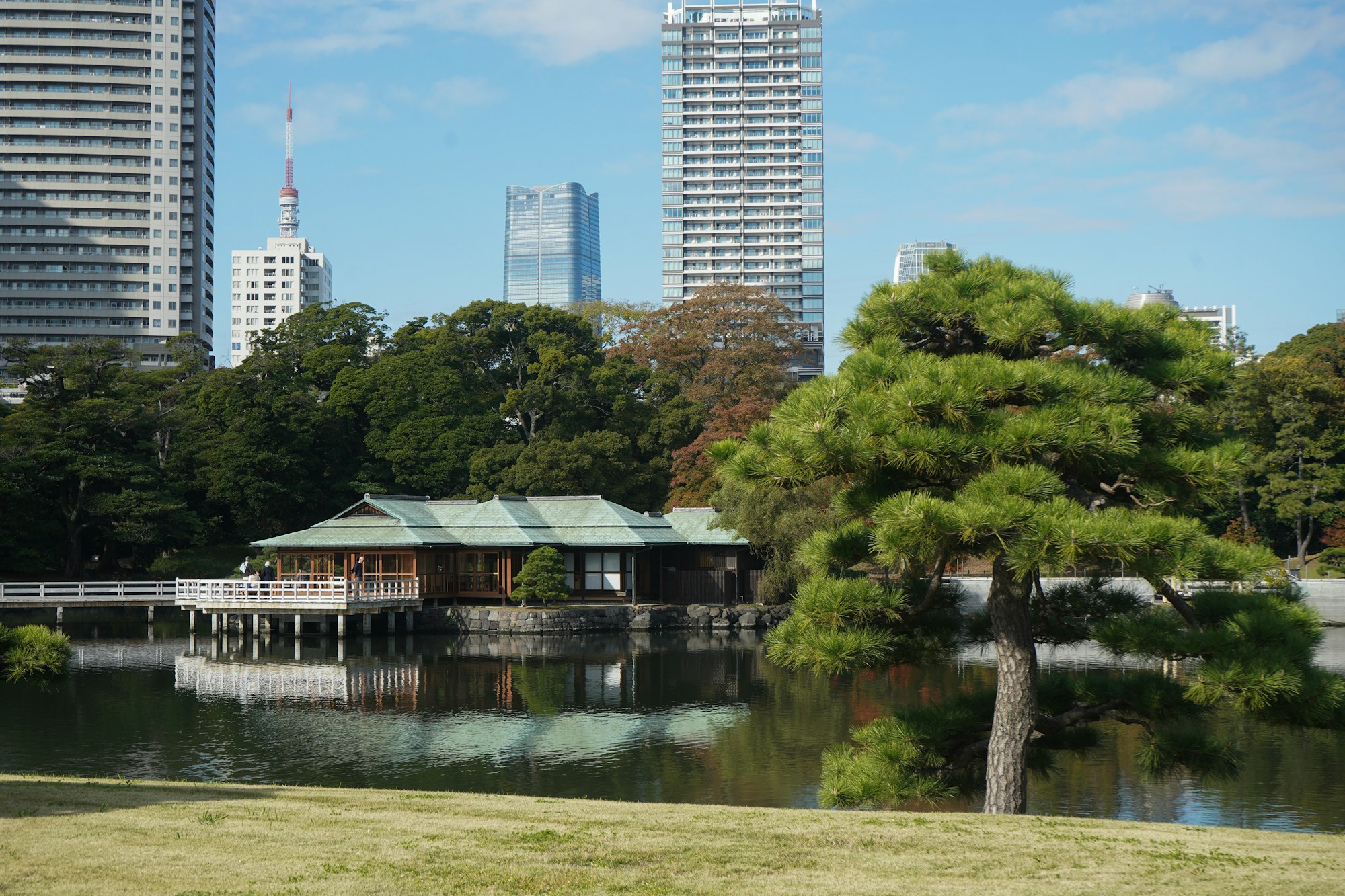
Hama-rikyu, a pond garden facing the skyscrapers
Hama-rikyu is a pond garden on the edge of Tokyo Bay, where the teahouse stands out over the water. Its autumn evenings run from 30 October to 3 November 2026, from 9 am to 9 pm, with a last entry at 8:30 pm for the main gardens. There is no separate night ticket: the usual fee applies, ¥300, or ¥150 from age 65 (official page, checked on 23 October 2026).
These evenings fall at the end of October and the start of November, before the late-November peak the 2026 forecasts point to. Come for the pond and the teahouse, then save Koishikawa Korakuen for mid-November.
Highlights
- The lowest entry fee in this selection: ¥300 in the evening
- A teahouse on the pond
- An early-autumn option if your trip falls before mid-November
5. Shinjuku Gyoen: the chrysanthemums, then the closed Monday
Shinjuku Gyoen, a national garden, closes on Mondays, or on the next weekday when the Monday is a public holiday, as well as over the year-end period (Ministry of the Environment page, checked on 23 October 2026). This is the rule that the guides we read don’t mention, and the most expensive one to miss: a visitor who turns up on a Monday loses the visit.
In 2026, Monday 23 November is a public holiday (勤労感謝の日, Labour Thanksgiving Day). Under the rule above, the garden should therefore close on Tuesday 24 November instead. We did not find that date confirmed on the garden’s own page at the time of checking: verify it there before you fix your visit.
For the foliage, the garden follows the general window, from mid-November to mid-December according to japan-guide. A chrysanthemum exhibition runs from 1 to 15 November 2026, from 9 am to 4:30 pm (last entry at 4 pm), for ¥500. These details come from a press release found in our research, not from the garden’s page: reconfirm them before you visit.
For access, search gives Shinjuku-Gyoenmae station (Marunouchi line) or Shinjuku station (JR), about 10 minutes on foot from the main entrance. These walking times still need checking.
6. The 2026 calendar: forecasts, averages and dates to remember
Two figures are going around, and they don’t say the same thing. 28 November is the “average year” date published by the JNTO, taken from the Japan Weather Association table: it is an average of past years, not a forecast for 2026. The 2026 forecast from Nihon Kishō (JMC), published on 2 September 2026 and repeated by Jorudan, gives 29 November for Tokyo’s maples, in line with the average. The nippon.com repeat of 5 September 2026 gives 26 November for the ginkgoes.
| Indicator | Value | Source | Published |
|---|---|---|---|
| Maples (momiji) | 29 November 2026, in line with the average (平年並み) | Nihon Kishō (JMC), via Jorudan | 2 September 2026 |
| Ginkgoes (ichō) | Around 26 November 2026 | Nihon Kishō (JMC), repeated by nippon.com | 5 September 2026 |
| “Average year” date | 28 November (an average, not a forecast) | JNTO, Japan Weather Association table | Undated page, checked on 23 October 2026 |
Source: Jorudan (JMC 2026 forecast), nippon.com (ginkgo repeat) and JNTO (average table), checked on 23 October 2026.
These forecasts are not set in stone. On 8 October 2026, Weathernews ran a headline that sums up the problem: autumn heat is slowing the reddening in Kantō (“秋の高温で色付き足踏み”). A hot end to October can push the peak back. Check the forecasts again in the first week of November, before you fix your evenings.
In October, Tokyo is still green. According to japan-guide, updated on 18 October 2026, the city is “Still Green”. The first sites to turn are Showa Kinen Park, from late October to late November, then Mount Mitake and Mount Takao on the outskirts, in November.
7. The sites and their 2026 dates
This table pulls together what the official pages confirm for 2026. Rows marked “to reconfirm” rely on the press or on a press release found during our research.
| Site | Dates 2026 | Hours | Adult fee |
|---|---|---|---|
| Koishikawa Korakuen (evening) | 13 to 24 November | 6 pm to 9 pm, last entry 8 pm | ¥1,000 in advance, ¥1,200 on the day |
| Rikugien (rally evenings) | 25 November to 6 December | 6 pm to 8:30 pm (press, to reconfirm) | ¥1,000 and ¥1,200 (press, to reconfirm) |
| Hama-rikyu (autumn evenings) | 30 October to 3 November | 9 am to 9 pm, last entry 8:30 pm | ¥300, ¥150 from age 65 |
| Nine-gardens rally | 10 October to 6 December | 9 am to 5 pm, last entry 4:30 pm | Depends on the garden |
| Shinjuku Gyoen (chrysanthemums) | 1 to 15 November | 9 am to 4:30 pm, last entry 4 pm (to reconfirm) | ¥500 (to reconfirm) |
| Meiji Jingu Gaien (ginkgoes) | Not announced for 2026 | Not announced | Not announced |
Source: Tokyo parks official pages, Ministry of the Environment and Meiji Shrine, checked on 23 October 2026.
What other guides don’t tell you
The guides we read for this page repeat a general window and an average date. Here are six points: five checked against official pages, and one against the JMC forecast relayed by the press, all checked on 23 October 2026.
- The 2026 peak isn’t 28 November. That figure is an average. The JMC forecast puts maples around 29 November (Jorudan, published 2 September 2026) and ginkgoes around 26 November (nippon.com, 5 September 2026, checked on 23 October 2026).
- Koishikawa Korakuen has an entry gate and an exit gate. You enter through the West Gate and leave through the East Gate, and the last entry is at 8 pm (official page of the garden’s manager, checked on 23 October 2026).
- Icho Namiki has no illumination announced for 2026. Guides cite the 2025 one, from 22 to 30 November, without saying that no announcement exists for this year (Meiji Jingu Gaien shrine, checked on 23 October 2026).
- The nine-gardens rally runs until 6 December. A single stamp card lets you visit nine Tokyo gardens, from 9 am to 5 pm (official rally page, checked on 23 October 2026).
- Shinjuku Gyoen closes on Mondays. The rule is on the Ministry’s page and isn’t in the guides we read. The next weekday applies if the Monday is a public holiday (Ministry of the Environment, checked on 23 October 2026).
- The City of Tokyo asks for the Icho Namiki ginkgoes to be preserved. It asks for every precaution to keep the four rows of the main avenue. For the avenue along the rugby ground, a study must decide whether the trees can be transplanted, with no final decision yet (City of Tokyo Q&A, partly updated on 2 December 2025, checked on 23 October 2026).
Budget for an outing
- During the day: Hama-rikyu costs ¥300, or ¥150 from age 65. Shinjuku Gyoen charges ¥500 for the chrysanthemum exhibition, a fee to reconfirm. The nine-gardens rally is paid garden by garden, with no common fee found.
- In the evening: Koishikawa Korakuen costs ¥1,000 in advance online and ¥1,200 on the day. Rikugien is given at ¥1,000 and ¥1,200 by the press, to reconfirm.
- Transport: the Tokyo Subway Ticket costs ¥1,000 for 24 hours, ¥1,500 for 48 hours and ¥2,000 for 72 hours, for one adult. These prices come from an indexed version of the Tokyo Metro website, whose official pages returned a 403 error when we checked: reconfirm them at the ticket counter before you buy. According to our research, a metro ride costs a few hundred yen depending on the line, so compare the pass with your planned trips.
An evening at Koishikawa on site (¥1,200) and a day at Hama-rikyu (¥300) make ¥1,500 in entry fees, excluding transport and meals. On a tight budget, Icho Namiki, with no fee found, and Hama-rikyu are the least expensive options in this article.
A plan for one late-November day
The most efficient plan fits into one day, as long as you respect the days and hours. Start with Icho Namiki in daylight, then keep the afternoon for another garden or for lunch. Then head to Koishikawa Korakuen for the evening illumination, which opens at 6 pm and accepts its last entry at 8 pm. Check the route between the two on a map: no walking time is given here.
Never plan Shinjuku Gyoen on a Monday. If you stay several days, book an evening at Rikugien between 25 November and 6 December, and Hama-rikyu’s evening between 30 October and 3 November if your trip starts early. For a livelier outing in November, the rake fair near Asakusa is covered in our Tori no Ichi 2026 guide.
Tokyo, Kyoto or Tōhoku? If you’re undecided, our article on Kyoto’s autumn maples covers the former capital’s own peak. Weathernews places Kyoto from late November, in its forecast of 3 September 2026. The north turns earlier: Tōhoku’s momiji show before Kyoto and Tokyo.
Variations by traveller
- Families: Koishikawa’s evening runs from 6 pm to 9 pm, late afternoon into the night. Bring warm layers for the children. Children of primary-school age don’t pay, according to a secondary source.
- Couples: a day at Icho Namiki, then the Koishikawa evening. It’s the most complete plan in this article for a single day.
- Tight budget: Hama-rikyu at ¥300 and Icho Namiki, with no fee found, make the cheapest base. Transport is the main cost.
- First time in Tokyo: aim for late November, not October. One day at Icho Namiki and one Koishikawa evening cover the essentials. The evenings are very busy, especially at weekends, according to the sources we consulted, though there is no official figure: a weekday evening should leave more room.
- Reduced mobility: Koishikawa’s ¥500 reduction applies with a disability certificate, for one person and one companion.
Mistakes to avoid
- Aiming for October for the colours. Tokyo is still green, and the first sites to turn are on the outskirts.
- Waiting for an Icho Namiki illumination in 2026. No date has been announced.
- Arriving at Shinjuku Gyoen on a Monday. The garden is closed that day, and Monday 23 November 2026 is a public holiday.
- Turning up at Koishikawa after 8 pm. The last entry is at 8 pm, and the West Gate window only takes cash.
- Missing the advance-sale deadline. The ¥1,000 ticket is no longer sold after 11:59 pm on 12 November.
- Arriving with no margin on a weekend evening. Illuminated evenings draw crowds, especially at weekends. No official attendance figure is published: arrive for the 6 pm opening rather than the last entry.
- Using 2025 prices. Rikugien’s 2025 fees (¥900 and ¥1,100) no longer apply.
Prepare your trip
An eSIM saves you from hunting for a SIM card when you land in Japan. Pick a plan that covers exactly how long you stay.
Price depends on the plan and duration, shown on the siteCompare the coverage and how long it lasts before you leave, based on the length of your trip.
Price depends on duration, shown on the siteFrequently asked questions
When can you see autumn leaves in Tokyo in 2026?
Between late November and early December. Maples should peak around 29 November, according to the JMC forecast published on 2 September 2026 (Jorudan). Ginkgoes around 26 November, a date repeated by nippon.com on 5 September. The 28 November many sites quote is an average of past years. Forecasts get revised: check them again in the first week of November.
Where can you see ginkgoes in Tokyo?
The reference is the ginkgo avenue of Meiji Jingu Gaien, known as Icho Namiki, with four rows of trees along the main avenue. According to japan-guide, Yoyogi Kōen and the Imperial Garden are also on the list of places to see in the same period. For maples, historic gardens such as Rikugien and Koishikawa Korakuen host the November evening illuminations.
Are Tokyo’s garden illuminations open in 2026?
Yes, at two sites. Koishikawa Korakuen holds an evening opening from 13 to 24 November 2026, from 6 pm to 9 pm, and Rikugien holds evenings from 25 November to 6 December, during the nine-gardens rally. Icho Namiki had announced no illumination for 2026 as of the check on 23 October 2026. Rikugien’s hours still need reconfirming.
How much does the Koishikawa Korakuen evening cost?
The ticket costs ¥1,000 in advance online, until 11:59 pm on 12 November 2026, and ¥1,200 on the day. The West Gate window, open from 6 pm to 8 pm, takes cash only. A ¥500 reduction applies to holders of a disability certificate and their companion. Source: official page of the garden’s manager, checked on 23 October 2026.
Is Shinjuku Gyoen open on Mondays?
No. The garden closes on Mondays, or on the next weekday when the Monday is a public holiday, and also over the year-end period. It hosts a chrysanthemum exhibition from 1 to 15 November 2026, at ¥500, a fee to reconfirm. In 2026, Monday 23 November is a public holiday: check the closing date on the garden’s page before you fix your visit.
Are the leaves coloured in October in Tokyo?
Generally not. According to japan-guide, updated on 18 October 2026, Tokyo is still green. Showa Kinen Park starts turning at the end of October, and Mount Mitake and Mount Takao in November. For colour in October, leave the city and pick a site on the outskirts.
Are Icho Namiki’s ginkgoes being cut down?
No, not as of the check on 23 October 2026. The City of Tokyo asks the operator to preserve the four rows of ginkgoes. For the avenue along the rugby ground, a study must decide whether the trees can be transplanted. No final decision has been published. Source: City of Tokyo Q&A.
Is 28 November the peak date in Tokyo?
No. 28 November is an average of past years, published by the JNTO from the Japan Weather Association table. The 2026 Nihon Kishō forecast gives 29 November for Tokyo’s maples. Use the average to get your bearings, and the forecast to plan your outing.
Sources
- Jorudan: 2026 colour forecast from Nihon Kishō (JMC), 2 September 2026
- nippon.com: repeat of the JMC forecast for ginkgoes, 5 September 2026
- JNTO: “average year” table from the Japan Weather Association
- Tokyo Metropolitan Parks Association: Koishikawa Korakuen evening opening in 2026
- Nine-gardens rally 2026 and Hama-rikyu evening 2026
- Ministry of the Environment: Shinjuku Gyoen, closing days
- Meiji Jingu Gaien: the shrine’s list of announcements
- City of Tokyo: Q&A on the Jingu Gaien project
- japan-guide: window by site, updated on 18 October 2026
- Weathernews: 2026 regional forecasts, October 2026 news
Sources checked on 23 October 2026.

Plan your trip with Pixidia
Pixidia learns how you travel and helps you build a trip that truly fits you and everyone coming along.
Open the planner