
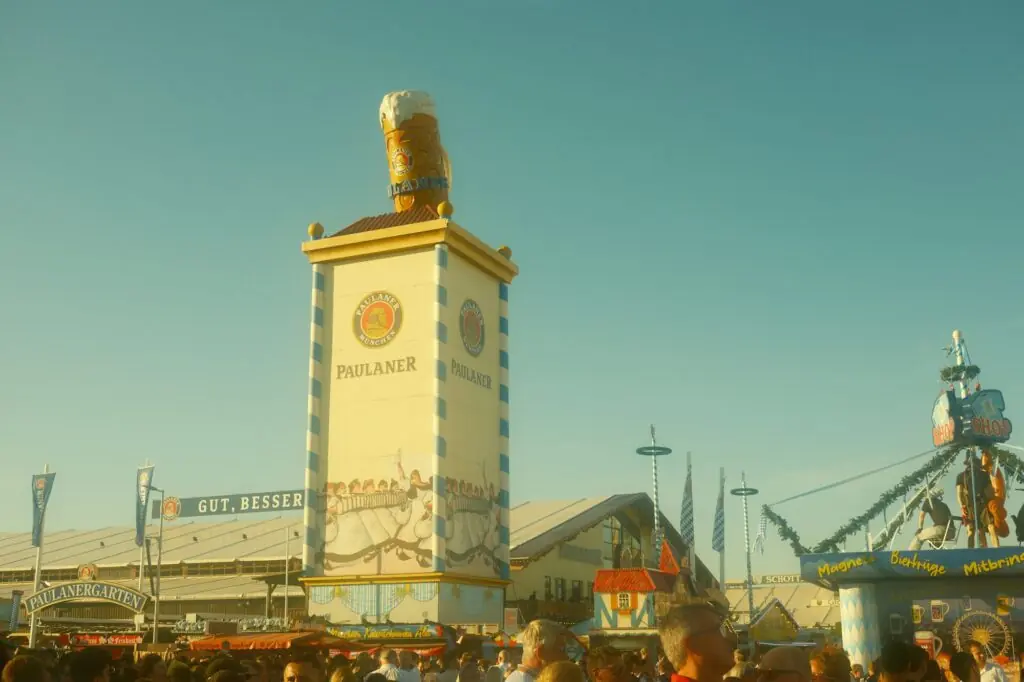
The Cannstatter Volksfest 2026 runs from 25 September to 11 October on the Cannstatter Wasen in Stuttgart, marking its 179th edition. The world’s second-largest folk festival after Munich’s Oktoberfest, it drew 4.2 million visitors in 2025 against Munich’s 6.5 million. Entry is free and a litre stein of beer (Maß) starts at €14.40, against up to €15.80 in Munich the same year. 2026 brings a rare coincidence: the four-yearly Landwirtschaftliches Hauptfest agricultural fair runs on the same grounds. Book your tent table at least a month ahead for the opening and closing weekends.
Every year, around four million people head to a corner of Stuttgart that most British travellers have never heard of. The Cannstatter Volksfest is no Bavarian knock-off of the Oktoberfest, though: founded in 1818 in the Kingdom of Württemberg to mark the end of a famine, it keeps a distinct Swabian identity, from its 26-metre Fruit Column to its dedicated wine tent. Here’s how it really compares to Munich’s Oktoberfest, and how to plan it from the UK.
1. What is the Cannstatter Volksfest?
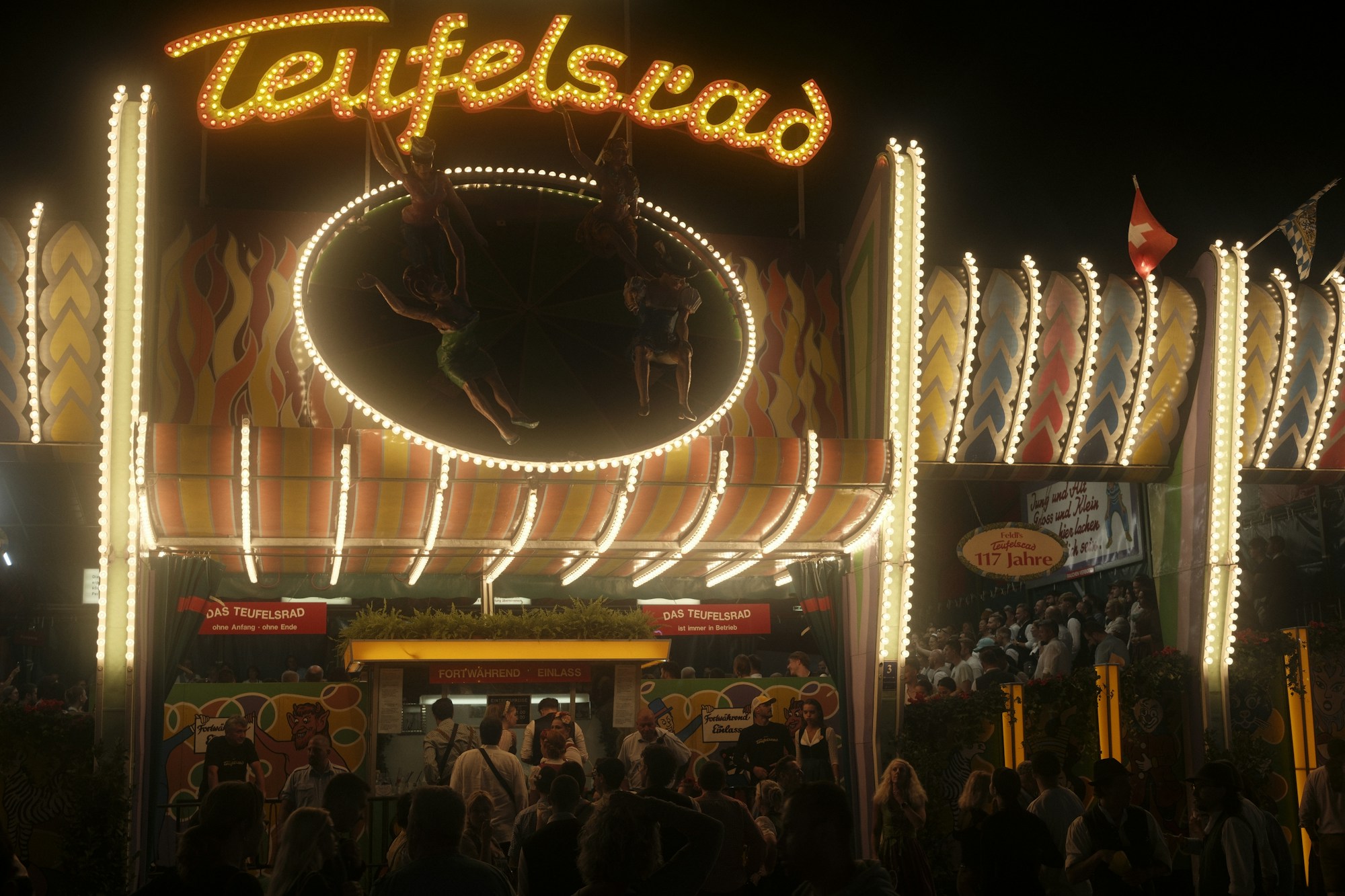
Cannstatter Wasen, Bad Cannstatt (Stuttgart)
The Cannstatter Volksfest, known locally simply as the « Wasen », is a 17-day folk festival held in Bad Cannstatt, a district of Stuttgart, the capital of Baden-Württemberg. It combines a fairground, giant beer tents and a traditional market, and is widely regarded as the world’s second-largest beer festival after Munich’s Oktoberfest, according to Wikipedia. In 2026 it celebrates its 179th edition from 25 September to 11 October on the Cannstatter Wasen grounds, on the banks of the Neckar, as confirmed by the festival’s official website.
Highlights
- Free entry to the grounds: only rides, tents and drinks are paid for
- Eight beer tents, an « Albdorf » village and a wine tent (Cannstatter Oberamt) — a feature Munich doesn’t have
- The Fruchtsäule, a 26-metre wooden column decorated with fruit and grain, a festival symbol since 1818
2. Programme and highlights of the 2026 edition
Fassanstich: the official opening
The official opening, the Fassanstich (tapping of the first keg), takes place on Friday 26 September 2026 at 4pm, in the Klauss & Klauss (Dinkelacker) tent. As tradition dictates, Stuttgart’s mayor, Dr Frank Nopper, taps the ceremonial first keg, according to the festival’s official news.
The historical parade (Historischer Volksfestumzug)
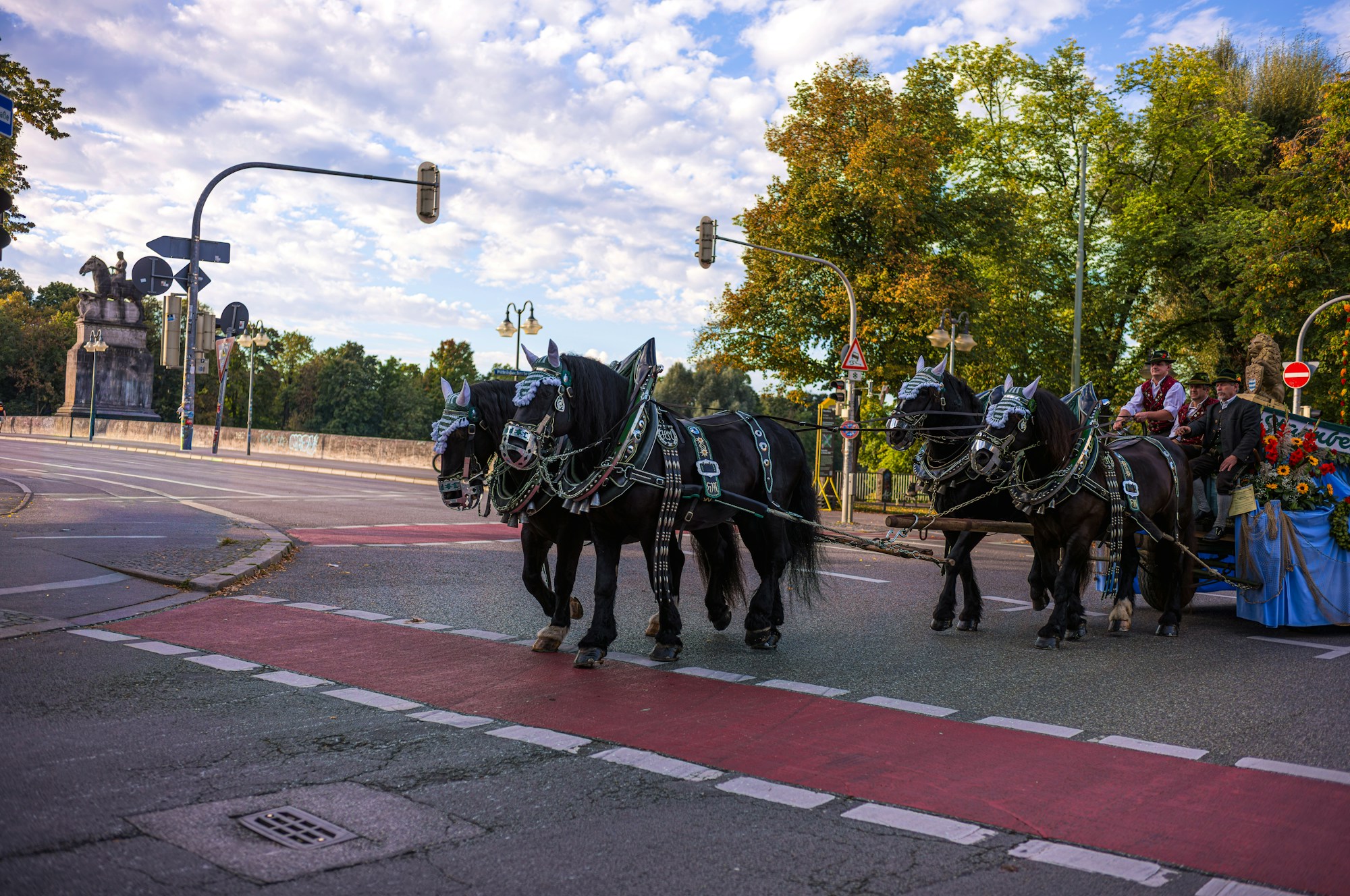
On Sunday 27 September 2026 at 11am, the historical parade takes place: a procession of around 3,500 participants across 127 groups and 5 themed sections, watched by roughly 150,000 spectators and broadcast live on SWR, according to the Cannstatter-Volksfestverein. The block names, in Swabian dialect (« Schaffa isch a Gschäft », « Schäferle sei wohlauf »…), trace the shift from an agricultural fair to a mass folk gathering.
Landwirtschaftliches Hauptfest: 2026’s rare coincidence
From 27 September to 4 October 2026, the four-yearly agricultural fair Landwirtschaftliches Hauptfest takes over the same grounds, with around 500 exhibitors and 200,000 expected visitors, according to wasen.de. It was last held in 2022, so 2026 visitors get to see the fairground, beer tents and a major agricultural fair side by side, with themed days such as Tag der LandFrauen (29 September) or Bauerntag (1 October).
- Family Days with reduced prices: Wednesdays 30 September and 7 October 2026, parking €6
- Closing musical fireworks display on the last Sunday evening, around 9:30pm, by Joachim Berner
3. Cannstatter Volksfest vs Munich’s Oktoberfest: the real comparison
The « cheaper twin » claim holds up, but with a caveat. In 2025, a Maß (one-litre stein) cost between €14.40 and €15.20 depending on the tent in Stuttgart, against up to €15.80 in Munich, according to the Stuttgarter Zeitung. The gap is real but narrow: German press has documented a 93% « Bierflation » on the Wasen since 2005, against just 55% in supermarkets over the same period.
| Criterion | Cannstatter Volksfest 2026 | Munich Oktoberfest 2026 |
|---|---|---|
| Dates | 25 Sept – 11 Oct (17 days) | 19 Sept – 4 Oct (16 days) |
| Visitors (2025 edition) | 4.2 million | 6.5 million |
| Beer stein (Maß, 2025) | €14.40 – €15.20 | up to €15.80 |
| Entry | Free | Free |
| Table booking | Usually from 10 people | Usually from 10 people |
| Site enclosure | Extra checks, no full fencing | Fully fenced and screened |
The clearest difference lies elsewhere: accommodation, which is noticeably less squeezed in Stuttgart than in Munich during the festival dates, even though hotel prices climb there too (up to around €500/night for a 3-star, according to price comparison sites). Another key difference: Munich’s Theresienwiese site is fully fenced and screened, while the Wasen stays open with extra checks but no complete perimeter fence.
For a deeper dive, our complete guide to Munich’s Oktoberfest covers tickets, tents and budget for the Bavarian original. Munich isn’t the only « original » with twins, either: Straubing’s Gäubodenvolksfest, in Bavaria, plays a similar role on a smaller scale. And since the 2026 Oktoberfest ends on 4 October while the Volksfest runs until the 11th, a direct rail link means you can theoretically combine both festivals in a single trip — for instance, by adding a Neuschwanstein Castle day trip from Munich before heading on to Stuttgart.
4. Beer tents, Swabian food and the costume debate
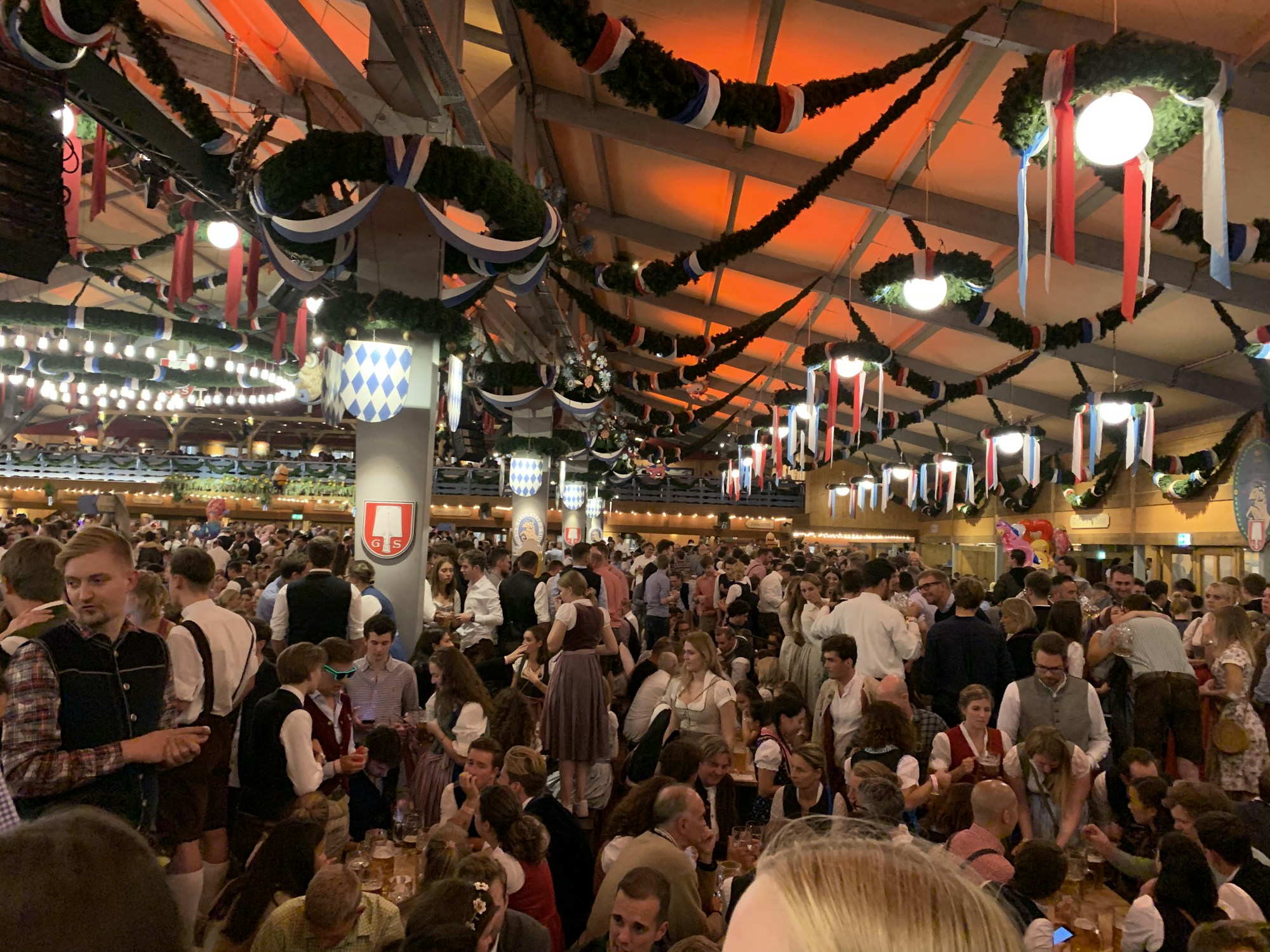
Eight tents, one wine tent, a Swabian identity
In 2026, eight beer tents (Wasenwirte) shape the experience: Sonja Merz, Klauss & Klauss (Dinkelacker), Fürstenberg, Göckelesmaier (Wulle beer), Beim Benz (Hofbräu), Schwabenwelt (the largest, with around 5,600-6,000 seats), Wasenwirt and Almhütte Royal, for a combined official capacity of 37,209 seats, according to Stuttgart-Tourist. A little-known detail: the Wasen also has a tent dedicated to local white wine, the « Cannstatter Oberamt », since the Stuttgart area is a wine-growing region with vineyards reaching right into the city centre.
Highlights
- Swabian food: Maultaschen (large ravioli), Käsespätzle, Schupfnudeln, Göckele (roast chicken)
- Tent meals: €10 to €40 depending on the dish, street food outside the tents around €7
- Table bookings usually required from 10 people, depending on the tent
The Dirndl/Lederhosen debate on Swabian turf
Around 90% of tent visitors wear a Dirndl or Lederhosen in the evening (expect to pay €100-€400 for a decent-quality outfit), but these outfits are Bavarian, not Swabian, in origin. The historical Swabian Tracht looked quite different: long trousers, white linen shirts, and long, high-necked dresses. According to expert Wulf Wager, quoted by the Stuttgarter Nachrichten, today’s German folk-festival dress code is neither authentically Bavarian nor authentically Swabian — it’s a trend that emerged in the 1990s.
5. Safety, the 2025 review and what to watch in 2026
Police gave a broadly positive assessment of the 2025 edition (4.2 million visitors, down 400,000 on the 2024 record), while flagging a rise in assaults on officers and a major brawl between two fairground-worker families that left 12 police and security staff injured, according to Ludwigsburg24. Access was temporarily closed twice in 2025 (3 and 11 October) due to capacity, with a peak of 73,000 people on 3 October, German Unity Day.
Another 2026 story to watch: funding for the free historical re-enactment in the city centre, the « Historisches Volksfest » on Schlossplatz (held every 4 years, 600,000 visitors in 2022), is under threat from municipal budget cuts. The city of Stuttgart has allocated only €100,000 of the €1 million needed, according to the Stuttgarter Zeitung. This uncertainty doesn’t affect the Volksfest itself on the Wasen, which is going ahead as planned.
6. Getting there from the UK and what to budget
From the UK, Eurowings runs direct flights to Stuttgart Airport (STR) from London Heathrow year-round, and seasonally from London Gatwick, Manchester and Edinburgh, with a flight time of around 1h45-2h. Fares commonly start from roughly £40-£100 one-way depending on the season, according to fare-comparison sites such as Kayak and Skyscanner. There’s no direct train: the fastest rail route runs on Eurostar to Paris or Brussels, then an onward TGV or ICE service to Stuttgart, for a total journey of around 6h30 to 8h, according to Trainline. From Stuttgart-Bad Cannstatt station, it’s a 6-10 minute walk to the Wasen, or take the U-Bahn (lines U11, U19, U1, U2, U13, U16) to the Cannstatter Wasen stop.
Budget on site
- Entry to the grounds: free
- Beer stein (Maß): €14.40 to €15.20 depending on the tent (2025 prices)
- Rides and attractions: €3 to €10 depending on the ride, reduced prices on Family Days
- Parking: around €2/hour, capped at €10/day (€6 on Family Days)
As for weather, late September and early October in Stuttgart bring average daytime temperatures around 15°C and 5-6°C at night, with roughly 12 rainy days in the month: pack a waterproof layer for the evenings, which are noticeably colder than the daytime.
Practical info for your trip to Stuttgart
Instant data connection the moment you land at Stuttgart Airport, no SIM swap needed.
Plans from a few eurosNomad Insurance: global coverage from $56 per 4 weeks, for a trip in Germany.
From $56 / 4 weeksFrequently asked questions
What are the exact dates of the Cannstatter Volksfest 2026?
From 25 September to 11 October 2026 — 17 days for the 179th edition — on the Cannstatter Wasen in Bad Cannstatt (Stuttgart), according to the festival’s official website.
Is the Cannstatter Volksfest really cheaper than Munich’s Oktoberfest?
Yes, but the gap is narrow: in 2025 a Maß cost €14.40-€15.20 in Stuttgart against up to €15.80 in Munich. The real difference lies mainly in accommodation and table availability, both less squeezed than in Munich during the festival.
Do you need to buy an entry ticket for the Cannstatter Volksfest?
No, access to the grounds is completely free; only rides, tents and drinks are paid for.
Is the Cannstatter Volksfest just a small Bavarian Oktoberfest?
No. It’s a distinct Swabian festival, founded in 1818 in the Kingdom of Württemberg, with its own traditions (Fruchtsäule, historical parade, Swabian food, wine tent), even though the traditional outfits worn today are Bavarian in origin.
How do you get to Stuttgart from the UK?
Direct Eurowings flights from London Heathrow (year-round) and seasonally from London Gatwick, Manchester and Edinburgh; there’s no direct train, but Eurostar via Paris or Brussels connects onward to Stuttgart in around 6h30-8h.
Do you need to book a table in a beer tent?
Strongly recommended for Friday and Saturday evenings as well as the opening and closing weekends, usually from 10 people depending on the tent, booked directly with each tent operator.
What’s the best time to visit without the crowds?
A weekday afternoon, outside the first and last weekends and away from the public holiday: 3 October (German Unity Day) is historically the busiest day, with a peak of 73,000 visitors in 2025.
Can you combine Munich’s Oktoberfest and the Cannstatter Volksfest in one trip?
Yes, in theory, for 2026: Munich’s Oktoberfest ends on 4 October, while the Cannstatter Volksfest runs until 11 October, and a direct rail link connects the two cities.
Sources
- Cannstatter Volksfest — official website — dates, history, tents, official festival FAQ.
- Cannstatter Volksfest — Fassanstich news — details of the official 2026 opening.
- Stuttgart-Tourist / Stuttgart-Marketing GmbH — official figures, history, tents.
- Wasen.de — consolidated events calendar for the grounds, including the Landwirtschaftliches Hauptfest.
- Cannstatter-Volksfestverein e.V. — details of the historical parade.
- Wikipedia — Cannstatter Volksfest — history and overview.
- Stuttgarter Zeitung — 2025 beer price comparison.
- Stuttgarter Nachrichten — investigation into the « Bierflation ».
- Stuttgarter Nachrichten — debate on traditional outfits.
- Ludwigsburg24 — police review of the 2025 edition.
- Stuttgarter Zeitung — threatened funding for the Historisches Volksfest.
- Oktoberfest.de — official dates for Munich’s Oktoberfest 2026.
- Trainline — London-Stuttgart rail connections via Eurostar.
- The Getaway Lounge UK — direct flight routes from the UK to Stuttgart.
- Wikipedia — Fruit Column — history of the Fruchtsäule.
Research conducted on 3 September 2026.

Plan your trip with Pixidia
Pixidia learns how you travel and helps you build a trip that truly fits you and everyone coming along.
Open the planner