
In Cardiff, the visitor levy is £1.30 per person per night, or £0.75 in a dorm or tent, for stays from 1 April 2027. The council voted the levy in March 2026, after its Cabinet meeting of 19 March. Stays of more than 31 nights are exempt.
Checked on against the official sources cited (gov.wales, legislation.gov.uk, Cardiff Council).
Cardiff has voted its visitor levy. It is neither announced nor suspended. If you book accommodation in the Welsh capital for 2027, you will pay a sum per person per night, a figure many guides still describe in the conditional. This guide separates what has been voted, what is in force and what is still to be confirmed, then works out the exact amount for your situation.
Voted, in force, collected: where Cardiff’s levy stands

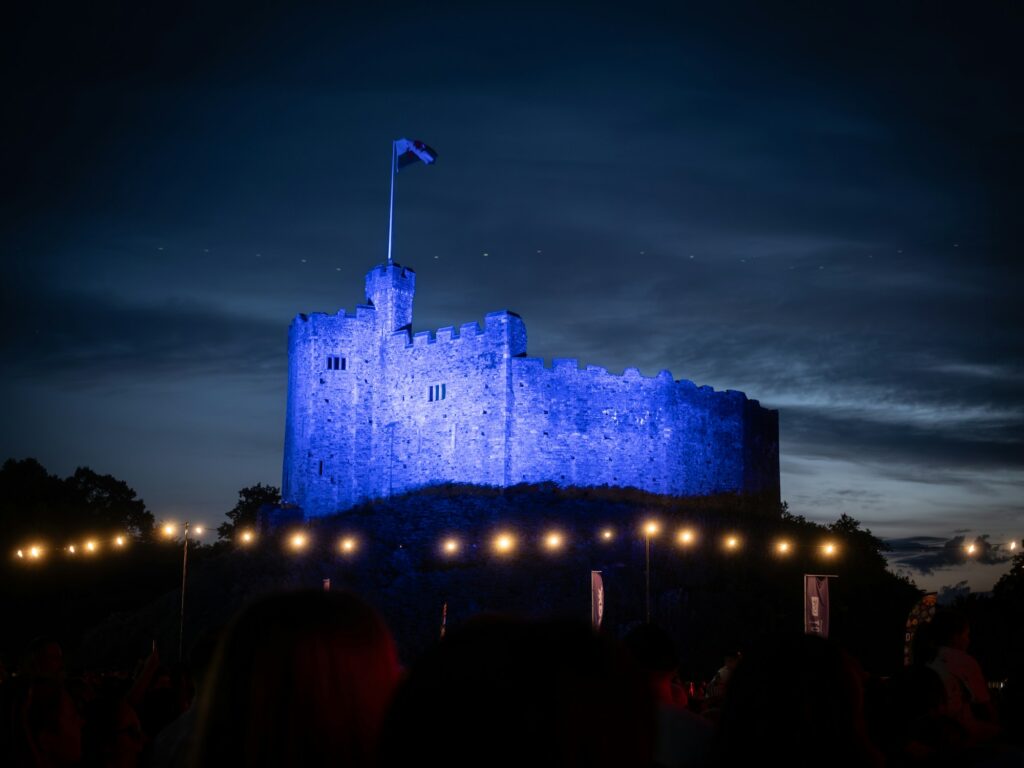
Cardiff, capital of Wales
Three steps are often confused in guides, though they need to stay separate. The national law, the Visitor Accommodation (Register and Levy) Etc. (Wales) Act 2025 (asc 2025/5), lets Welsh local authorities introduce a tax on overnight stays. The Senedd passed it, and the press dates royal assent to September 2025 (Swansea Bay News, accessed 20 October 2026). The exact name of the Act is on legislation.gov.uk, asc/2025/5, accessed 20 October 2026.
Cardiff then voted its own levy in March 2026, after the scrutiny committee on 17 March and the Cabinet on 19 March (Cardiff Council Cabinet agenda, accessed 20 October 2026). The Welsh Government’s official site states that Cardiff Council has introduced a levy on overnight stays (gov.wales, Visitor Levy Wales, accessed 20 October 2026). The council expects about £3.5 million a year from it (council press release of 12 March 2026).
It is not being collected yet. The first day of collection is 1 April 2027, for stays from that date. For stays from 1 April 2027, providers have already been counting it on new bookings since 28 September 2026, as well as on nights or people added to an existing booking (gov.wales, checked 20 October 2026). The sources consulted do not settle the case of a booking made before 28 September 2026 for a 2027 stay: ask your accommodation provider.
Three terms therefore need to be kept apart: voted by Cardiff in March 2026, counted on new bookings since 28 September 2026, collected only from 1 April 2027. The rate itself is set in national law, not in a city order.
Wales recorded 7.76 million overnight tourist stays in 2025, according to gov.wales provisional figures (tourism statistics 2025, accessed 20 October 2026). We found no recent visitor figures for Cardiff alone. If you want to combine your stay with the coast and the castles of south Wales, the day tour from Cardiff shown below runs on 8 of the 31 days between 27 October and 26 November 2026, as of 20 October 2026: 31 October, and 2, 7, 9, 14, 16, 21 and 23 November.
Key points
- Voted by Cardiff Council in March 2026
- Rate set in national law, not by the city
- About £3.5 million a year expected, according to the council
- Stays of more than 31 nights exempt
Who it’s for: anyone who wants to see the coast and castles of south Wales without driving. What sets it apart: private transport is included, over 8 hours, with a full refund up to 24 hours before departure, and the listing names an English-language guide. The catch: tips are not included, and the meeting point is the City United church, near the Bike Lock café. Arrive 15 minutes before departure.
How much the levy costs, per person and per night
The sum is one multiplication: number of people, times number of nights, times the rate. Unlike Edinburgh’s levy, the amount depends neither on the room price nor on the category of the hotel. A luxury hotel and a small guesthouse pay the same rate per person per night, as long as the accommodation falls under the standard rate.
| Type of stay | Amount | Note |
|---|---|---|
| Hotel, B&B, self-catering, cottage, glamping | £1.30 per person per night | Standard rate |
| Hostel dorm, bunkhouse, bothy | £0.75 per person per night | Reduced rate |
| Tent pitch, campsite | £0.75 per person per night | Reduced rate |
| Under-18 in a dorm or tent | £0 | Exempt, reduced rate only |
| Under-18 in a standard room | £1.30 per night | No exemption |
| Stay of more than 31 nights | £0 | Whole stay exempt |
Source: gov.wales, Visitor Levy Wales, checked on 20 October 2026.
Examples (the author’s calculations, excluding VAT):
- One adult, 3 nights in a hotel: 3 × £1.30 = £3.90.
- A couple, 2 nights in a hotel: 2 × 2 × £1.30 = £5.20.
- Two adults and two children in a standard room, 4 nights: 4 × 4 × £1.30 = £20.80, as children pay the standard room rate.
- Two adults and two children in a dorm, 4 nights: only the adults pay, so 2 × 4 × £0.75 = £6.00.
- A solo traveller in a hostel, 1 night in a dorm: £0.75.
The case of a stay that mixes a room and a dorm, or of nights a hotel gives away, is not covered by the texts we checked. Ask your accommodation before booking. To compare with other European cities, our comparison of tourist taxes across Europe in 2026 sets the rules side by side.
Who pays, who collects, who passes it on
The levy is owed by the provider, not the traveller. In practice you pay it to your accommodation, which passes it on to the Welsh Revenue Authority (WRA), the Welsh tax authority. The WRA then transfers the proceeds to Cardiff Council, which must spend them on tourism: promoting the city, infrastructure, welcoming visitors and supporting tourism businesses (council press release of 12 March 2026, accessed 20 October 2026).
The provider remains responsible for declaring and paying. It can hand those tasks to an accountant, but the responsibility cannot be delegated, according to ACCA (ACCA, Visitor Levy in Wales, accessed 20 October 2026). Returns are annual by default, due by 31 May of the following year at the latest, or quarterly, sixty days after the end of each period. For quarterly periods, the exact dates still need confirming on gov.wales. A return is required for every period, even one with no overnight stays.
Children, long stays and refunds
This is the point most often explained badly online. Many sites say children pay nothing at hotels. That is wrong according to the official text: under-18s are exempt only when they stay in a tent or a shared dorm, at the reduced rate. In a standard room, a child pays the £1.30 per night rate (gov.wales, accessed 20 October 2026).
Beyond 31 nights, the stay is exempt. Cardiff Council’s press release of 12 March 2026 refers to chargeable stays of 31 nights at most. The word « consecutive », which some sites use, does not appear on the official pages we checked.
Some people can claim a refund after their stay: carers, people temporarily without a home, and people fleeing violence or danger, according to gov.wales. The documents do not all give the same number of categories, so the list on the official page is the reference. Emergency or temporary accommodation arranged by the council is also exempt (press release of 12 March 2026).
VAT: what passing the levy on does to your bill
If the provider passes the levy on to the guest, the standard UK VAT rate of 20% applies to the full amount paid, levy included (gov.wales, accessed 20 October 2026). The provider can also absorb the levy without charging it, in which case no VAT is added on top. A provider that is not VAT-registered and charges the levy may see its taxable turnover rise, and should then consider whether to register (ACCA).
Take a couple staying two nights with the levy passed on: £5.20 in levy, plus £1.04 VAT on that amount, so £6.24 in total. This is the author’s calculation, to be checked against your invoice.
Some online calculators add 20% VAT to the £1.30 nightly rate without saying whether the provider is VAT-registered. The official text does not set a VAT-inclusive figure. The reference rate remains £1.30 per person per night, and the VAT depends on how the levy is passed on, as described above.
Timeline: what is settled, what still needs confirming
The table separates settled dates from conflicting ones. For the opening of the register, the sources say « autumn 2026 », « 1 October 2026 » or « October 2026 »: no official source has settled it so far.
| Date | Step | Status in the sources |
|---|---|---|
| March 2026 | Cardiff Council vote, after the Cabinet meeting of 19 March | Exact day not confirmed by the sources consulted |
| 26 August 2026 | Memorandum of understanding between Cardiff Council and UKHospitality Cymru | Confirmed by the council |
| 28 September 2026 | New bookings start being counted | According to gov.wales |
| Not yet set | Opening of the registration service | « Autumn 2026 », « 1 October 2026 » or « October 2026 » depending on the source: to be confirmed on gov.wales |
| 31 March 2027 | Registration deadline for existing accommodation | Given by gov.wales; not stated in other sources: to be confirmed |
| 1 April 2027 | Start of collection and penalties | According to gov.wales |
Source: gov.wales, Visitor Levy Wales and Cardiff Council press release of 26 August 2026, checked on 20 October 2026.
Registering accommodation: a duty separate from the levy
All paid accommodation must be registered with the WRA: a room in someone’s home, a cottage, a cabin, a campsite or a hotel. Registration is a national duty. A hotelier or host can therefore register before the levy is collected, and the city council is not a prerequisite.
For accommodation already on offer, the gov.wales pages cite 31 March 2027 as the deadline, but other sources give no date. The date is therefore not settled: confirm it on gov.wales before taking any step. For new accommodation, registration must come before the first booking. Any change must be declared within thirty days.
Penalties start only from 1 April 2027. A first warning costs £100 per unregistered premises. If the premises remain unregistered after contact from the WRA, the sum can reach £1,400 per premises. A review or an appeal remains possible (gov.wales, checked 20 October 2026).
And the rest of Wales?
Cardiff is, as of the verification date, the only authority whose adoption is confirmed by its own documents. For the others, the sources consulted confirm no decision. Anglesey consulted from 18 May to 13 July 2026, with a start considered no earlier than 1 October 2027, and no decision published (Isle of Anglesey County Council, accessed 20 October 2026). The status of Gwynedd, Conwy, Flintshire and Denbighshire is not confirmed. In the sources consulted, no decision was found for Swansea or Newport.
In practice, a stay in Cardiff falls within the levy from April 2027. A stay in another Welsh town is not, as of today, subject to a confirmed levy. Check the page of the relevant council before booking.
Comparison: Edinburgh and Stirling, two other models
Edinburgh applies a levy of 5% on the cost of accommodation, limited to five consecutive nights, for stays from 24 July 2026 (Edinburgh Council, accessed 20 October 2026). Stirling announces 3%, but that rate relies on secondary sources (Central FM, DWF): the council minutes were not consulted, and the announced start for stays, 14 June 2027, remains to be confirmed.
| Criterion | Cardiff | Edinburgh | Stirling (as reported in the press) |
|---|---|---|---|
| Calculation | £1.30 per person per night | 5% of the room price | 3% of the room price |
| Cap | 31 nights | 5 consecutive nights | Exempt beyond 7 nights, according to Central FM (to be cross-checked) |
| Start | Stays from 1 April 2027 | Stays from 24 July 2026 | Stays from 14 June 2027, to be confirmed |
| Example: 2 people, 5 nights, room at £250 | £13.00 | £62.50 | £37.50 |
Sources: gov.wales for Cardiff, Edinburgh Council for Edinburgh, press reports for Stirling (secondary source). Example: the author’s calculation, excluding VAT, checked on 20 October 2026.
The sharpest contrast for a traveller is the basis of calculation. In Cardiff, a luxury hotel and a small guesthouse pay the same levy per person. In Edinburgh, the amount rises with the room price. If your route combines Scotland and Wales, compare the start dates: Edinburgh has applied its levy since 24 July 2026, while Stirling’s is announced for 14 June 2027, a date still to be confirmed.
For another model, our guide to Barcelona’s tourist tax 2026 explains the Catalan levy, useful if you want to compare systems.
Before you book: a checklist
- Ask whether the levy is included in the displayed price or added at checkout, and what amount it is calculated on.
- Note the exact number of people and nights: the sum is worked out from them, and a stay of more than 31 nights is exempt.
- If you are travelling with children, compare the options: in a dorm, children do not pay the levy, but the accommodation has to suit the whole group.
- Keep your booking confirmation, and check whether it shows the levy amount if one is shown.
- Before you pay, ask your host about its registration with the WRA.
By profile: families, tight budgets, long stays
Families. Two adults and two children pay £20.80 for four nights in a standard room, against £6.00 in a dorm, where only the adults are charged. The £14.80 gap should be weighed against the price of the two options and the comfort of a private room.
Tight budgets. In a hostel, the £0.75 reduced rate applies per person per night. A solo traveller spending one night in a dorm pays £0.75.
Long stays. For a stay of more than 31 nights, the levy does not apply, according to the official text. A 32-night stay is therefore exempt in full.
A first couple’s trip. Two nights in a hotel come to £5.20 in levy. The sum is modest; what matters more is whether it appears in the displayed price.
What other guides don’t tell you
Online guides often repeat the same mistakes. Here are six points checked against the official pages or council minutes, with the date they were consulted.
- Cardiff has voted the levy, it is not suspended. Some guides present it as a future or suspended tax. The official page says Cardiff Council has introduced a levy on overnight stays, applying to new bookings from 1 April 2027 (gov.wales, Visitor Levy Wales, checked 20 October 2026).
- Children are not free everywhere. They are exempt only in a dorm or tent, at the reduced rate. In a standard room, they pay £1.30 per night (gov.wales, checked 20 October 2026).
- The number of consultation responses varies between press releases. They cite « more than 1,500 » or « nearly 2,000 » responses. The Cabinet report gives 1,908 responses, 62% in favour and 33% against (Cardiff Council Cabinet agenda, checked 20 October 2026).
- The £2.1 million figure is not Cardiff’s. That figure is attributed to Conwy. Cardiff expects about £3.5 million a year (council press release of 12 March 2026, checked 20 October 2026).
- Edinburgh started on 24 July 2026, not 1 July. Stays from that date are taxed at 5%, up to five consecutive nights (Edinburgh Council, checked 20 October 2026).
- The 31-night threshold should not be confused with a 29-night exemption. ACCA cites a 29-night exemption linked to a VAT measure. That figure appears in no official text we checked, so it is not repeated here (ACCA, checked 20 October 2026; legislation.gov.uk, asc/2025/5).
Frequently asked questions
How much is Cardiff’s visitor levy?
It is set at £1.30 per person per night for hotels, B&Bs, self-catering, cottages and glamping, and £0.75 for dorms and tent pitches. The amount is set in national law and does not depend on the room price. Stays of more than 31 nights are exempt, according to gov.wales.
Does Cardiff’s visitor levy apply yet?
It applies to stays from 1 April 2027. Providers have been counting it on new bookings since 28 September 2026 (gov.wales, checked 20 October 2026). The dates for opening the register and the registration deadline for existing accommodation do not match across sources, so confirm them on gov.wales before taking any step.
Do children pay the levy?
It depends on the accommodation. Under-18s are exempt in a tent or shared dorm, at the reduced rate. In a standard hotel, B&B or self-catering room, they pay £1.30 per night. So there is no general exemption for children, contrary to what many sites claim (gov.wales).
Is the levy charged on stays of more than a month?
No. Chargeable stays of 31 nights at most are taxed, and beyond that the stay is exempt, according to Cardiff Council’s press release of 12 March 2026 (press release). A 32-night stay is therefore exempt in full. Check the billed length with your host.
Is the levy included in the displayed price?
It depends on the host and the platform, which do not always add it automatically (ACCA). If it is passed on, 20% VAT applies to the amount paid, levy included. Ask for the exact amount before paying, and whether the levy is absorbed or charged.
Who do I pay the visitor levy to in Cardiff?
You pay your accommodation, which collects it and passes it on to the Welsh Revenue Authority. The WRA transfers the proceeds to Cardiff Council, which spends them on tourism. The host remains responsible for declaring and paying (gov.wales).
Do Swansea and Newport also charge a visitor levy?
In the sources consulted, no decision has been found for Swansea or Newport. Cardiff is, as of the verification date, the only authority whose adoption is confirmed by its own documents. Anglesey consulted from May to July 2026 with no decision published, and the status of Gwynedd, Conwy, Flintshire and Denbighshire is not confirmed.
Can I get a refund of the levy?
Some people can claim a refund after their stay: carers, people temporarily without a home, and people fleeing violence or danger. The documents do not all give the same number of categories, so the list on the official page is the reference (gov.wales).
Sources
- gov.wales, Visitor Levy Wales: rates, exemptions, registration, VAT and timeline
- legislation.gov.uk, Visitor Accommodation (Register and Levy) Etc. (Wales) Act 2025: name and text of the Act (asc 2025/5)
- Swansea Bay News, press article: date of royal assent (September 2025), secondary source
- Cardiff Council, press release of 12 March 2026: consultation and expected amount
- Cardiff Council, press release of 26 August 2026: memorandum of understanding with UKHospitality Cymru
- Cardiff Council, Cabinet agenda: timeline and number of consultation responses
- Edinburgh Council: Edinburgh visitor levy
- Isle of Anglesey County Council, consultation: status of Anglesey
- ACCA, Visitor Levy in Wales: collection, VAT and platforms (secondary source)
- gov.wales, tourism statistics 2025 (provisional): overnight tourist stays in Wales
- Central FM and DWF, for Stirling’s rate (secondary sources, to be confirmed)
Sources consulted or checked on 20 October 2026.

Plan your trip with Pixidia
Pixidia learns how you travel and helps you build a trip that truly fits you and everyone coming along.
Open the planner