
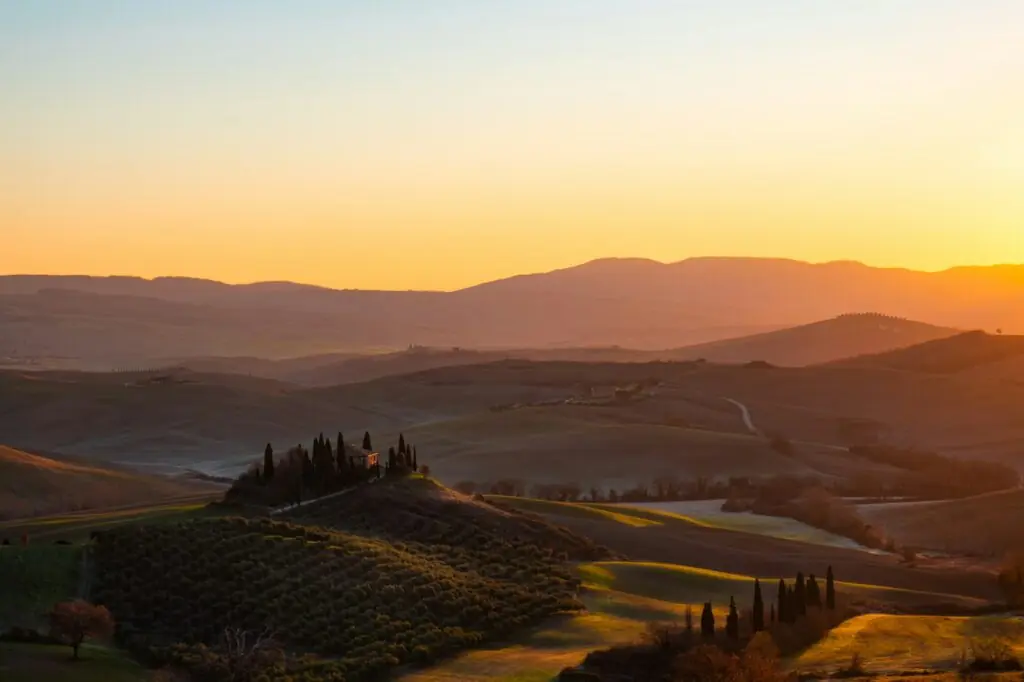
The Expo del Chianti Classico 2026 runs from 10 to 13 September in Greve in Chianti, marking its 54th edition. Entry with a tasting kit costs €20, on Piazza Matteotti. Greve has no train station: allow 30-40 minutes by car from Florence, or a longer, less frequent bus at weekends. The 2026 Sangiovese harvest started unusually early because of the heat, with reduced yields across Tuscany. The easiest plan: arrive Thursday evening or Friday, book accommodation months ahead, and pair the visit with a nearby Chianti village.
The same September weekend, two timelines overlap in the Chianti hills: out in the vineyards, the 2026 Sangiovese harvest is wrapping up earlier than ever; on Greve in Chianti’s Piazza Matteotti, dozens of producers are pouring previous vintages for anyone who wants a taste. From 10 to 13 September 2026, the 54th Expo del Chianti Classico draws the same mix of curious visitors and connoisseurs that has packed this Tuscan village since the 1970s. This guide answers the practical questions a visitor actually has: how to get there without a car, what to budget, where to stay without booking everything last-minute, and how to dodge the queues some visitors have run into in past editions.
1. The Expo del Chianti Classico 2026: Dates, Tickets and What’s New
Piazza Matteotti, 10-13 September 2026
Every year, on the second weekend of September, producers from the Consorzio Vino Chianti Classico take over Piazza Matteotti to pour their wines for the public. According to the official Expo website, the 2026 edition runs from Thursday 10 to Sunday 13 September. The €20 ticket includes a tasting glass with a shoulder lanyard and a booklet of seven tickets: up to four redeemable at individual producers’ stands, up to seven at the Consorzio’s shared pavilion (premium wines — Riserva, Gran Selezione and Vin Santo — count double). Extra booklets cost €20 once you run out of tickets.
Beyond free tasting, themed guided tastings are available by reservation (€15-25, groups capped at 40), booked through Eventbrite or the official website. According to WeChianti, a preview week called « Aspettando l’Expo » already fills Greve and the neighbouring hamlet of Montefioralle from 2 to 8 September, with a programme that’s noticeably more cultural than the tasting itself.
Highlights
- Full kit included in the ticket: glass, shoulder lanyard, booklet of seven tasting tickets
- Themed guided tastings by reservation: Gallo Nero, altitude, food and wine pairings
- « Aspettando l’Expo » programme, 2-8 September: dinner with six Michelin-starred chefs, night market in Montefioralle, Rificolona lantern parade
2. Greve in Chianti: Gateway to the Historic Chianti
Greve in Chianti is the only municipality in Florence province entirely inside the Chianti zone, according to Visit Tuscany. The village began life as a « mercatale » — a market square at the crossing of strategic routes linking Florence to Siena through the hills — originally just an outpost of the nearby Montefioralle castle. Piazza Matteotti’s distinctive triangular shape, lined with stone arcades where merchants once displayed their goods, was already in place by the early 16th century: Grand Duke Leopold described it as « a very beautiful square where a great market of livestock and foodstuffs is held every Saturday » — a weekly market that still runs today, independent of the Expo.
At the centre of the square stands a statue of Giovanni da Verrazzano, born a few kilometres from Greve in 1485: this Florentine explorer was the first European to chart the North American Atlantic coast in 1524, from Florida to New Brunswick, sailing for King Francis I. New York’s Verrazzano-Narrows Bridge carries his name. On the corner of the square, the Santa Croce church houses a triptych by Bicci di Lorenzo, and the Museo del Vino, set in the old cellars of the town hall, traces Chianti winemaking history back to the Etruscans through a collection of 180 corkscrews.
A 15-20 minute walk above the village, the fortified hamlet of Montefioralle is said to be the birthplace of the Vespucci family, including Amerigo Vespucci: a curious double act of explorers born a few kilometres apart, both of whom lent their names to a major American landmark.
4. On Site: The Right Strategy to Make the Most of the Expo
The official website hadn’t published the hour-by-hour schedule for the 2026 edition at the time of writing, but the rhythm has stayed steady since 2024 and 2025: late-afternoon opening on Thursday, then 11am-8pm on Friday and Saturday, with a midday break on Sunday (10am-1pm, then 3-7pm). One source lists a simplified 11am-8pm schedule every day for 2026 — worth confirming on the official website before you leave. The square is fitted with covered stands, so tasting carries on even in the rain.
Once you’re there, the strategy experienced visitors mention most often is simple: buy your glass early, then head straight for the small producers’ stands (Volpaia and Vertine come up as examples), who pour limited single-parcel wines rarely found elsewhere. The big-name stands, often mobbed all day, aren’t the best place for an unhurried tasting.
5. Chianti Classico, Explained in One Page
Chianti Classico is a DOCG (Denominazione di Origine Controllata e Garantita), the top tier of Italy’s wine classification, the rough equivalent of France’s AOP. It shouldn’t be confused with plain « Chianti »: two separate designations, run by two separate consortiums. Chianti Classico is the historic heart of the zone, between Florence and Siena, requiring a minimum of 80% Sangiovese (up to 100% allowed since 1996); plain Chianti covers a much wider territory with looser rules, needing just 70% Sangiovese. Since 2005, according to the Consorzio, every bottle of Chianti Classico DOCG must carry the Gallo Nero symbol, the black rooster. Legend has it two riders, representing Florence and Siena, set off from their respective cities at the crow of a rooster to fix the border at their meeting point: the Florentines are said to have cheated by starving their rooster so it would crow before dawn, gaining extra ground.
Production splits into three tiers, with ageing time calculated from 1 January following the harvest:
| Tier | Minimum ageing | What to know |
|---|---|---|
| Annata | 12 months | The most affordable, most common at the Expo |
| Riserva | 24 months | More structured character |
| Gran Selezione | 30 months (3 in bottle) | Created in 2014, top of the pyramid, minimum 90% Sangiovese |
Since June 2021, eleven UGA (Unità Geografiche Aggiuntive, or additional geographic units) let producers name a sub-zone of origin on a Gran Selezione label: Greve and Montefioralle are among them, alongside Panzano, Radda, Gaiole, Castellina and six others. It’s the conceptual equivalent of Burgundy’s « climats » — an angle few mainstream Chianti guides take the time to explain.
6. The 2026 Harvest: Tuscany Faces the Heat
An early harvest, under climate and economic pressure
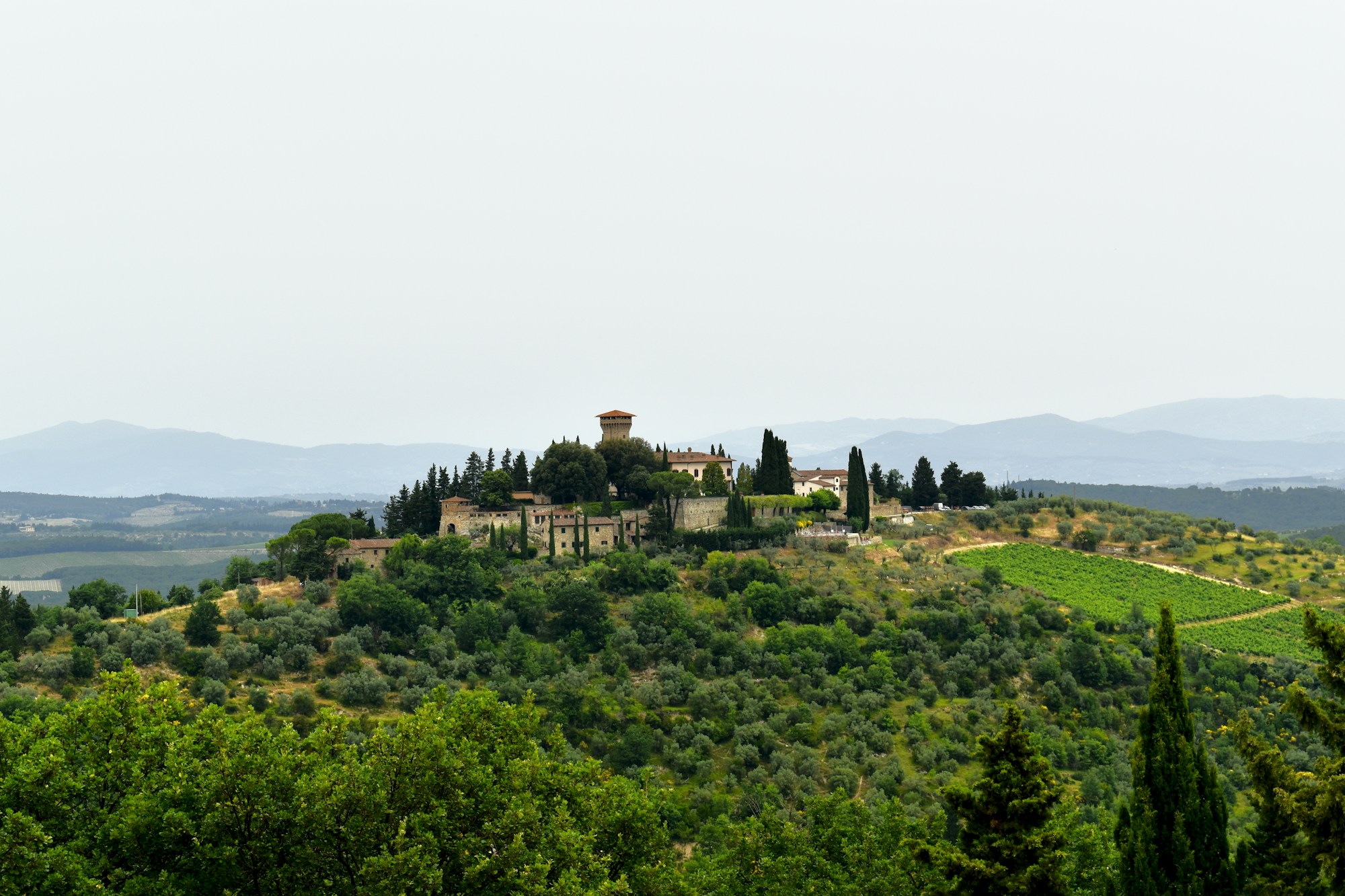
According to Coldiretti, the 2026 harvest started around ten days earlier than usual across Italy because of extreme heat — two to three weeks ahead of harvests from twenty or thirty years ago. In Tuscany, some early Sangiovese parcels could exceptionally be picked as soon as mid-August 2026, unheard of for a grape traditionally harvested between September and November. Faced with this erratic year, Tuscany approved a cut to permitted yields for Chianti Classico DOCG, Chianti DOCG and Brunello di Montalcino DOCG, according to FirenzeToday — a sign of cautious management rather than alarm.
The market itself is moving at two speeds. Chianti Classico sales grew 2.6% in value in 2025 but fell 2.6% in Italian supermarkets: the premium segment (Gran Selezione) is pulling prices up while entry-level wines feel the squeeze from weaker purchasing power. « Bottles at €26-28 in a restaurant are becoming a barrier for consumers, » noted Roberta Zanobini of the Castelli del Grevepesa estate at the 2025 Expo, according to WeChianti. Benedetta Marini, of Terre di Perseto, added that in a downturn, importers favour established brands, squeezing small producers already facing geopolitical uncertainty and US tariffs. The Consorzio’s answer is a sustainability manifesto unveiled for its 2024 centenary: 52% of the vineyard area is already organic or converting, and 62% of the denomination’s territory remains woodland, 80% of it permanent forest — far from the intensive-monoculture image sometimes pinned on Tuscan vineyards. The same Chianti Classico DOP olive oil, grown across the same area as the wine, is harvested later, in October-November: our European olive oil trail guide covers this other side of the terroir.
7. Extending Your Stay: Chianti Villages Worth Combining
The SR222, the Chiantigiana, links Florence to Siena over about 69 km, running through the main Chianti Classico villages. It’s a 1.5-hour drive without stops, but two days are recommended for an unhurried look around:
- Panzano in Chianti: views over the « Conca d’Oro », plus Dario Cecchini’s institution of a butcher shop. Its own festival, « Vino al Vino », runs 18-20 September 2026, the weekend right after the Greve Expo.
- Montefioralle: fortified hamlet 15-20 minutes’ walk from Greve, the Vespuccis’ claimed birthplace. « Montefioralle Divino » takes place 25-26 September 2026.
- Castellina in Chianti: well-preserved medieval centre, and the Via delle Volte, a vaulted passage along the old ramparts.
- Radda in Chianti: the Consorzio’s historic seat, founded here in 1924. Quieter than Greve or Castellina, so more pleasant in high season.
- Gaiole in Chianti: another village from the old « Lega del Chianti », alongside Radda and Castellina.
Siena, less than an hour from Greve, is also worth the detour: we recently covered the Palio dell’Assunta, the horse race that takes over Piazza del Campo in mid-August. For a wider look at the region, our pick of the best day trips from Florence in Tuscany covers San Gimignano, Pisa and Siena alongside Chianti.
Practical Info for the Expo del Chianti Classico
Book your guided tastings on Eventbrite, follow directions to the neighbouring villages and check the day’s schedule, even in the Tuscan hills’ patchy signal. Installed in two minutes before you leave.
Italy data packs from a few eurosCancellation, medical costs, luggage: travel insurance is still worth having for any Italy trip, even within the Schengen area. Nomad Insurance covers you globally from $56/4 weeks — 10% off through our link.
From $56 / 4 weeksTo compare data plans before you go, our eSIM travel comparison remains the reference.
Frequently asked questions
What are the dates of the Expo del Chianti Classico 2026?
Thursday 10 to Sunday 13 September 2026, on Piazza Matteotti in Greve in Chianti. It’s the 54th edition. A preview programme, « Aspettando l’Expo », already fills the village and the hamlet of Montefioralle from 2 to 8 September. Official source.
How much is entry and what does it include?
€20, including a tasting glass, a shoulder lanyard and a booklet of seven tickets (up to four usable at producers’ stands, up to seven at the Consorzio pavilion). Premium wines count double.
Do I need to book in advance?
Not for general entry. Themed guided tastings (€15-25, capped at 40 people) do need booking though, via Eventbrite or the official website — spots go quickly.
How do I get to Greve in Chianti without a car?
The Autolinee Toscane bus from Florence (Porta al Prato), about 50-57 minutes for €3-4, though service is reduced at weekends. No train station serves Greve directly. Rome2Rio.
What’s the best time to visit and avoid the crowds?
Thursday evening at opening time, or Friday late afternoon, before the weekend rush. Saturday and Sunday draw most of the roughly 20,000 visitors of the edition.
What’s the difference between Chianti and Chianti Classico?
Two separate DOCGs, run by two separate consortiums. Chianti Classico is the historic zone between Florence and Siena, protected by the Gallo Nero, with a minimum of 80% Sangiovese. Plain Chianti covers a much larger zone, with just 70% minimum Sangiovese and looser ageing rules.
Do I need an ETIAS authorisation for this trip in 2026?
No. The EU’s ETIAS rollout has slipped again, with 2027 now the target date. The EES system — biometric checks at the Schengen area’s external borders — has applied since 10 April 2026 to non-EU nationals, UK travellers included.
Sources
- Expo del Chianti Classico: official website, 54th edition: dates, tickets, tasting kit
- Expo del Chianti Classico: parking and services: parking areas, free shuttle
- Consorzio Vino Chianti Classico: events calendar: confirmation of 2026 dates
- Consorzio Vino Chianti Classico: historical timeline: 1924 founding, key milestones of the denomination
- Consorzio Vino Chianti Classico: wine characteristics: grape varieties, quality pyramid
- Consorzio Vino Chianti Classico: the UGAs: the eleven geographic sub-zones
- Consorzio Vino Chianti Classico: history of the Gallo Nero: origin of the symbol
- Visit Tuscany: Greve in Chianti: village history, Piazza Matteotti
- WeChianti: 2026 dates and Aspettando l’Expo programme: article from 18 August 2026
- WeChianti: producers speak out, Expo 2025: market testimonials
- GoNews.it: early 2026 harvest: Coldiretti analysis
- FirenzeToday: yield reductions in Tuscany: Chianti Classico DOCG and Brunello
- TripAdvisor: Tuscany forum, Expo Chianti Classico discussion: traveller feedback
- Rome2Rio: Florence to Greve in Chianti: transport options
- WineNews: the health of Chianti Classico’s territory: market and sustainability
Sources consulted on 19 August 2026.

Plan your trip with Pixidia
Pixidia learns how you travel and helps you build a trip that truly fits you and everyone coming along.
Open the planner
3. Getting There, Where to Stay and What to Budget
No train station in Greve: a car is still your best bet
Greve in Chianti has no train station, and the Florence-Siena rail lines skirt around the Chianti hills through the valley, according to Rome2Rio. From Florence, allow 30-40 minutes by car on the SR222, the scenic route nicknamed the « Chiantigiana », which winds through vineyards and cypresses for about 30 kilometres. The Autolinee Toscane bus from Porta al Prato takes 50-57 minutes for €3-4, but its schedule — built around locals’ commutes — thins out right on weekends. From Siena, it’s about 42 km and 49 minutes by road. If you’re coming from further afield, our night train vs flight to Italy comparison can help you pick your entry point.
If you’re renting a car, pick it up at Florence airport rather than downtown: limited traffic zones (ZTL) come with automatic fines that plenty of visitors only discover afterwards. On accommodation, book early: places near Piazza Matteotti fill up fast during the festival, and some hosts require a minimum four-night stay. The neighbouring villages (Castellina, Radda, Barberino Tavarnelle), 15-25 minutes away by road, often have more availability at softer rates. For food on a budget, Piazza Terra Madre hosts food stalls during the Expo, and the butchers and grocers on Piazza Matteotti sell everything you need for a cheap picnic between tastings. If you’d rather hand the planning to a guide, our private Tuscany tours also cover Florence, Siena and Chianti.
Highlights