
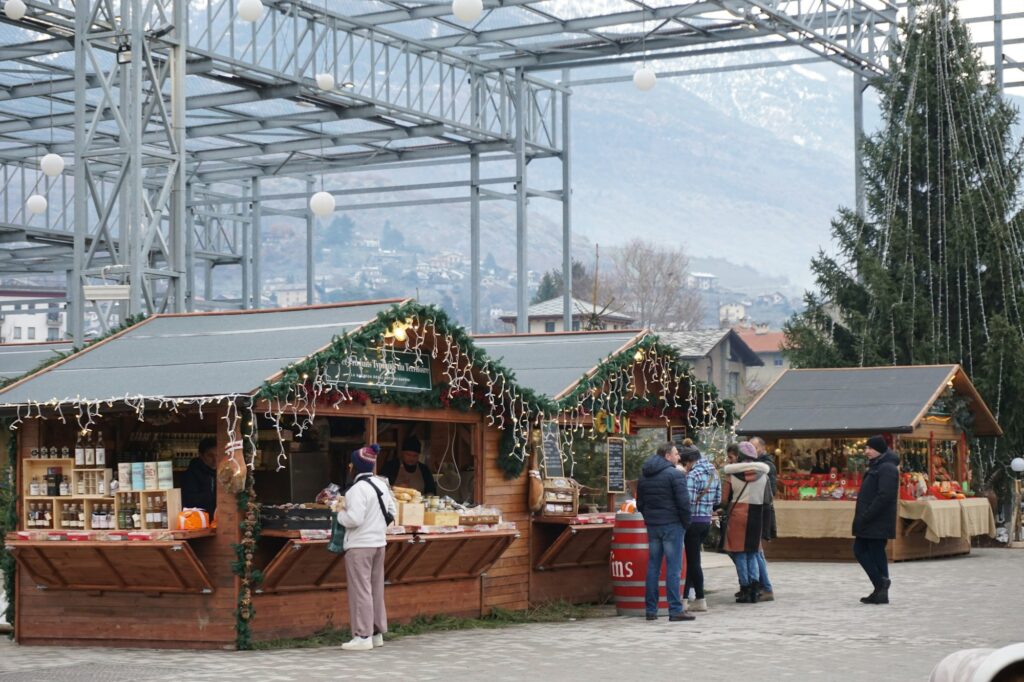
The Fiera di Sant’Orso 2027 runs on Saturday 30 and Sunday 31 January 2027 in Aosta’s historic centre. More than a thousand exhibitors, according to 2025 press reports, show traditional Aosta Valley craft. None of the sources consulted mention an entry fee, and the Ivrea–Aosta railway line is still under works: plan on a bus or by road.
Checked on against the official sources cited, including the official programme and the 2027 regulation.
Every late January, the centre of Aosta turns into a craft market. The Fiera di Sant’Orso takes over the historic streets for two days, with stalls selling wood, stone, leather and thread, and craftspeople demonstrating their skills. This guide covers the 2027 programme, the rules for exhibitors and, above all, what matters if you’re travelling from further away: the journey, dated fares and the points still to be confirmed.
1. Dates and programme 2027
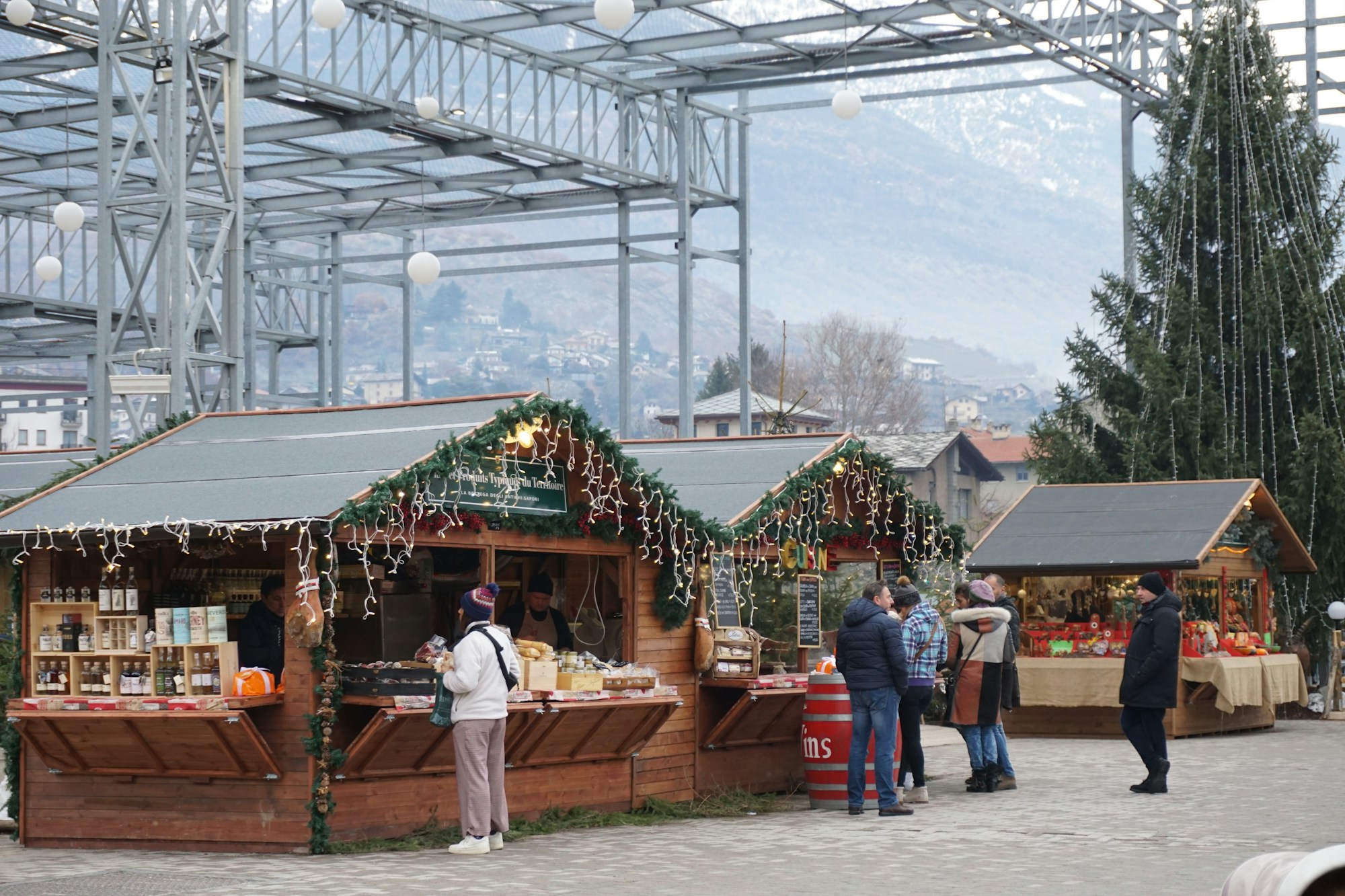
The official programme for the 2027 edition
The official programme places the main fair on Saturday 30 and Sunday 31 January 2027. It contains a slip: it says « Friday 31 January », but 31 January 2027 is a Sunday. The Autonomous Region of Aosta Valley, through its Ufficio artigianato di tradizione (traditional crafts office), announces the 1,027th edition. Fair programme.
Highlights
- The main fair runs on Saturday 30 and Sunday 31 January 2027, in the historic centre.
- The Atelier des Métiers opens as early as Thursday 28 January, with craft demonstrations.
- The Veillà starts on Saturday 30 January at 7 pm.
For a day out, a walking food tour of the centre of Aosta is offered on 30 and 31 January, at the date of consultation. It isn’t linked to the fair or the artisans: it’s a meal option, not a route past the stalls.
The full calendar fits in a few lines. The dates for Donnas, the neighbouring fair, come from the Aosta organiser and have not been confirmed by the Donnas committee.
| Item | Date or time |
|---|---|
| Atelier des Métiers | Thursday 28 to Sunday 31 January 2027 |
| Main fair | Saturday 30 and Sunday 31 January 2027 |
| Veillà | Saturday 30 January 2027, from 7 pm |
| Donnas (neighbouring fair) | Sunday 17 January 2027, according to the Aosta organiser |
| Artisan registration deadline | 13 November 2026, already passed |
Source: fair programme, 2027 regulation and organiser’s website, checked on 24 November 2026.
2. Who runs the fair and who can exhibit
The fair is run by the Autonomous Region of Aosta Valley, through its Ufficio artigianato di tradizione (traditional crafts office). Aosta city hosts the event in its historic centre without running it alone: regional rules govern the exhibitors.
The 2027 regulation stems from Regional Government resolution (delibera della Giunta regionale) no. 1114 of 25 September 2026. It reserves exhibition places for artisans who live in the Aosta Valley, or who have a registered office and a working unit in the region. Registrations for 2027 closed on 13 November 2026, so for visitors the fair is a spectator experience.
3. Artisans and crafts to see
The heart of the fair is handwork. The 2025 press talks about more than a thousand exhibitors, and the range is wide: wood (carving, engraving, clogs), soapstone (pierre ollaire), decorative ironwork, leather and hides, basketry, weaving and lace. To watch the work itself rather than just the objects, the Atelier des Métiers, which starts on 28 January, groups demonstrations over several days.
Two crafts have a documented history worth the detour. Cogne lace, known as tombolo lace, is passed from mother to daughter without a paper pattern, unlike French or Belgian lace according to lace museums (Movio). Tradition credits its arrival to Benedictine nuns who supposedly fled the monastery of Cluny in 1665; LoveVDA notes, however, that the technique was probably imported in the 16th century. The 1665 date therefore comes from tradition, not from a document. According to the LoveVDA database (date of survey not specified), the Les Dentellières cooperative in Cogne has around 40 lacemakers and produces about 1,500 metres a year.
The Valgrisenche drap is a rustic spun wool, woven on old maple-wood looms. The Les Tisserands cooperative has kept the tradition alive for more than forty years and offers four-shaft weaving courses, lasting three or five days, for adults, plus a permanent exhibition, « Lo drap ». The exhibition’s opening hours have not been verified: confirm them before you travel.
The Ayas clog (sabot d’Ayas) is carved from a single piece of wood. According to Monte Rosa Ski, which cites Turin’s National Museum of the Mountain, production became commercial once it went beyond home use. Today the clog is mostly a decorative object, and the Cooperativa Li Tsacolé, in Ayas, promotes the craft. Finally, documents from Bard castle attest to soapstone turning workshops in Champorcher from the 14th century. Current soapstone craftspeople could not be listed: don’t count on a list in advance.
| Craft | Organisation | What visitors can do |
|---|---|---|
| Cogne lace | Les Dentellières, Cogne | Working cooperative, around 1,500 metres a year |
| Valgrisenche drap | Les Tisserands, Valgrisenche | Three- or five-day weaving courses, « Lo drap » exhibition |
| Ayas clog | Li Tsacolé, Ayas | Promotion of the clog-maker’s craft |
Source: LoveVDA, Les Dentellières and Aosta Chamber of Commerce, Les Tisserands, checked 24 November 2026.
4. Getting to Aosta: train, bus, car and tunnels
The train: don’t count on it
The Ivrea–Aosta line is under works. According to an RFI notice of 21 November 2026, replacement buses run until 3 January 2027. After that, the pages consulted contradict each other: the ministry announced a reopening « from January 2027 », and a regional RFI page gives 11 January 2027 for the Ivrea–Pont-Saint-Martin section, but the same page announces a suspension until 12 June 2027, subject to change. No reopening date is confirmed. Check with RFI in early January before relying on the train.
The bus from Turin and Malpensa
FlixBus runs from Turin to Aosta with at least five departures a day, from €14.48 (indicative price, undated). From Malpensa, the FlixBus route takes around two hours. The Savda shuttle, bookable 24 hours ahead, costs €25 per person per trip, according to a timetable probably from the 2025–2026 season: no 2026–2027 timetable has been published.
From Savoy: the Francony coach
The carrier Francony runs a Savoy–Aosta coach on Sunday 31 January 2027, at €50, meals not included. It’s a commercial offer from the carrier, not a fair fare: check the booking terms on its website.
| Route | Option | Price or frequency |
|---|---|---|
| Turin–Aosta | FlixBus | From €14.48; five departures a day, the first at 8:15 am (indicative price, undated) |
| Malpensa–Aosta | FlixBus | One daily service announced (3:05 am to 9:45 pm), around 2 hours’ journey |
| Malpensa–valley | Savda, by reservation | €25 per person per trip; probably the 2025–2026 season timetable |
| Savoy–Aosta | Francony, commercial offer | €50 on 31 January 2027, meals not included |
| Ivrea–Aosta | Replacement bus | Running until 3 January 2027 |
Source: FlixBus, Aosta–Turin, Qualitytravel, Savda transfers, Francony, coach offer and RFI notice of 21 November 2026, checked 24 November 2026.
Car and tunnels
The Great St Bernard Tunnel links Switzerland with the Aosta Valley, and the Mont Blanc Tunnel links France. The Great St Bernard toll is €33.50 one way for a car, according to TCS, on an undated survey. The Fréjus Tunnel leads to Turin, not Aosta: it is only a comparison here, at €55.50 one way. The Mont Blanc car fare could not be found in the sources we could access; it was raised by 1.19% on 1 January 2026, according to Trans.info. Check the fare with the operator.
| Tunnel | One-way car fare | Data status |
|---|---|---|
| Great St Bernard (towards Aosta) | €33.50 | TCS survey, undated |
| Mont Blanc (towards Aosta) | Not published in the sources read | Increased by 1.19% on 1 January 2026 |
| Fréjus (towards Turin, comparison) | €55.50 | TCS survey, undated |
Source: TCS, alpine tunnel prices and Trans.info, tunnels 2026, checked 24 November 2026.
Parking and traffic
No 2027 parking plan had been published at the date of consultation. Previous editions relied on outer-ring car parks, and the 2025 sources disagree on whether the shuttles are free. The centre is largely pedestrianised, and regional notices from past editions mention one-way pedestrian routes and street closures during the fair. Park on the outskirts and walk.
5. Staying over: accommodation, food and weather
Where to stay
No hotel rate for January 2027 has been found. Two prices from a comparison site, with no date, give only a rough idea: Hotel Le Pageot from €121 a night, and Hotel Cecchin from €171, about 777 metres from the centre. We’d suggest booking early, as no public figure confirms the demand expected over the fair weekend.
Eating and drinking on site
The fair has regional food stalls run by the Pro Loco associations. The products cited by official sources are fontina, polenta and mulled wine. Past editions also handed out broth on the evening of the Veillà. Other specialities often mentioned could not be confirmed by an official source: try them on the spot rather than counting on them.
Late-January weather
The 1991–2020 averages give a mean temperature of 1.5 °C in January in Aosta, with an average low of −3.2 °C and an average high of 6.2 °C. These are historical averages, not forecasts for 2027.
| Indicator | Value |
|---|---|
| Mean temperature | 1.5 °C |
| Average low | −3.2 °C |
| Average high | 6.2 °C |
| Precipitation | About 40 mm over six days |
Source: Climats et Voyages, Aosta, checked 24 November 2026.
6. Attendance: figures you shouldn’t compare with each other
The published figures don’t measure the same thing: passages counted at Place Chanoux, visitors estimated by the press, entries at the Atelier. The table gives the unit for each figure, so you don’t add them up. The sources don’t explain the drop recorded in 2023.
| Year | Figure | Unit |
|---|---|---|
| 2015 | 322,000 | Passages |
| 2023 | 172,079 | Passages |
| 2024 | 206,387 | Passages, Place Chanoux counter |
| 2025 | About 150,000 | Visitors, press estimate |
| 2025 | 38,430 | People over the two days of the Atelier, up 74% |
Source: Nos Alpes, Gazzetta Matin, 2024 and Gazzetta Matin, 2025, checked 24 November 2026.
7. Budget: the costs and what’s dated
Your budget depends mostly on transport and the night’s stay. The table separates published amounts, dated or not, so you can weigh them without mistaking an old figure for a current fare.
| Item | Amount | Data status |
|---|---|---|
| Fair entry | No charge mentioned | To be reconfirmed for 2027 |
| Bus Turin–Aosta | From €14.48 per person | Indicative price, undated for January 2027 |
| Savda shuttle from Malpensa | €25 per person per trip | Probably the 2025–2026 season timetable |
| Savoy–Aosta coach (Francony) | €50, meals not included | Commercial offer for 31 January 2027 |
| Great St Bernard toll | €33.50 one way, car | Undated survey |
| Walking food tour (Viator) | €91 per adult, 30 and 31 January 2027 | Availability checked 24 November 2026 |
Source: fair programme, FlixBus, Qualitytravel, Francony and TCS, checked 24 November 2026.
8. The Veillà, the collegiate church and the Roman town
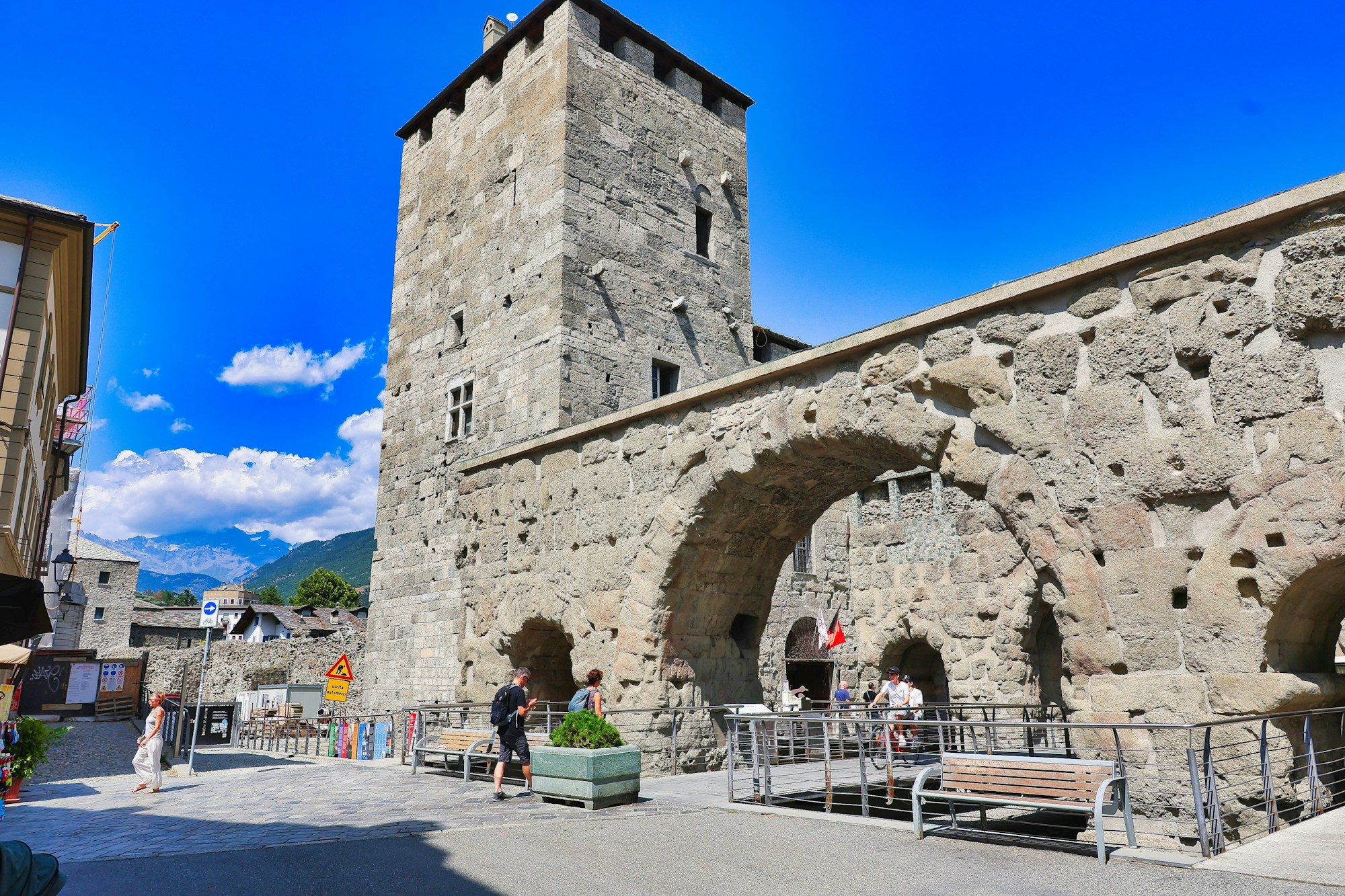
Aosta, a Roman town
The Arch of Augustus, dating from 25 BC, is freely accessible at no charge, according to italia.it. It’s a useful landmark for finding your way around the centre during the fair, when traffic is restricted.
The Veillà on 30 January
On the eve of the main fair, the Veillà starts at 7 pm in the historic centre. LoveVDA describes it as a popular evening with folk groups. The only detailed programme you can read is for 2025: an artisans’ Mass at 6 pm at the church of Saint-Orso, then animation in the centre from 7 pm. The 2027 programme gives only the start time: don’t treat the rest as settled until the official announcement.
The collegiate church of Saint-Pierre and Saint-Ours
The collegiate church houses a Romanesque cloister dated 1132 by italia.it, with 42 Romanesque capitals, and a pavement mosaic in the choir, probably 12th century, showing Samson and the lion. Sources disagree on the date of the portal, so it’s better not to state one. The 2026 regional document lists the church as open 9 am to 6:30 pm, and the cloister 9 am to 5 pm from November to February. Guided visits are offered at 11 am and 3 pm according to the LoveVDA listing, with booking recommended. These hours date from 2026: check the 2027 ones before you plan.
Donnas, the neighbouring fair
Donnas holds its own fair, the Fiera del Legno di Sant’Orso, in the old village. For the 2026 edition, LoveVDA lists 16 to 18 January, while the regional calendar keeps only the 18th. The Aosta fair organiser announces Sunday 17 January 2027, but the Donnas committee had not confirmed it at the date of consultation. If you plan to do both, check this date before you go.
Where the fair comes from
Tradition places the origin of the fair around the year 1000, near the collegiate church. That date is a conventional reference, repeated by most sources, not a documentary attestation. The legend that has Saint Ours handing out clothes and clogs to the poor is a local story with no ancient source.
9. Depending on your trip
- First visit. Start with the Atelier des Métiers, which opens on 28 January: indicative hours 10 am to 7 pm on 28 and 29 January. The demonstrations give you a feel for the crafts, and the main fair makes more sense afterwards.
- Families. The drap weaving courses last three or five days: this isn’t a weekend activity. For children, the fair is best treated as a walk, with a stop for broth or mulled wine on the evening of the Veillà.
- Couples on a tight budget. The bus from Turin remains the lightest cost, from €14.48 per person. No entry fee is mentioned in the sources consulted, so the budget goes on the night and the meal.
- Reduced mobility. The centre is largely pedestrianised, but the streets are cobbled. The sources don’t describe access to the stalls or on the replacement buses. Ask the organiser before you come.
What other guides don’t tell you
The points below come from the sources cited, some of which are not official, and don’t appear in the guides we read.
- The 2027 dates are set by a regulation, and registrations are closed. Regional Government resolution no. 1114 of 25 September 2026 governs the edition. Artisan registrations for 2027 closed on 13 November 2026. 2027 fair regulation (consulted 24 November 2026).
- The Atelier des Métiers starts on Thursday 28 January 2027, three days before the main fair. Official fair programme (consulted 24 November 2026).
- The Great St Bernard Tunnel offered a free return to fair visitors for the 2017 to 2019 editions: one-way ticket presented, return within 72 hours, postcard at the information point. This was a past promotion, and nothing confirms the offer for 2027. Letunnel.com, promotions (consulted 24 November 2026).
- The Ivrea–Aosta line runs replacement buses until 3 January 2027, according to an RFI notice of 21 November 2026. RFI notice (consulted 24 November 2026).
Practical information
As a British citizen you need a valid passport to enter Italy. The gov.uk entry requirements call for a valid travel document and don’t list UK photocards or ID cards, so don’t rely on one. Under Schengen rules, the passport needs an expiry date at least 3 months after the day you plan to leave the Schengen area, and a date of issue less than 10 years before you arrive. Passports are no longer stamped at the border under the EU’s Entry/Exit System (EES): you may be asked for biometric details instead.
The fair is on foot, outdoors, over cobbles, with night-time temperatures below zero in January: wear sturdy shoes and warm layers.
Frequently asked questions
What are the dates of the Fiera di Sant’Orso 2027?
The main fair runs on Saturday 30 and Sunday 31 January 2027, in Aosta’s historic centre. The Atelier des Métiers starts on Thursday 28 January, and the Veillà is on Saturday 30 from 7 pm. The official programme contains a slip: it says « Friday 31 January », but 31 January 2027 is a Sunday. Official programme.
Is the Sant’Orso fair free to enter?
No entry fee is mentioned in the sources consulted, including the LoveVDA listing for the 2026 edition. The official 2027 programme says nothing about fares: that silence proves nothing either way. Check the organiser’s website before you go.
Who organises the Fiera di Sant’Orso?
The Autonomous Region of Aosta Valley organises it, through its Ufficio artigianato di tradizione. The city of Aosta hosts the event in its historic centre without running it alone. The 2027 regulation reserves exhibition places for artisans who live in the region or have a registered office and a working unit there. Registrations for 2027 closed on 13 November 2026.
Can you get to the fair by train?
Not under normal conditions at the date of consultation. The Ivrea–Aosta line is under works, with replacement buses until 3 January 2027. No reopening date is confirmed: check with RFI in early January. Without a car, the published options are the FlixBus from Turin, the Savda shuttle from Malpensa (its 2026–2027 timetable is not published), and, from Savoy, the Francony coach on 31 January 2027 at €50.
How much does the bus from Turin cost?
FlixBus runs Turin–Aosta from €14.48, an indicative undated price for January 2027, with at least five departures a day, the first at 8:15 am. Comparison sites show much wider ranges, from €7.49 to €44.98 depending on the date and booking method. Compare before you book.
What’s the weather like in Aosta at the end of January?
The 1991–2020 averages give a mean of 1.5 °C in January, with lows around −3 °C and highs close to 6 °C. About 40 mm of rain falls over six days. These are historical averages, not forecasts for 2027. Dress in layers and wear sturdy shoes for the cobbles.
Do I need a passport to visit?
Yes. As a British citizen you need a valid passport. Under Schengen rules, it must expire at least 3 months after the day you plan to leave the Schengen area and have been issued less than 10 years before you arrive. Check the gov.uk Italy entry requirements before you travel.
Can you visit the collegiate church during the fair?
According to the 2026 regional document, the church is open from 9 am to 6:30 pm and the cloister from 9 am to 5 pm from November to February. Guided visits are offered at 11 am and 3 pm, with booking recommended. These hours date from 2026: check the 2027 ones before you plan your visit.
Sources
- Fiera di Sant’Orso programme : official 2027 programme, Atelier and Veillà
- 2027 fair regulation : resolution no. 1114, registrations
- Organiser’s website, Autonomous Region of Aosta Valley : organisation, Donnas date
- Regional page, 2026 fair : 2026 regulation and hours
- LoveVDA, Fiera di Sant’Orso listing : regional database, entry, food
- RFI, notice of 21 November 2026 : Ivrea–Aosta replacement buses
- FlixBus, Aosta–Turin : departures and price from
- Qualitytravel, Malpensa valley transfers : Savda fare, season
- Francony, Savoy–Aosta coach offer : 31 January 2027, €50, meals not included
- TCS, alpine tunnel prices : one-way car fare, undated survey
- Trans.info, Mont Blanc and Fréjus tunnels 2026 : increase on 1 January 2026
- GOV.UK, Italy entry requirements : passport validity under Schengen rules
- Climats et Voyages, Aosta : 1991–2020 normals
- Nos Alpes, fair attendance : 2015 and 2023 figures
- Gazzetta Matin, Atelier 2025 : 38,430 people over two days
- Quotidiano.net, the Fiera di Sant’Orso : more than a thousand exhibitors, 2025 visitors
- LoveVDA, Les Dentellières de Cogne : cooperative and production
- Aosta Chamber of Commerce, Les Tisserands : Valgrisenche drap, courses
- Monte Rosa Ski, Ayas clogs : commercial production, National Museum of the Mountain references
- Letunnel.com, promotions : free return offer 2017–2019
- Italia.it, Aosta Roman town : Arch of Augustus, Romanesque cloister
Sources consulted on 24 November 2026, unless stated otherwise.

Plan your trip with Pixidia
Pixidia learns how you travel and helps you build a trip that truly fits you and everyone coming along.
Open the planner