
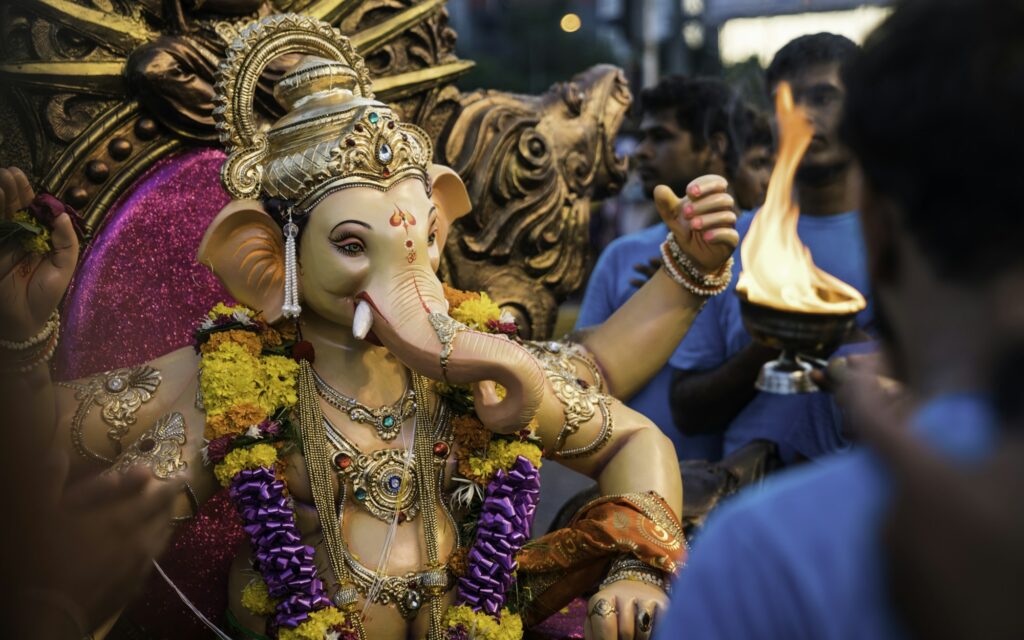
Mumbai’s most spectacular visarjan happens on Friday 25 September 2026 at Girgaon Chowpatty. It’s the last of Ganesh Chaturthi’s ten days (Anant Chaturdashi), when the city’s most revered idols, including Lalbaugcha Raja, are immersed after processions that can run until dawn. You reach the beach by train to Charni Road station, whose timetable changes for this exact evening. It’s best to arrive in late afternoon, stay back from the waterline, and agree a fixed meeting point with your group, since the mobile network gets overloaded in the crowd.
Every year, hundreds of thousands of Mumbaikars converge on a single beach to say goodbye to Ganesh. Girgaon Chowpatty, at the end of the « Queen’s Necklace » formed by Marine Drive, is where the city’s largest and most revered idols arrive during the visarjan, the ritual immersion that closes Ganesh Chaturthi. In 2026, that big night falls on Friday 25 September. This guide is for travellers who want to experience the spectacle as a spectator: how to get there, where to stand, what to expect, and how to stay safe in an enormous crowd.
Ganesh Chaturthi 2026 in Mumbai: what to know
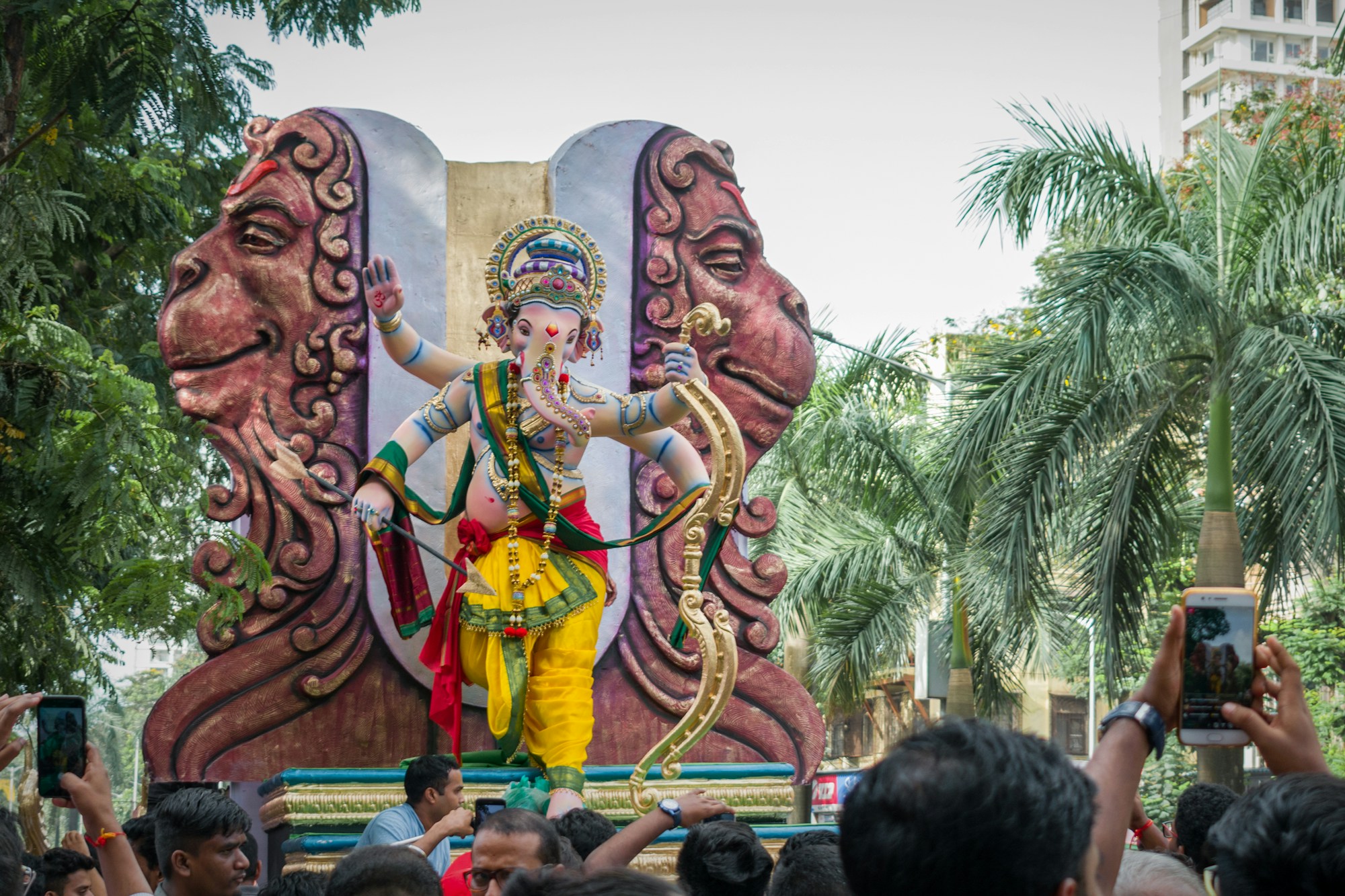
Ten days of festival, one final night for the biggest idols
Ganesh Chaturthi celebrates the birth of Ganesh, the elephant-headed god of wisdom and « remover of obstacles ». The festival opens on the fourth day of the Hindu lunisolar month of Bhadrapada, which is why the date shifts every year: 14 September in 2026, a public holiday in the state of Maharashtra. The celebration itself is ancient, but its public, collective form dates back to 1893, when Bal Gangadhar Tilak, a leading figure of the anti-colonial resistance, turned it into a rallying point for Hindus of every caste against British rule. According to Wikipedia, that founding decision still explains the sheer scale of the festival in Mumbai today.
The festival runs for ten days, from the idol’s installation (Sthapana) to its immersion (visarjan). Some families immerse their home idol after just a day and a half, or on the fifth or seventh day. But the large public idols, carried by neighbourhood mandals, always wait for the tenth and final day, Anant Chaturdashi, before heading out to sea. That’s what makes 25 September 2026, not the days before it, the date to mark if you want to see the spectacle at its biggest at Girgaon Chowpatty.
One chant rings out constantly on site: « Ganpati Bappa Morya ». Ganpati means « lord of the multitude », Bappa is Marathi for « father », and Morya refers to a legendary 14th-century devotee to whom Ganesh is said to have promised that his name would be invoked alongside his own forever after, according to Chai Bisket.
Highlights
- Lalbaugcha Raja and the city’s other landmark idols, immersed here and nowhere else on 25 September
- An atmosphere that’s both festive and reverent: chanting, dhol drums, petals raining down from balconies
- Marine Drive lit up right next door, a calmer counterpoint after hours in the crowd
The festival runs across ten days, so plenty of travellers use the extra time to combine the visarjan with other Mumbai essentials, starting with the Elephanta Caves, reached by boat from the Gateway of India in the Colaba district.
The big night: Anant Chaturdashi at Girgaon Chowpatty
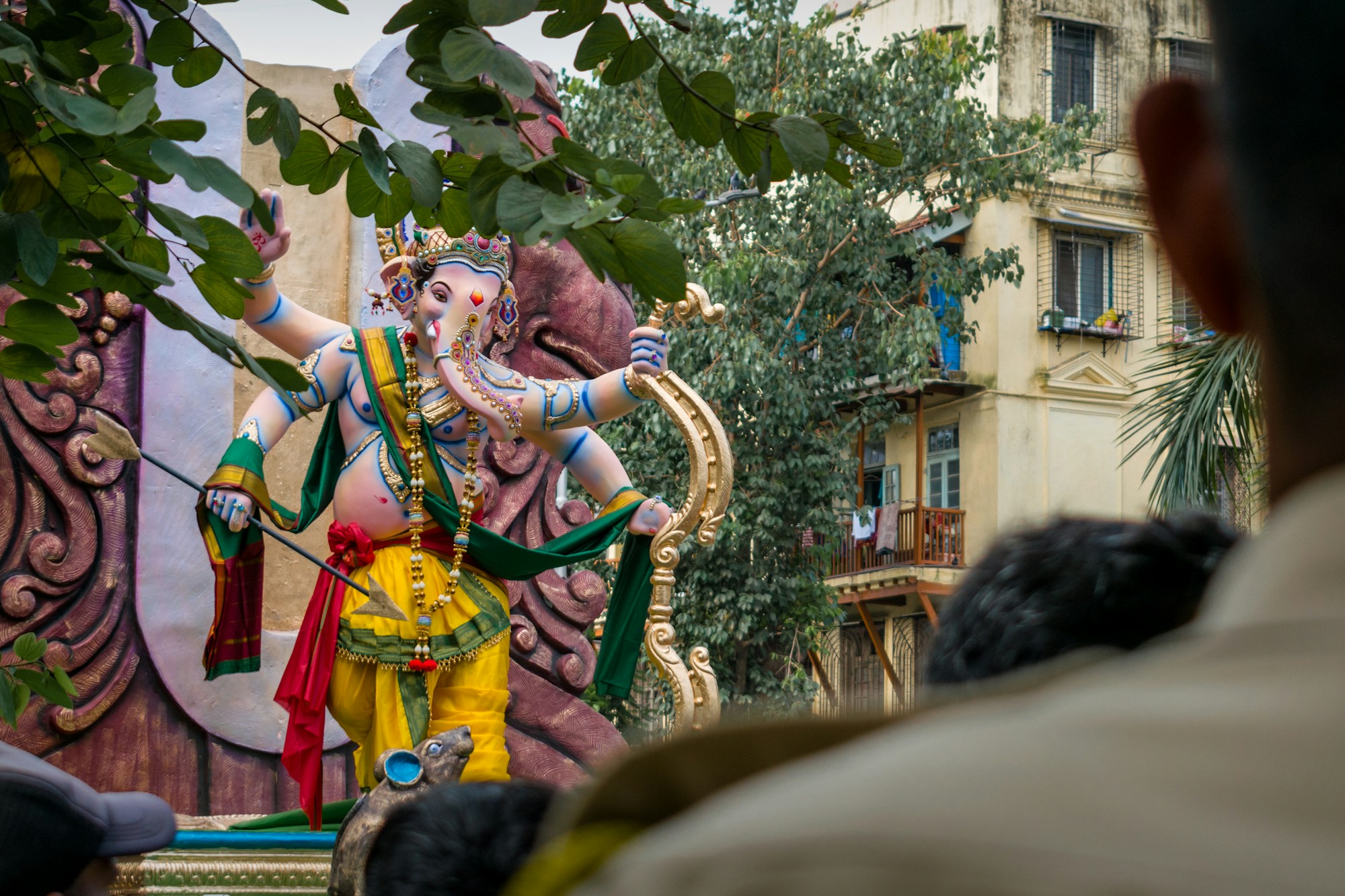
A procession that can run until dawn
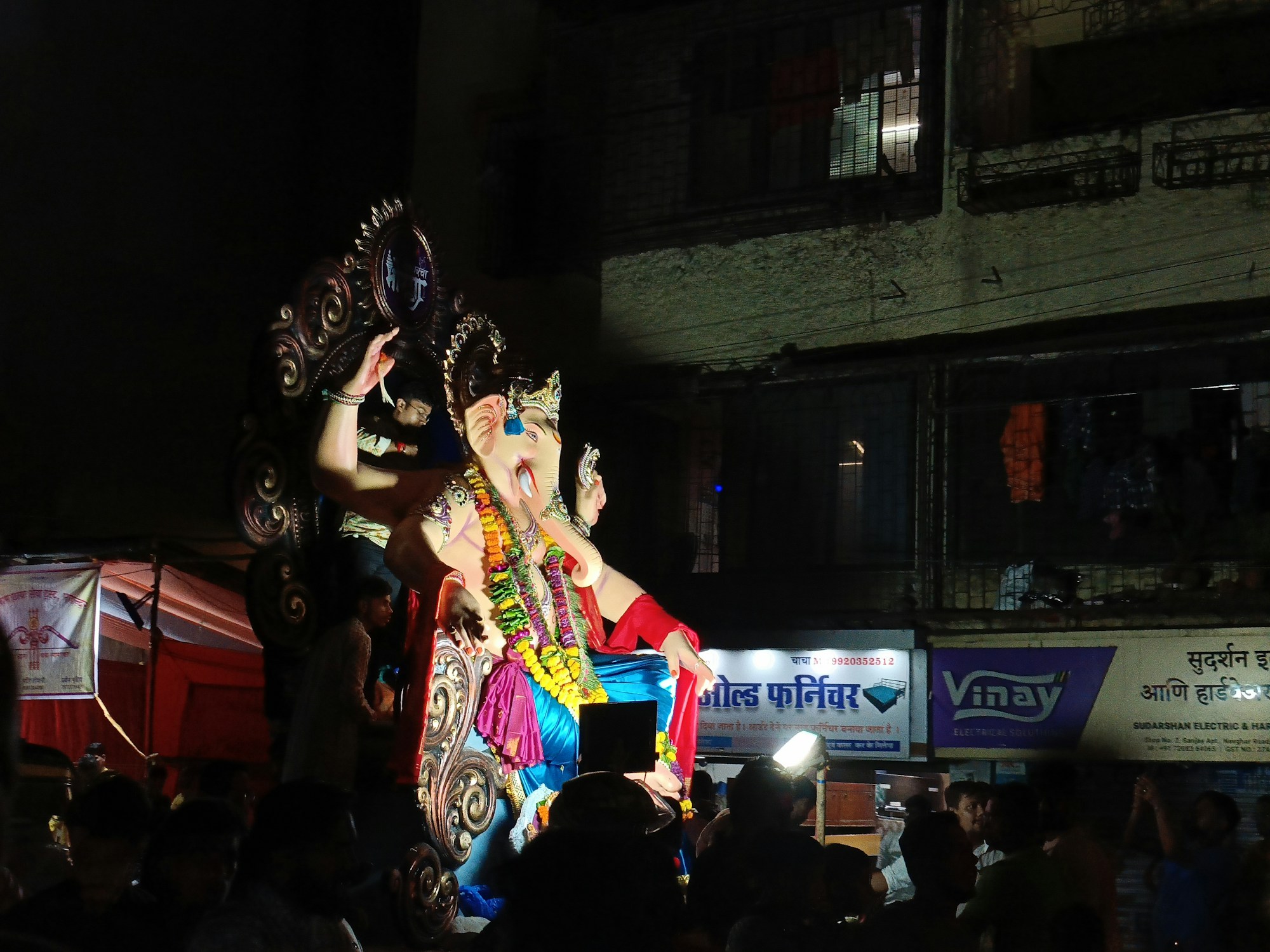
The procession carrying Lalbaugcha Raja, the city’s most revered idol, leaves the Lalbaug neighbourhood in late morning, around 10am, and takes several hours to cross central and southern Mumbai, with dense crowds along the entire route. Arrival at Girgaon Chowpatty and the immersion itself can drag on late: between 5 and 7am the next morning in the busiest years. The full procession can therefore run past twelve hours, according to travel blog Sandeepa Chetan.
The site comes alive from early afternoon and stays busy well into the night, sometimes beyond, for the biggest idols: Chinchpoklicha Chintamani, Ganesh Gallicha Raja, Tejukyacha Raja and Mumbaicha Raja all reach the sea at Girgaon Chowpatty the same evening. This isn’t a single immersion but a continuous parade of flatbed trucks carrying dozens, then hundreds, of idols over the hours, each one escorted by dancers.
Published timings stay indicative: the immersion depends on the tide. In 2025, Lalbaugcha Raja’s immersion was delayed by around 90 minutes after the raft meant to carry it out to sea drifted out of position in the rising swell. In 2024, by contrast, organisers had to speed things up to finish immersing the big idols before 11pm ahead of a forecast high tide, according to Lokmat Times.
Highlights
- A continuous parade of flatbed trucks all night, each one escorted by dancers and devotees
- High tide can delay the immersion by several hours: published timings are only indicative
- After the evening’s peak, the lit-up Marine Drive offers a calmer moment right next door
How to get to Girgaon Chowpatty and where to stand
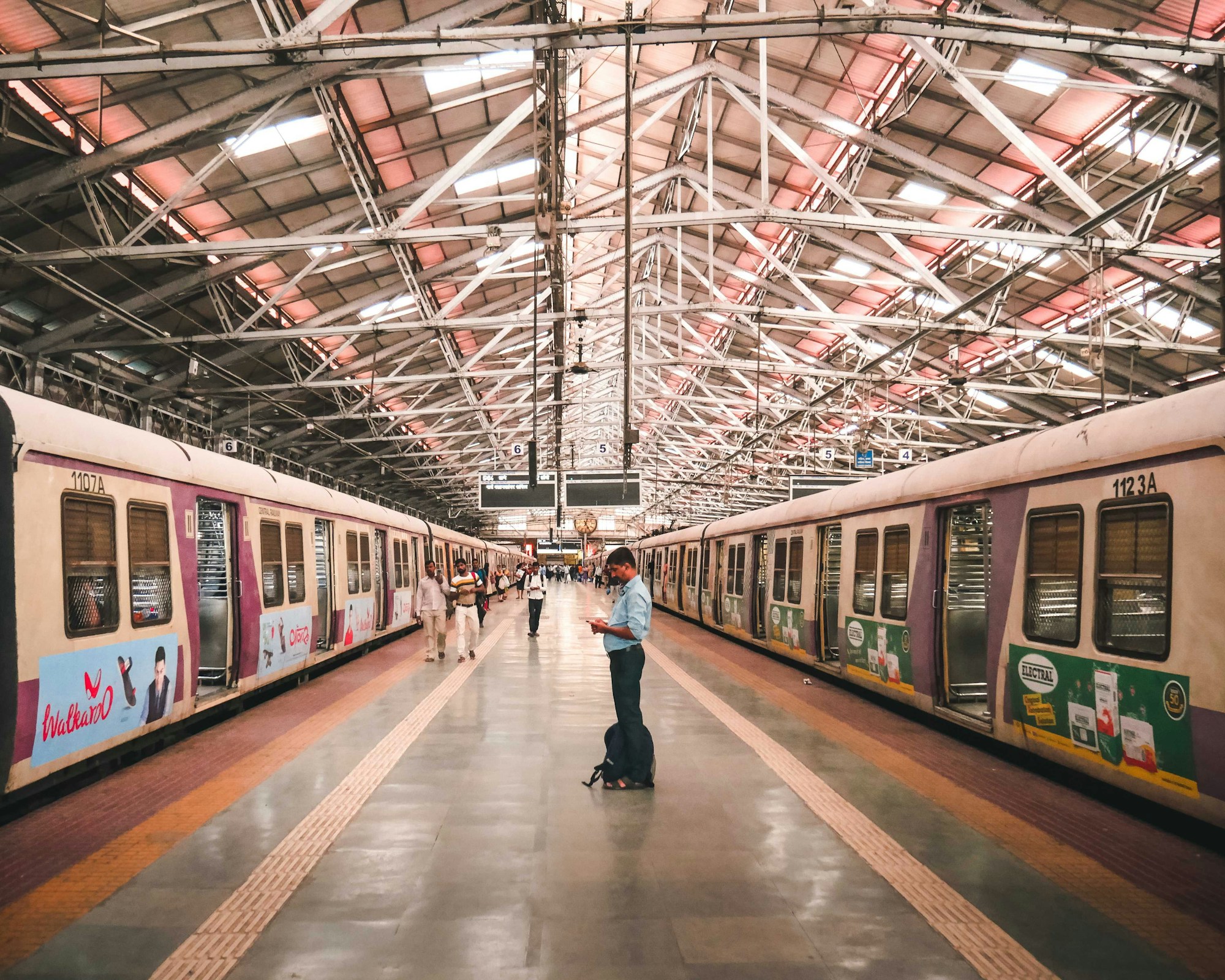
The train: the only truly reliable option that night
The closest station is Charni Road, on the Western Line, a 5 to 10-minute walk from the beach. Grant Road metro station (Line 3) or Girgaon station both work as backups. From Chhatrapati Shivaji Maharaj International Airport, allow around 22 kilometres and 1 to 1.5 hours under normal conditions, noticeably longer on visarjan day because of road closures.
On Anant Chaturdashi, Western Railway adjusts its timetable to handle the crowds. In 2025, twelve extra local trains ran between Churchgate and Virar overnight, up fast trains made an exceptional stop at every station between Mumbai Central and Churchgate from 5pm to 8.30pm, and up slow trains skipped the Charni Road stop entirely from 5pm to 11.30pm to ease platform crowding, according to Free Press Journal. Check Western Railway’s announcements as 25 September 2026 approaches: a similar setup is likely.
Taxis and ride-hailing apps are strongly discouraged in the evening: parking is banned across a wide radius, the streets around the beach close to traffic for several kilometres, and only vehicles carrying idols are allowed near the main approach. For a clear view without getting caught in the thickest crowds, it’s better to position yourself along Marine Drive rather than on the sand itself, which is reserved for processions and emergency services.
Highlights
- Get off at Charni Road (Western Line) or Grant Road metro station, then walk
- Check Western Railway’s announcements closer to the date: stops and frequencies change specifically for this evening
- Agree a physical meeting point with your group before entering the crowd: mobile networks get overloaded
Safety and crowds: what to expect
The real risk is the density, not crime
Local press consistently describes Girgaon Chowpatty as Mumbai’s busiest immersion site. In previous years, the city-wide operation deployed somewhere between 14,000 and 19,000 police officers on the day of the main visarjan, including watchtowers, plainclothes patrols and dedicated « Nirbhaya Squads » for women’s safety, according to Deccan Herald. Exact 2026 figures won’t be released by the Brihanmumbai Municipal Corporation (BMC) until closer to the festival, so treat these as an order of magnitude only. The BMC also deploys several hundred lifeguards and dozens of motorboats for the main visarjan evening alone.
Several bans apply: drones and other flying objects across the whole city for around a month surrounding the festival, firecrackers and loud music right at the immersion site itself, and sharing photos or videos of partially immersed idols. Swimming is banned outside the supervised ritual itself.
The documented risks are mostly about density: unavoidable physical contact, pickpocketing if valuables stay visible, and sudden direction changes from the flatbed trucks that can occasionally push the crowd back. Drownings are recorded every year during the festival, but mostly in rivers and lakes in other Maharashtra districts rather than at Girgaon Chowpatty itself, where the safety operation is heavier. One death by electrocution was also recorded in Mumbai in 2025, in the Sakinaka area, when a processional idol touched an overhead power cable. The seawater itself is documented as heavily polluted: faecal coliform levels measured at 1,455 per 100mL in 2013, well above the 500 threshold, with fisheries authorities occasionally reporting stingrays and jellyfish.
Highlights
- Stay back from the waterline: access to the sand is reserved for processions and police
- No visible jewellery or valuables: pickpocketing is the most common risk, not crime
- Join groups with families and women present if you want to get involved in the dancing
Less crowded alternatives for watching a visarjan
Girgaon Chowpatty draws the biggest idols and the densest crowds, but other immersion sites across Mumbai offer comparable ritual intensity with noticeably fewer people.
- Powai Lake: the most peaceful option, small neighbourhood mandals, an almost meditative atmosphere.
- Bandstand, Bandra: an open promenade facing the Arabian Sea, with immersions at sunset.
- Versova Beach: celebrations known for being more eco-friendly, with clay idols, cleaner and quieter.
- Dadar, Shivaji Park Chowpatty: a community feel and well-organised, noticeably less overwhelming than Girgaon.
- Juhu Beach: a family, festive atmosphere in the neighbourhood associated with Bollywood, sandy and loud.
Visa, budget and weather: planning your trip
Most nationalities need an Indian e-Tourist Visa before departure, applied for through the official government portal. No special permit is required to watch a public religious event like the visarjan: the standard tourist visa covers it. Your passport needs at least six months’ validity beyond your arrival date, with a minimum of two blank pages; allow 3 to 5 working days for processing, though it’s worth applying further ahead for the 30-day option, according to Opaige. Check your passport also meets the validity rules specific to your nationality: our 2026 passport ranking covers the most common restrictions.
This isn’t medical advice, but Western health authorities generally recommend updating routine vaccinations before a trip to India, along with stronger mosquito protection, especially during the tail end of the monsoon. A travel health clinic or your own doctor remains the right point of contact before you leave, as the CDC notes.
Late September marks the tail end of the monsoon in Mumbai: humid heat (24 to 30°C, around 83% humidity), with roughly a fortnight of possible rain days still left in the month. The monsoon typically withdraws in the third week of September, so 25 September 2026 theoretically falls in a drier window, though nothing is guaranteed, according to Weather and Climate. Pack a poncho or a light umbrella regardless.
Accommodation spans a huge range: from around $10 a night for the simplest places near Girgaon Chowpatty, $55 to $70 for mid-range options, and $100 to over $200 on Marine Drive or Nariman Point for upmarket hotels. For a first trip built around the festival, Colaba or Marine Drive are the best-placed neighbourhoods, within easy reach of Girgaon Chowpatty and the classic tourist sites, according to Travel Lemming. Expect to pay roughly $500 to $600 for a Europe-Mumbai return flight in September, one of the cheaper months of the year on this route, with a higher risk of rerouting if your flight crosses Middle Eastern airspace: our article on Middle East airspace closures covers the impact on routes to India.
One last thing worth checking locally: the first and last days of the festival are traditionally dry days in some Maharashtra jurisdictions, a rule that varies by city. If your trip doesn’t stop at Mumbai, our guide to North India, covering Rajasthan, Delhi and Varanasi, picks up where a first trip to the country logically continues. You can also start mapping out your own route for this trip with the Pixidia travel planner.
Practical info for your trip
Activate it before you fly and you’ll skip the queues at the airport’s Airtel and Jio counters, staying connected for the rest of your trip, including when the network gets overloaded in the visarjan crowds.
Data plans to suit your trip, from a few days to several weeksHumid heat, polluted water near the immersion sites, and dense crowds for several days: travel insurance with medical evacuation cover handles the health curveballs of a festival trip to India.
Flexible plans, from $56 for 4 weeksFrequently asked questions
What is the exact date of the visarjan at Girgaon Chowpatty in 2026?
The main immersion day, Anant Chaturdashi, falls on Friday 25 September 2026, ten days after the festival begins on 14 September. That’s the exact day the city’s large public idols, including Lalbaugcha Raja, are immersed at Girgaon Chowpatty, according to Drik Panchang.
Is it dangerous to watch the visarjan at Girgaon Chowpatty?
The main risk isn’t crime but crowd density: unavoidable physical contact, difficulty moving around, and pickpocketing if valuables stay visible. Drownings are recorded every year during the festival, but mostly in rivers and lakes in other Maharashtra districts; at Girgaon Chowpatty itself, the safety operation is heavier, with lifeguards, boats and a swimming ban outside the supervised immersion. According to Navhind Times, at least nine drownings were recorded across Maharashtra during the 2025 edition.
How do you get to Girgaon Chowpatty without a car on visarjan day?
The train stays the most reliable option: get off at Charni Road station, on the Western Line, a 5 to 10-minute walk from the beach, or at Grant Road metro station. Taxis and ride-hailing apps are strongly discouraged in the evening, as the streets around the beach close to traffic for several kilometres. Check Western Railway’s announcements closer to the date, since train timetables change specifically for that evening.
Are there less crowded alternatives for watching a visarjan?
Yes. Powai Lake has the most peaceful atmosphere, with small neighbourhood mandals. Bandstand, in Bandra, offers an open promenade facing the Arabian Sea. Versova Beach and Dadar’s Shivaji Park Chowpatty are also less crowded than Girgaon Chowpatty while keeping the ritual intensity of the visarjan.
Is the water safe if you get splashed during the immersion?
No. The seawater at Girgaon Chowpatty is documented as heavily polluted, with faecal coliform levels well above accepted norms, and it isn’t intended for swimming outside the supervised ritual itself. It’s best to stay back from the waterline anyway, since it’s reserved for processions and police during the visarjan, according to Wikipedia.
Do you need a special visa to attend a religious festival in India?
No, the standard e-Tourist Visa is enough to watch the visarjan from public space: no special permit is required for this kind of event. Your passport just needs to stay valid for at least six months after your arrival date, with a minimum of two blank pages.
Sources
- Drik Panchang: dates and tithis for Ganesh Chaturthi and Anant Chaturdashi 2026.
- Wikipedia, Ganesh Chaturthi: history and meaning of the festival.
- Wikipedia, Girgaon Chowpatty: site geography and water quality.
- Wikipedia, Lalbaugcha Raja: Mumbai’s most revered idol.
- Wikipedia, Marine Drive: the promenade known as the « Queen’s Necklace ».
- Sandeepa Chetan Travel Blog: procession timeline and on-the-ground tips.
- Free Press Journal: Mumbai police safety guidelines.
- Free Press Journal: Western Railway’s special measures at Charni Road.
- Lokmat Times: 2025 immersion delay caused by high tide.
- Deccan Herald: BMC’s deployment (lifeguards, boats, control rooms).
- Deccan Herald: police numbers deployed for the festival.
- Navhind Times: drownings recorded during the 2025 festival.
- LawBhoomi: legal restrictions on Plaster of Paris idols.
- Citizen Matters: noise pollution levels measured during the festival.
- CDC: general health recommendations for India.
- Opaige: guide to the 2026 Indian e-Tourist Visa.
- Weather and Climate: Mumbai’s average climate in September.
- Travel Lemming: neighbourhoods and accommodation in Mumbai.
- Maharashtra Tourism: official festival page.
Information verified on 23 August 2026.

Plan your trip with Pixidia
Pixidia learns how you travel and helps you build a trip that truly fits you and everyone coming along.
Open the planner