
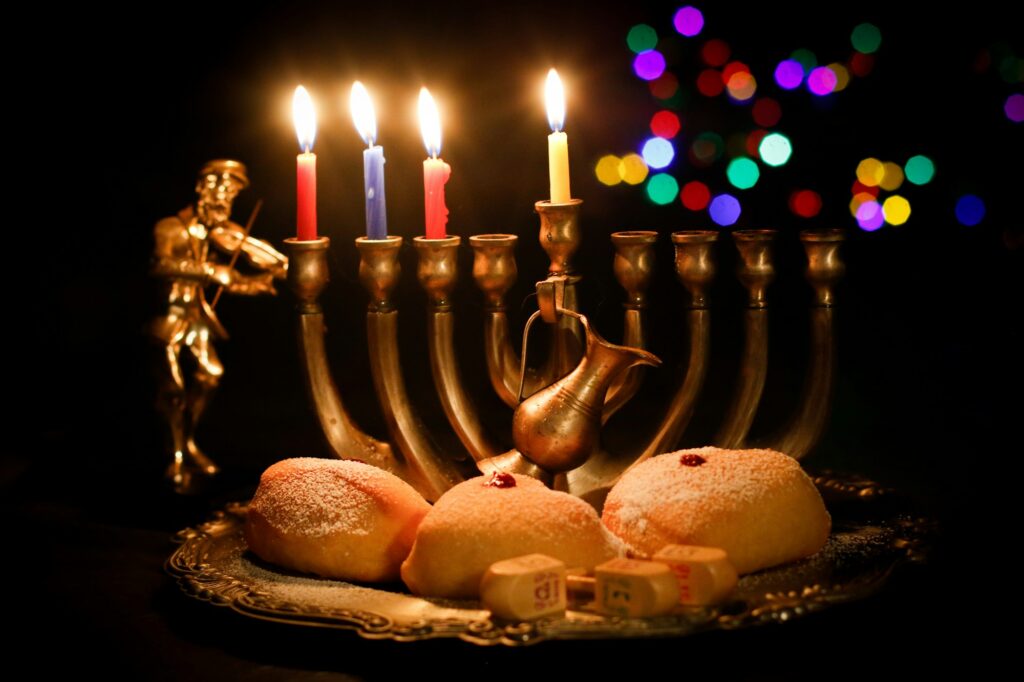
Hanukkah 2026 begins at sundown on Friday 4 December 2026 and ends on Saturday 12 December 2026. The festival lasts eight nights: the last candle is lit on Friday 11 December, before Shabbat, at around 4:35 pm in Paris. Saturday 5 December is 25 Kislev, day 1 of the Hebrew calendar.
Checked on against the Hebcal and Chabad calendars, and the FCDO travel advice.
Hanukkah, the Festival of Lights, is celebrated over eight nights in December 2026. It commemorates the reclaiming of the Temple in Jerusalem more than two thousand years ago, and it’s lived first at home, by the flame of a hanukkiah. This article gives the dates night by night, the ritual gestures, where to mark it this year, and what to check before you go. The frequently asked questions at the end cover the most common queries.
Hanukkah 2026 dates, night by night
The Jewish calendar counts each day from sundown. So the first night falls on Friday 4 December, at the candle lighting before Shabbat. Day 1, 25 Kislev, covers Saturday 5 December, and day 8, 2 Tevet, covers Saturday 12 December. Each night adds one candle to the hanukkiah, up to eight.
| Civil date | Hebrew date | Candles that night | Lighting in Paris (indicative) | Lighting in Jerusalem (indicative) |
|---|---|---|---|---|
| Friday 4 December | 24 Kislev (eve of day 1) | 1 + shamash | 4:37 pm | 3:54 pm |
| Saturday 5 December | 25 Kislev (day 1) | 2 + shamash | Not checked | Not checked |
| Sunday 6 December | 26 Kislev | 3 + shamash | Not checked | Not checked |
| Monday 7 December | 27 Kislev | 4 + shamash | Not checked | Not checked |
| Tuesday 8 December | 28 Kislev | 5 + shamash | Not checked | Not checked |
| Wednesday 9 December | 29 Kislev | 6 + shamash | Not checked | Not checked |
| Thursday 10 December | 30 Kislev | 7 + shamash | Not checked | Not checked |
| Friday 11 December | 1 Tevet (Rosh Hodesh) | 8 + shamash | 4:35 pm | 3:55 pm |
| Saturday 12 December | 2 Tevet (day 8) | End of the festival | End of Shabbat: Havdalah at 5:48 pm (not a lighting) | End of Shabbat: Havdalah at 5:16 pm (not a lighting) |
Source: Hebcal, Hanukkah 2026, checked on 12 October 2026; the day count and the last night are confirmed by the Chabad.org Hanukkah 2026 FAQ, checked the same day. The rows for 6 to 9 December follow the rule of one extra candle each night (same FAQ).
The Hebrew date names the civil day; the candles of each night are lit at sundown. The times in the table come from Hebcal and are only a guide: they vary by city and by day. For an exact time at a specific place, a local sunset calculator gives the precise time. The times for the middle nights haven’t been checked for this article, so don’t work them out from another calendar.
The last night deserves attention. The eighth candle is lit on Friday 11 December, before Shabbat begins, at 4:35 pm in Paris and 3:55 pm in Jerusalem according to Hebcal. Remembering « 4 to 12 December » isn’t enough: the festival ends on Saturday 12 at nightfall, but the last candle is lit the day before. According to the Chabad 2026 FAQ, the last candles are lit on Friday afternoon, before Shabbat.
The civil calendar doesn’t follow the Jewish calendar, and Hanukkah moves through the Gregorian calendar every year. Hanukkah 2027 is already scheduled from Friday 24 December 2027 to Saturday 1 January 2028, according to Hebcal, checked on 12 October 2026.
Where the festival comes from: the Maccabees and the Temple
Hanukkah, meaning « dedication » or « inauguration » in Hebrew, commemorates the reclaiming of the Temple in Jerusalem by the Maccabees around 164 BCE. They had fought the Seleucid Empire, which had desecrated the sanctuary. According to Wikipedia’s Hanukkah article, checked on 12 October 2026, the festival is fixed on 25 Kislev in the Hebrew calendar.
It isn’t a biblical festival: the rabbis established it, and tradition describes it as a relatively minor festival in religious terms. Its best-known story comes from the Talmud (tractate Shabbat): a flask of pure oil, enough for one day, is said to have burned for eight days. Encyclopedic sources present this story as Talmudic tradition, not as established historical fact. That’s how it should be read.
The candle-lighting rules have a school dispute too. The House of Hillel recommends lighting one candle on the first night, then one more each night. The House of Shammai recommends the reverse, starting from eight candles. Jewish law follows Hillel’s position, the one practised today.
Traditions: what happens over the eight nights
The hanukkiah and the flame
The hanukkiah, or Hanukkah menorah, has nine branches: eight for the eight nights, and a ninth, the shamash (« servant » or « guardian »), used to light the others. Chabad.org explains that one candle is added each night and that you always start with the newest one. According to Welcome Israel, the candles should burn for at least 30 minutes, and they’re lit at sundown or just after.
An electric hanukkiah can decorate a window, but it doesn’t do the ritual: the Chabad 2026 FAQ reminds you that a real flame must be lit. The hanukkiah is often placed near a window or a door so passers-by can see it, because tradition holds that the light makes the miracle visible.
Two blessings are said each night, and the shehecheyanu blessing is added on the first night (Chabad 2026 FAQ). The first lighting is therefore the busiest in gestures, before the ritual becomes routine.
Games, coins and food
The dreidel is a four-sided spinning top with four Hebrew letters, nun, gimel, hei and shin, which form an acronym for a phrase meaning « a great miracle happened there. » In Israel, the version says « here » (Welcome Israel). People often play with gelt, coins in silver or chocolate given to children (Wikipedia).
Frying recalls the miracle of the oil. Latkes, potato pancakes, are served with sour cream and apple sauce. Sufganiyot, round jam-filled doughnuts coated in sugar, are very popular in Israel. A recipe for a jam-filled doughnut appears in a Nuremberg cookbook from 1485 (Wikipedia, Sufganiyah article, checked on 12 October 2026).
Polish immigrants brought the ponchik to Mandatory Palestine, and the Histadrout, founded in 1920, pushed to replace homemade latkes with doughnuts that bakeries could make more easily. Today the usual fillings are strawberry or raspberry jam, then dulce de leche and chocolate or vanilla cream.
Hanukkah and Christmas: a cultural closeness, not a religious one
Christmas Day falls two weeks after the last night of Hanukkah 2026. Yet the two festivals have no liturgical link. Hanukkah follows the Hebrew lunisolar calendar and never falls on a fixed date in the Gregorian calendar. If the comparison took hold, it’s because of the festival’s history in the West: Wikipedia notes that its closeness to Christmas has given it particular cultural weight in the Western world.
Gifts and chocolate coins are part of the atmosphere, especially for children. No ritual requires them, though. Presenting Hanukkah as a gift holiday would be a misreading.
If your December takes you to Prague, the Prague Christmas markets 2026 guide covers the city’s markets, and the best day trips from Prague guide helps you plan your days.
Four mistakes to avoid
- Mixing up the first night with the first calendar day. The first candle is lit on Friday 4 December, not Saturday 5, even though the 5th is day 1 of the Hebrew count.
- Taking the end of Shabbat for the lighting time. Some calendars show a Shabbat end or exit time, which isn’t when the candles are lit. Use the lighting time, and check it for your city.
- Buying an electric hanukkiah and stopping there. It decorates, but the ritual calls for a real flame (Chabad 2026 FAQ).
- Planning around a 2025 programme. Last year’s events give a format, not a schedule. For 2026, no public programme had been found when this was written.
Paris: the Jewish history of the Marais, outside the festival
As of 12 October 2026, Paris has no public lighting programme announced for 2026. The tour below isn’t about Hanukkah: it’s a Jewish history tour of the Marais district, to take during your stay, outside any ceremony. According to the product page, a guide named Karen has been running it for more than fifteen years and says she has built lasting ties with the local Jewish community.
Jewish history tour of the Marais, about 4 hours
The price shown on the Viator listing on 12 October 2026 is €200 for two adults, which works out at €100 per person. The same amount applies to the five open dates checked: 4, 6, 7, 9 and 11 December.
Highlights
- Tour of about 4 hours, according to the product page
- 5 of 9 dates open, as checked on 12 October 2026
- Rated 5.0 from 33 reviews (8 on Viator, 25 on TripAdvisor), as checked on 12 October 2026
Price and availability checked on 12 October 2026 on Viator (5 of 9 dates open between 4 and 12 December). Availability changes: check the date on the listing before you book.
Where to mark it in 2026: what’s announced and what isn’t
No official public lighting programme has been found for 2026 as of 12 October 2026, in Paris or in the other cities often mentioned. Past editions give an idea of scale, but they guarantee nothing for December. The table only includes what could be checked.
| Place | What is documented | 2026 programme found | Advice |
|---|---|---|---|
| Prague, Jewish Museum | Homepage checked: no Hanukkah event is announced there | None listed on the page checked | Check with the Jewish community in Prague |
| Israel | FCDO advice updated on 22 July 2026, still in force on 12 October 2026 | Not applicable | Read the advice zone by zone before you book |
| Sydney (Bondi Beach) | Attack on 14 December 2025 against the « Chanukah by the Sea » gathering | Not applicable | Follow the access conditions for public gatherings |
Sources: Jewish Museum in Prague, homepage; GOV.UK, Israel travel advice; Wikipedia, 2025 Bondi Beach shooting. Checked on 12 October 2026.
Public lightings are usually announced locally as the festival approaches. So check the councils, Jewish communities and local authorities in the city where you’ll be staying. In Jerusalem, Welcome Israel (checked on 12 October 2026) describes large hanukkiot set up near public buildings. That page isn’t dated: it describes a custom, not a 2026 programme.
Israel and Jerusalem: read the advice zone by zone
The UK government’s travel advice for Israel (FCDO) was updated on 22 July 2026, and it was still in force when this was written, on 12 October 2026. It mentions regional tensions, recent strikes and retaliatory attacks, gatherings that can turn violent around anniversaries and major events, cancelled flights, and airspace closures at short notice. It advises against all travel to some areas, and against non-essential travel to others.
Check your own government’s advice as well. The French Foreign Ministry page could not be read when this article was written, so read it alongside the UK advice and follow both up to the day you travel.
For Jerusalem, public transport is in principle stopped from Friday afternoon to Saturday evening, during Shabbat. The 2026 transport timetables for the festival dates haven’t been checked: ask the local operator before you plan your journeys.
Sydney: the Bondi Beach attack
On 14 December 2025, an attack targeted the « Chanukah by the Sea » gathering organised by Chabad at Archer Park, in Bondi Beach, Australia. According to Wikipedia, checked on 12 October 2026, the attack killed 16 people, including one attacker, and wounded 40 to 41 others; some media report 15 deaths. The official Australian toll hasn’t been used here. Since then, security reinforcements have been announced for Hanukkah gatherings in several cities. Check with the organisers before you attend a public gathering.
What other guides don’t tell you
Three points that short answers about Hanukkah 2026 don’t always give. Each one points to a source checked on 12 October 2026.
- The last candle is lit on Friday 11 December, not Saturday 12. The festival ends on Saturday 12 at nightfall, but the eighth candle is lit the day before, before Shabbat (Hanukkah 2026 FAQ, Chabad.org, checked on 12 October 2026).
- The UK advice for Israel has to be read zone by zone. It doesn’t treat the whole country the same way, and it changes: its last update was on 22 July 2026 (GOV.UK, Israel travel advice, checked on 12 October 2026).
- Hanukkah 2027 is already scheduled. It’s set to run from Friday 24 December 2027 to Saturday 1 January 2028 (Hebcal, Hanukkah 2027, checked on 12 October 2026).
Practical info for a stay during the festival
What changes over the eight nights, as checked for this article:
- Lighting happens at sundown or just after, and the flame must burn for at least 30 minutes (Welcome Israel). The Paris and Jerusalem times in the table are indicative: check the exact time for your city.
- Shabbat falls on Saturdays 5 and 12 December. On Fridays 4 and 11 December, the candles are lit before it begins, and transport and shops in Jerusalem may stop during this period (check for each city and each date).
- School breaks: Welcome Israel says Israeli schools take eight days off at this time (check with the Israeli Ministry of Education). None of the sources consulted links Hanukkah to school holidays.
An eSIM sets up from your phone, before you leave or on arrival. Plans, coverage and validity vary by country: compare them on the provider’s site before you choose.
Prices depend on the plan, shown on the siteFor a stay abroad, compare the cover (cancellation, repatriation, luggage) for your destination and your activities.
Prices depend on cover and durationFrequently asked questions about Hanukkah 2026
When is Hanukkah in 2026?
Hanukkah 2026 begins at sundown on Friday 4 December 2026 and ends at nightfall on Saturday 12 December 2026. The festival lasts eight nights. These dates are confirmed by the Hebcal calendar and the Chabad.org 2026 FAQ, both checked on 12 October 2026.
Does Hanukkah 2026 start on 4 or 5 December?
The first night is Friday 4 December, at sundown. Saturday 5 December is 25 Kislev, day 1 of the Hebrew calendar. That’s why some civil calendars show the 5th as the first day, but the first candle is still lit on the 4th.
When is the last candle of Hanukkah 2026?
The last candle is lit on Friday 11 December 2026, on the eighth night, before Shabbat: at 4:35 pm in Paris and 3:55 pm in Jerusalem, according to Hebcal (indicative times). On Saturday 12 December at nightfall, the festival ends. Source: Chabad.org 2026 FAQ, checked on 12 October 2026.
Hanukkah 2026: what are the dates?
The dates are Friday 4 to Saturday 12 December 2026, with the last candle lit on Friday 11 December. Some calendars show 5 December as the first day. That’s 25 Kislev, not the first night.
Can you travel to Israel during Hanukkah 2026?
The answer depends on the official advice at the time, which applies zone by zone. The UK government’s travel advice for Israel (FCDO) was updated on 22 July 2026: it advises against travel to some areas and against non-essential travel to others. Check your own government’s advice before you travel, and check flights at the last minute.
Is there a public lighting in Paris in 2026?
No official public lighting programme in Paris has been found for 2026 as of 12 October 2026. Public lightings are announced locally as the festival approaches: follow the councils and Jewish communities of the city where you’re staying.
Is Hanukkah a public holiday in the UK?
No. Hanukkah isn’t on the official list of bank holidays in England, Wales, Scotland or Northern Ireland, according to GOV.UK, checked on 12 October 2026. Check the official list for each year.
Does Hanukkah fall during the Christmas school holidays?
The sources consulted don’t link Hanukkah to school holidays, and the December 2026 term dates weren’t checked for this article. Welcome Israel says Israeli schools take eight days off at this time: check with the Israeli Ministry of Education before planning a trip.
When is Hanukkah 2027?
Hanukkah 2027 is scheduled to begin at sundown on Friday 24 December 2027 and end at nightfall on Saturday 1 January 2028, according to Hebcal, checked on 12 October 2026. As every year, the festival follows the Hebrew calendar, so its dates move through the Gregorian calendar.
Sources
- Hebcal, Hanukkah 2026: dates, Hebrew count and indicative lighting times
- Chabad.org, Hanukkah 2026 FAQ: lighting rules and the last night
- Hebcal, Hanukkah 2027: 2027 dates
- Welcome Israel, Hanukkah: traditions, candle duration, school breaks
- Wikipedia, Hanukkah: origin, Talmudic tradition, gifts and Christmas
- Wikipedia, Sufganiyah: history of the doughnuts
- Wikipedia, 2025 Bondi Beach shooting: date, place and provisional toll
- GOV.UK, Israel travel advice (FCDO): advice by zone
- GOV.UK, bank holidays: the official UK list
- Jewish Museum in Prague: homepage, checked on 12 October 2026
Sources checked on 12 October 2026. Lighting times are indicative and should be checked for your city.
Plan your trip with Pixidia
Pixidia learns how you travel and helps you build a trip that truly fits you and everyone coming along.
Open the planner