

As of 1 January 2027, Italy’s tourist tax stays capped at €5 per night and per person, or €10 in provincial capitals where tourist presence reaches twenty times the resident population. Hosts who fail to declare it face a penalty of 100% of the unpaid tax, with a minimum of €50 (Legislative Decree 147/2026).
Checked on against the official texts read (Normattiva, MEF, Comune di Venezia) and, for Milan, the professional press.
From 1 January 2027, the rules for Italy’s tourist tax change mainly for hosts. For travellers, the principle stays the same: the tax is a charge per night and per person, set town by town. For the owner of a flat, the manager of a B&B or the host of a rental, Legislative Decree 147 of 7 August 2026 mainly changes the cost of a reporting mistake. This article covers both angles. Figures were checked on 25 November 2026 against the official texts where they could be read, and are flagged as press figures where they could not.
A municipal tax, framed by national law
In Italy, the imposta di soggiorno is a municipal tax. Its legal basis is Legislative Decree 23 of 2011, whose Article 4 sets the standard cap at €5 per night and per person. Provincial capitals where tourist presence reaches twenty times the resident population can go up to €10. Between that cap and the rate actually charged, the commune decides: the rate is set by a resolution of the Giunta comunale, category by category of accommodation.
The Ministry of Economy and Finance (MEF), on the page it dedicates to the tax, sets out three points. The gestore, the person running the accommodation, is responsible for payment: they collect the tax and pass it on to the commune according to the local schedule. The annual return must be filed before 30 June of the following year, in grouped form and online. Finally, regions with special status, such as Trentino-Alto Adige, Aosta Valley or Friuli Venezia Giulia, have their own tributo and do not follow this model.
The table below separates what is in force, what applied only to 2026 and what is only proposed.
| Framework | Cap per night and per person | Legal basis | Status as of 25 November 2026 |
|---|---|---|---|
| Standard cap | €5 | Legislative Decree 23/2011, Article 4 | In force |
| Provincial capitals meeting the twenty-times-residents test | €10 | Legislative Decree 23/2011, Article 4 | In force, depending on tourist presence |
| Jubilee derogation | +€2 (optional) | Law 199/2025, comma 683 | Valid for 2026 only |
| Milan-Cortina derogation (Lombardy and Veneto, 30 km from the venues) | up to €5 | 2026 derogation published by the MEF | Valid for 2026 only |
| 2027 extension for Rome and Venice | +€2 (optional) | ANCI proposal | Proposed, not adopted |
Source: MEF, Disciplina del tributo and written submission from ANCI, checked on 25 November 2026.
Penalties: what Decree 147/2026 changes for hosts
Legislative Decree 147 of 7 August 2026 reforms regional and local taxes. Published in the Official Journal on 11 August 2026, it took effect on 12 August under its Article 39. Its Article 12 covers penalties and rewrites the regime for the tourist tax: an omitted declaration is penalised at 100% of the unpaid tax, an incorrect declaration at 40%, and in both cases the penalty cannot be less than €50.
Two points of reading matter. First, the percentage applies to the unpaid tax, not to the room price. If €200 of tax was not passed on, the 100% penalty is €200, and the €50 minimum only bites on small amounts. Second, comma 9 of Article 12 sets the effective date: the provisions apply to breaches committed from 1 January 2027.
The trade press, such as PMI.it, cites for the former regime penalties of 100% to 200% for an omitted annual return on short-term lets. We have not checked that figure against the earlier text; it is used here only as a reference point.
Two cautions, to avoid repeating an error already in circulation. Some articles cite a « decree 23/2026 »: the correct number is 147/2026, and the text it amends is Decree 23/2011. Also, spontaneous regularisation, the ravvedimento, is reported by several commentators to extend to local taxes. Its exclusion conditions, notably the notification of a notice, have not been checked against the text.
| Breach | Penalty | Minimum | Effective date |
|---|---|---|---|
| Omitted declaration | 100% of the unpaid tax | €50 | Breaches committed from 1 January 2027 |
| Incorrect declaration | 40% of the unpaid tax | €50 | Breaches committed from 1 January 2027 |
| Short-term let, regime of Article 4, comma 5-ter, of Decree-Law 50/2017 | Same scale: 100% and 40% | €50 | As above |
Source: Normattiva, Legislative Decree 147/2026, Article 12, checked on 25 November 2026.
The dates to remember
The key dates in this file fit on one table. They show which regime applies to a given situation.
| Date | What happens | Level of evidence |
|---|---|---|
| 14 March 2011 | Legislative Decree 23/2011, the basis of the imposta di soggiorno (Article 4) | MEF page read |
| 9 February 2024 | Airbnb announces automatic collection of the tax in Italy | Airbnb page read |
| 3 September 2024 | Publication in the Official Journal of the BDSR notice (TX24ADA8917) | Notice consulted |
| 20 May 2026 | EU Regulation 2024/1028 on short-term rentals applies | EU institutional source |
| 11 August 2026 | Decree 147/2026 published in the Official Journal | Official text read |
| 12 August 2026 | Decree 147/2026 takes effect | Official text read, Article 39 |
| 31 December 2026 | End of the 2026 derogations (Jubilee, Milan-Cortina) | MEF page read |
| 1 January 2027 | New penalties apply to breaches committed from this date | Official text read, Article 12, comma 9 |
| 30 June 2027 | Annual return deadline for 2026, under the general MEF rule | Inferred from the general rule, not checked for 2026 |
Source: Normattiva, MEF, Airbnb, Gazzetta Ufficiale, checked on 25 November 2026.
2027: what is settled and what is still under discussion
Beyond €5, two cases coexist. On one hand, provincial capitals that meet the twenty-times-residents test can charge up to €10 per night. Rome has applied resolution 255 of 17 July 2023 since 1 October 2023 (Turismo Roma page), and the €10 figure for a 5-star hotel comes from the press. On the other hand, the 2026 derogations allow exceptional increases: the first adds €2 to the cap for the Jubilee, extended to 2026; the second, linked to the Milan-Cortina Olympics, allows up to €5 in 2026 in communes in Lombardy and Veneto no more than 30 km from the venues. These derogations expire on 31 December 2026.
As of 25 November 2026, no adopted text extends them, and a proposal is under discussion. In a written submission to the hearing on the 2027 Budget Bill, ANCI, the association of Italian municipalities, asks for the option to add €2 for Rome and Venice to be extended into 2027, pending a wider reform. An amendment from ANCI Lombardy goes the same way. The Chamber of Deputies file (volume I, dated 9 November 2026) contains, in the text search carried out, no provision on the imposta di soggiorno. Volume II, covering Articles 76 to 157, has not been reviewed.
The short answer: as of 25 November 2026, no adopted text extends the exceptional increases beyond 2026. A proposal is under discussion in Parliament.
For travellers, two steps are enough. First, read the commune’s resolution on its official website, noting its number and date (for example Milan’s resolution no. 1481 of 12 November). Second, if the 2027 rate is not yet published when you leave, ask the accommodation for the applicable rate and keep the receipt.
City rates: Milan, Venice, Rome and Florence
Milan: the 2027 rates are published
By resolution no. 1481 of 12 November, the commune of Milan set its rates for 2027. They are reported by the business association Assolombarda, whose page lists each category. Amounts are per night and per tourist. The press, including Greenme and Affaritaliani, reports that the drop is due to the end of the derogation, and that the Giunta reserved the option to revise these rates if an amendment is adopted. The text of the resolution itself was not read directly.
| Accommodation category | 2027 amount |
|---|---|
| Hotels 4 and 5 stars | €5.00 |
| Hotels 3 stars | €4.80 |
| Hotels 2 stars | €3.80 |
| Hotels 1 star | €3.00 |
| Locande, case vacanza, B&Bs, short-term lets | €4.80 |
| Case per ferie | €3.80 |
| Youth hostels and campsites | €2.80 |
Source: Assolombarda, Milan 2027 rates, checked on 25 November 2026.
For a three-night stay for two adults in a 4-star hotel in Milan in 2027, the sum is direct: €5 × 3 nights × 2 people, so €30. One guide says minors under 18 are exempt in Milan, a rule still to be checked against the commune’s regulation.
For 2026, press sources disagree: €10 for 4 and 5 stars according to a November 2025 resolution, €12 from April 2026 according to a February 2026 resolution, and €9.50 for short-term lets according to a guide. We therefore publish no 2026 amount for Milan until these resolutions have been read on the commune’s website.
Venice: the most detailed scale, valid for 2025
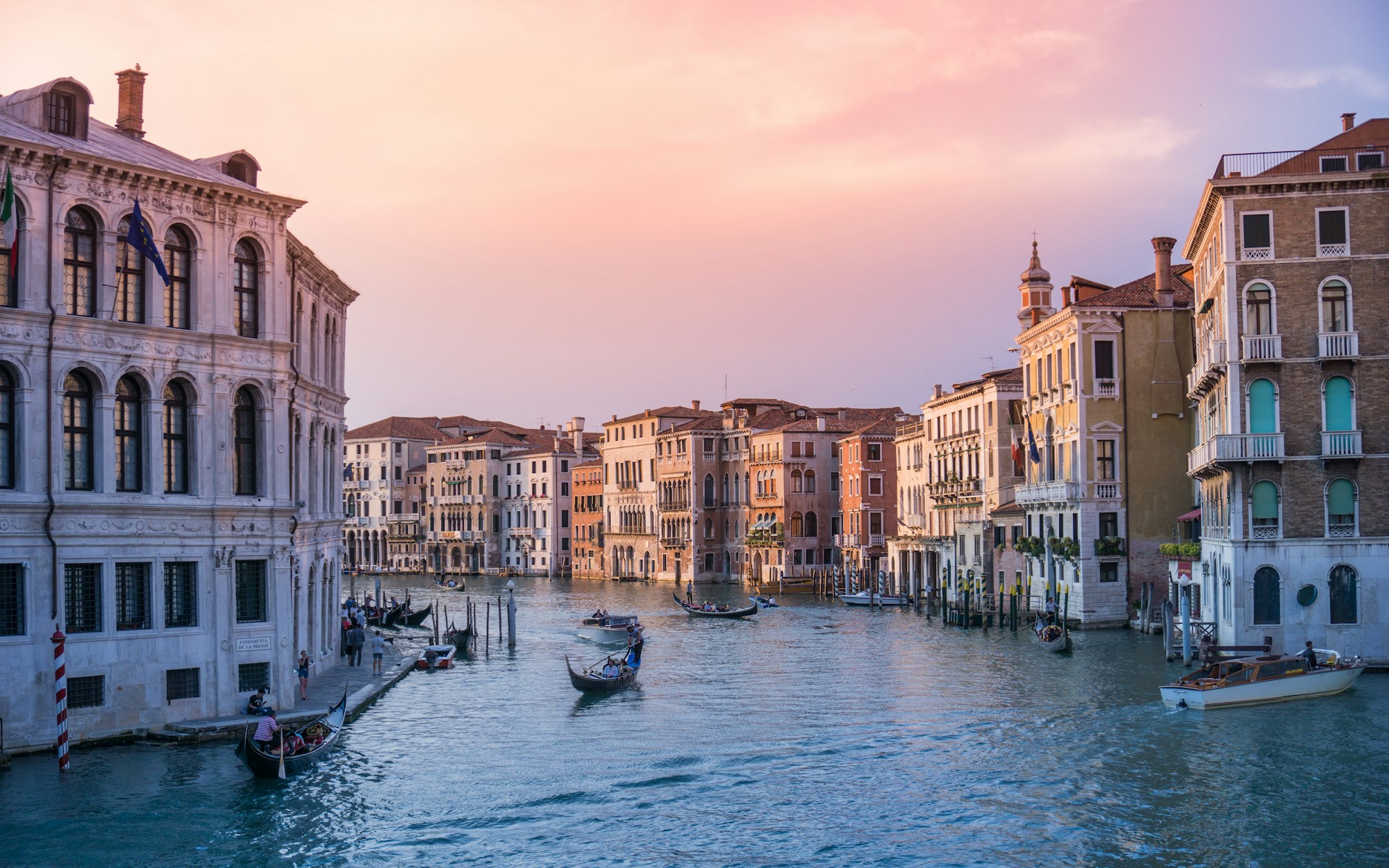
Venice, historic centre
The City of Venice’s scale, in its leaflet valid from 1 April 2025, is the most complete document we could read for this research. The full rate for a 5-star hotel in the historic centre is set there at €5 per night and per person. No 2027 schedule was found: this scale is therefore a reference, not next year’s rate. The official City PDF details each category.
Before you arrive
- Exemptions: Venice residents, children under 10, people receiving care and their companions, drivers and escorts of groups of at least 25 people, disabled people, police on duty.
- Online payment is possible with a QR code, according to one guide: show it if you are checked.
- One guide cites a fine of €50 to €300 for unpaid tax, an amount to check against the Venetian regulation.
For a different way to see Venice, Viator runs a Murano and Burano tour from the city.

Rome and Florence: press figures for 2027
Rome has applied the rates set by resolution no. 255 of 17 July 2023 since 1 October 2023. The official Turismo Roma page confirms that date, but the table by category does not appear in the text we read. According to the press, amounts run from €4 for a 1-star hotel to €10 for a 5-star, and €6 for a B&B. Affaritaliani reports €10 for a 5-star in 2027. No official 2027 act has been found for Rome.
In Florence, resolution no. 535 of 10 December 2024 has applied since 1 February 2025, according to Chekin. The amounts cited are €3.50 for a 1-star hotel, agriturismi and campsites, €6 for other non-hotel accommodation, and around €8 for a 5-star. Not all sources agree, and no 2027 resolution has been found. One blog says that in March 2026 no new resolution had been adopted: the 2025 scale would still apply, to be confirmed on the municipal portal.
We therefore publish no 2027 table for Rome or Florence. The figures above are press reference points, to be read with the date of their source.
Naples, Bologna and other communes
Naples added €1 from 2026 for hotels and B&Bs, according to the daily Fanpage. Bologna exempts minors under 14, according to a Bologna Welcome page seen in search; this rule has not been checked against the commune’s regulation. Pisa, Rimini and Verbania appear, according to Affaritaliani, on the list of cities that could go above €5 in 2027, without confirmation from an official source we read.
Who collects the tax: the host, the platform or you
The general rule does not change: the gestore collects the tax, issues a receipt and passes it on to the commune. When you book direct, the accommodation asks you for it.
When and how do you pay? According to the guides we consulted, travellers usually pay at check-out, in cash or by card. The tax is often absent from the price shown on platforms and is added separately: check the breakdown of the price before you confirm the booking.
Airbnb announced automatic collection of the imposta di soggiorno on 9 February 2024. Collection started on 15 February 2024 in 1,200 communes, then in the other communes that levy the tax. Airbnb calculates the local rate, collects it at booking and passes it to the authorities. The host nonetheless keeps their reporting obligations. One guide gives 15 February 2026 as the start date: that is an error, since the official announcement dates from 2024.
Booking.com and Expedia: no source we read confirms that they collect the tax for Italian communes. One guide says Booking reservations remain the host’s responsibility. If the detail of your booking does not mention the tax, ask the accommodation before your stay and keep the receipt.
EU Regulation 2024/1028 on short-term rentals has applied since 20 May 2026. It requires platforms to pass activity data to the authorities. We could not read the official text on EUR-Lex: the date and scope were cross-checked against European institutional sources.
The CIN, a host obligation
The codice identificativo nazionale, or CIN, is obtained on the BDSR platform of the Ministry of Tourism, set up by a notice in the Official Journal of 3 September 2024. It must appear in the accommodation and in listings. Travellers have no obligation linked to the CIN: they can only check that a listing displays it. No sanction amount linked to the CIN has been verified in an official text, so we do not quote one.
For hosts: what to prepare before 1 January 2027
If you run an accommodation, the obligations remain those of the tax: calculate, collect, declare and pass on. What changes is the cost of a mistake: an omitted or incorrect declaration can cost a share of the unpaid tax, with a €50 floor. For example, €20 of unpaid tax gives a €50 penalty (the minimum), while €200 of unpaid tax gives €200 (100%). The useful work is therefore consistency.

Four checks before year end
- Check the rate for your category in your commune’s regulation, including if it has published its 2027 rates.
- Calculate the tax per night and per person, after removing exemptions (children, residents depending on the commune).
- Prepare the annual return, to be filed before 30 June, online and in grouped form.
- For a short-term let, check that the CIN appears in the listing and in the property.
Depending on your travel style
The same tax weighs differently depending on how you travel. Four situations come up often.
- Families. The exemption age makes the difference. Venice exempts children under 10, Florence those under 12 under its 2023 regulation, and Milan minors under 18 according to one guide. To line up a trip with school holidays, the dates by region are in our article on Carnival 2027 holidays in Italy.
- Tight budget. In Milan’s 2027 scale, hostels and campsites are the cheapest: €2.80 per night and per tourist. In Venice, a 1-star hotel drops to €1 under the 2025 scale.
- Long stays. The number of taxed nights varies: Venice excludes nights beyond the 5th, Florence applies the tax over 7 consecutive nights (search result, full regulation not read), Rome over 10 (guide), Milan over 14 (guide), Naples over 14 (consolidated text not read). The exact rule is in the commune’s regulation, as the press does not always say whether the count is consecutive or annual.
- First time in Italy. Keep the receipt, check the « imposta di soggiorno » line before you pay, and see whether the tax is included in the displayed price or added on top.
What remains open as of 25 November 2026
Six questions cannot be settled with the sources we read. We leave them open rather than fill the gap with an estimate.
- The 2027 extension of the derogations for Rome and Venice: proposed, not adopted.
- The 2027 rates for Rome and Florence: press figures only, no official act found.
- The 2026 rates for Milan: conflicting sources, no amount retained.
- The dates of the Venice access fee in 2027: 72 days announced by the press, not confirmed by the commune.
- The amount of CIN-related penalties: not verified in an official text.
- The role of Booking.com and Expedia in collection: not confirmed.
What other guides don’t tell you
Six points, checked against official texts, administration pages or, where stated, professional press or platform communications, as of 25 November 2026. General guides leave them out or give them incompletely.
- The full penalty scale under Decree 147/2026. Some press articles cite incomplete figures. The text sets 100% for an omission and 40% for an inaccuracy, with a minimum of €50 in both cases. Normattiva, Decree 147/2026 (checked on 25 November 2026).
- The seven 2027 Milan rates by category. The Hostaway guide to Milan does not contain these rates. The amounts come from professional press: Assolombarda, 2027 rates (checked on 25 November 2026); the resolution itself was not read.
- An out-of-date Roman scale in a guide. The Climb page is dated 27 March 2023, earlier than resolution 255/2023, in force since 1 October 2023. Turismo Roma, new rates (checked on 25 November 2026).
- The start date of Airbnb collection. The official announcement is dated 9 February 2024, with collection from 15 February 2024. One guide gives 2026, which is an error. Airbnb News Italia (checked on 25 November 2026).
- Nights excluded in Venice. Beyond the fifth night the tax no longer applies (the text does not say whether the count is consecutive or annual), and the exemption list also covers people receiving care, their companions, and escorts of groups of at least 25 people. Comune di Venezia, IDS leaflet (checked on 25 November 2026).
- Who pays and when to file. The gestore collects and passes on the tax, and the annual return must be filed before 30 June, online and in grouped form. MEF, Disciplina del tributo (checked on 25 November 2026).
Before you book: four checks
The host must issue a receipt. Keep it: some communes ask for a certificate to claim an exemption, for example a health certificate in Venice for the companion of a sick person.
Check whether the tax is included in the displayed price or added separately, especially on a platform, before you confirm the booking.
One guide says Venice carries out random checks and cites a fine of €50 to €300 for unpaid tax: an amount to check against the Venetian regulation.
A 2027 rate may not be published when you book. Check the commune’s website before you leave, or ask the accommodation for the applicable rate.
Frequently asked questions about the tourist tax in Italy
How much is the tourist tax in Italy?
The standard legal cap is €5 per night and per person. Provincial capitals where tourist presence reaches twenty times the resident population can go up to €10. Each commune sets its own rate by accommodation category: in Venice, the full rate for a 5-star in the historic centre is €5 under the 2025 scale. The amount therefore has to be checked city by city. Source: MEF.
Italy tourist tax 2027: what changes?
For hosts, Legislative Decree 147 of 7 August 2026 changes the penalties for breaches committed from 1 January 2027: 100% of the unpaid tax for an omitted declaration, 40% for an incorrect one, with a minimum of €50. For travellers, 2027 rates are still set by each commune: Milan has published them, Rome and Florence have not. The 2026 derogations expire, and their extension has not been adopted. Source: Normattiva.
Do children pay the tourist tax in Italy?
It depends on the commune. In Venice, children under 10 are exempt according to the official leaflet. Rome applies the same age limit according to a 2023 guide, to be checked against the Roman regulation. In Florence, the 2023 regulation cited by a search result sets 12, and in Milan one guide says under 18. These rules should be checked against the commune’s regulation before you travel.
Do I pay the tax if I book on Airbnb?
In communes where Airbnb collects the tax, it is taken at booking and passed to the authorities. Collection started on 15 February 2024 in 1,200 communes, then in the other communes concerned. Otherwise, the tax is paid to the accommodation. It is worth checking the price breakdown before you confirm. Source: Airbnb.
What if I book on Booking.com?
No source we read confirms that Booking.com collects the tax for Italian communes. If the tax does not appear in your booking details, plan to pay it at the accommodation. Ask for a receipt: it will serve as proof in case of an exemption or a check.
What risk does a host face for not declaring the tax from 2027?
For an omitted declaration, the penalty is 100% of the unpaid tax, with a minimum of €50. For an incorrect declaration, it is 40%, with the same minimum. These rules apply to breaches committed from 1 January 2027, according to comma 9 of Article 12 of Decree 147/2026. Source: Normattiva.
How much do you pay in Venice?
The scale valid from 1 April 2025 sets the full rate at €1 for a 1-star hotel and €5 for a 5-star in the historic centre. Nights beyond the fifth are excluded from the tax. The access fee for the historic centre is separate and does not replace the tourist tax. Source: Comune di Venezia.
Do British visitors pay a different rate from Italians?
No, according to the texts we read: no rule depends on nationality. Rates are set by commune and by accommodation category, and exemptions depend on residence in the commune, age or personal situation. The receipt remains the best proof to keep.
Why is the tourist tax going up in some cities?
Communes set their rate within the legal cap. The 2026 increases were made possible by the Jubilee and Milan-Cortina derogations, which expire on 31 December 2026. The press estimates national revenue at €1.308 billion in 2026, according to Sky TG24. Source: Sky TG24, 16 November 2026.
Sources
- Normattiva, Legislative Decree 147/2026 : text of Articles 12 and 39, read on 25 November 2026
- MEF, Disciplina del tributo : caps, derogations, responsibility of the gestore and annual return
- Comune di Venezia, IDS rates valid from 1 April 2025 : scale and exemptions (PDF)
- Assolombarda, Milan 2027 rates : resolution 1481 as reported by the association (professional press, text not read)
- Turismo Roma, contributo di soggiorno : entry into force of Rome’s rates
- Chamber of Deputies, 2027 Budget Bill file, volume I : text search on the imposta di soggiorno
- Airbnb News Italia, tax collection : announcement of 9 February 2024
- Transition Pathways, Regulation (EU) 2024/1028 : application date and scope
- Gazzetta Ufficiale, BDSR notice : publication of 3 September 2024
- Sky TG24, 2026 revenue : tax figures as of 16 November 2026 (press)
- Greenme, Milan 2027 : press on the drop in Milan rates (secondary source)
Checked on 25 November 2026. Links to the press, guides and associations are secondary sources, flagged as such in the text.

Plan your trip with Pixidia
Pixidia learns how you travel and helps you build a trip that truly fits you and everyone coming along.
Open the planner