
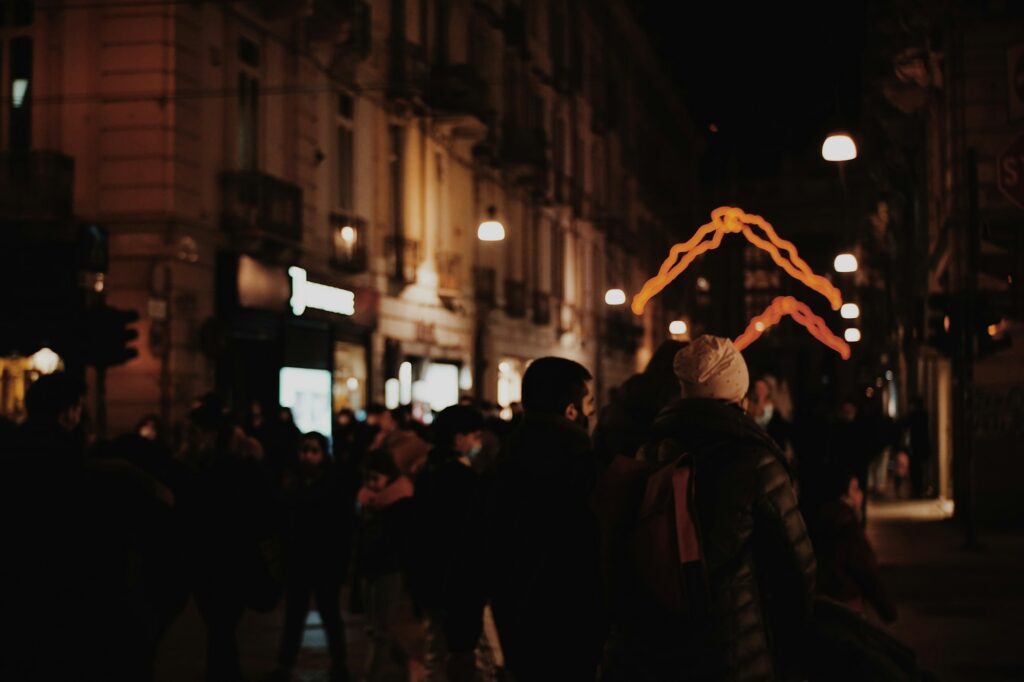
Luci d’Artista is a collection of light installations that brighten the streets and squares of Turin every winter, and entry is free. The 28th edition ran from 24 October 2025 to 11 January 2026, lit from 6:30pm to 11:45pm, with about thirty installations (33 according to the official leaflet). For 2026-2027, the Piemonte Italia regional portal announces 22 October 2026 to 10 January 2027, dates the city has not confirmed yet. Our tip: plan a 1h30 to 2h walk through the centre after dark, and check the dates on lucidartistatorino.org before you go.
Every winter, Turin turns its squares, arcades and monuments into an outdoor gallery. Since 1998, the city has hung contemporary art in light across the centre, on foot and without a ticket. This article separates what is confirmed for the 28th edition from what is still open for the next one, then gives you a route you can follow tonight.
1. Luci d’Artista in 2025-2026: the facts to keep
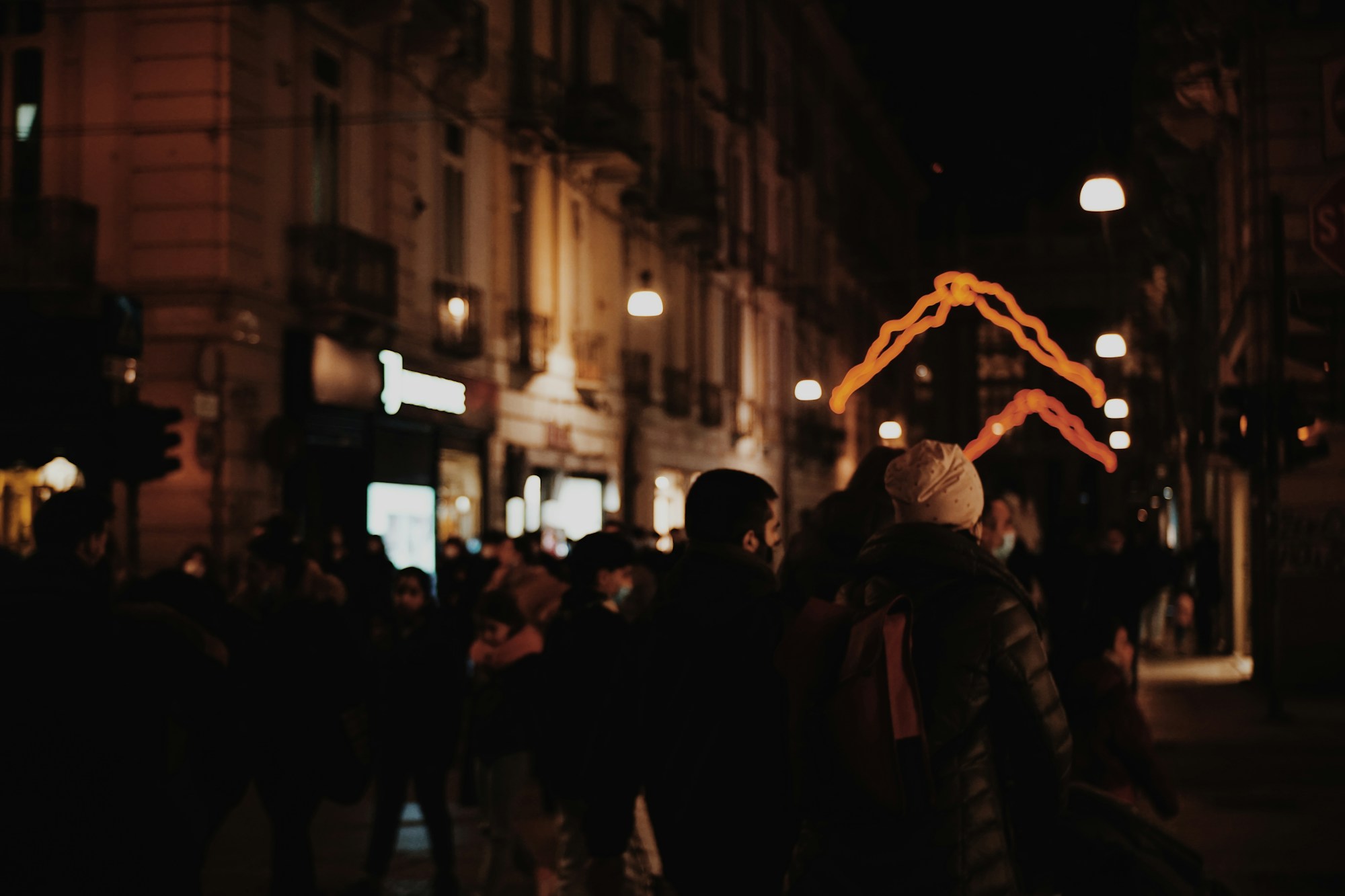
A public art collection across Turin’s streets
Luci d’Artista began in 1998 as a Christmas decoration for the City of Turin, and the idea of a public collection of contemporary art took hold from the start. Each winter the event presents a new selection of light installations, alongside works that stay on view all year. The City organises it and the Fondazione Torino Musei produces it. Curator Antonio Grulli is in his third year on the event’s visual identity, according to Finestre sull’Arte.
The 28th edition ran from Friday 24 October 2025 to Sunday 11 January 2026. The installations were lit from 6:30pm to 11:45pm and entry was free, according to GuidaTorino. No ticket or booking was needed to see the works. The five new installations were extended until Sunday 1 February 2026, according to Mentelocale.
How many works? The official leaflet for the 28th edition lists 33, numbered on a map of the centre. Other sources count 32. To avoid that debate, say « about thirty installations » or quote the leaflet as it is.
The programme had three strands. The historic collection takes up most of the route. The Costellazione section brings together cultural institutions from the city and has expanded to Milan and, according to some sources, Lyon. The DUET section, new in 2025-2026, presents international collaborations. Finally, Luminarie groups light fixtures shown as a complement, with no detailed scope in the leaflet.
Highlights of the 2025-2026 edition
- Free entry, with no ticket or booking
- Permanent works visible all year, such as « Piccoli spiriti blu » by Rebecca Horn at the Monte dei Cappuccini
- A compact centre you can walk in 1h30 to 2h, stops and photos included
If you’d rather have a guide, the 2-hour walking tour below, in a small group, starts at Piazza CLN and passes Piazza San Carlo, Galleria San Federico and Piazza Castello before ending at the Mole Antonelliana. It covers the same city centre as the light trail, with a guide to explain the sights.
2. 2026-2027: what’s announced, and what isn’t
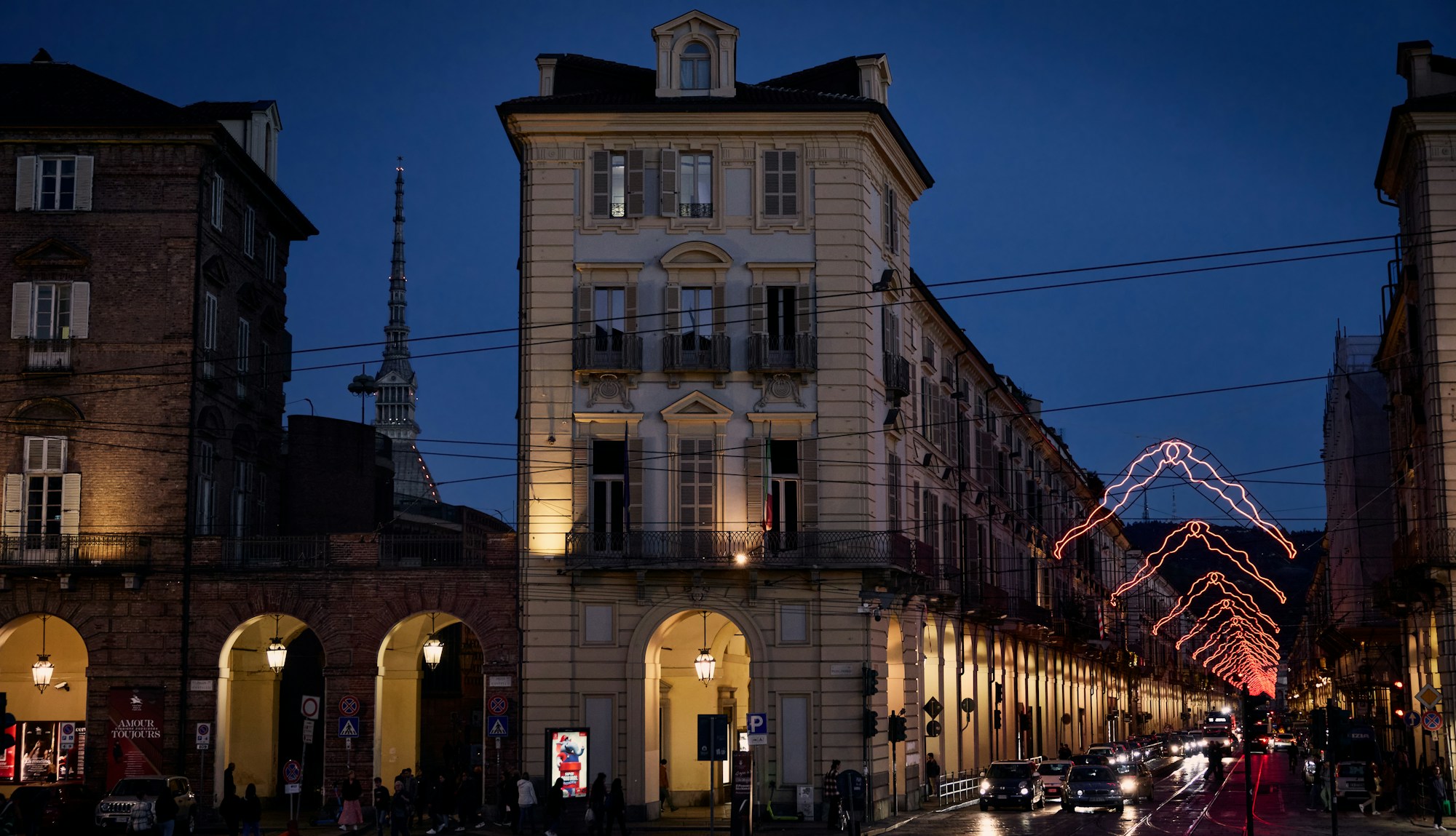
Dates announced, not yet confirmed by the City
The regional portal Piemonte Italia lists an edition running from Thursday 22 October 2026 to Sunday 10 January 2027. The listing does not name the organiser or the hours, and does not say whether the dates are provisional. The official site lucidartistatorino.org still presented the 28th edition as the current one when this was written, on 9 October 2026. Two press articles dated 27 August 2026, from GuidaTorino and from Zipnews, also said the dates had not been announced yet.
Treat these dates as a forecast. If you’re planning a Christmas stay around them, wait for the official announcement before you book a non-refundable room.
What’s announced as new
- “Decodificare la luce” by Vittoria Caldera: a balcony installation inspired by Morse code. The phrase “Light finds us” is spelled out through alternating letters and flashes. The exact spot, on Via San Francesco da Paola, is still to be confirmed.
- “The Radiant Van” by CANEMORTO: a light-up van that travelled through 2026, from Turin to Ljubljana and then Venice during the Biennale. It is due to join the City’s collection from this edition, according to Artribune, with no installation site announced in Turin yet.
The number of installations, the map and the hours of the next edition are not published. There is no attendance figure for Turin either. The tourist office speaks of “migliaia di visitatori”, thousands of visitors from around the world, without a figure.
3. The 2025-2026 route: the centre, district by district
The places below come from the map of the 28th edition. The 2026-2027 list has not been published. These neighbourhood landmarks are still useful, since the permanent works are in place all year.
Piazza Castello, Giardini Reali and Via Roma
This is the heart of the route. In the Giardini Reali Bassi, Tracey Emin showed “Sex and Solitude”, a new neon in 2025-2026. On Piazza Palazzo di Città, Daniel Buren had installed a work, and the Giardini Sambuy, on the Via Roma side, hosted “Scia’Mano” by Luigi Ontani, according to the official leaflet. On Piazza San Carlo, Riccardo Previdi installed “Bouncing the Ball”, another new piece this edition.
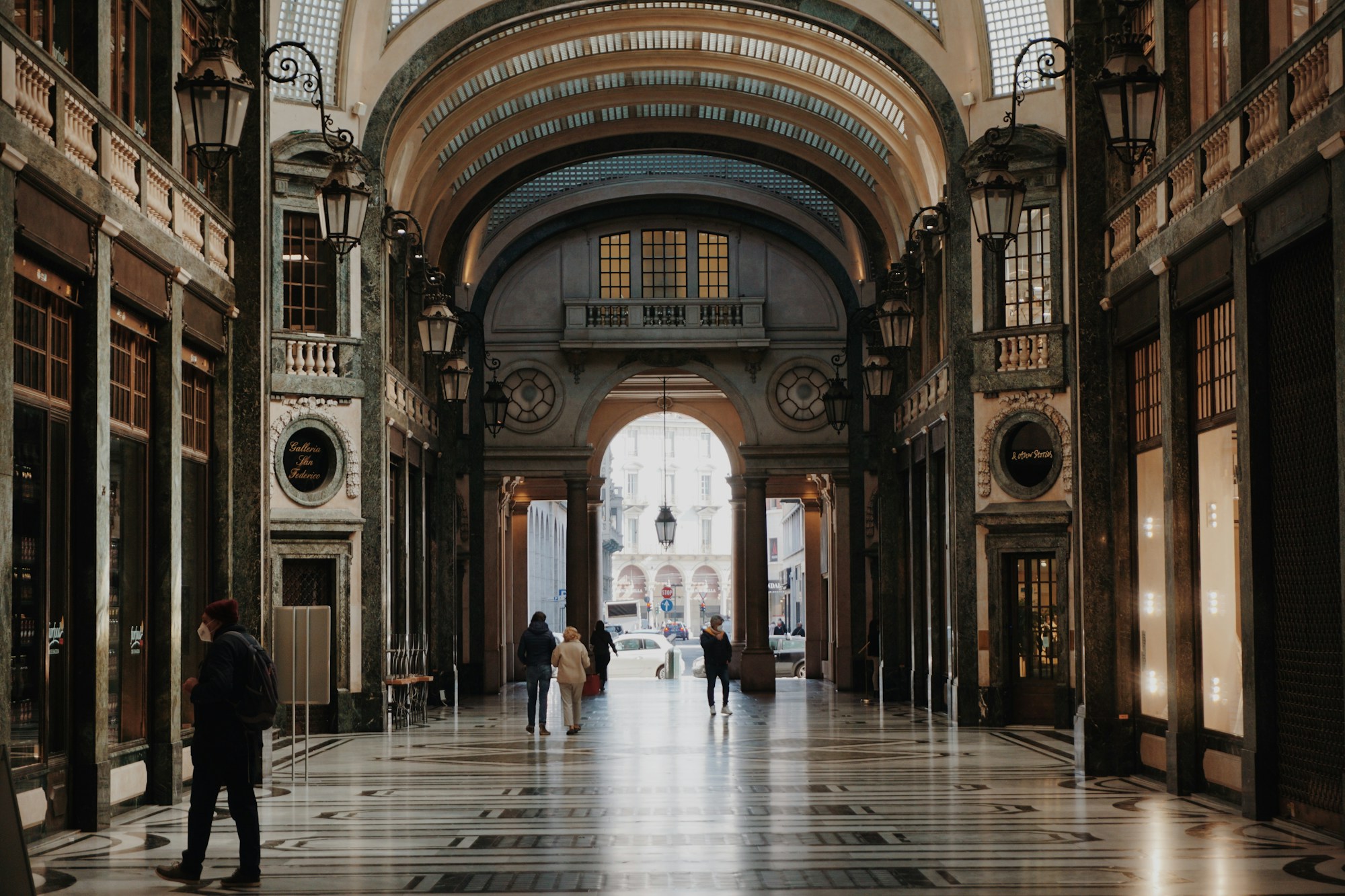
The centre’s galleries and arcades, such as the Galleria San Federico, offer covered passages to warm up between installations. The Galleria Umberto I houses Marco Gastini’s permanent work “L’energia che unisce si espande nel blu”. On Piazza Carlina, Nicola De Maria’s “Regno dei fiori” stays visible all year, according to Turismo Torino.
What to look for
- Giardini Reali Bassi and Piazza Palazzo di Città: Tracey Emin, Daniel Buren
- Giardini Sambuy, Via Roma: Luigi Ontani
- Piazza San Carlo: Riccardo Previdi
- Piazza Carlina and Galleria Umberto I: permanent works by Nicola De Maria and Marco Gastini
The Mole, Piazza della Repubblica and Vittorio Veneto
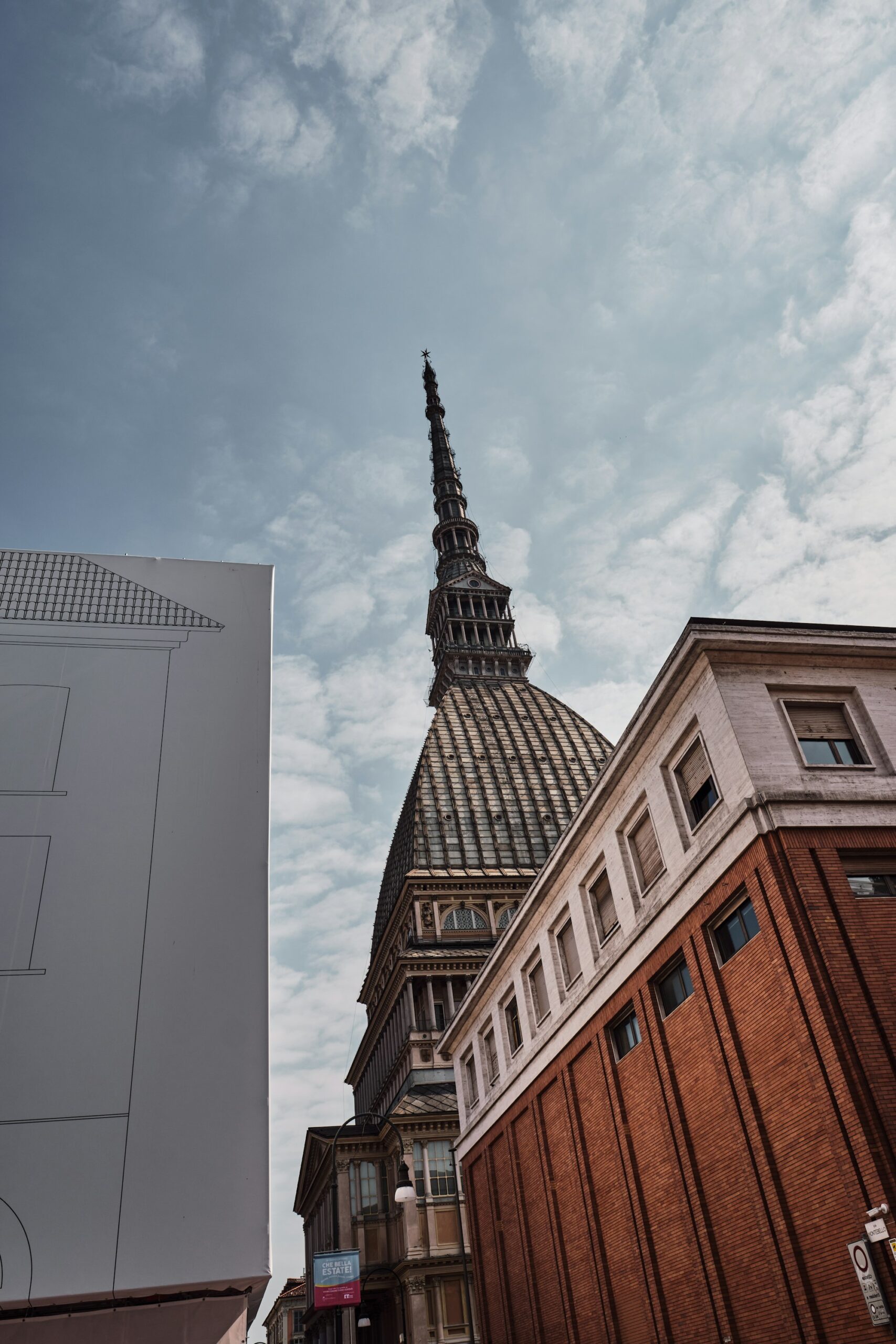
The Mole Antonelliana holds Mario Merz’s “Il volo dei numeri”, a permanent work. On Piazza della Repubblica, the façade of the Tettoia dell’Orologio carried Michelangelo Pistoletto’s “Amare le differenze” in 2025-2026. Further east, Piazza Vittorio Veneto hosted “VR Man” by Andreas Angelidakis, by the Lungo Po, and Piazza Polonia hosted Mario Molinari’s “Concerto di parole” in a green area, according to Turismo Torino.
These three stops follow each other on foot from the Mole. They are the furthest points from Piazza Castello, so leave them for the end, when you still have energy for the walk back down to the centre.
Right bank and Parco del Valentino: the trip to plan
The Parco del Valentino had no installations in the 2025-2026 leaflet, and its map places it at the edge of the route. The nearest installation was “Luce Fontana Ruota” by Gilberto Zorio, on Corso Unità d’Italia, by the Laghetto Italia ’61. Since 2026, the Valentino ZTL has been closed to transit and parking 24 hours a day, according to SicurAuto. You can still walk through it.
On the right bank, the Monte dei Cappuccini holds Rebecca Horn’s “Piccoli spiriti blu”, a 1999 work restored in 2022. It is one of the most photographed pieces in the collection, but the access is uphill. Corso Spezia, where Renato Leotta installed a work on the roof of the Ospedale Sant’Anna, needs an extra trip by bus or tram. Don’t put it in a two-hour walking route.
4. An evening on foot: the concrete plan
The route below follows the logical order of the 2025-2026 districts. Adapt it to the official map of the next edition once it is published. Allow 1h30 to 2h for the centre, without stops or photos.
- Piazza Castello: start at the Giardini Reali and Tracey Emin’s work, then cross to Piazza Palazzo di Città for Daniel Buren.
- Via Garibaldi and Piazza San Carlo: head back up to Piazza San Carlo for Riccardo Previdi’s work.
- Piazza Carlina: walk along the Quadrilatero to Nicola De Maria’s permanent work.
- Galleria Umberto I: go in for Marco Gastini’s permanent work, then come out on the Piazza della Repubblica side.
- Piazza della Repubblica: Michelangelo Pistoletto’s work on the Tettoia dell’Orologio.
- Via Roma and Giardini Sambuy: Luigi Ontani’s work, then Piazza Carlo Felice.
- The Mole and Vittorio Veneto: finish at the Mole, then walk to Piazza Vittorio Veneto and the Lungo Po for “VR Man”.
The advice in the sources stresses one point: the works are designed to stand out against the night sky, so they are best seen after dark. Start early in the evening if you want to see the installations before the streets empty, and keep the end of the night for the Mole.
5. Getting to Turin: transport, ZTL, budget and calendar
Turin is easy to visit without a car. The centre is walkable, and the Porta Nuova and Porta Susa stations are a few minutes from the main squares. The table below lists the transport options and their status. Fares were gathered from sources dated 2024 to 2026, so check them before you travel.
| Option | Detail | Status |
|---|---|---|
| Metro, line 1 | Serves Porta Nuova and Porta Susa | GTT ticket to check on gtt.to.it (about €2 according to sources) |
| City Sightseeing open-top bus | About an hour, with commentary in several languages | €19 full fare in 2025-2026, to check before you go |
| Torino+Piemonte Card | From 24 to 120 hours of validity | €29.90 to €52.90 according to a 2024 source, to check |
| Caselle airport bus | About 45 to 50 min to Porta Nuova or Porta Susa | Fare between €6.50 and €7.50 according to sources, to check |
| Car | Central ZTL and Valentino ZTL | Not recommended for an evening in the centre |
Driving and the ZTL
The Central ZTL is active on weekdays from 7:30am to 10:30am, Saturdays excluded. Its sub-zone, Area Romana, closes to transit and parking from 9pm to 7:30am the next day, every day, public holidays included. Unauthorised access is fined between €87 and €345 under article 7 of the Codice della Strada, according to SicurAuto. Electronic checks were not yet active at the date of that source, in March 2026.
Typical budget for an evening
- Entry to the installations: €0.
- Public transport: two GTT journeys, about €4 according to sources, to check.
- Guided tour: the 2-hour walking tour above is paid, from €39 per adult.
- Hot drink: prices vary by venue, so budget extra.
Climate and calendar
At Caselle airport the average is 3.8 °C in December and 3.2 °C in January, over 1991-2020, according to Climieviaggi. The leaflet and the media both recommend dressing warmly. On Sunday 25 October 2026, the clocks go back: the first evenings of the 2026-2027 edition would fall on summer time, the rest on winter time.
Two periods need planning ahead. The Immaculate Conception long weekend, from Saturday 5 to Tuesday 8 December 2026, draws visitors, and our article on the Immaculate Conception weekend 2026 compares snow and sea. From 15 to 22 November, the Nitto ATP Finals bring crowds to the Inalpi Arena, as our guide to the Nitto ATP Finals 2026 in Turin details. Finally, a general strike has been announced in Italy for 4 December 2026: our article on the 4 December strike covers the trains and motorways to watch.
Accessibility
We found no official information on the accessibility of the installations. The routes are largely flat: Piazza Castello and Piazza Carlina have no slope. The Mole and the Monte dei Cappuccini involve a climb. Cobbles and pavements of varying width call for care with a pushchair or wheelchair. For questions, contact Turismo Torino on +39 011 535181.
6. Field tips and mistakes to avoid
A few traps come back every edition. Avoiding them saves you an evening.
- Don’t drive in the evening. The Area Romana closes at 9pm, and parking in the centre is tricky. Park outside the zone and take the metro or the bus.
- Don’t plan around installations in Parco del Valentino. The 2025-2026 leaflet listed none. Walk the Valentino for the walk itself, not for the works.
- Don’t count on fixed hours. In 2022, the City cut the lighting for energy reasons: switched off at 10pm from Sunday to Thursday, at midnight on Friday and Saturday, including from 19 December to 2 January. That precedent could happen again, so check the hours on the day.
- Don’t book an Italian Sign Language (LIS) tour based on an old article. A LIS tour was offered in 2007, but no equivalent has been found for recent editions.
- Don’t mix the two editions. Not all of the 2025-2026 works are guaranteed to return, and the announced 2026-2027 novelties have no map yet.
For a stress-free stay, book accommodation on a weekday if you can. Late October and mid-November offer longer evenings and fewer people than the December weekends, which fill up with the Christmas markets of earlier editions.
Plan your stay in Turin
Check the centre map, the metro route and the bus times without hunting for Wi-Fi at the foot of the Mole.
Plans by duration, compare them on the siteCovers medical costs and cancellation. Useful for a night out in cold weather, and worth comparing against the length of your stay.
Price depends on duration and your profileFrequently asked questions about Luci d’Artista
What are the dates of Luci d’Artista 2026-2027?
The Piemonte Italia portal lists 22 October 2026 to 10 January 2027. The City of Turin had not confirmed these dates when this was written, on 9 October 2026. Check the official site before you book, and see the regional portal listing for the announcement.
Is entry free?
Yes for the 2025-2026 edition, with free entry and no ticket or booking needed, according to GuidaTorino. The 2026-2027 entry price has not been published. Guided tours and the open-top bus are paid, though.
What time can you see the installations?
In 2025-2026, the installations were lit from 6:30pm to 11:45pm, according to GuidaTorino. Hours for 2026-2027 have not been published. Aim for the evening, once it is dark, and allow for a reduction in lighting like the one in 2022.
How many installations are in the collection?
The official leaflet for the 28th edition lists 33, on a map of the centre. Other sources count 32. Use « about thirty » if you want to avoid the debate, and don’t give a figure for 2026-2027 until the official list is out.
Can you see the works outside the season?
Yes. The permanent works stay visible all year: “Regno dei fiori” by Nicola De Maria on Piazza Carlina, “Il volo dei numeri” by Mario Merz at the Mole, “Piccoli spiriti blu” by Rebecca Horn at the Monte dei Cappuccini, or Joseph Kosuth’s “Doppio Passaggio” on the Ponte Vittorio Emanuele I. According to Turismo Torino, these are permanent landmarks.
Are there installations in Parco del Valentino?
Not in the 2025-2026 leaflet, where the park appears with no works. The nearest installation was “Luce Fontana Ruota”, on Corso Unità d’Italia. For 2026-2027, check the official map, which is not published yet. The park’s ZTL is closed to traffic 24 hours a day, according to SicurAuto.
Can you drive there?
It isn’t recommended for an evening in the centre. The Central ZTL is active on weekdays from 7:30am to 10:30am, and the Area Romana closes at 9pm. Park outside the zone and take the metro, where line 1 serves Porta Nuova and Porta Susa, according to SicurAuto.
Is there a sign-language tour?
A LIS tour was offered in 2007, for the tenth edition. No equivalent has been found for recent editions. For help with access, contact Turismo Torino on +39 011 535181, who can tell you what the current edition offers.
What’s new for 2026-2027?
Two new works are announced: “Decodificare la luce” by Vittoria Caldera, a balcony installation inspired by Morse code, and “The Radiant Van” by CANEMORTO, a light-up van due to join the City’s collection. According to Artribune, its installation site in Turin has not been announced yet.
What temperature should you expect in December and January?
The average is 3.8 °C in December and 3.2 °C in January at Caselle airport, over 1991-2020, according to Climieviaggi. Evenings are cold and the squares are windy. A warm coat, flat shoes and a scarf are enough for a two-hour walk.
Sources
- Piemonte Italia: Luci d’Artista listing: dates announced for 2026-2027
- Official Luci d’Artista site: programme of the 28th edition and contacts
- Turismo Torino: Luci d’Artista page: permanent works and contacts
- GuidaTorino: Luci d’Artista 2025-2026: hours and free entry
- Official leaflet, 28th edition (ATTS): map, sections and list of installations
- Finestre sull’Arte: the 28th edition: organisation and curatorship
- Mentelocale: dates and programme of the 28th edition: extension of the new works
- GuidaTorino: Decodificare la luce: new installation for 2026-2027
- Zipnews: two new installations: dates not yet announced
- Artribune: The Radiant Van: mobile work and entry into the collection
- SicurAuto: Turin and Valentino ZTL: hours and fines
- Climieviaggi: Turin climate: December and January averages
Sources consulted on 9 October 2026. Dates, hours and prices for 2026-2027 are to be confirmed on the official channels.

Plan your trip with Pixidia
Pixidia learns how you travel and helps you build a trip that truly fits you and everyone coming along.
Open the planner