

From 1 January 2027, the tourist tax in Riga rises to €2 per person per night, VAT included (€1.78 excluding VAT), up from €1 today. The accommodation provider collects it, it is capped at 10 nights of continuous stay, and the city council approved the rise on 8 July 2026.
Checked on against the official sources cited (pip.riga.lv, govilnius.lt).
Riga is doubling its tourist tax on 1 January 2027. The rate goes from €1 to €2 per night, but the €2 figure doesn’t tell the whole story. Three details change what you will actually pay: the amount quoted includes VAT, the tax is collected by your accommodation rather than by the city, and the cap stops at 10 nights. Here is what to know before you book, with the city’s figures and the points missing from the pages we checked for this investigation.
1. What changes on 1 January 2027
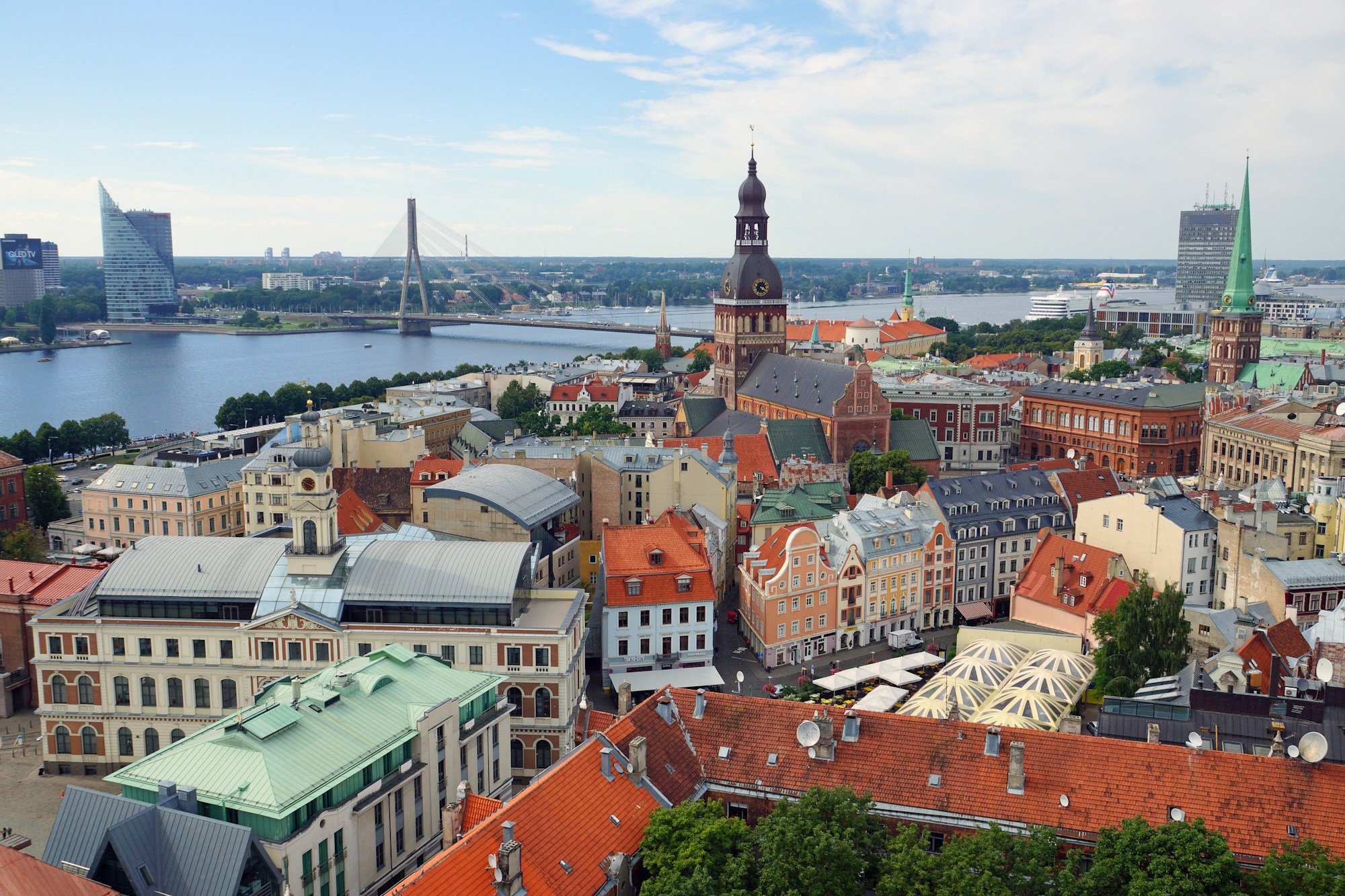
Riga: from €1 to €2 per person per night
Riga’s city council approved the increase on Wednesday 8 July 2026. The city’s official page sets the new rate at €1.78 excluding VAT, or €2 including VAT, per person per night. Today the rate is €1 including VAT, or €0.89 excluding VAT. The city’s official tourist tax page remains the reference for the amounts.
The rules at a glance
- The tax is calculated per person, per night.
- It is capped at 10 nights of continuous stay in the same accommodation.
- The accommodation provider collects it and passes it on to the city every quarter.
- According to the city, business travellers fall within scope from 2027.
For your first day, a walking tour of the Old Town gives you useful bearings before you choose a neighbourhood or an accommodation. The tour is listed at €17 to €19 per adult (based on 2 people). Availability checked on 25 October 2026: it runs on 30 days out of 30, from 16 November to 15 December 2026.
2. What it really costs: the VAT-excluded and VAT-included maths
The city gives two figures for the same tax: €1.78 excluding VAT and €2 including VAT. The VAT-included amount is the one that matters for your budget. To estimate a bill, multiply the number of people by the number of nights, stopping at 10 nights per person.
Worked example: two people staying three nights in Riga in 2027 make six person-nights. Before VAT, the calculation base is 6 × €1.78 = €10.68. The city quotes the VAT-included rate, so 6 × €2 = €12 for this stay. At today’s €1 rate, the same stay would cost €6.
| Period | Per person per night, VAT included | Base excluding VAT | Continuous-stay cap |
|---|---|---|---|
| In force today | €1 | €0.89 | 10 nights |
| From 1 January 2027 | €2 | €1.78 | 10 nights. Cap: €17.80 (10 × €1.78, base excluding VAT; the city does not state explicitly whether this cap is excluding VAT) |
Source: pip.riga.lv, the city’s official tourist tax page, checked on 25 October 2026.
For a stay of ten nights or more, the cap comes to €17.80 per person (10 × €1.78, base excluding VAT; the city does not state explicitly whether this cap is excluding VAT). The safest step is to ask your accommodation for the amount that will appear on your bill.
| Travellers and stay | Person-nights | 2026 tax (€1, VAT included) | 2027 tax (€2, VAT included) |
|---|---|---|---|
| 1 person, 2 nights | 2 | €2 | €4 |
| 2 people, 3 nights | 6 | €6 | €12 |
| 2 people, 5 nights | 10 | €10 | €20 |
| 1 person, 14 nights | 10 (cap reached) | €10 (cap reached at 10 nights) | €17.80 (10 × €1.78, base excluding VAT; the city does not state explicitly whether this cap is excluding VAT); about €19.94 including VAT if the 12% VAT rate applies (rate not confirmed) |
Source: calculation based on the rates published by pip.riga.lv and the Latvian press (LSM, 8 July 2026), checked on 25 October 2026.
3. Who pays the tax, to whom and when

The tax is paid to your accommodation, not to the city hall
You don’t pay the tax directly to the city of Riga. You pay it to your accommodation, which collects it on the municipality’s behalf. At the Grand Hotel Kempinski Riga, the hotel says the tax is added to the final bill, paid at check-out, and that it applies to the first ten nights of a long stay. The hotel’s practical information describes how this works.
The payment calendar
- Quarterly payment to the city, on 30 April, 30 July, 30 October and 30 January.
- Monthly report from the accommodation provider, due before the 20th of the month.
- Source: pip.riga.lv, checked on 25 October 2026.
This collection method has a practical consequence: before comparing two offers, check whether the tax is included. If it is missing from the displayed price, add it yourself: €2 per person per night from 2027, €1 until 31 December 2026.
4. Who is affected, and who isn’t
Tourist accommodation. The tax targets commercial accommodation, where the provider is the collector. We found no confirmation, in the sources we checked, that Airbnb or Booking.com collects the tax in Riga. For a private rental, ask the host whether the tax is included or payable on site.
Business travellers. According to the city’s official page, they fall within scope from 1 January 2027. The Latvian press we checked does not mention this point, so we present it as the city’s position.
Staff working on site. The city sets this exemption until 31 December 2026; the version we checked does not say whether it continues into 2027. Ask your employer or your accommodation.
Minors. A tourism source published in 2024 says under-18s are exempt. We could not read the official legal text, so this exemption is not confirmed for 2027.
Long stays. Our sources mention no exemption for long stays. Only the 10-night cap applies, per establishment and without interruption.
Digital nomads. We found no exemption for digital nomads in our sources, but no positive confirmation either: ask your accommodation.
5. Riga compared with Vilnius and Tallinn
Riga is not the only Baltic capital asking this question. Vilnius has charged the tax since 1 January 2024, while Tallinn is opposed to one. The table compares the situations as of 25 October 2026, for one night and one person. For other European destinations, see the tourist tax in Amsterdam in 2027 and the tourist tax in Poland in 2027.
| City | Amount per person per night | What to know |
|---|---|---|
| Riga, today | €1 VAT included (€0.89 excl. VAT) | Rate in force, 10-night cap |
| Riga, from 1 January 2027 | €2 VAT included (€1.78 excl. VAT) | Increase voted on 8 July 2026 |
| Vilnius | €2 | In force since 1 January 2024; Booking.com has collected the tax since 15 June 2026 |
| Tallinn | No tax | The municipality opposes a tourist tax, according to ERR (July 2026) |
Sources: pip.riga.lv (Riga), govilnius.lt (Vilnius), ERR (Tallinn), checked on 25 October 2026.
In the region, Kuldīga, in Latvia, put forward a draft tax of €1.50 per night in June 2026. According to the Latvian public broadcaster LSM, business travellers and minors would be exempt there, and no tax would apply after the tenth night. In Riga, the official page does not exempt business travellers. For a route linking all three capitals, see the 9-day Baltic itinerary.
6. What the tax changes for your profile
The cases below apply €2 VAT included per person per night (€1.78 excl. VAT), with a cap of 10 nights per person.
- The short stay (one to three nights). One person staying two nights pays €4 in 2027, against €2 at today’s rate. For a weekend for two over three nights, the tax goes from €6 to €12. The 10-night cap does not come into play.
- The week for two (seven nights). A couple staying seven nights totals 14 person-nights, so €28 in 2027 (7 × 2 × €2). Each traveller stays under the 10-night cap, which does not apply here.
- The long stay (more than ten nights). For one person staying fourteen nights in the same establishment, the tax stops at ten nights, so €17.80 (10 × €1.78, base excluding VAT; the city does not state explicitly whether this cap is excluding VAT). If you change accommodation along the way, ask your provider how the nights are counted, since the cap applies to a continuous stay in the same establishment.
- The family trip. According to a 2024 source, under-18s are exempt, but we could not read the official text. Until this is confirmed, calculate for the whole group: two adults and two children for three nights make 12 person-nights, so €24 in 2027 if no child is exempt. For family outings beyond the city, see the 8 day trips from Riga.
- The business trip. According to the city’s official page, business travellers are covered from 2027. If your employer reimburses your expenses, include the tax in the expense claim at the VAT-included amount, to avoid a gap at reimbursement time.
7. Mistakes to avoid
The errors we found during the investigation came from figures read too quickly. Some pages and online answers repeat false information; four traps come up again and again in the pages and answers we read.
- Applying €2 to a 2026 stay. The €2 rate only applies from 1 January 2027. A stay that ends in 2026 stays at the €1 VAT-included rate.
- Reading the €17.80 cap as a VAT-included amount. This cap is ten times €1.78: €17.80 (10 × €1.78, base excluding VAT; the city does not state explicitly whether this cap is excluding VAT). Taking it as your total bill can understate the invoice if VAT is added on top.
- Assuming the platform collects the tax. An AI-generated answer claims that Airbnb collects the tax in Riga, with no source. We found no confirmation; the obligation falls on the accommodation provider, so check your rental’s bill.
- Relying on an exemption without checking it. The only source for the minors’ exemption dates from 2024 and does not cover 2027. Ask for confirmation before you leave, rather than finding out at check-out.
What other guides don’t tell you
Two of the four pages read for this investigation still give the old €1 rate; those that quote €2 do not state the base excluding VAT. Four points missing from the pages checked for this investigation change the calculation or the way you pay.
- The €2 figure includes VAT. The city sets €1.78 excluding VAT. The €2 figure is therefore the VAT-included total, not a pre-tax amount. pip.riga.lv (checked on 25 October 2026).
- The accommodation passes the tax on, on fixed dates. Quarterly payments fall on 30 April, 30 July, 30 October and 30 January, and the monthly report is due before the 20th. pip.riga.lv (checked on 25 October 2026).
- Staff working on site are exempt until 31 December 2026. pip.riga.lv (checked on 25 October 2026).
- Business travellers fall within scope in Riga, not in Kuldīga. According to the city’s official page, the tax applies to them from 2027. The Kuldīga draft exempts them, according to LSM. LSM (3 June 2026, checked on 25 October 2026).
Practical information before you go
Before you book, three checks are enough. Ask your accommodation whether the tax is included in the price or added to the bill, and when it will be charged. Recalculate with the rate that applies on your stay date: €1 before 1 January 2027, €2 from that date. And keep the 10-night cap in mind if your stay is long.
If your stay starts in 2026 and ends in 2027, we did not find the rule that applies to each night. Ask your accommodation in writing how those nights will be charged before you arrive.
To arrive in Riga connected without waiting for the hotel wifi, an eSIM avoids nasty roaming surprises.
Mobile data on arrival, without changing your SIM card. Plans vary by duration and data volume.
Price varies by planFrequently asked questions about Riga’s tourist tax
How much is the tourist tax in Riga in 2026?
In 2026, the tourist tax in Riga is €1 per person per night, VAT included, or €0.89 excluding VAT. It is calculated per person per night and capped at 10 nights of continuous stay in the same accommodation. The accommodation provider collects it and passes it on to the city, according to the official tax page.
How much will the tax cost from 1 January 2027?
From 1 January 2027, it rises to €2 per person per night, VAT included, or €1.78 excluding VAT. The city council approved the increase on 8 July 2026, and the Latvian press has reported it. For a three-night stay for two people, the tax goes from €6 to €12.
Does the €17.80 cap include VAT?
The €17.80 cap is ten times €1.78: €17.80 (10 × €1.78, base excluding VAT; the city does not state explicitly whether this cap is excluding VAT). If the 12% VAT rate applies, the total comes to about €19.94 (rate not confirmed). To avoid surprises on your final bill, ask your accommodation for the exact amount when you book.
Who pays the tax, and when?
You pay it to your accommodation, under the establishment’s terms. At the Grand Hotel Kempinski Riga, it is added to the final bill, paid at check-out. The accommodation then passes it on to the city every quarter, on 30 April, 30 July, 30 October and 30 January, according to the official page.
Do business travellers pay the tax in 2027?
Yes, according to the city’s official page, the tax applies to business travellers from 1 January 2027. This point does not appear in the Latvian press we checked. In Kuldīga, by contrast, business travellers would be exempt according to LSM. If you travel for work, check this point with your employer before you leave.
Do children pay the tourist tax in Riga?
A tourism source published in 2024 says under-18s are exempt. We could not read the official legal text, so we cannot confirm this exemption for 2027. Before travelling with children, ask the accommodation or the city whether it applies, and keep the receipt.
Is the tax capped for long stays?
Yes. The cap is 10 nights of continuous stay in the same establishment, and beyond that the tax no longer increases. For 2027, the cap is €17.80 (10 × €1.78, base excluding VAT; the city does not state explicitly whether this cap is excluding VAT). Our sources mention no other exemption for long stays.
Do Airbnb and Booking.com collect the tax in Riga?
We found no source confirming that Airbnb or Booking.com collects the tax in Riga. In Vilnius, by contrast, Booking.com has collected the tax since 15 June 2026, according to the city of Vilnius. For a rental, ask the host whether the tax is included or payable on site.
Do Tallinn and Vilnius have a tourist tax?
Vilnius has charged €2 per night since 1 January 2024, according to the city’s official website. Tallinn has no tourist tax: the municipality opposes one, according to ERR (July 2026). In 2027, Riga will therefore have the same nominal amount as Vilnius.
Sources
- Riga city official tourist tax page: amounts, cap, collection and payment calendar (consulted on 25 October 2026).
- LSM, 8 July 2026: council vote and rise to €2 from 1 January 2027.
- Jauns.lv: confirmation of the effective date (Latvian press).
- Eurointegration, 9 July 2026: current rate of €1 VAT included.
- Grand Hotel Kempinski Riga: payment at check-out and application to the first ten nights.
- City of Vilnius: tax of €2 per night since 2024 and collection by Booking.com.
- ERR: Tallinn’s position on the tourist tax (July 2026).
- LSM, 3 June 2026: draft tax in Kuldīga (€1.50) and exemptions.
Sources checked on 25 October 2026. The published legal text could not be read: the amounts and rules above rely on the city’s official page and the press, and should be rechecked before you travel.
Plan your trip with Pixidia
Pixidia learns how you travel and helps you build a trip that truly fits you and everyone coming along.
Open the planner