
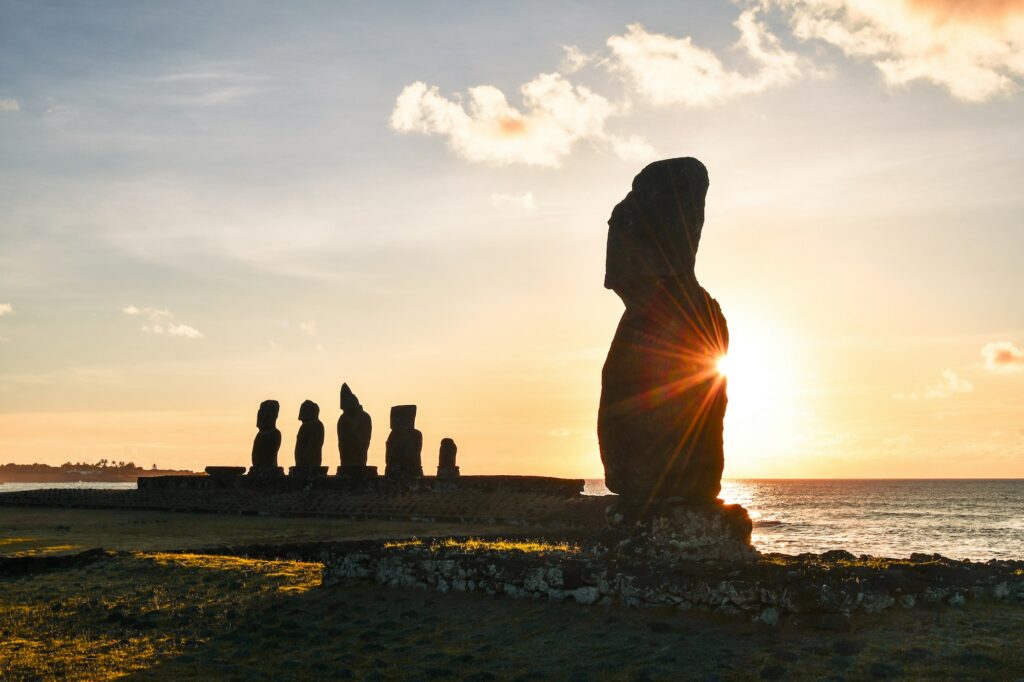
Tapati Rapa Nui 2027 is announced for Saturday 30 January to Friday 12 February 2027, 14 days of festival in Hanga Roa. The detailed programme isn’t published yet. The national park ticket costs US$100 for a foreign adult, and a licensed guide is mandatory at the key sites.
Checked on against the sources cited in the article.
Every year, in January or February, Easter Island runs to the rhythm of the Tapati Rapa Nui. The clan festival of Hanga Roa packs two weeks of ancestral contests, dance, song and parades. For 2027, the 59th edition is announced for 30 January to 12 February. This guide separates what is settled (the park ticket, the mandatory guide, a return flight and the 30-day stay) from what is still announced (dates, times, events), and gives you what you need to plan the trip now.
1. A clan festival, born on the island
The Tapati, a clan competition
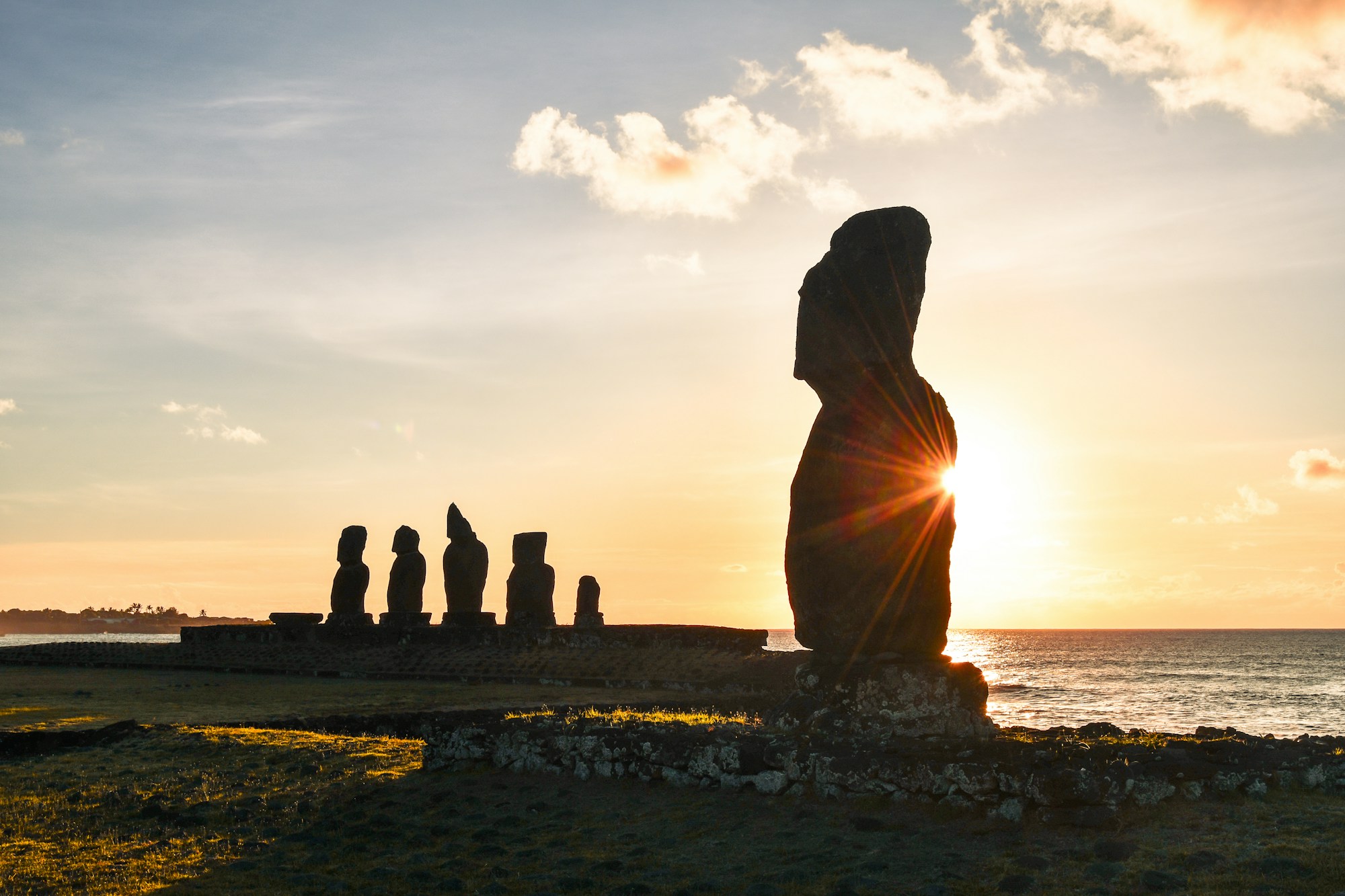
Organised by the clans of Hanga Roa, the Tapati crowns a queen each year, the Ariki Vahine, at the end of trials that judge craftsmanship as much as the rivalry between families. According to voyage-ile-de-paques.com, the first edition dates back to February 1975. The festival is therefore recent in its current form, but it draws on older spring celebrations, according to GoChile. The contests test making as much as speed: a costume, a body painting or a wooden sculpture is judged.
Highlights
- Each clan puts forward a candidate for the Ariki Vahine crown
- Ancestral contests: the Tau’a triathlon, Haka Pei, canoes, dance, song
- A festival first and foremost for the community, open to visitors as spectators
- Most shows and competitions are free, according to Easter Island Travel
2. Editions and dates: what is confirmed, what is announced
The Tapati is traditionally held during the first two weeks of February. The 59th edition is announced for Saturday 30 January to Friday 12 February 2027 by two tourism sites, Imagina Rapa Nui and Easter Island Travel. Neither site names an authority that has confirmed these dates, and no page from the municipality or the ministry could be read on the day of checking. Treat these dates as announced, not official.
| Edition | Dates | Date status |
|---|---|---|
| 2025 (57th) | 1 to 14 February 2025 | official programme relayed |
| 2026 (58th) | 3 to 14 February 2026 | end confirmed by the Chilean Ministry of Cultures, start according to Meteored Chile |
| 2027 (59th) | 30 January to 12 February 2027 | announced, unofficial tourism source |
Source: Imagina Rapa Nui (2025 and 2027), Chilean Ministry of Cultures (2026, for the end of the festival), checked on 26 November 2026. The 3 February start of the 2026 edition comes from Meteored Chile (section 3).
The only official confirmation read for a recent edition comes from the Ministry of Cultures: its article of 6 February 2026 reports the opening at Hanga Vare Vare, in the presence of the minister, and says the festival runs until 14 February. For 2027, the official programme was not published on the day of checking. The two sites that announce the dates say the organisers have not yet published the official programme, which was not online on 26 November 2026.
3. The 2027 programme: the 2026 model in the meantime
No published 2027 programme could be read. The most solid model remains that of 2026, as reported by Meteored Chile on 5 February 2026. It gives the structure of an edition: coastal clean-up and opening early in the week, morning contests, evening shows, parades, then closing on a Saturday night.
Days and times don’t carry over directly to 2027, since the week’s calendar shifts by one year. The table is therefore a guide to structure, and the final times will be the ones the organisers publish.
| Day (2026) | Time | Event |
|---|---|---|
| Tuesday 3 February | 9 am | coastal clean-up |
| Tuesday 3 February | 10 pm | official opening, speeches and show |
| Wednesday 4 February | 10 am | Tau’a triathlon |
| Sunday 8 February | 1:30 pm | community curanto |
| Monday 9 February | 10 am to 3 pm | banana race, regatta |
| Thursday 12 February | 3 pm | water duathlon |
| Friday 13 February | 4 pm | parade, with farándula and floats |
| Saturday 14 February | 9 pm | official closing |
Source: Meteored Chile, programme published 5 February 2026, checked on 26 November 2026.
Two trends stand out in this model. The day’s contests often start at 10 am, sometimes at 3 pm. The evening highlights take place on the main stage at Hanga Vare Vare, in the village of Hanga Roa. If your stay is short, prioritise the 10 am contests and keep the evenings for the ceremonies.
4. The contests: from the Tau’a triathlon to the banana race
The Tau’a Rapa Nui triathlon is arguably the most spectacular event. It combines a swim in the crater lake of Rano Raraku, a run of about one kilometre carrying bunches of bananas on a pole, then a swim back or a return by canoe. According to Atlas Obscura, the event was revived in the 1990s by organiser Rodrigo Paoa Atamu, who preferred Rano Raraku to the Orongo site, judged too dangerous on the cliff edge. No published official rules could be consulted.
Haka Pei is a downhill race on banana-trunk sleds, on Cerro Pui, near the Anakena road. It is the event you come to see up close, and also the one on which sources agree least. They don’t agree on the slope or the speed, and this guide repeats none of those figures. Haka Pei events don’t always count toward the clans’ score, according to one source.
Other contests round out the programme: spearfishing, canoes, dance and song, wood carving, and body painting called takona, where the judges score the aesthetics and symbolism of the design. Food has its place too, with curanto, the collective dish of the 2026 community meal. For the evenings, kai kai, a storytelling show with string figures, completes the programme.
A few terms to follow the announcements:
- Ariki Vahine: the queen of the Tapati, chosen at the end of the contests (section 5).
- Tau’a: the triathlon described above.
- Haka Pei: the banana-trunk downhill race, according to Easter Island Travel (2026 edition).
- Takona: body painting with natural pigments, whose design the judges score (Easter Island Travel, 2026 edition).
- Kai kai: a storytelling show with string figures (Easter Island Travel, 2026 edition).
- Curanto: a collective dish, served at the community meal on Sunday 8 February 2026 (programme from Meteored Chile).
5. The clans, the queens and the candidates
Each Hanga Roa clan puts forward a candidate, and the festival’s queen, the Ariki Vahine, is chosen at the end of the contests. For 2027, one tourism site only, Easter Island Travel, reports that a preselection assessment was held on 24 and 25 April 2026, with three candidates at the start and two finalists announced. No official source read confirms this: don’t present it as settled until the organisers publish it.
In 2026, dance rehearsals for the candidates began in early January, again according to Easter Island Travel. The crowning of the queen closes the festival, on 12 February 2027 according to the announced dates. The venue is disputed: Imagina Rapa Nui places the crowning at Hanga Vare Vare for 2025, while Espacio 13C places it at Ahu Tahai for 2026. This contradiction is not resolved here; the official programme will set the venue and the time.
6. Arriving and entering the island: flight, form and 30 days
The direct service from Santiago lands at Mataveri airport (IPC) after a flight of about 5 h 30, according to chile.travel. LATAM is the airline cited by the sources. Fares are higher in January and February, and the KAYAK comparison site advises booking about 12 weeks ahead. No fare for February 2027 could be found: don’t rely on any figure until you have checked the exact date on a comparison site.
| Point | Reference | Source |
|---|---|---|
| Direct flight from Santiago | about 5 h 30 | chile.travel |
| Maximum stay on the island | 30 days | LATAM; easterisland.travel |
| Air ticket | return, with a return flight within 30 days | LATAM |
| Entry form (FUI) | to fill in online, confirmation email shown to the PDI | LATAM |
| Orongo from the airport | about 5 km, 10 minutes | chile.travel |
Source: LATAM Airlines help centre, chile.travel, checked on 26 November 2026.
The entry form (FUI, Formulario Único de Ingreso) is filled in online. At the airport, you show the confirmation email to the PDI, Chile’s immigration police, according to LATAM. A guide citing ChileAtiende says the form is free. Deadlines for filing vary from one source to another: check them on the official portal before booking your flight, because this is the one point this guide cannot settle.
The stay is limited to 30 days on the island, and the return ticket must fall within that period. Bring a valid passport and, if asked, proof of accommodation.
7. The national park and the sites: moai, Rano Raraku, Tongariki
The park ticket, a must
The Rapa Nui National Park ticket is required for the archaeological sites, Rano Raraku and Orongo included. Its price rose to US$100 for a foreign adult on 1 October 2025, according to the announcement by the Ma’u Henua community, relayed by GoChile. The park website, rapanuinationalpark.com, sets out the access rules but did not list a price on the day of checking.
Highlights
- A ticket valid for 10 consecutive days
- One entry per ticket at Rano Raraku, and one at Orongo
- Ahu Tongariki, with its fifteen restored moai, with no access restriction reported
| Category | Price | Rule |
|---|---|---|
| Foreign adult | US$100 | valid 10 consecutive days |
| Foreign child | US$40 | valid 10 consecutive days |
| Chilean adult | CLP 40,000 | valid 10 consecutive days |
| Chilean child | CLP 20,000 | valid 10 consecutive days |
Source: GoChile, which relays the Ma’u Henua announcement of 19 May 2025, checked on 26 November 2026. Amount to be checked on site.
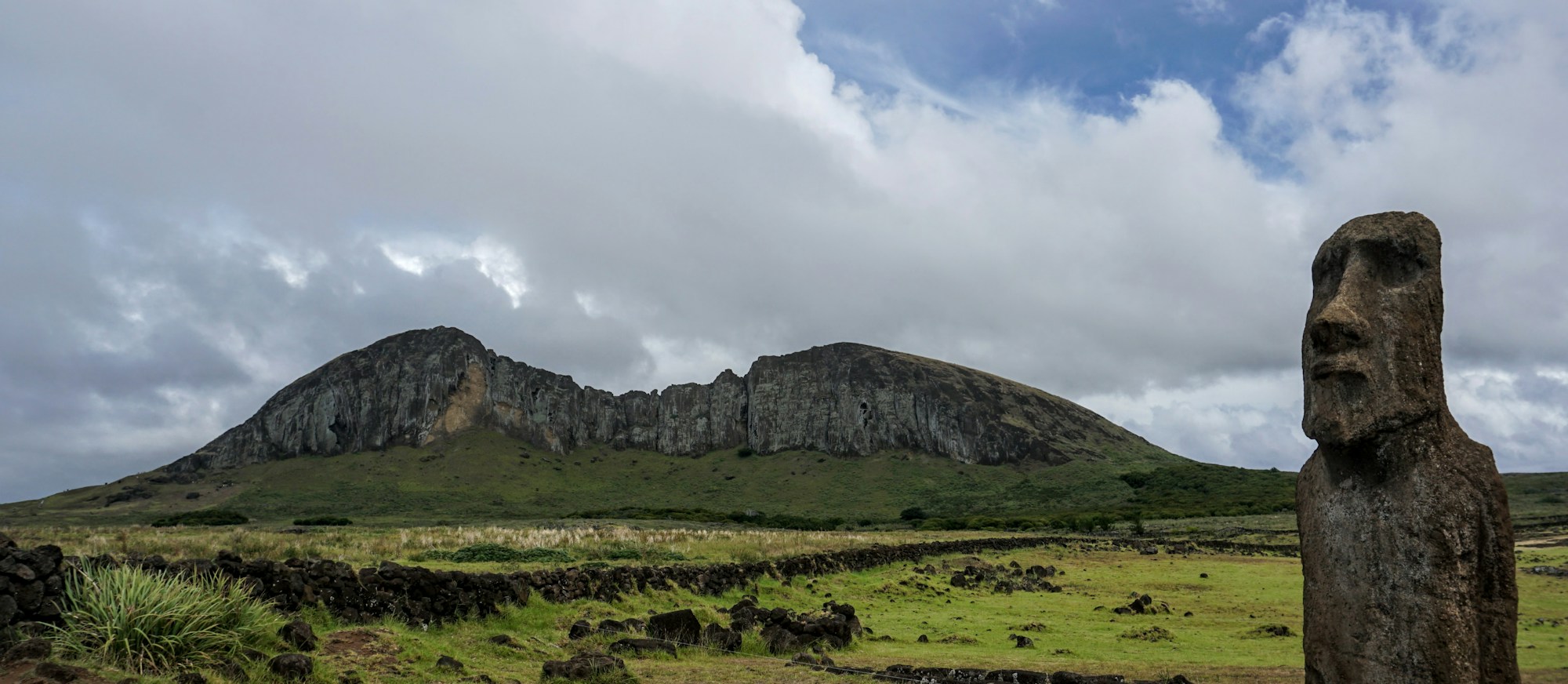
Rano Raraku is the quarry where the moai were carved, and it is where the triathlon swim takes place. Don’t touch the moai or the platforms (ahu), and stay on the path. The ticket gives a single entry to this site, which means organising your visit carefully: once you have left, you can’t come back on the same ticket.
8. Orongo and Rano Kau, the birdman village
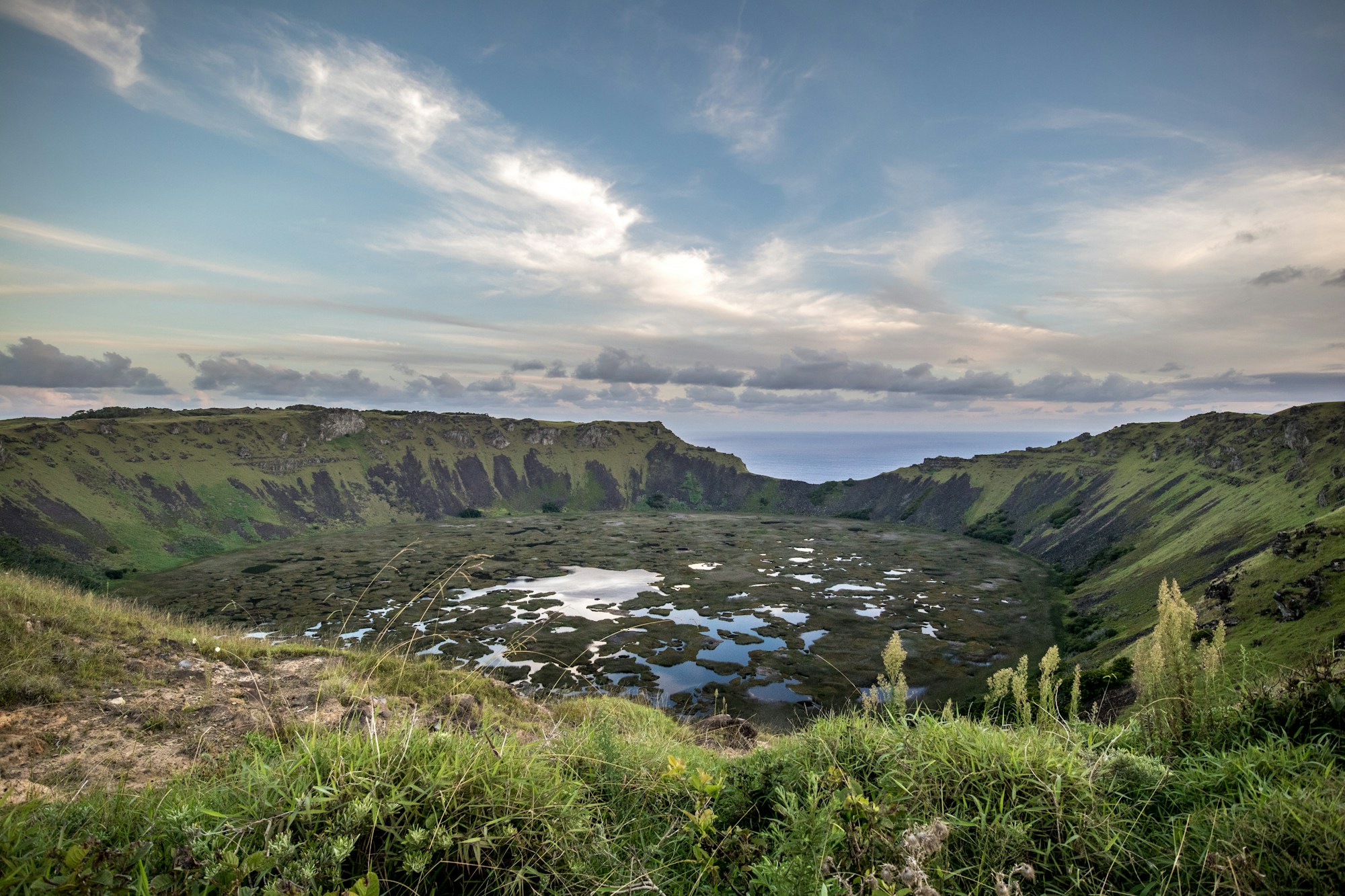
Orongo, a ceremonial village on the crater’s edge
Orongo is the ceremonial village linked to the birdman competition, the Tangata Manu, built on the edge of the Rano Kau crater. You reach it on foot along a path at the cliff edge. Chile.travel says access is with a licensed guide or as part of a tour, on marked paths, with a ban on touching the petroglyphs.
Highlights
- The site is about 5 km from the airport, or 10 minutes
- The Rano Kau crater can be seen from the village
- The park ticket covers one entry to Orongo
9. Budget: what can be priced and what can’t yet
For February 2027, no flight or accommodation fare could be found. The table therefore lists only the dated reference points. For accommodation prices, booking platforms only show them once you enter dates.
| Item | Reference | Status |
|---|---|---|
| Park ticket, foreign adult | US$100 | relayed announcement, to check on site |
| Private day tour, 2-adult basis | €334.36 per adult (€668.72 for two) | Viator figure of 26 November 2026, 2-adult basis; park ticket not included |
| Return flight from Santiago, February 2027 | not found | book early, compare on the exact date |
| Accommodation in Hanga Roa, February 2027 | not found | prices visible once dates are entered |
| All-inclusive tour, 8 days, 2025 edition | US$13,895 per person, double occupancy | high-end tour operator, domestic flights included |
Source: GoChile (park), Viator (private tour, 2-adult basis, checked on 26 November 2026), Abercrombie & Kent (2025 tour), checked on 26 November 2026.
The high-end tour is not a reference point for travelling independently: it is a tour-operator package, with domestic flights and a guide included. On the other hand, most shows and competitions are free and open to the public, according to Easter Island Travel. Your budget therefore centres on the park ticket, the flight, accommodation and car hire, the main way to get around the island. No car hire rate was found for this article.
10. Accommodation: book early and choose your area
The tourism sites recommend booking accommodation several months ahead for the festival period, since supply is limited in Hanga Roa. No official list of accommodation, whether from Sernatur or the municipality, could be consulted. Private rentals are plentiful, but their availability for the festival has not been checked.
Without a car, the area matters more. Central Hanga Roa puts you close to the shops, the main stage and the departure points for tours. A property out of town means renting a car or scooter, and booking early, as the same sites recommend.
11. Getting around and coping with the heat
The island is mostly covered by car and motorbike. An origin-destination survey by the Ministry of Transport, presented by CNN Chile, records 3.1 trips per person across a sample of 270 households and 696 people. The bus is little used. Rent a vehicle as soon as your dates are set.
| Mode | Share of trips | Average duration |
|---|---|---|
| Car | 57% | 12.1 min |
| Motorbike | 20% | 13.7 min |
| Walking | 14% | 15.4 min |
| Bus | share not specified | 28 min |
Source: CNN Chile, presentation of the mobility survey, checked on 26 November 2026.
On the weather side, February marks the end of the austral summer. Highs hover around 26 to 28 °C and nights around 20 °C, according to the sources, which agree on this order of magnitude but not on the detail of rainfall. Pack a windproof layer, sun cream, a hat and water, as there is little shade at the sites.
12. A possible itinerary around the 14 days of festival
Here is one way to organise the stay around the festival, based on the 2026 programme benchmarks. Adjust it once the 2027 programme is published, and keep the weekday details for the final version.
- Arrival, two days before 30 January. Flight from Santiago, entry form completed before departure, settling in at Hanga Roa.
- The day before 30 January, the park sites. A guided day at Rano Raraku and Tongariki, with the park ticket and a licensed guide. The ticket is valid for 10 consecutive days: check from which day it starts running if you want to cover the festival.
- Orongo, in the morning, before the heat. Guided visit of the village and the Rano Kau crater. Schedule it on a free morning, before or during the festival, depending on how many days the park ticket has left.
- During the festival, 30 January to 12 February according to the announced dates. Keep mornings for the day’s contests, often at 10 am, and evenings for the ceremonies on the main stage. The official programme will set the times.
- 12 February, closing and return. The crowning closes the festival, according to the announced dates. Check that your return date stays within the 30 days allowed.
If you want to extend your trip into northern Chile, our excursions to book from San Pedro de Atacama pair well with a week on the island.
13. Adapting the trip to your profile
First time. A full week lets you see both the contests and the sites. Several guides recommend staying at least seven days. Book a guided day at the park early on, to understand the sites before the contests.
With family. The foreign child ticket is US$40, according to GoChile. Morning contests are easier to follow than the long evening ceremonies, and the lack of shade at the sites means frequent breaks.
On a small budget. Focus your spending on the park ticket and the flight, and enjoy the free shows and competitions. Simpler accommodation in Hanga Roa reduces the need for a vehicle.
Couples and photographers. Book the Orongo visit in the morning, before the heat, and a guided day at the park. For another week in the desert, see our excursions from San Pedro de Atacama.
Reduced mobility. No source read documents the accessibility of the sites or of the festival. Ask the operator before booking, and check the terrain: paths, the cliff edge at Orongo, tracks around the crater.
What other guides don’t tell you
Four points, checked against sources read on the date of consultation, are missing or wrong in several guides in circulation.
- Some guides still quote old prices. Several give US$80 or CLP 95,000; the price in force since 1 October 2025 is the one in section 7, relayed by GoChile (checked on 26 November 2026).
- The licensed guide is not optional. Many guides present it as optional; the park website says so explicitly. Source: rapanuinationalpark.com (checked on 26 November 2026).
- The 10-day limit changes the order of visits. It is missing from many guides, along with the single entry at Rano Raraku and the one at Orongo. Source: GoChile and chile.travel (checked on 26 November 2026).
- The entry form is online. Some guides still mention a paper form or a visit to an office; at the airport it is presented as an email. Source: LATAM, help centre (checked on 26 November 2026).
Practical info
The festival is held in Rapa Nui and Spanish. The contests have Rapa Nui names: the vocabulary in section 4 helps you follow the announcements.
Don’t touch the moai or the platforms, don’t touch the petroglyphs, and stay on the marked paths.
The Tapati is a festival for residents. You are welcome to watch, and to take part in some activities such as dance or the parade, without making it a performance. According to Easter Island Travel (2026 edition), no alcohol is sold during the festival, and some areas are smoke-free.
Frequently asked questions
What are the dates of Tapati Rapa Nui 2027?
From Saturday 30 January to Friday 12 February 2027, according to Imagina Rapa Nui and Easter Island Travel. These dates are announced by private tourism sites, with no open official source at the consultation date of 26 November 2026. The detailed programme is not yet published, and the 2026 model only gives its structure.
How much is the Rapa Nui National Park entrance fee?
US$100 for a foreign adult, in force since 1 October 2025, according to the Ma’u Henua community announcement relayed by GoChile. The ticket is valid for 10 consecutive days and gives a single entry to Rano Raraku and to Orongo. The park website did not list a price when consulted: check the amount when you pay.
Do you need a guide to visit Rano Raraku and Orongo?
Yes. The national park website states that a licensed guide is mandatory for the visit. For Orongo, chile.travel says you go with a licensed guide or as part of a tour. The private excursion mentioned above includes a private guide, in English or Spanish, according to its Viator listing.
Do you need to fill in a form to enter Easter Island?
Yes, the FUI (Formulario Único de Ingreso), filled in online before your flight. At the airport, you show the confirmation email to the PDI, according to LATAM. A guide citing ChileAtiende says the form is free. Deadlines for filing vary between sources: check them on the official portal before you book.
What is the maximum length of stay on the island?
30 days, according to LATAM and Easter Island Travel. Your air ticket must be return, with a return within that period. Also bring a valid passport and, if asked, proof of accommodation.
When should you book the flight and accommodation for the Tapati?
As early as possible. The tourism sites recommend several months’ notice for accommodation during the festival. For flights, KAYAK advises about 12 weeks before departure, as fares are higher in January and February. No fare for February 2027 could be found at the consultation date.
When is the best time to visit?
For the festival, the end of the austral summer, January to March, with highs around 26 to 28 °C. For fewer crowds and more balanced weather, Easter Island Travel suggests April-May and September-October. The choice depends on your priority: the festival atmosphere or the calm of the sites.
Can you take part in the Tapati as a tourist?
Yes, but the festival is first and foremost for the community. Tourists are welcome to watch, and to take part in some activities such as dance and the parade, according to Easter Island Travel. Most shows and competitions are free and open to the public.
Is Haka Pei dangerous?
It is a downhill race on a steep slope, on banana-trunk sleds. Sources disagree on the slope and the speed, so no figure is given here. To judge the risk, check with the organisers or your operator before going to the race venue.
Sources
- Imagina Rapa Nui, Tapati 2027: dates, schedule and activities : announced dates for the 59th edition, no programme published.
- Easter Island Travel, Tapati 2027: dates and candidates : announced dates, preselection of candidates, most shows free.
- Imagina Rapa Nui, Tapati 2025: programme and closing : dates of the 2025 edition.
- Chilean Ministry of Cultures, opening of the Tapati Rapanui 2026 : confirmation of the 2026 dates and of the festival’s role.
- Meteored Chile, start of the Tapati Rapa Nui 2026 : 2026 programme used as a structural model.
- GoChile, Rapa Nui National Park announces adjustment of entrance ticket prices : park prices and validity rules, relaying the announcement of 19 May 2025.
- GoChile, The Tapati, the most impressive cultural festival on Easter Island : origin of the festival and its contests.
- Rapa Nui National Park (Ma’u Henua), access rules : licensed guide mandatory.
- Chile.travel, Orongo : access to the ceremonial village, direct flight and distances.
- Voyage Île de Pâques, the Tapati festival : first edition in February 1975.
- Atlas Obscura, the Rapa Nui triathlon : history and course of the Tau’a.
- LATAM Airlines help centre, travel documents for Easter Island : FUI, return ticket, 30-day stay.
- Easter Island Travel, entry and immigration : maximum stay of 30 days.
- CNN Chile, results of the Rapa Nui mobility study : mode shares and trips per person.
- Easter Island Travel, best time to visit the island : seasons and crowds.
- Climates to Travel, Easter Island climate : order of magnitude of temperatures.
- Abercrombie & Kent, Easter Island and the Tapati Festival (2025) : high-end tour benchmark, 2025 edition.
- Viator, private full-day tour « The Highlights » : price from, for two adults, and availability on six sampled dates of the announced window, checked on 26 November 2026, park ticket excluded (affiliate link, see the card in section 1).
- Easter Island Travel, Tapati Rapa Nui 2026: dates, activities and tips : no alcohol sold, takona, kai kai, Haka Pei.
Research and checks as of 26 November 2026. The 2027 dates remain announced by tourism sites, pending a programme published by the organisers.

Plan your trip with Pixidia
Pixidia learns how you travel and helps you build a trip that truly fits you and everyone coming along.
Open the planner