
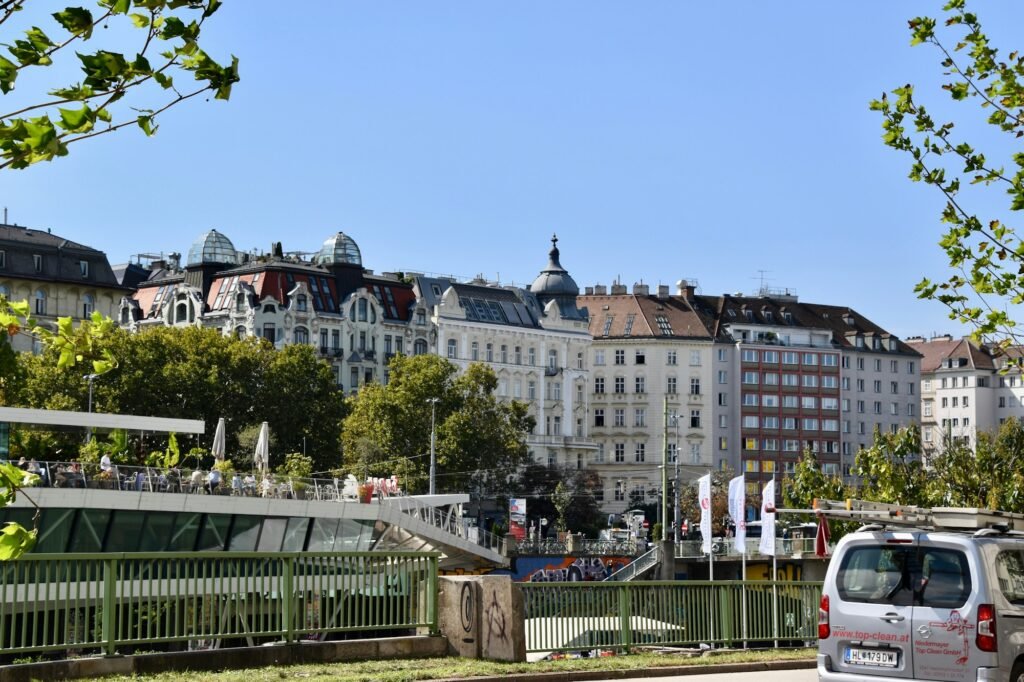
Vienna is fully visitable during Eurovision 2026 (10–17 May), even without a show ticket. The city welcomes around 100,000 extra visitors over the week, but its 2 million inhabitants and 84,600 hotel beds absorb the pressure far better than Malmö or Basel did. The quietest days are 11, 13 and 15 May (no shows). The imperial museums — Schönbrunn, Belvedere, Kunsthistorisches Museum — operate on normal hours. Book your accommodation as early as possible: prices have doubled, rising on average from $247 to $512 per night.
The Eurovision Song Contest 2026, the 70th edition of the competition, takes over Vienna from 10 to 17 May. Semi-finals on 12 and 14 May, grand final on Saturday 16 May at the Wiener Stadthalle — and in between, a free Eurovision Village at Rathausplatz that can hold up to 15,000 fans. If you have a trip to Vienna planned that week without a show ticket, you may be wondering what to expect. The short answer: a city in full celebration, slightly pricier and busier than usual, but with its tourist attractions entirely intact. This guide gives you everything you need to plan each day, find the quiet neighbourhoods, eat authentically and dodge the most common pitfalls. Direct flights from London Heathrow and Gatwick make this one of the most accessible European city breaks of the spring season.
1. Weekly schedule: which days are genuinely quiet?

Strategic calendar: 10 to 17 May
According to wien.info, the official programme clearly distinguishes show evenings from rehearsal days. The semi-finals take place on Tuesday 12 and Thursday 14 May, with the grand final on Saturday 16 May (starting at 21:00 CEST). On those three evenings, crowds begin building from 18:00 around Rathausplatz, the Ringstrasse and the 15th district (Stadthalle). By contrast, Monday 11, Wednesday 13 and Friday 15 May are rehearsal days with no official show: the city breathes.
Thursday 14 May is also Ascension Day, a public holiday in Austria: the Eurovision Village opens from 11:00 instead of 14:00, and central Vienna takes on a bank-holiday feel. Plan your travel accordingly. On Sunday 17 May, the Eurovision Village closes at 19:00 and most fans leave — an ideal day to explore museums that are usually packed in high season.
Key highlights
- 11, 13, 15 May: rehearsal days — lighter crowds in museums and restaurants in the city centre
- 12, 14, 16 May (show evenings): allow an extra 30 minutes for any journey after 18:00 in the Innere Stadt
- 17 May (Sunday): excellent day for Schönbrunn or Belvedere — the ESC fans have gone home
2. Museums and sights: the off-peak windows you need to know
Schönbrunn, Belvedere, KHM: the quiet time slots
The good news confirmed by Wien.info’s official FAQ: no museum closes during Eurovision. The Kunsthistorisches Museum (€22 adult, free under-19s), the Albertina (€19.90), the Upper Belvedere (~€18) and Schönbrunn Palace (Grand Tour €38) all run on their normal timetables. The Wien Museum even transforms into an « Eurofan House » from 11 to 16 May — free entry.
The strategy to avoid the rush: arrive at opening time. According to schoenbrunn.at, Schönbrunn’s ticket desk opens at 08:30 — aim to arrive by 09:00 at the latest. For the Upper Belvedere, the 10:00–11:00 and 15:00–17:00 windows are the most peaceful. For the KHM, 10:00 to 10:45 before the main surge arrives. The Belvedere Gardens are free and open from 06:30: perfect for an early-morning stroll before the crowds.
Key highlights
- Schönbrunn: book online 2–3 weeks ahead, arrive at 09:00, enjoy the Neptune Fountain side without the crowds
- Belvedere Gardens free from 06:30 — one of Europe’s finest baroque gardens, no queuing
- Stephansdom: nave is free, but avoid noon and show evenings — 09:00 to 11:30 is ideal
3. Quiet neighbourhoods away from the ESC orbit
Josefstadt, Karmeliterviertel, Neubau
The ESC hot zone concentrates around Rathausplatz (1st district) and the 15th district (Stadthalle). Three neighbourhoods offer an authentic Viennese experience well outside that perimeter.
Josefstadt (8th district): a residential neighbourhood of just 1 km², a 15–20-minute walk from Rathausplatz. Old-school cafés like Café Eiles (Josefstädter Str. 2) and Café der Provinz, neighbourhood theatres, and Fromme Helene restaurant for a Schnitzel without the tourist queue. According to Connecting Vienna, Josefstadt is described as « an art nouveau city wrapped in culture » — a fair summary.
Karmeliterviertel (2nd district): a revitalised historic Jewish quarter. The Karmelitermarkt (Mon–Fri 06:00–21:00, Sat 06:00–18:00) is Europe’s first entirely energy-self-sufficient market. Notable restaurants: Pizza Mari (Neapolitan), Schöne Perle (modern Viennese). The nearby Augarten is a free baroque garden open to the public, with the Augarten Porcelain Manufactory (founded 1718) and Vienna Boys’ Choir concerts.
Neubau (7th district): Vienna’s « boho » neighbourhood — independent galleries, serious coffee roasters, vintage shops. The MuseumsQuartier is based here (Leopold Museum, MUMOK, Kunsthalle Wien). The Spittelberg area, with its Biedermeier lanes and open terraces in May, is perfect for a relaxed lunch away from the bustle.
Key highlights
- Josefstadt (8th): authentic Viennese soul, local cafés, art nouveau architecture — 15 min on foot from the Rathaus
- Karmelitermarkt (2nd): ideal Friday and Saturday morning market, local producers, coffee on site
- Neubau (7th): MuseumsQuartier, Spittelberg terraces, speciality coffee — relaxed atmosphere, no ESC crowds
4. Authentic food: eating like a Viennese without the queue
Würstelstand, Beisl, Heuriger: the addresses that stand the test
The most authentic and affordable meal in Vienna costs €4–6: the Käsekrainer at a Würstelstand. This cheese-filled sausage is part of the UNESCO intangible cultural heritage of Austrian culinary traditions. The Bitzinger stand (behind the Opera House) is touristy but excellent quality. For a more local feel, look for Würstelstand LEO, the city’s oldest.
For a sit-down meal, a traditional Gasthaus (also called a « Beisl ») offers a Mittagsmenü (lunch menu) at €16–20 for two courses. Arriving before 12:30 avoids the regulars’ queue. The Naschmarkt (U4 Kettenbrückengasse or Karlsplatz) brings together 170+ stalls of spices, cheeses and olives — best time: early morning or after 14:30.
Vienna’s most unique experience remains the Heuriger: these wine taverns in the green belt villages (Grinzing, Nussdorf, Neustift am Walde, Stammersdorf) serve the estate’s new wine alongside a Brettljause — a wooden board of cheeses, cold cuts and pickles. Look for the « Buschen » (pine sprig) and the « Ausg’steckt is' » sign at the door: it means it’s open. Access via tram D from Schottentor to Nussdorf, or U4 Heiligenstadt then bus 38A towards Grinzing. According to Moon Honey Travel, a mid-week afternoon remains the best time to avoid the ESC weekend groups.
Key highlights
- Käsekrainer at a Würstelstand: €4–6, Vienna’s must-try on the UNESCO intangible heritage list
- Naschmarkt: 170+ stalls, best times early morning or after 14:30 — open Saturday until 18:00
- Heuriger on a weekday (11, 13 or 15 May): local wine, Brettljause, Schrammelmusik — a uniquely Viennese experience
5. Impact on prices and booking
+280% bookings: what it actually means for you
According to aviation.direct, hotel bookings in Vienna have jumped 280% compared to the same period in 2024. The average nightly rate has risen from $247 to $512. A 4-star hotel near the Konzerthaus is documented at €2,300 for the final weekend, against roughly €700 normally. Even hostels have adjusted their prices (up 50–70%). In sterling, mid-range options now typically start around £90–130 per night in outer districts.
The good news: Vienna has 84,600 beds across 42,400 rooms. Unlike Malmö 2024 (population 360,000) or Basel 2025, the city is nowhere near full capacity. The Wieden (4th), Mariahilf (6th) and Leopoldstadt (2nd) districts offer accommodation that is slightly cheaper than the Innere Stadt. The 15th and 14th districts, close to the Stadthalle, also offer better value during Eurovision week. From London Heathrow, direct flights to Vienna Airport (VIE) take approximately 2 hours 15 minutes with British Airways or Wizz Air — a manageable city break journey.
For transport passes: the 48h and 72h Wiener Linien passes were discontinued in January 2026. The Vienna City Card (€37 for 72 hours) includes unlimited transport and discounts at 200+ partners. The 7-day Wiener Linien pass costs €25.20 in digital format. For short stays, a single digital ticket costs €3.00. For more on accommodation options and the best neighbourhoods, see our Eurovision Vienna hotel guide.
Key highlights
- Cheaper districts: Wieden (4th), Mariahilf (6th), Leopoldstadt (2nd) — 15–25% less than the centre
- Vienna City Card 72h (€37): unlimited transport + museum discounts — ideal for a 3-day stay
- 48h and 72h Wiener Linien passes discontinued January 2026 — these products no longer exist
6. Atmosphere and safety: what you need to know
A city in celebration — with heightened awareness
According to SafeAbroad, the city has deployed 500 additional security officers for the ESC week. The atmosphere is festive and cosmopolitan — fans from 70 countries, flags, costumes, singing. That is precisely why many non-fan travellers deliberately choose to visit Vienna during Eurovision: the atmosphere is one of a kind.
The downside: Vienna records around 5,300 pickpocketing incidents per year, with 1,290 in the 1st district alone in 2024. The U1 line between Stephansplatz and Reumannplatz is flagged as a « hot corridor ». During Eurovision, with dense crowds, vigilance is essential. A few habits: phone in a zipped front pocket, cross-body bag with the clasp facing your chest, hand on your bag when metro doors open.
Watch out too for event-specific scams: fake ESC ticket websites (if in doubt, report to [email protected]), fraudulent QR codes in restaurants, and the so-called « fake police officer » scam that asks for a « check » of your wallet and PIN. For public transport logistics during the week, our Eurovision Vienna metro and neighbourhoods guide covers line-by-line changes.
Key highlights
- Eurovision Village Rathausplatz: free entry, bags max A4 size, bag-free policy on 10 and 16 May (lockers available on site)
- Medical emergency: 112 — Block a bank card: 116 116 (24/7) — Police: 133
- iVie app: Vienna’s official app includes an ESC guide and a gamified « ESC Challenge » for exploring the city
7. Culture and parallel events alongside the ESC
Wiener Festwochen, VieVinum, Genuss Festival
Eurovision week coincides with an exceptionally packed cultural calendar. The Genuss Festival at Stadtpark (8–10 May, just before the semi-finals) brings together 100+ Austrian artisan producers — wines, cheeses, charcuterie, pastries — with free entry to the park. The Wiener Festwochen (performing arts festival) begins on 15 May and runs until 21 June across multiple venues throughout the city.
Above all, note the VieVinum: the international wine festival at the Hofburg Palace takes place exactly on the grand final weekend (16–18 May). For the traveller who wants to experience Vienna’s soul without Eurovision, it is the perfect counterpoint — Vienna in Grüner Veltliner and Blaufränkisch mode at the heart of the imperial palace while 15,000 fans sing at Rathausplatz.
For an evening of music in the Viennese tradition, classical concerts at St Peter’s Church are a stunning alternative to the grand concert halls. Mozart, Bach, Beethoven, Schubert and Vivaldi performed in one of the most beautiful baroque interiors in the city — far removed from the ESC week commotion.
Key highlights
- Genuss Festival Stadtpark (8–10 May, free): ideal before the main ESC crowds arrive
- VieVinum at the Hofburg (16–18 May): Austrian wines, imperial palace — the perfect counterpoint to the ESC final
- Prater Giant Ferris Wheel (from €19.50): 360° view over Vienna — on the night of the final, a spectacular sight
Practical information for your Vienna trip
Stay connected without a physical SIM card. Instant activation from the app. The 5 GB / 7-day plan is recommended for the ESC week: full coverage of the Austrian network.
From €6.50 / 7 daysNomad Insurance: global medical coverage from $56/4 weeks. Covers medical, emergency evacuation and travel delays. 10% off via our link — ideal for a 7–10 day Vienna stay.
From $56 / 4 weeksFrequently asked questions
Do you need to book hotels in advance for Eurovision week in Vienna?
Yes, early booking is essential. According to aviation.direct, bookings have jumped 280% compared to 2024 and the average nightly rate has doubled from $247 to $512. Even though Vienna has 84,600 beds, the best rooms at reasonable rates go several months in advance. Prioritise the Wieden (4th), Mariahilf (6th) or Leopoldstadt (2nd) districts for slightly lower prices than the Innere Stadt.
Do Vienna’s museums close during Eurovision?
No. The Kunsthistorisches Museum, Upper Belvedere, Schönbrunn, the Albertina and the Sisi Museum all operate normally throughout Eurovision week. The Wien Museum even becomes an « Eurofan House » from 11 to 16 May with free entry. Online booking is still advised, especially for Schönbrunn, whose Grand Tour tickets (€38 adult) sell out quickly in high season.
Which public transport is best on ESC show evenings?
On semi-final evenings (12 and 14 May) and the grand final (16 May), the Ringstrasse in front of Rathausplatz is closed from noon until 1:00 am, diverting trams 1 and 2. The U6 line towards the Stadthalle is heavily loaded on show evenings. Use U2 and U3 lines to reach the Innere Stadt on those nights. Note that your Wiener Stadthalle show ticket doubles as a free travel pass on the entire Wiener Linien network on the day of the event. The 48h and 72h Wiener Linien passes were discontinued in January 2026 — opt for the Vienna City Card 72h (€37) for a 3-night stay.
Is the Eurovision Village at Rathausplatz accessible without a show ticket?
Yes, completely free. The Eurovision Village is open from 10 to 17 May, 14:00 to midnight (except 14 May from 11:00 for Ascension Day, and 17 May until 19:00 only). Maximum capacity of 15,000 fans at any one time. Bags are limited to A4 size; on 10 and 16 May, no bags are permitted (lockers available on site). According to wien.info, 15 screens broadcast the shows live.
Is Café Central open during Eurovision week 2026?
No. Café Central is closed from March until autumn 2026 for renovation. Its temporary alternative, the pop-up café « Decentral » (by the Hawelka group), is set up at Palais Harrach, Freyung 3, in the 1st district. For a traditional Viennese café that is less touristy, Café Eiles (Josefstädter Str. 2, 8th district) is an excellent alternative.
Which areas should you avoid on ESC show evenings in Vienna?
The high-density areas after 18:00 on show evenings (12, 14 and 16 May) are: Rathausplatz and the surrounding Ringstrasse (1st district), and the Wiener Stadthalle neighbourhood (15th district). For a quieter evening, head to Josefstadt (8th), Neubau (7th) or Wieden (4th) — these neighbourhoods remain well outside the ESC orbit. The Donauinsel is an excellent option for an evening stroll, completely free of crowds.
How do you get to the Wiener Stadthalle for a Eurovision show?
The Wiener Stadthalle (Roland-Rainer-Platz 1, 1150 Wien) is directly accessible by U6, Burggasse-Stadthalle station. This is the recommended way to travel. Reminder: your show ticket doubles as a free travel pass on the entire Wiener Linien network on the day of the event. For more on transport during Eurovision week, see our metro and neighbourhoods guide.
Sources
- Wien.info — ESC 2026 in Vienna (official page) — programme, Eurovision Village, official FAQ
- Eurovision.com — Vienna 2026 — official EBU site, host city guide
- Aviation.direct — Vienna hotel capacity ESC 2026 — booking statistics, average prices
- ESC Insight — Vienna, a major city hosting a major contest — comparative tourism analysis
- SafeAbroad — Security advisory Eurovision Vienna — security measures, transport disruptions
- Wiener Linien — New fare structure from January 2026 — discontinuation of 48h/72h passes, new prices
- Schönbrunn Palace — Tickets and prices 2026 — official prices, opening hours
- Vienna City Card — Prices and inclusions — transport pass options
- Wien.info — Eurovision Village at Rathausplatz — opening hours, capacity, access rules
- Connecting Vienna — Guide to the 8th district Josefstadt — local cafés and restaurants
- Moon Honey Travel — Guide to Vienna’s Heuriger — wine taverns, green belt villages
- Tabiji.ai — Tourist scams in Vienna 2026 — types of scams, prevention tips
- ESCToday — Economic impact of Eurovision 2026 — returns, jobs created, advertising value
- Naschmarkt Vienna — Opening hours — complete market guide
- Explorial — Café Central / Hawelka 2026 — closure confirmed until autumn 2026
Research conducted on 7 May 2026 — data verified against official sources.
Plan your Vienna trip
Vienna in May 2026 is set to be one of the most cosmopolitan weeks the Austrian capital has ever seen. Whether you are coming for Eurovision or simply for its imperial palaces, century-old coffee houses and the Naschmarkt, the city has a unique experience in store for you.
Explore Pixidia itineraries