
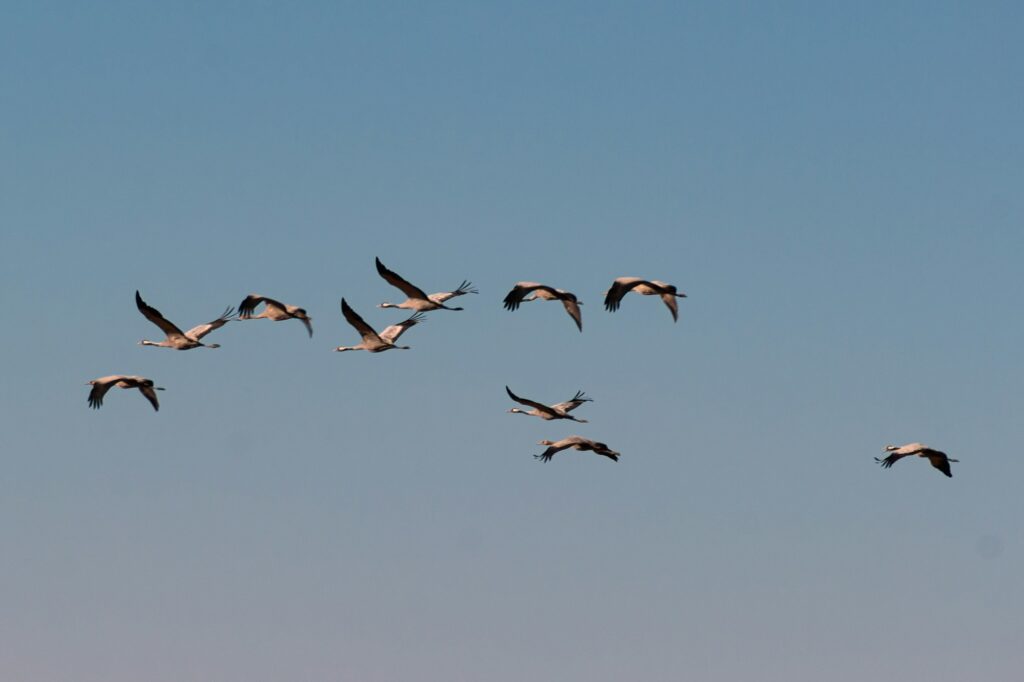
The 28th Woche des Kranichs (Crane Week) runs from 20 to 27 September 2026 in Western Pomerania, along the Bodden lagoons between Zingst and Rügen. In peak seasons, up to 90,000 common cranes have gathered here at once, with a documented record of 86,000 birds in 2019-2020. The old Groß Mohrdorf visitor centre closed in August 2025 and has been replaced by KRANICHWELTEN in Günz. An avian flu outbreak killed more than 18,000 cranes across Germany in autumn 2025, around 10% of the total population — better to head for the official viewing platforms at dusk than to chase an exact headcount.
A sky streaked with long silhouettes, necks stretched taut, and a call that carries for miles: every autumn, the Bodden lagoons of Western Pomerania become the stage for one of Europe’s largest common crane gatherings. In 2026, the Woche des Kranichs marks the occasion from 20 to 27 September, but two recent events change how you should plan the trip. The long-standing Groß Mohrdorf centre has closed its doors after almost thirty years, and an avian flu outbreak hit the crane population hard in autumn 2025, on a scale not seen before. Here’s what to check before you book.
Woche des Kranichs 2026: the 28th edition’s programme, 20-27 September
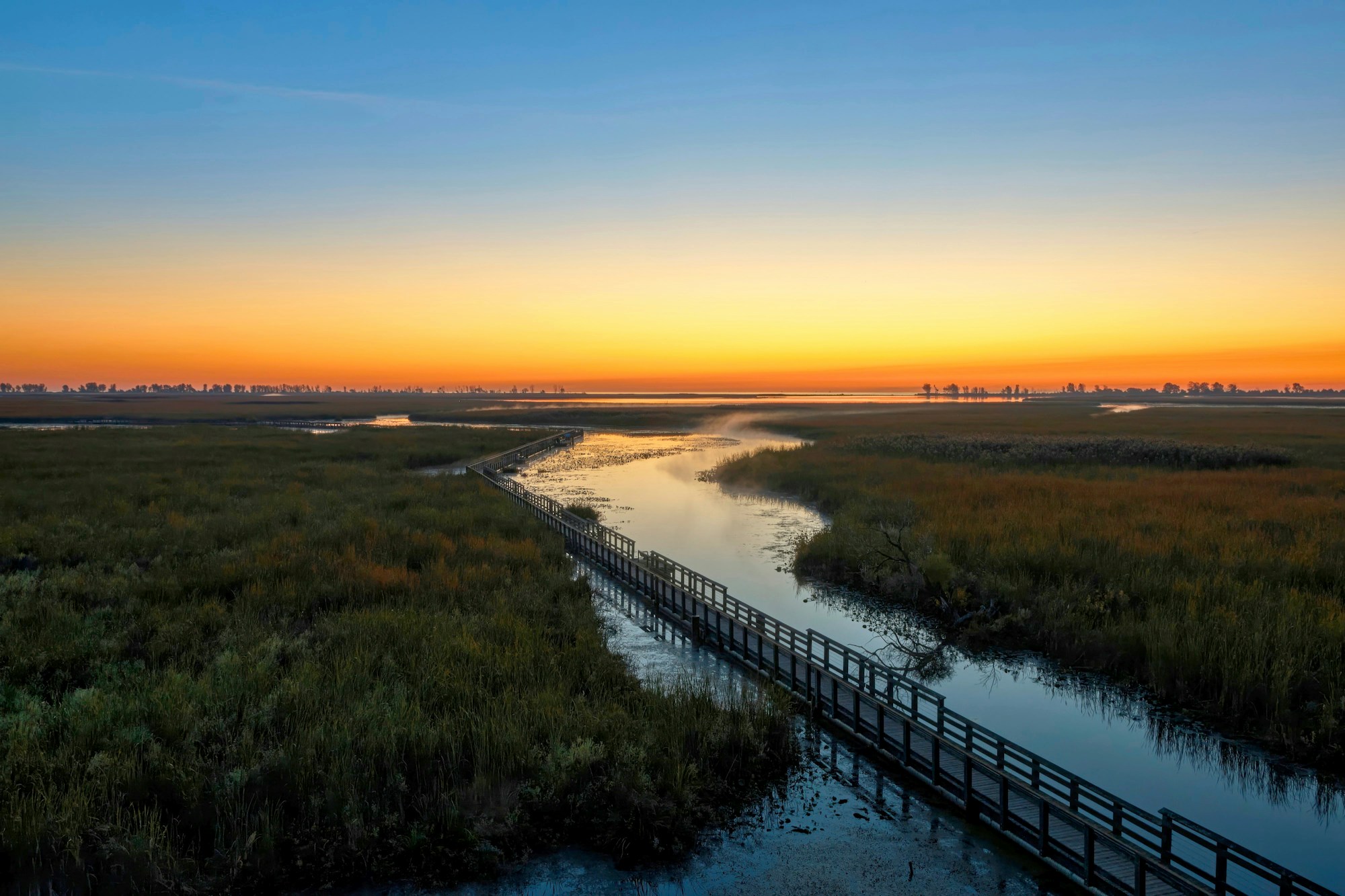
Since the late 1990s, the region has marked the return of what the organisers call the « Dancers from the North » with a week of talks, night walks and excursions. According to kraniche.de, the official site of Kranichschutz Deutschland run in cooperation with NABU, the 28th edition takes place this year from Sunday 20 to Sunday 27 September 2026, with an official opening at KRANICHWELTEN, in Günz.
The programme mixes a coastal watching excursion at the Zingst-West platform on 21 September, two talks on 22 and 25 September, an evening of crane tales and myths on the 24th, a guided excursion to Groß Mohrdorf-Bisdorf on the 26th, and a closing musical slideshow at the « Zu den zwei Birken » nature camp in Duvendiek on the 27th. Don’t confuse this event with the « Kranichtage » at Nationalpark Unteres Odertal, held in early October along the Oder on the Polish border: a different region entirely, more than two hours’ drive from here.
Highlights
- Official opening at KRANICHWELTEN on 20 September
- Guided excursion on the Zingst-West platform on 21 September
- Closing concert at the Duvendiek nature camp on 27 September
Many visitors reach the region via Stralsund, a Hanseatic UNESCO World Heritage city and one of the departure ports for crane-watching excursions. Here’s an original way to see the harbour before heading on to the Bodden:
Groß Mohrdorf has closed: welcome to KRANICHWELTEN, the new centre in Günz
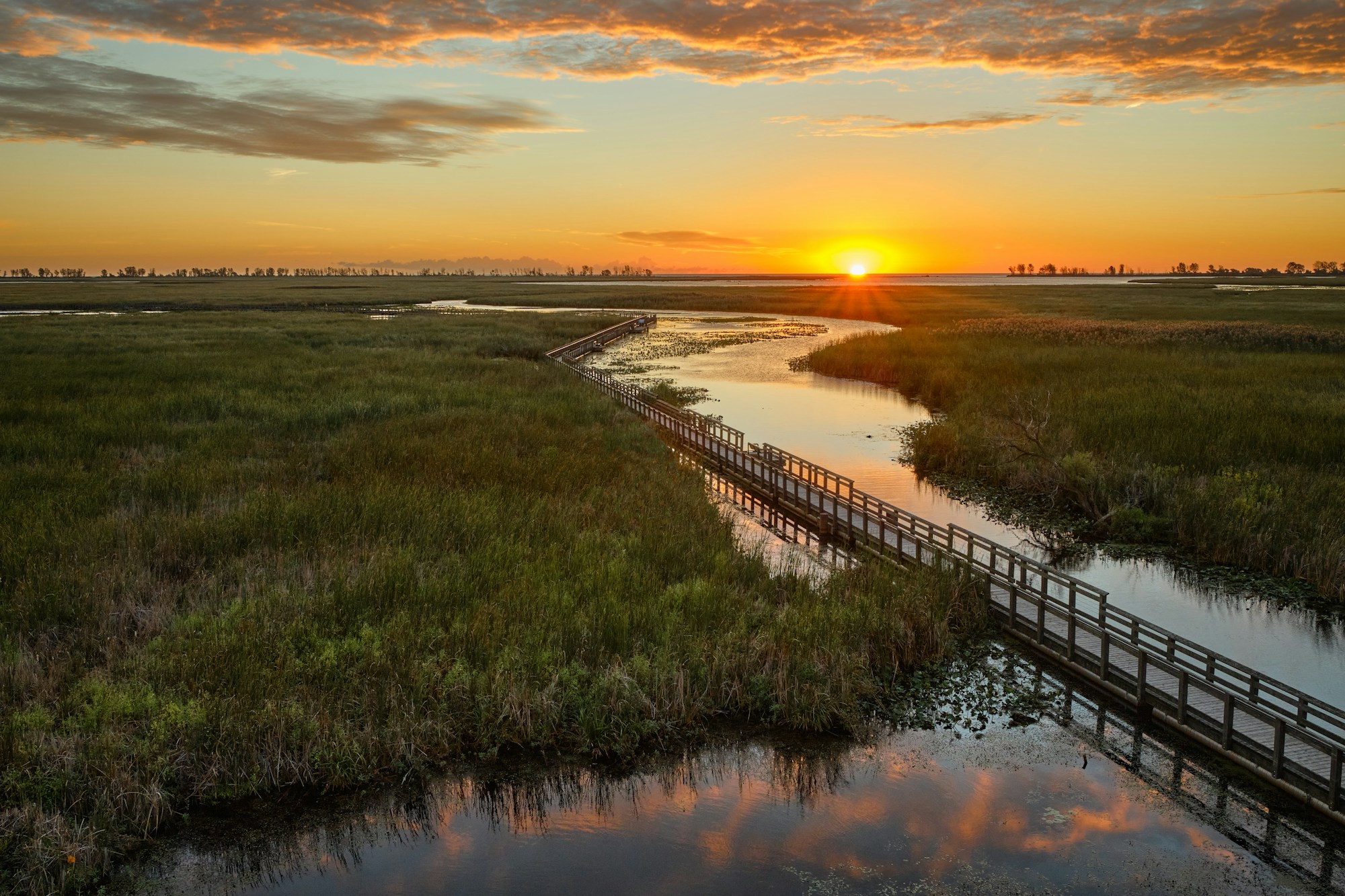
Plenty of guides still mention the « Kranich-Informationszentrum » in Groß Mohrdorf, which opened in 1996. It closed for good on 1 August 2025, a victim of its own success: rising visitor numbers had outgrown a display that hadn’t been updated in almost thirty years. Its replacement opened on 6 September 2025 as the Internationales NABU-Erlebniszentrum KRANICHWELTEN, in Günz, about 4km from the old site and 16km from Stralsund.
The new building spans 500m² of indoor exhibition space and 1.7 hectares of grounds, with multimedia zones, virtual-reality displays and a sound booth playing the duet calls of all 15 crane species found worldwide, not just the European common crane. The Kranorama observation platform hasn’t moved: it’s still 300 metres from the new centre, on the edge of the Günzer See, free to visit every day from 9am to 6pm in September and October.
Highlights
- Germany’s largest exhibition dedicated to cranes
- Free Kranorama platform, 300m away, open daily in season
- Bus access from Stralsund or Barth, line 305
90,000 cranes, really? What bird flu changed in 2025-2026
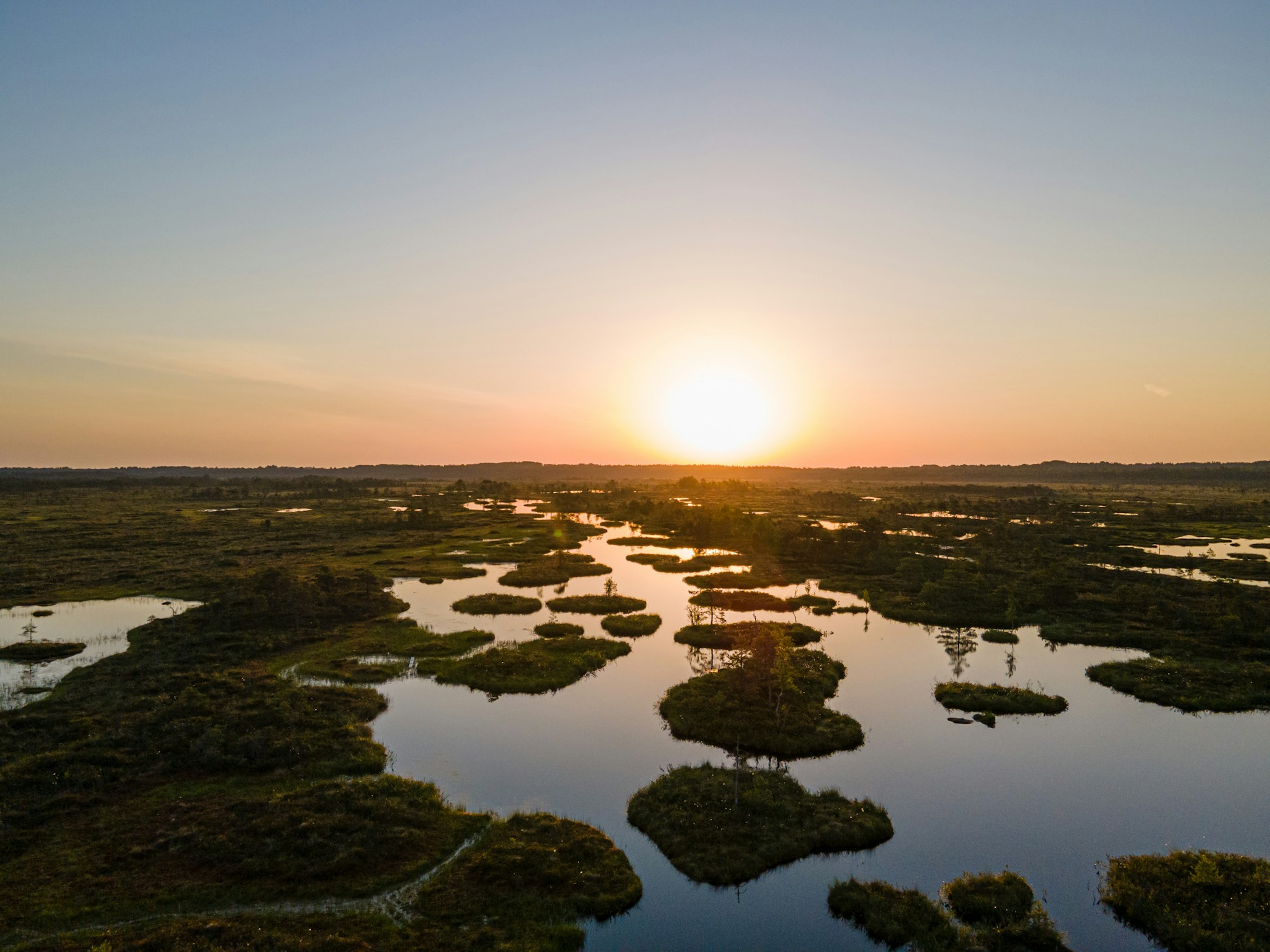
The figure of 90,000 cranes comes up often, even on official sources: the Vorpommersche Boddenlandschaft national park FAQ does mention « up to 90,000 cranes » at peak in certain years. The actual measured record is 86,000 birds during the 2019-2020 season, according to scientific monitoring by LPO Champagne-Ardenne, up from 63,015 the previous season.
Since then, things have changed. On 20 October 2025, the Friedrich-Loeffler-Institut, Germany’s federal veterinary research institute, confirmed highly pathogenic H5N1 in cranes across Mecklenburg-Western Pomerania, Brandenburg, Saxony-Anhalt and Thuringia — the first time the species had been hit at this scale. The death toll documented by kraniche.de rose from more than 15,500 dead cranes on 12 November 2025 to more than 18,000 a week later, a figure revised upward again in a study published in May 2026 by the CDC’s Emerging Infectious Diseases journal. Across the entire Western European flyway, home to more than 420,000 birds, mortality is estimated at around 10% — likely an undercount, since many sick cranes retreat to inaccessible areas before dying.
No cancellation of the Woche des Kranichs 2026 has been announced, and the Kranorama is due to reopen as normal this autumn. But after a die-off on this scale, nobody can promise 90,000 birds for this edition: better to come for the real show, whatever its size, than for a specific number.
Highlights
- The show goes on: no cancellation confirmed for 2026
- 60,000 to 80,000 cranes, the usual range cited by NABU outside crisis years
- No known risk to visitors watching from a distance
Where to watch the cranes without disturbing them
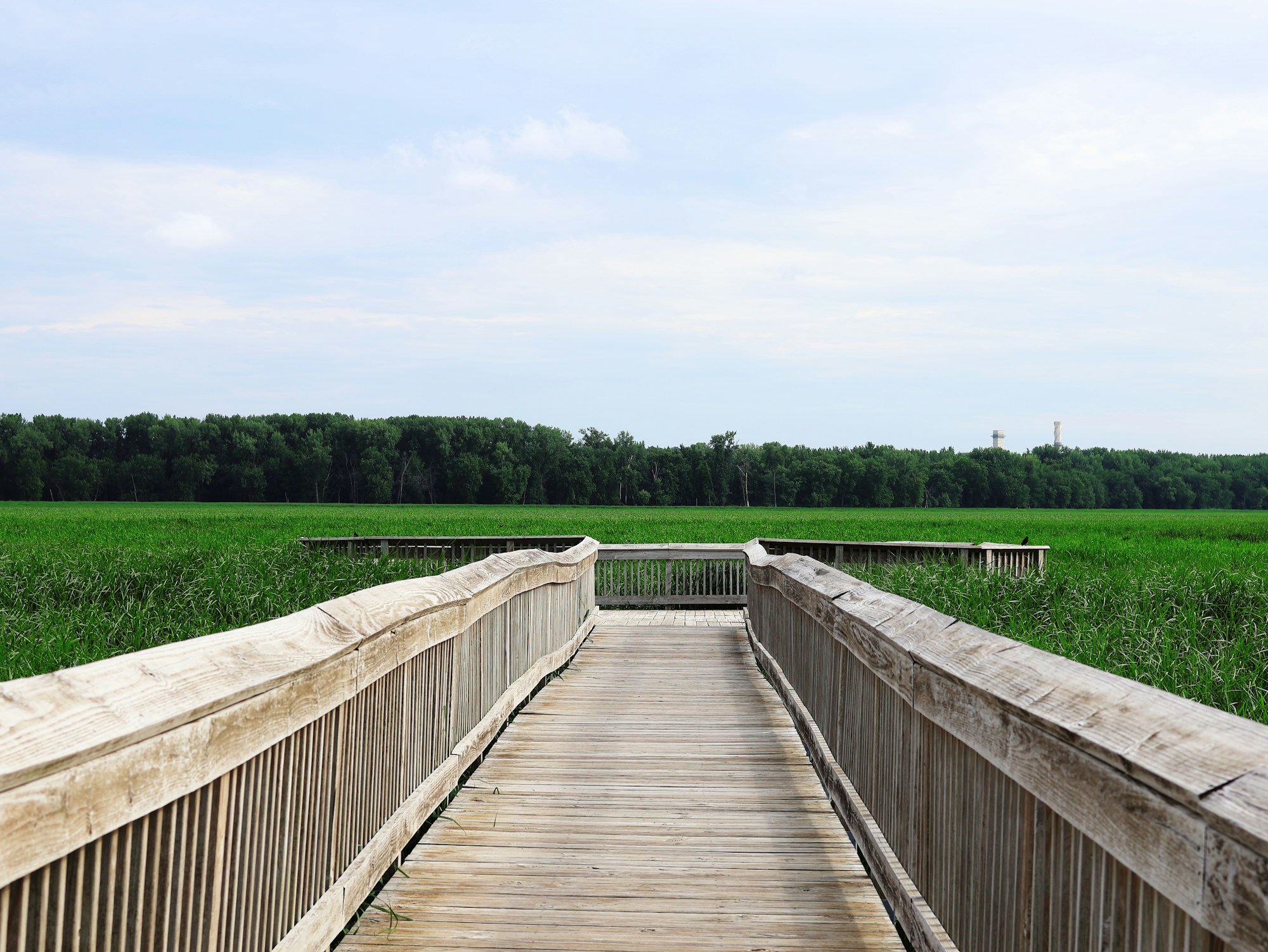
Several official platforms are dotted around the region, cross-referenced by the national park, Zingst’s tourist office and NABU: the Kranorama by the Günzer See, the Tankow platform on Ummanz island (open 24 hours, one of the most spectacular spots), the Zingster Stromwiesen, Pramort at the tip of the Darß peninsula, and the sheltered Udarser Wiek hide on the reed bed’s edge. Every source agrees on the same rules, summarised by Zingst.de: watch only from the designated trails and platforms, keep your distance, use binoculars rather than approaching directly, and park only in authorised spots.
The best time is still 1.5 hours before sunrise or sunset, when the cranes flock to their roosts for the night. Too much human disturbance can send them circling for a long time before they move on to a quieter site, an expensive waste of energy just before their long flight south. From 7 September to 1 November 2026, access to the Sundische Wiese, a key sector of the national park, is restricted: general access before 3pm, or until dusk with the Nationalpark-Card.
Highlights
- Tankow, on Ummanz island: accessible at any hour
- Pramort: the largest crane roosting site on the Darß
- Udarser Wiek: a sheltered hide, open access at all times
Crane, heron or stork: how to tell them apart
The common crane (Grus grus) is best identified by its bare red forehead patch and its neck held straight out in flight, unlike the grey heron, which folds its neck into a characteristic S-shape, according to La Salamandre. The white stork also flies with its neck extended, which makes the confusion easy: it’s the crane’s trumpeting call, audible for several kilometres, that settles the question most reliably.
An omnivore, the crane spends 40 to 60% of its active time feeding during the autumn stopover, small mammals and insects on the animal side, cereals and acorns on the plant side, to build up the fat reserves it needs for the long haul south. It can fly up to 2,000km at a stretch in good conditions, even though typical daily legs range from 10 to 100km.
A bird loaded with symbolism, from ancient Greece to Japan
The crane carries an unusually rich symbolic weight for a wading bird. To the Greeks and Romans, it embodied vigilance: legend has it that it carried a small stone in its beak so as not to give away its position with its cries over the Taurus mountains. In Rome, the motif of a crane holding a stone in its claw, to wake itself if it dozed off, still decorates crests and façades. In China, it symbolises longevity and wisdom; in Japan, folding a thousand origami cranes (senbazuru) is said to grant a wish, and the red-crowned crane appears on the back of the 1,000-yen note.
In Germany, contrary to popular belief, the crane isn’t the heraldic animal of Mecklenburg-Western Pomerania, whose coat of arms combines a bull’s head, a griffin and an eagle. It was, however, named « Bird of the Year » in 1978, when only around 800 breeding pairs remained in the country. Its recovery since then, to around 11,000-12,000 pairs today according to NABU, makes it a textbook conservation success story, though Dr Günter Nowald, who now heads Kranichschutz Deutschland, tempers that optimistic narrative: breeding success appears to be declining, with 80% of monitored pairs failing to raise young in recent years, up from 60% a decade ago.
Coexistence remains a live issue too. Classed as sensitive to wind energy, the crane requires a recommended minimum distance of 3,000 metres between wind farms and regular roosts, a point of friction in a district as windy as Vorpommern-Greifswald. On the farming side, the region has replaced direct compensation for crop damage with a diversion-feeding scheme, funded by Kranichschutz Deutschland and regional authorities. Unlike some other migratory waders still hunted in France, the common crane remains a strictly protected species across the whole European Union, and, for scale, Britain’s entire population, rebuilt from scratch by the RSPB and WWT’s Great Crane Project in Somerset since 2009, still numbers only around 250 birds nationwide. A single dusk roost in the Bodden can outnumber it many times over.
If this kind of natural spectacle appeals to you, puffin nesting season in Iceland and Scotland is another highlight, this time in spring.
Practical info for planning your trip
Stay reachable to confirm a last-minute excursion or check the local forecast, without worrying about roaming charges in Germany.
From €4.50 for 1GBAn early-morning walk out to an isolated platform, sometimes several kilometres from the car park, is a good reason for cover that includes outdoor activities.
From $56 / 4 weeksFrequently asked questions
When can you see the cranes in Pomerania in 2026?
The autumn stopover generally runs from early September to early November, with a peak usually falling between mid-October and late October. The Woche des Kranichs, which celebrates the arrival of the Scandinavian and Baltic contingents, runs from 20 to 27 September 2026, according to kraniche.de.
How many cranes can you expect to see in 2026?
Up to 90,000 in some years, according to the national park, with a measured record of 86,000 birds in 2019-2020 from LPO Champagne-Ardenne. After the autumn 2025 avian flu outbreak, which killed more than 18,000 cranes in Germany alone, 2026 numbers remain uncertain, though no cancellation of the event has been announced.
Does the Groß Mohrdorf information centre still exist?
No. It closed on 1 August 2025 after almost thirty years in operation. It has been replaced by the new KRANICHWELTEN centre in Günz, which opened on 6 September 2025.
Where can you watch the cranes without disturbing them?
From the official platforms only: the Kranorama near Günz, Tankow on Ummanz island, the Zingster Stromwiesen, Pramort, or the Udarser Wiek hide, keeping your distance and staying out of the fields, following the recommendations of Zingst.de.
Do UK citizens need a visa?
No visa is needed for stays of up to 90 days in any 180-day period. You’ll need a passport valid for at least three months beyond your departure date and issued within the last 10 years, according to gov.uk. Since April 2026, the EU’s Entry/Exit System (EES) records fingerprints and a photo on your first crossing. ETIAS, the EU’s pre-travel authorisation, will eventually apply to UK travellers too, but it’s still not in force as of 2026.
How much does a boat excursion to see the cranes cost?
Between €22 and €32 per adult depending on the package for the 2026 season, with departures from Zingst, Prerow, Barth or Stralsund, according to Reederei Poschke. These excursions are booked directly with the local operators; they aren’t listed on international platforms.
How do you tell a crane apart from a heron or a stork?
In flight, the crane holds its neck straight out in front, like the stork, while the heron folds its into an S-shape, according to La Salamandre. Its trumpeting call, audible for several kilometres, remains the most reliable way to tell.
How do you get there without a car from the UK?
By train, via Brussels and Berlin, then on to Stralsund, for a total journey of around 13 to 15 hours from London. The Berlin-Stralsund leg takes 2.5 to 3 hours, from €11 on a Deutsche Bahn promotional fare, and regional buses (lines 210, 305 or 38 depending on your destination) then take over.
- Kraniche.de: official programme of the 2026 Woche des Kranichs
- Nationalpark Vorpommersche Boddenlandschaft: official FAQ, figures and access restrictions
- LPO Champagne-Ardenne: scientific monitoring of the Rügen-Bock stopover, 2019-2020 record
- Kraniche.de: mortality bulletin from the avian flu outbreak, November 2025
- CDC Emerging Infectious Diseases: scientific study on H5N1 in common cranes, May 2026
- Friedrich-Loeffler-Institut: official confirmation of the outbreak in cranes
- NABU: presentation of the new KRANICHWELTEN centre in Günz
- Reederei Poschke: boat excursion prices and timetables, 2026 season
- Zingst.de: viewing points and behaviour guidelines
- La Salamandre: how to identify a crane in flight
- Darss-Halbinsel.de: 2025 edition programme, for comparison
- gov.uk: UK entry requirements for Germany (passport, EES, ETIAS status)
- Trainline: London-Stralsund route and journey times
- RSPB: the UK’s common crane population and the Great Crane Project
- Nationalpark Unteres Odertal: Kranichtage dates, a separate event on the Oder
Research conducted on 31 August 2026.

Plan your trip with Pixidia
Pixidia learns how you travel and helps you build a trip that truly fits you and everyone coming along.
Open the planner
Getting to Pomerania, and how long to stay
There’s no direct train from London to Stralsund either: journey planners like Trainline put the fastest options at around 13 hours 40 minutes with two changes, typically via Brussels and on through Germany. Since March 2026, the new European Sleeper night train has simplified the middle leg: change at Brussels, reachable from London via Eurostar in around two hours, onto the direct overnight service to Berlin. The Berlin-Stralsund leg then takes 2.5 to 3 hours, from €11 on a Deutsche Bahn promotional fare. To plan the whole trip on a sensible budget, our 2026 Interrail guide covers the passes and connections that are useful for this part of Germany. By car, head for the A19 motorway to Rostock, then the B105 towards Stralsund, coming off towards Barth for Zingst and the Darß.
One thing many guides still haven’t corrected: the historic Sassnitz-Trelleborg ferry to Sweden, running since 1909, was permanently withdrawn on 30 September 2024 by operator FRS Baltic. The alternatives now run via Rostock-Trelleborg or Travemünde-Malmö. As for the weather, expect a damp sub-oceanic autumn, averaging around 14.5°C in October, with rain more frequent than in summer: pack warm, waterproof layers.
Allow at least two days for a taste of Rügen, Germany’s largest island and the most visited in the Baltic, with the UNESCO-listed chalk cliffs of the Jasmund. Two to four days allow for a comfortable visit, and up to six to eight days let you combine Rügen with the car-free island of Hiddensee and Usedom. Book your accommodation ahead: autumn, when the deer rut is also under way in this same national park, is a busy local season.
Highlights