
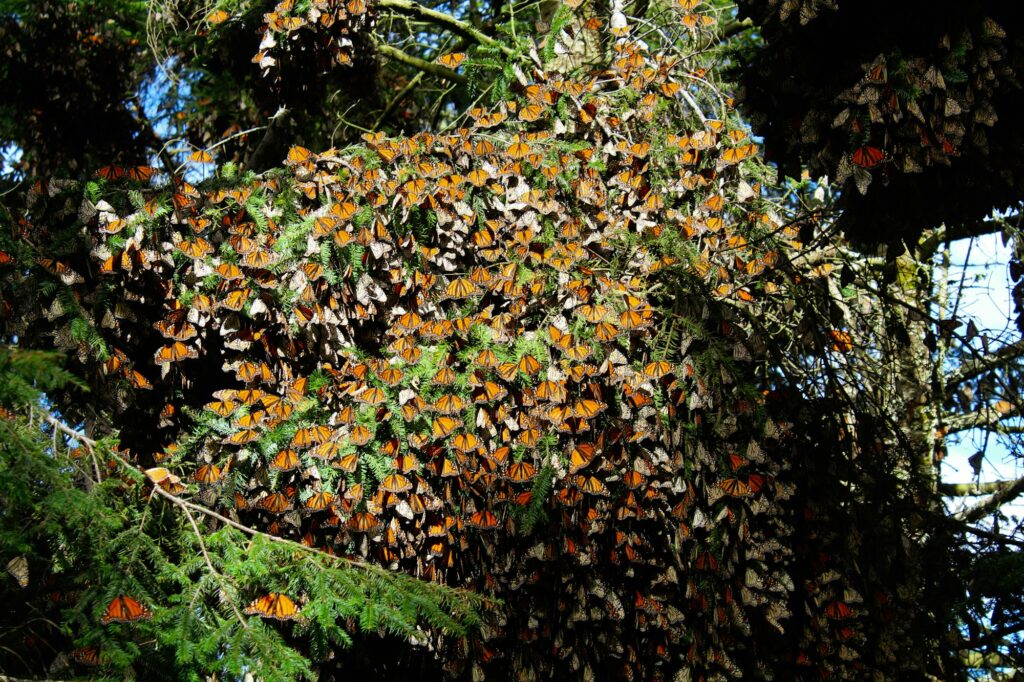
The sanctuaries opened on 21 or 22 November 2025 and closed on 31 March 2026, and no 2026-2027 dates had been published as of 15 October 2026. Five were listed as open: three in Michoacán and two in the State of Mexico. Canada and the UK advise against non-essential travel to Michoacán, except Morelia and Pátzcuaro.
Checked on against the official sources cited (FCDO, Government of Canada); 2025-2026 dates and prices come from the press and are not confirmed by an official source.
Monarch butterflies covered 2.93 hectares in 2025-2026: 64% more than the previous season (1.79 ha), and above the ten-year average of 2.81 ha. No dates have been published for the 2026-2027 season. This guide covers the sanctuaries, the fees we could verify and the travel advisories that apply to Michoacán.
1. A season measured in hectares
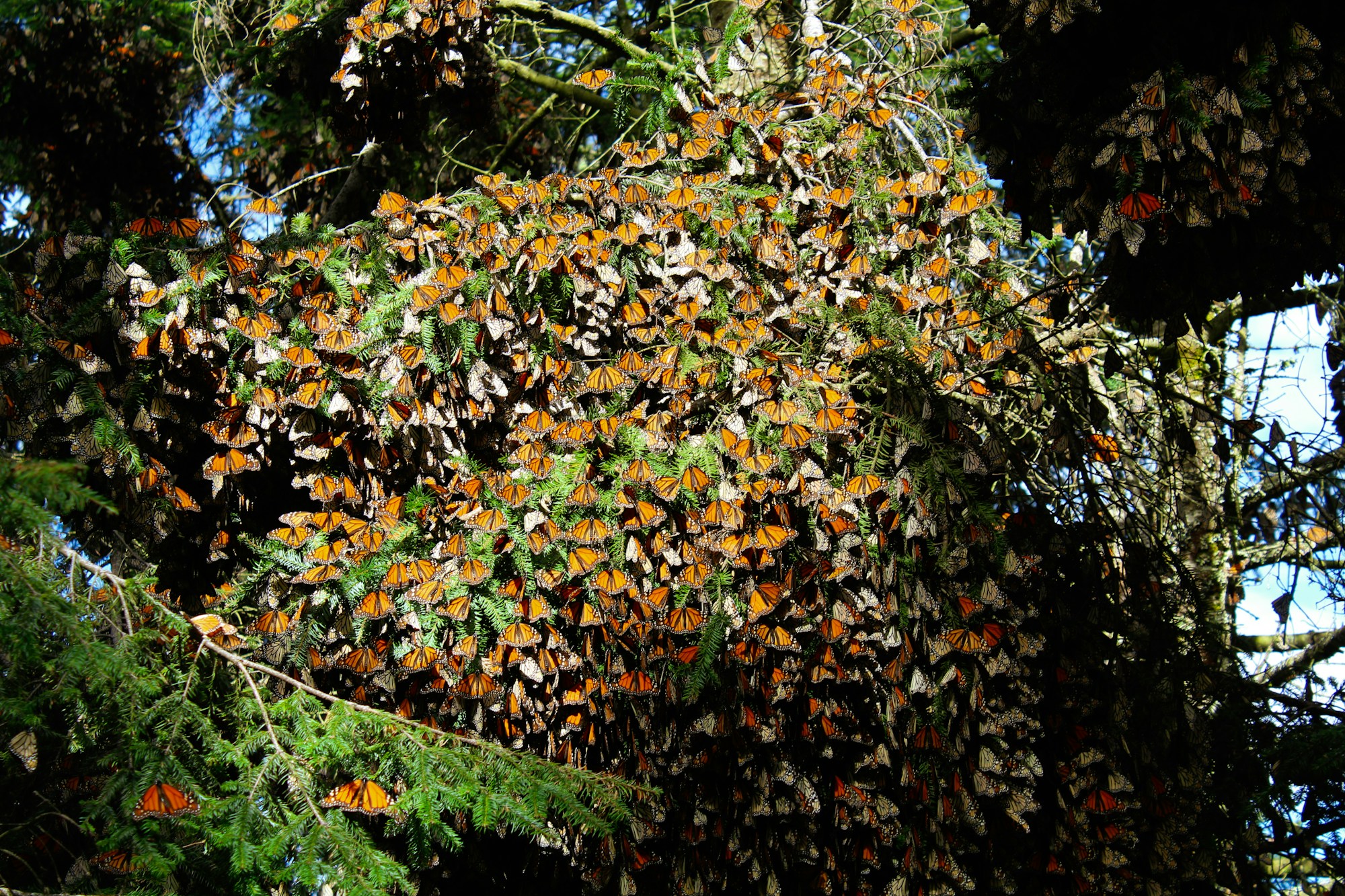
Each winter, monarchs from eastern North America fly to the oyamel fir forests (Abies religiosa) in the mountains of central Mexico. They form dense clusters on trunks and branches. Scientists don’t count butterflies one by one: they measure the area the colonies cover, in hectares. This is the indicator that eButterfly and Monarch Conservation publish each season.
For 2025-2026, a joint announcement from the WWF-Fundación Telmex Telcel alliance, CONANP, UNAM and the Reserve, dated 17 March 2026, gives 2.93 hectares, 64% more than in 2024-2025 (1.79 ha). Nine colonies were counted: three in Michoacán and six in the State of Mexico. According to eButterfly, the area splits into 2.271 hectares inside the reserve and 0.661 hectare outside it. We could not read the original announcement: the figure comes from the relays of these organisations.
Previous seasons give this figure its weight. In 2023-2024 the area was only 0.90 hectare, the second-worst season since 1993 according to a WWF press summary. The all-time peak was in 1996-1997, at 18.19 hectares, against a low of 0.67 hectare in 2013-2014 (eButterfly). The ten-year average is 2.81 hectares, according to Monarch Conservation.
| Season | Area (ha) | Change | Reading |
|---|---|---|---|
| 1996-1997 | 18.19 | all-time peak | eButterfly |
| 2013-2014 | 0.67 | all-time low | eButterfly |
| 2022-2023 | 2.21 | baseline | WWF press summary, February 2024 |
| 2023-2024 | 0.90 | -59% | second-worst season since 1993 |
| 2024-2025 | 1.79 | +99% year on year | below the ten-year average |
| 2025-2026 | 2.93 | +64% | above the ten-year average (2.81 ha) |
Source: eButterfly, 2025-2026 season and Monarch Conservation, 2025-2026 population, checked on 15 October 2026. The 2022-2023 and 2023-2024 rows come from WWF press summaries.
Monarch Conservation estimates an average density of about 21 million butterflies per hectare. That is the authors’ estimate, and it varies from year to year: it does not replace a count. Multiplied by the 2025-2026 area, it gives an order of magnitude of around sixty million butterflies. Consumer guides sometimes quote « 100 to 200 million » without a source: that figure is not the one from scientific monitoring.
2. The open sanctuaries, and El Rosario as the most accessible site
Five sanctuaries were listed as open for the 2025-2026 season, according to a list published by UnoTV on 25 November 2025. Three are in Michoacán and two in the State of Mexico. This list comes from a media outlet, not from an official announcement, and sources disagree on one of the five names.
El Rosario and Sierra Chincua, near Angangueo
El Rosario is the most cited and most accessible sanctuary in the sources we read. It sits near the village of Angangueo, whose altitude is 2,579 metres according to the Pueblos de América locality profile. The walk to the colony takes about 30 to 40 minutes, according to Tus Buenas Noticias and Brooke Beyond. The opening hours listed are 8 am to 5 pm, every day (UnoTV).
Highlights
- A short walk to the colony, on marked trails.
- About two hours’ drive from Morelia (Rome2Rio, an aggregator not checked with operators).
- Local guides are present at the entrance. The sources don’t settle whether they are mandatory: check on site.
If you spend a night in Morelia before or after the drive to the sanctuaries, the walking tour of the historic centre fills a morning without leaving the city. It is sold on Viator with a certified tour guide, and the product page includes no stop outside Morelia.
The five sanctuaries listed as open are shown below. Fees and statuses are for the 2025-2026 season: reconfirm them before you go.
| Sanctuary | State, municipality | Adult fee | 2025-2026 status |
|---|---|---|---|
| El Rosario | Michoacán, Ocampo (near Angangueo) | 150 MXN | open (UnoTV, Tus Buenas Noticias) |
| Sierra Chincua | Michoacán, Angangueo | 150 MXN | open (UnoTV) |
| Senguio | Michoacán, Senguio | 150 MXN | open (UnoTV); access to be checked |
| Piedra Herrada | State of Mexico | not verified (50 MXN on an old page) | open (UnoTV) |
| San Mateo Almomoloa or La Mesa | State of Mexico | 80 MXN from age 13 (La Mesa, ADN40) | open; list differs across media |
Source: UnoTV, 25 November 2025, ADN40, 27 November 2025 and Tus Buenas Noticias, 28 November 2025, checked on 15 October 2026. Cerro Pelón and El Capulín, cited by some online guides, are not in this list of five sites.
The sites in the State of Mexico do not appear in the Michoacán travel advisory, and the advisories we read do not classify them. Check the general Mexico advice before you choose a site in that region.
3. The 2026-2027 season: what is projected, and what is not
As of 15 October 2026, no official dates had been published for the 2026-2027 season. The dates below are therefore projections based on past seasons. They are not announcements, and they may change.
The known markers are as follows. The 2025-2026 season opened on 21 or 22 November 2025 and closed on 31 March 2026 (one source says 30 March). The opening ceremony is dated 21 November, but UnoTV and Tus Buenas Noticias give 22 November. An old page gives 16 November as the opening date, with no publication date. In 2025, arrivals were delayed by the weather, according to a Mexico News Daily summary.
Projection: an opening between 15 and 30 November 2026, and a closing around 31 March 2027, are consistent with past seasons. An early arrival of the first monarchs in October 2026 could not be confirmed, so we do not present it as fact.
When to go: January and February, on weekdays if you can
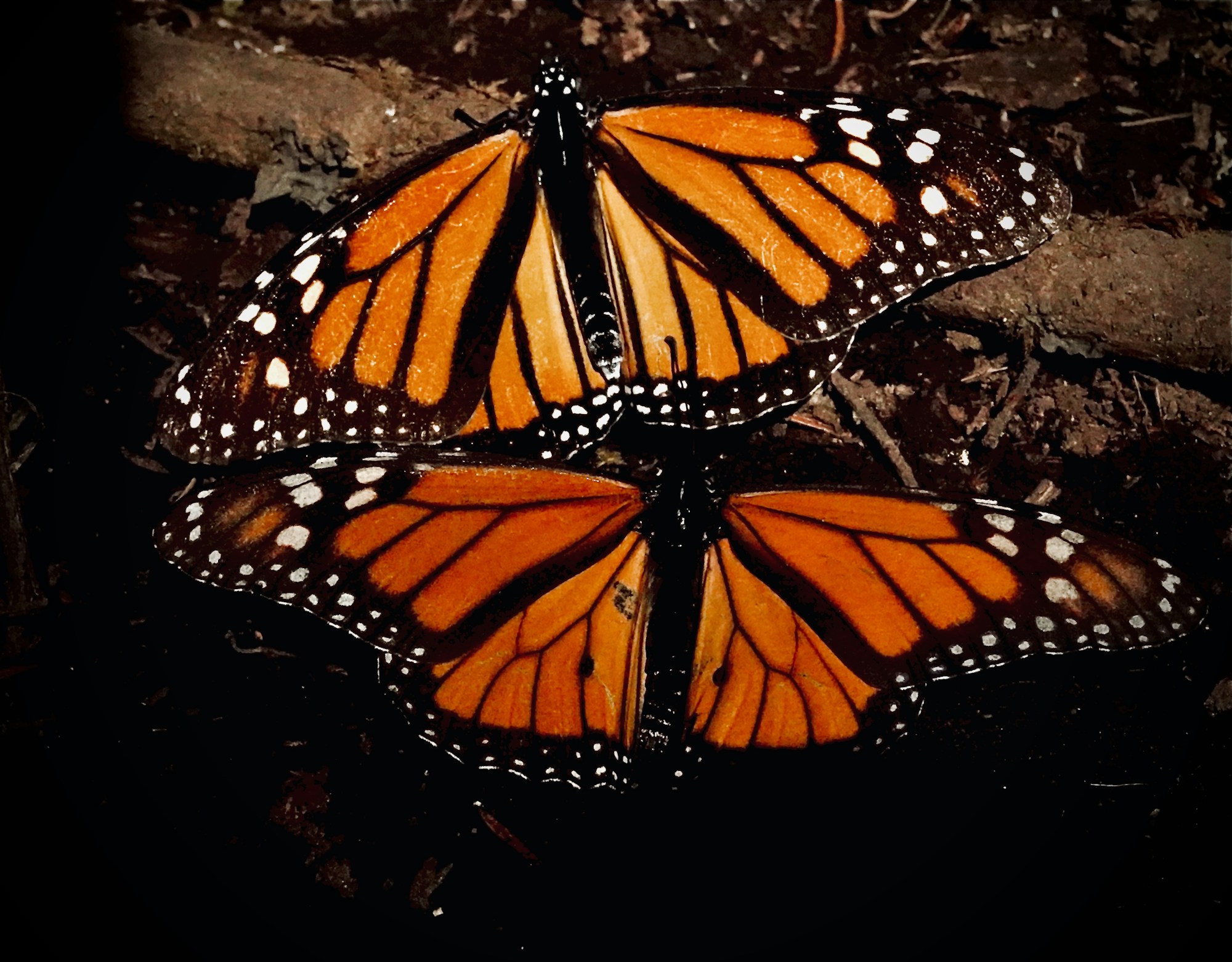
January and February are the months most cited by the guides we read (Tus Buenas Noticias, Brooke Beyond, Meltour), and Altiplano Voyage recommends February and March. Visibility is best between 11 am and 3 pm on sunny days. In cold, cloudy or windy weather the butterflies stay clustered and hard to see, so plan a spare day.
Arrive between 10 and 11 am if you can. Crowds increase noticeably after 2 pm, and weekends are busier than weekdays (Brooke Beyond, 2022, page updated in 2024). These tips come from guides, not from official visitor figures.
Climate data for the site is easier to read in numbers. The figures below come from a model, not from a weather station, and should be read as rough orders of magnitude.
| Month | Average maximum temperature | Average minimum temperature | Average precipitation |
|---|---|---|---|
| November | 13.1 °C | 1.3 °C | 37 mm |
| December | 12.3 °C | -0.2 °C | 19 mm |
| January | 11.6 °C | -1.0 °C | 22 mm |
| February | 13.5 °C | 0.0 °C | 34 mm |
| March | 15.3 °C | 1.0 °C | 29 mm |
Source: Open-Meteo, archive 2010-2025, checked on 15 October 2026. Reference point 19.6° N, 100.25° W, model elevation 3,495 m: the model sits higher than the sanctuaries, so actual temperatures on site are probably a little milder.
4. Budget and how a day runs
The budget depends mostly on getting there. From Morelia, a car or taxi to Angangueo takes about two hours, according to Rome2Rio (an aggregator not checked with operators). There is no direct bus to the village: the bus runs to Las Grutas in about 2 h 43 min for 200 to 250 MXN according to Rome2Rio, and then you need a taxi. The sanctuaries are isolated, and according to Frommer’s (undated page) a return taxi is not guaranteed. This is the first thing to plan.
| Item | Amount found | Source and date | Status |
|---|---|---|---|
| Adult entry, El Rosario or Sierra Chincua | 150 MXN | ADN40 (27 November 2025, updated 10 July 2026); Tus Buenas Noticias (28 November 2025) | press report, to be confirmed for 2026-2027 |
| Child entry | 100 MXN | same sources | press report, to be confirmed for 2026-2027 |
| Horse, one way or return | 150 to 350 MXN | undated blog; undated page | conflicting, undated for 2026 |
| Local guide | no rate found | no rate recorded | to be negotiated on site |
Source: fees checked on 15 October 2026 on the pages cited in the Sources section. Peso amounts come from the press and are not converted into another currency.
A possible day from Morelia
- Leave Morelia early in the morning. The drive takes about two hours (Rome2Rio, not checked), and a return taxi is not guaranteed: book one in advance.
- Arrive at the sanctuary between 10 and 11 am. The path is soft earth. Several visitors slipped on it, according to Brooke Beyond: wear closed shoes and bring a walking stick if you need one.
- Between 11 am and 3 pm, the visibility window. The butterflies become active when the sun warms the trunks. This is when the clusters move.
- Late in the day, head back to Morelia. Leave a margin for the road, and for a possible postponement if conditions worsen.
For a self-guided visit, budget for the return transport, the 150 MXN entry fee, a guide if you take one (no rate recorded) and a horse if you want one (150 to 350 MXN). We do not calculate a total: no taxi fare was recorded in the sources. If you extend your stay in Mexico, our Mexico 2026 itinerary from Mexico City to Oaxaca covers another part of the country, and the road trip from Oaxaca to Puebla and Teotihuacán combines culture and nature.
5. Safety in Michoacán: what to check before you go
This point is not a side issue. Three of the five sanctuaries listed as open for 2025-2026 are in Michoacán, and several governments advise against non-essential travel there. The advisories below are current as of the date we checked them: they can change from one day to the next, so reread them on the day you leave.
| Source | Position for Michoacán | Last updated |
|---|---|---|
| FCDO, United Kingdom | non-essential travel advised against, except Morelia, Pátzcuaro and certain listed roads | page with no visible date, checked 15 October 2026 |
| Government of Canada | avoid all non-essential travel, except Morelia and Pátzcuaro | updated 14 October 2026 |
| United States, press relays | level 4 « do not travel » reported, to be reconfirmed on travel.state.gov (page unavailable when checked) | N+ article of 3 August 2026, updated 6 August 2026 |
| France Diplomatie | state-by-state advice not checked in the extract we read; cyclone alert on the Michoacán coast | last updated 9 October 2026 |
Source: FCDO, Mexico, regional risks, Government of Canada, Mexico, N+, security alert of 3 August 2026 and France Diplomatie, Mexico, checked on 15 October 2026.
In August 2026, the Mexican press relayed the US embassy alert: road blockades in Morelia (Libramiento), Los Reyes and Peribán, criminal activity and a risk of escalation. Angangueo and the road to the sanctuaries are not named in the alert. It advises avoiding areas of police operations and crowds, enrolling in the STEP programme and following local media.
The FCDO also excludes certain roads in Michoacán: 15D, 126, 43, 48D and 14D. If your route to the sanctuaries uses one of them, the exemption applies to that stretch only. Check the route on the FCDO page before you travel.
Pixidia tip: on the day you leave, ask your accommodation and your operator about road conditions. Keep a backup plan, such as postponing by a day if the road is blocked. Don’t rely on a list of open sanctuaries without cross-checking it against these advisories.
Rules on site
The sources agree on the essentials. Flash is banned, and so are drones, and visitors are asked to keep quiet (Tus Buenas Noticias, 28 November 2025). Do not touch the butterflies or the branches they land on. Stay on the marked trail. Alcohol, weapons, pets and fire are prohibited, and taking a butterfly or a plant out of the reserve is forbidden (Mexicodesconocido, undated page). The 18-minute time limit on site, cited on an undated page, is not confirmed by any official text: do not present it as a rule.
Altitude and fitness
The colonies sit at about 3,000 metres according to David Suzuki (2018 article), and at 3,200 metres according to Brooke Beyond (2022). Angangueo, the village next to the sanctuaries, is at 2,579 metres according to the Pueblos de América profile. Symptoms of altitude sickness, such as headaches, fatigue or nausea, can appear above 2,500 metres, according to Aetna International (secondary source). We could not consult the CDC for this threshold.
This article does not give medical advice: see a doctor or a travel health service before you leave if you are concerned.
What other guides don’t tell you
Four points missing from the guides we read for this article, with their source and the date we checked it.
- Travel advisories for Michoacán. The guides we read don’t mention them. The FCDO and the Government of Canada advise against non-essential travel in the state, except Morelia and Pátzcuaro (FCDO, checked 15 October 2026; Government of Canada, updated 14 October 2026).
- The 2025-2026 population in hectares. Guides quote « 100 to 200 million » butterflies without a source. The alliance announcement of 17 March 2026 gives 2.93 hectares, up 64%, with nine colonies, relayed by eButterfly (checked 15 October 2026).
- The 2025-2026 status of some sanctuaries. Some guides present Cerro Pelón and El Capulín as open. The list published at the opening by UnoTV (25 November 2025, checked 15 October 2026) names only five sites, without these two. Press source, to be reconfirmed.
- The recent entrance fee. The guides we read give 80 MXN (Brooke Beyond, 2022) or 50 MXN (undated page). The press reports 150 MXN for an adult and 100 MXN for a child in 2025-2026 (ADN40, 27 November 2025, updated 10 July 2026, checked 15 October 2026). Press source, to be confirmed for 2026-2027.
Practical information before you go
Two points follow from the sources we read. The US alert from August 2026 recommends following local media, which means having a mobile connection. And 2025-2026 fees and hours do not guarantee those for 2026-2027: check them the day before.
A mobile connection from the moment you land, to follow advisories, call a taxi and find your accommodation. Plans by duration and country.
Plans by duration, prices shown on the siteBefore you buy, check that the policy does not exclude the areas advised against by Canada or the UK (see section 5).
Prices by duration and age, shown at sign-upFrequently asked questions
When can you see monarch butterflies in Mexico?
The season usually opens in late November and ends in late March. In 2025-2026, the sanctuaries opened on 21 or 22 November 2025 and closed on 31 March 2026 (one source says 30 March), according to UnoTV. January and February are the most cited months for a visit. The 2026-2027 dates had not been published as of 15 October 2026: check the official announcement before you book.
Which sanctuaries should you visit, and which are open in 2026-2027?
For 2025-2026, UnoTV lists five open sites: El Rosario, Senguio and Sierra Chincua in Michoacán (three sites), and Piedra Herrada and San Mateo Almomoloa in the State of Mexico (two sites). Another list names La Mesa instead of San Mateo Almomoloa. Cerro Pelón and El Capulín are not on the UnoTV list, and their status is not established. The 2026-2027 list had not been published as of 15 October 2026.
How much does entry cost, and do you need a guide or a horse?
The press reports 150 MXN for an adult and 100 MXN for a child at El Rosario and Sierra Chincua in 2025-2026, according to ADN40. Local guides wait at the entrance, but the sources disagree on whether a guide is required. Horses are advertised at between 150 and 350 MXN depending on the source, with no verified 2026 price. Fees for 2026-2027 are not known.
Is it dangerous to travel to Michoacán in 2026?
Canada and the UK advise against non-essential travel to Michoacán, except Morelia and Pátzcuaro. Three of the five sanctuaries listed as open are in Michoacán, outside those two cities. The FCDO excludes certain roads (15D, 126, 43, 48D and 14D): check whether your route uses one of them. A US alert from August 2026, relayed by the press, reports road blockades and criminal activity. Check the latest advice on the day you leave.
Do you need to be fit, and what is the altitude risk?
The colonies sit at about 3,000 metres according to David Suzuki (2018), and at 3,200 metres according to Brooke Beyond. The walk in takes 30 to 60 minutes depending on the sanctuary and your pace, according to the guides we read. This article does not give medical advice: see a doctor or a travel health service before you leave if you are concerned.
How many butterflies arrived this season?
The 2025-2026 season covers 2.93 hectares of forest, 64% more than the previous year, according to the alliance announcement of 17 March 2026 relayed by eButterfly. The butterflies are not counted one by one: an estimated density of about 21 million per hectare gives an order of magnitude, and should be presented as such. 0.661 hectare was outside the reserve.
Can you go without a guide, from Mexico City or Morelia?
From Morelia, it takes about two hours by car to Angangueo, according to Rome2Rio (an aggregator not checked with operators). No direct bus goes to the village: you take a bus to Las Grutas, then a taxi, and a return taxi from the sanctuaries is not guaranteed. From Mexico City, the sources we read document no journey time or route. The sources do not settle whether a guide is required.
Sources and consultation dates
- FCDO, Mexico, regional risks: UK travel advice, checked 15 October 2026.
- Government of Canada, Mexico: travel advice, updated 14 October 2026.
- France Diplomatie, Mexico: updated 9 October 2026, state-by-state advice not checked.
- eButterfly, 2025-2026 season: area covered, colonies and history, checked 15 October 2026.
- Monarch Conservation, 2025-2026 population: ten-year average and estimated density, checked 15 October 2026.
- Open-Meteo, climate archive: model data for 2010-2025, checked 15 October 2026.
- UnoTV, opening of the 2025-2026 season: list of five sanctuaries, 25 November 2025.
- ADN40, entrance fees: 150 MXN adult, 100 MXN child, 27 November 2025, updated 10 July 2026.
- Tus Buenas Noticias, 2025-2026 guide: sanctuaries, fees and visiting rules, 28 November 2025.
- N+, security alert: relay of the US alert, 3 August 2026, updated 6 August 2026.
- Mexico News Daily, El Rosario: 2025 season summary and arrivals delayed by the weather.
- Brooke Beyond, visiting tips: crowd levels, walk and gear, 2022 page updated in 2024.
- David Suzuki, searching for monarch sanctuaries: colony altitude, 2018 article.
- Frommer’s, day trips from Morelia: return taxi not guaranteed from the sanctuaries, undated page.
- Rome2Rio, Morelia to Angangueo: travel time and transport options, aggregator not checked.
- Pueblos de América, Angangueo: village altitude, locality profile.
- Aetna International, Mexico health guide: altitude sickness, secondary source.
Consultation dates: 15 October 2026 for all sources, unless stated otherwise.

Plan your trip with Pixidia
Pixidia learns how you travel and helps you build a trip that truly fits you and everyone coming along.
Open the planner