
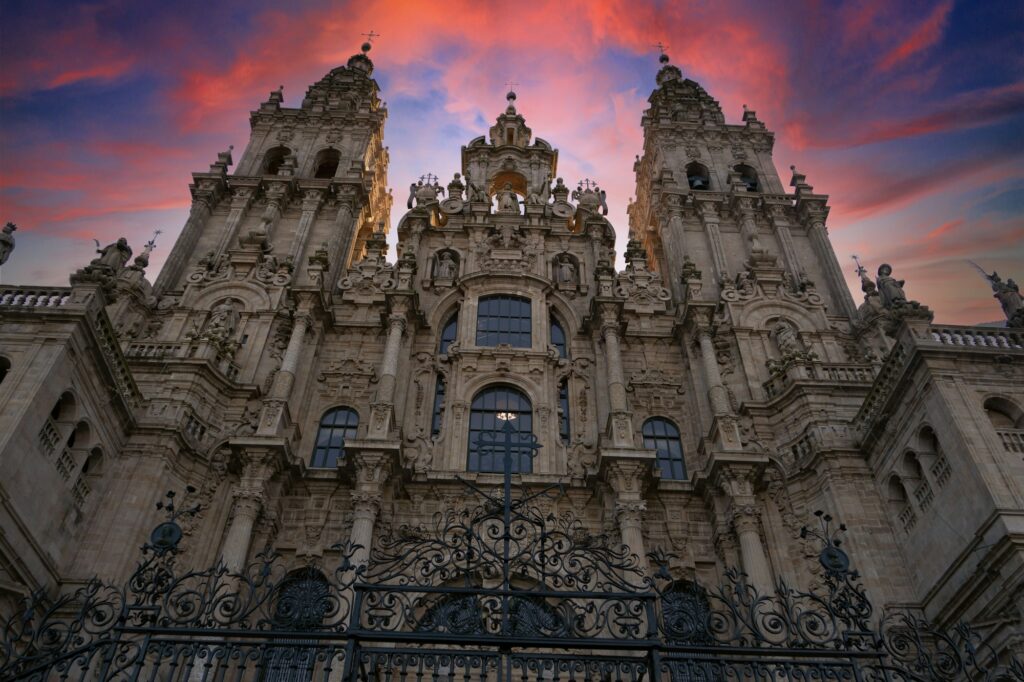
On 31 December 2026, around noon, according to the cathedral’s announcement of 24 September 2026. That’s no longer the usual 5 pm time. The Holy Door only opens during Holy Years: the 2027 one is due to end on 31 December 2027 according to guides, with no official announcement as of the date checked.
Checked on against the official sources cited (cathedral, Oficina del Peregrino, European Commission) and the press of 24 September 2026.
On 31 December 2026, the cathedral of Santiago de Compostela opens its Holy Door, and the 2027 Holy Year begins. This opening is not a typical end-of-year ceremony. Xacobeo is the Compostelan Holy Year, which returns when 25 July, the feast of Saint James, falls on a Sunday. The door stays walled up the rest of the time, and its opening starts a year in which the plenary indulgence is available to pilgrims who meet the published conditions.
Short answers: the Door opens around noon on 31 December 2026, according to the announcement of 24 September 2026. Entry to the cathedral and the Compostela are free. For visa-exempt nationalities, the stay without a visa is 90 days in any 180, and the EES entry system has been running since 10 April 2026. The details, with the date of each source, follow.
1. The Holy Door, at the back of the cathedral
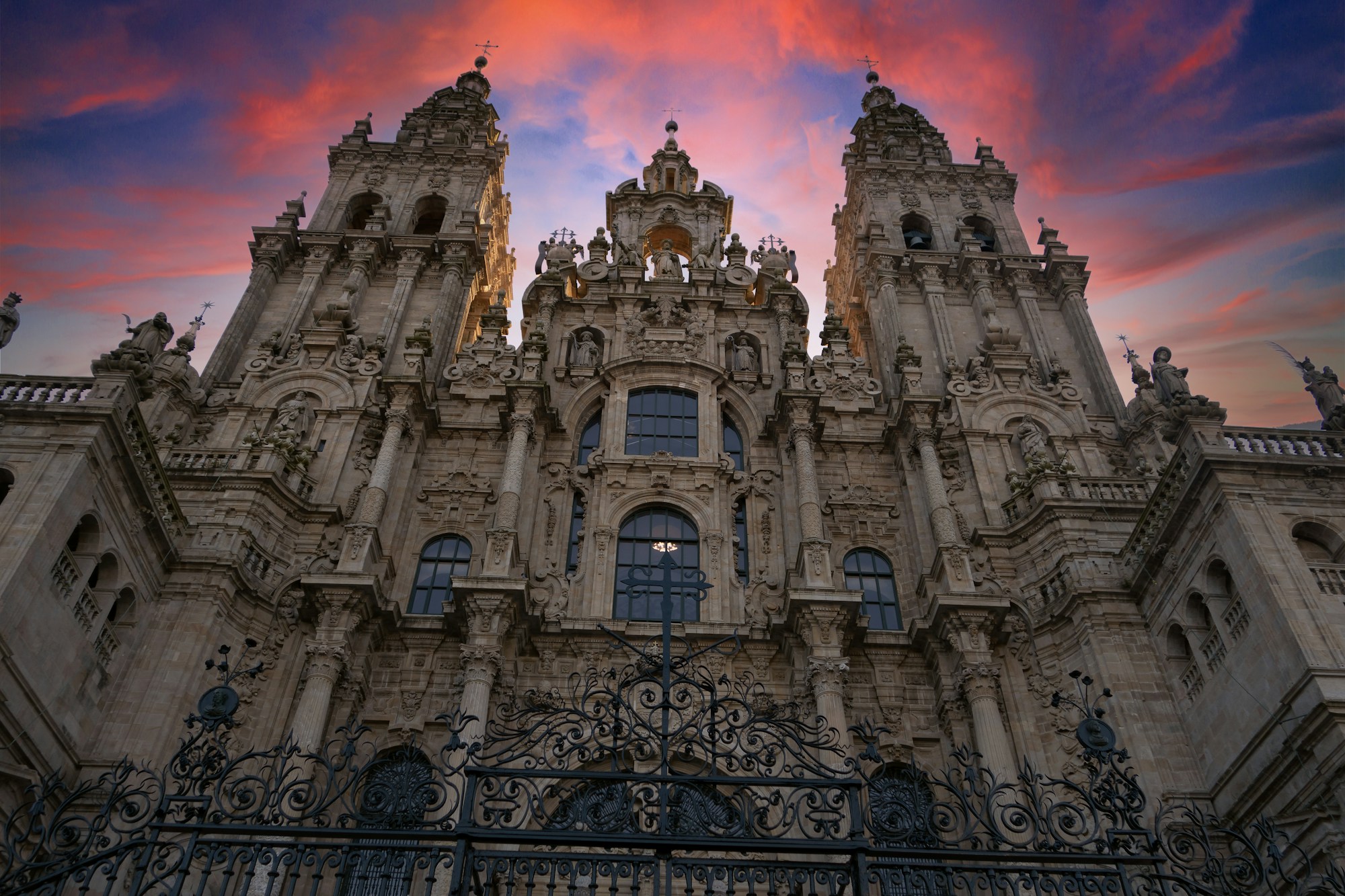
Praza da Quintana: where the Door is
The Holy Door, or Puerta Santa, is on the Praza da Quintana, at the back of the building. It isn’t on the monumental façade of the Praza do Obradoiro, which is what most visitors photograph first. The cathedral points this out on its visitor page: the door only opens during Holy Years, and it stays walled up the rest of the time.
For a guided visit, a tour of the cathedral, the museum and the old town is offered on Viator. Check the available dates when you book.
What happens on 31 December
- The ceremony follows the usual ritual: the archbishop strikes the wall blocking the door three times with a silver hammer, and then the passage is opened to the public. The full official programme is not yet published.
- A jubilee horn could sound to announce the Holy Year, provided it can still be played. The announcement is conditional.
- The door stays open for the whole Holy Year, which is due to end on 31 December 2027 according to guides, with no official announcement as of the date checked.
2. Opening time: noon announced, instead of 5 pm
Older guides give a late-afternoon opening. One French-language online guide says « around 4:30 to 5 pm, according to the press », with no source named. It is now out of date. On 24 September 2026, the cathedral’s dean, Manuel Jesús Formoso, presented the Jubilee Year at San Martín Pinario and announced an opening « en torno a las 12.00 horas, en lugar de las 17.00 horas habituales » (« around 12.00, instead of the usual 17.00 »). The daily El Correo Gallego and the radio station COPE reported the statement the same day. No published reason explains the change, and the official programme isn’t out yet: read the time as an announcement, not a fixed opening time.
| Source | Time given | Status | Publication date |
|---|---|---|---|
| Cathedral dean, reported by El Correo Gallego | Around 12 noon | Announced, official programme not yet published | 24 September 2026 |
| COPE Santiago | Noon (« a mediodía ») | Announced, same statement | 24 September 2026 |
| French-language online guide (Camino de Santiago) | 4:30 to 5 pm « according to the press » | Source not named, predates the announcement | Undated |
| Usual cathedral time | 5 pm | Replaced for 2026 according to the announcement | Not applicable |
Source: El Correo Gallego, 24 September 2026 and COPE Santiago, 24 September 2026, checked on 23 October 2026.
So what should you do with this time? If you want to see the opening, get to the Praza da Quintana before noon, allowing time for the crowds. If you’re only coming for the ceremony, check the official programme a few days before you leave, as the announced time may still be refined. Cathedral opening hours are on the official page, but the cathedral doesn’t admit visitors during services: to see the tomb, go in before the ceremony.
3. The Holy Year calendar, from 31 December 2026 to 31 December 2027
A Compostelan Holy Year happens when 25 July, the feast of Saint James, falls on a Sunday. That’s the case in 2027: 25 July 2027 is a Sunday, as the calendar confirms. The most recent Holy Years were 2010 and 2021, the latter extended into 2022. So 2027 isn’t a new kind of exceptional year: it’s the regular one in this cycle. Secondary sources give the next one as 2032.
| Date | Event | Status | Source |
|---|---|---|---|
| 31 December 2026 | Holy Door opens, around noon | Announced by the cathedral | COPE and El Correo Gallego, 24 September 2026 |
| 1 January 2027 | Oficina del Peregrino closed | Confirmed | Oficina del Peregrino |
| 28 March 2027 | Easter Sunday | Calendar calculation | Calculation |
| 15 to 18 July 2027 | European Youth Pilgrimage (PEJ27) | Announced by the dean | COPE, 24 September 2026 |
| 25 July 2027 | Feast of Saint James, falling on a Sunday | Calculation and matching sources | Camino de Santiago 20 |
| 31 December 2027 | End of the Holy Year | According to guides, no official announcement | Planning guides |
Source: Cathedral of Santiago, Oficina del Peregrino, COPE Santiago, checked on 23 October 2026.
The 2027 programme isn’t published yet. The Xunta de Galicia said it would present a wider programme before the end of 2026, with no specific date. For 25 July, several planning pages mention a solemn Mass, the King’s offering, the botafumeiro and fireworks. These still need confirming against the official programme. The botafumeiro, the giant censer, is described as swung at major feasts, but one pilgrimage site reports internal works that keep it out of sight until further notice. So we aren’t quoting any swing schedule for 2027.
A papal visit isn’t confirmed as of the date checked, so don’t plan a trip around one (details in the FAQ). If you’re combining this with other pilgrimages, our overview of European Christian pilgrimages in 2026 compares the shrines.
4. Compostela and indulgence: two documents, two conditions
Many readers mix the two up. The Compostela is the certificate issued by the Oficina del Peregrino to anyone who has completed the pilgrimage. The plenary indulgence is a spiritual grace linked to visiting the cathedral during the Holy Year. The conditions published by the Oficina don’t mention any distance: the Compostela does.
| Document | Condition | Where and how | Cost |
|---|---|---|---|
| Compostela | At least 100 km on foot or on horseback, 200 km by bike, or 100 nautical miles | Oficina del Peregrino, on presentation of the credencial, with a QR ticket | Free |
| Plenary indulgence | Visit the cathedral, pray the Our Father and the Creed for the Pope’s intentions, confession and communion | One plenary indulgence per day, which can be applied to the dead | No published fee |
| Confession | Possible at the cathedral or anywhere else | Within fifteen days before or after the visit | Not specified |
| Oficina del Peregrino | Every day 9 am to 7 pm, closed 25 December and 1 January | Rúa Carretas, 33, Santiago | Free |
Source: Oficina del Peregrino, Compostela and welcome pages, checked on 23 October 2026.
In practice, if you want your Compostela after a walk, get to the Oficina before late afternoon. In peak periods, same-day issue isn’t guaranteed. Don’t count on 1 January: the Oficina is closed that day, and the day after the Door opens falls exactly on that closure.
For the indulgence, keep two points in mind. First, confession can take place outside the cathedral, within a fifteen-day window around the visit. Second, many guides say the indulgence doesn’t depend on walking, but the Oficina doesn’t state that rule explicitly. For questions of conscience or religious practice, ask your parish or the cathedral’s welcome desk.
5. Budget: what’s free, what’s still unknown
The budget for a visit during the Holy Year splits into three parts. Access to the cathedral is free, and the cathedral’s booking page covers the museum and paid visits, not that access. Paid visits, whose prices aren’t shown on the official pages we read, make up the second part. Accommodation and the tourist tax make up the third: for those, only press reports and guides exist.
| Item | Amount | Status | Source |
|---|---|---|---|
| Compostela | Free | Confirmed | Oficina del Peregrino |
| Access to the Apostle’s tomb | Free, through the Puerta de Platerías | Confirmed | Cathedral, visitor page |
| Cathedral museum | No amount shown on the page we read | Not confirmed | Cathedral, visitor page |
| Pórtico de la Gloria and the roofs | No amount shown on the page we read | Not confirmed | Cathedral, visitor page |
| Tourist tax | €1 to €2.50 per night, for 1 to 5 nights | Press reports, municipal text not read | El Debate, 31 July 2025; Chekin |
| Private albergue Fin del Camino | €15 a night | Private guide rate, 2 August 2026 | alberguescaminosantiago.com |
| Botafumeiro on group request | €450 to €500 | Guide information, not confirmed | Camino de Santiago (in French) |
Source: official pages of the cathedral and the Oficina, press cited, checked on 23 October 2026.
According to the press (El Debate, 31 July 2025; Chekin), Santiago’s tourist tax, in force since 1 October 2025, is €1 to €2.50 per night, for 1 to 5 nights. The municipal text hasn’t been read. Revenue for the first half of 2026 reached €1,141,816.46, according to municipal data reported by El Español (5 August 2026). That figure says nothing about what a visitor will pay. None of the sources we read confirm an exemption for pilgrims.
For accommodation, no official rate data exists for 2027. Commercial sources advise booking early for 15 to 25 July 2027, but they don’t put a figure on that advice.
6. Entering Spain: the 90-day rule, EES and ETIAS
For a national of a country outside the European Union, the European Economic Area or Switzerland, visa-free stays are limited to 90 days in any 180-day period. Spain’s Ministry of Foreign Affairs sets this out on its entry requirements page. Your passport must be valid for at least three months after your planned exit from the Schengen area. The Entry/Exit System (EES) has been fully operational since 10 April 2026: biometric registration now happens at the border.
| Point | Rule | Status | Source |
|---|---|---|---|
| Visa-free stay (non-EU, non-EEA, non-Swiss) | 90 days in any 180-day period | Confirmed | Spanish Ministry of Foreign Affairs |
| Passport | Valid at least 3 months after leaving Schengen | Confirmed | Spanish Ministry of Foreign Affairs |
| EES (border checks) | Operational since 10 April 2026 | Confirmed | European Commission |
| ETIAS | Launch announced for the last quarter of 2026; €20 fee being validated | Not confirmed | Official ETIAS portal |
Source: European Commission ETIAS portal, checked on 23 October 2026.
For ETIAS, check the official site when you book.
7. Getting there: train, plane and on foot
By train. Madrid and Santiago are linked by high-speed train (AVE or Avlo). We haven’t checked a journey time with the operator, and the sample timetables we found on ticket aggregators date from August 2026: check them before you book.
By air. Santiago-Rosalía de Castro airport handled 308,945 passengers in August 2026, 10.7% fewer than a year earlier, according to Aena (press release, 15 September 2026). The runway was closed for 35 days between April and May 2026, and night works continue until the end of 2026, with no impact on operations announced. Traffic is falling: don’t assume the summer 2026 routes will be repeated. The Ryanair base at Santiago was announced to close from 26 October 2025 (eldiario.es, 19 September 2025). Check direct flights before adding them to your itinerary.
From the airport to the city. The bus link hasn’t been verified.
In the city. Santiago is compact but hilly. In the historic centre, walking is the simplest option, as long as you bring suitable shoes and a rain layer, since the weather in Galicia is changeable, even in summer.
8. A day around the opening, step by step
Here’s a possible plan for 31 December 2026. It’s based on the official hours checked on 23 October 2026 and on the time announced for the ceremony. It’s a suggestion, not an official programme.
- Morning, before noon: go into the cathedral through the Puerta de Platerías, open from 7 am, to see the Apostle’s tomb before the ceremony. The cathedral doesn’t admit visitors during services. The pilgrims’ Mass is listed at 7:30 am, 9:30 am, 12 noon and 7:30 pm on the cathedral’s site, but one guide only cites 12 noon and 7:30 pm: we don’t assume these times will be kept on 31 December.
- Around noon: head to the Praza da Quintana, at the back of the building, allowing time for the crowds. That’s where the opening ceremony takes place, according to the announcement.
- Early afternoon: the Oficina del Peregrino is open 9 am to 7 pm on 31 December. If you’ve walked, this is the time to collect your Compostela, as the office is closed the next day.
- Afternoon: the cathedral museum opens 10 am to 8 pm, with tickets sold at the Praza do Obradoiro. If you’ve booked a guided tour, it may take up this part of the day.
- Evening: enjoy the old town. To plan New Year’s Eve, check the Christmas holidays in Spain 2026-2027 calendar, which varies by autonomous community.
For 1 January 2027, plan something other than the Compostela: the Oficina is closed, and the cathedral is open at its usual hours, without that day being presented as a special opening day.
9. By profile
- Walking or cycling pilgrim. The Compostela requires 100 km on foot, 200 km by bike or 100 nautical miles. Book your final stage with a margin, as commercial sources report strong demand for accommodation in summer. Keep your credencial up to date.
- Visitor who doesn’t walk much. The cathedral is free, the museum is paid, and the guided tour combines both. It suits a first visit, as long as you’re happy with the hills of the old town.
- Family. Plan breaks and short journeys, as the city is hilly. Remember that the cathedral doesn’t admit visitors during services.
- Tight budget. The tomb, the Oficina and the Compostela cost nothing. The tourist tax and private albergues (€10 to €30 a night according to guides) are the costs to budget for.
- Reduced mobility. The sources we read don’t cover the accessibility of the cathedral or of the Praza da Quintana. We can’t say anything for certain, so contact the cathedral before you visit.
If you’re also planning a spring or autumn 2027 trip, our Spain 2027 public holidays and bridge days calendar helps you choose dates and avoid the busiest long weekends.
What other guides don’t tell you
Four gaps between the guides we read on 23 October 2026 and the official sources:
- The opening is announced for around noon, not 5 pm: El Correo Gallego, 24 September 2026 (consulted 23 October 2026).
- The Oficina del Peregrino is closed on 1 January, the day after the opening: Oficina del Peregrino (consulted 23 October 2026).
- The Holy Door only opens during Holy Years: cathedral, visitor page (consulted 23 October 2026).
- Confession can take place outside the cathedral: Oficina del Peregrino (consulted 23 October 2026).
Frequently asked questions
How long does the Door stay open?
It stays open for the whole Holy Year, which is due to end on 31 December 2027 according to guides, with no official announcement as of the date checked. The cathedral mainly makes clear that the door only opens during Holy Years, and that it stays walled up the rest of the time.
What is the Compostela, and how do you get one?
The Compostela is the certificate issued by the Oficina del Peregrino to anyone who has covered at least 100 km on foot or on horseback, 200 km by bike, or 100 nautical miles. It’s issued on presentation of the credencial, with a QR ticket, and it’s free. In peak periods, same-day issue isn’t guaranteed. The Oficina opens 9 am to 7 pm, and stays closed on 25 December and 1 January.
Does the plenary indulgence depend on the Compostela?
No, according to the conditions published by the Oficina: visiting the cathedral, praying the Our Father and the Creed for the Pope’s intentions, confession and communion, with no distance to cover. Guides conclude that the two are independent, which the Oficina doesn’t state explicitly.
Can you go to confession somewhere other than the cathedral?
Yes, according to the Oficina del Peregrino, confession can take place at the cathedral or anywhere else, within fifteen days before or after the visit. Many guides link it to the cathedral, which isn’t the published rule. For the rest of the conditions, see the Oficina’s official page.
Is the cathedral paid?
Access to the Apostle’s tomb is free, through the Puerta de Platerías, every day from 7 am to 9 pm, and until 8:30 pm on Saturdays in summer. The museum is paid and opens 10 am to 8 pm, with tickets sold at the Praza do Obradoiro. No price appears on the official page we read for the museum, the Pórtico de la Gloria or the roofs. The booking page covers the museum and paid visits.
Is there an official programme for the 2027 Holy Year?
Not yet, as of the date checked, 23 October 2026. The Xunta de Galicia said it would present a wider programme before the end of 2026, with no date announced. The cathedral’s dean gave the dates of the European Youth Pilgrimage, 15 to 18 July 2027. No official concert programme has been published.
Will the Pope visit Santiago de Compostela in 2027?
No visit is confirmed. The archbishop invited Pope Leo XIV in August 2025 and presented the Jubilee Year to him. The president of the Xunta renewed the invitation to visit Galicia during Xacobeo 2027, according to El Debate of 6 June 2026. The archdiocese says any visit must go through the official protocol channels, and no official date has been published.
Should you book accommodation in advance?
Commercial sources strongly recommend it for 15 to 25 July 2027, which combines the youth pilgrimage and the feast of Saint James. That advice isn’t priced: there is no official hotel rate data for 2027 yet.
Do British and US travellers need a visa?
Nationals of the EU, the EEA and Switzerland don’t need a visa. For visa-exempt nationalities, including UK and US passport holders, stays are limited to 90 days in any 180-day period, with a passport valid for three months after leaving the Schengen area. For ETIAS, check the official site.
Sources
- Cathedral of Santiago, visitor page: opening hours, free access, museum, Holy Door rule (consulted 23 October 2026).
- Oficina del Peregrino: opening hours, closures, conditions for the Compostela and the indulgence (consulted 23 October 2026).
- El Correo Gallego: announcement of the opening time (24 September 2026).
- COPE Santiago: same announcement, PEJ27, priority given to welcoming visitors (24 September 2026).
- Xunta de Galicia, press releases no. 026742 (14 July 2026) and no. 026847 (17 July 2026): preparation of the Holy Year and Compostelas issued.
- Decree 3/2026 of 26 January 2026, published in the Official Gazette of Galicia (DOG) on 2 February 2026: legal framework for Xacobeo 2027.
- European Commission: EES entry into service on 10 April 2026, and the ETIAS portal.
- Spanish Ministry of Foreign Affairs: entry requirements, the 90-day rule and passport validity.
- Aena, press release of 15 September 2026: passenger traffic at Santiago de Compostela airport in August 2026.
- El Español (5 August 2026, 14 July 2026, 25 February 2026) and El Debate (31 July 2025, 6 June 2026): tourist tax, traffic, hotels and papal invitation, press data.
- Camino de Santiago (in French): used to spot readers’ questions and gaps, not as a source of fact.
Checks carried out on 23 October 2026. Commercial guides are only used to spot readers’ questions, not to establish facts.
Plan your trip with Pixidia
Pixidia learns how you travel and helps you build a trip that truly fits you and everyone coming along.
Open the planner