
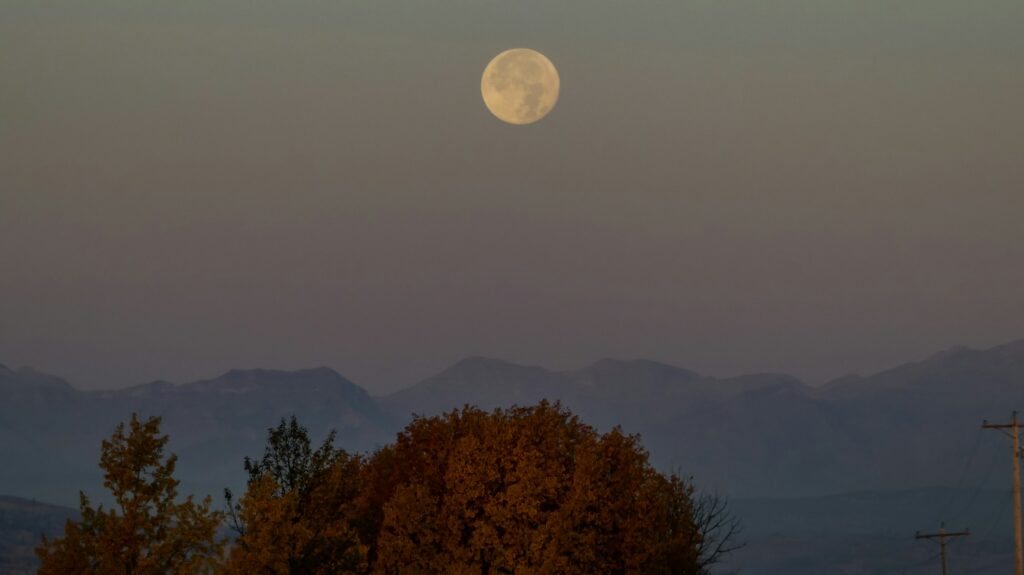
The Hunter’s Moon 2026 is full on Monday 26 October at 04:12 GMT, but the time to photograph it is moonrise on the evenings of 25 and 26 October. It is not a supermoon by the astronomers’ usual definition: at 368,900 km it is only about 4% closer than average, while the true supermoons of 2026 fall on 3 January, 24 November and 24 December. In London the Moon rises at 16:00 on the 25th, 47 minutes before sunset. Aim for the 25th and keep the 26th as plan B.
A full moon rising behind a landmark is one of the easiest photos to miss and one of the most rewarding to nail. This year the calendar is on your side: the clocks go back on the night of 24 to 25 October, the sun sets early and the Moon appears before full darkness, while the landscape is still lit. Here are the evenings to target, moonrise times for around twenty European cities, the places that really work and the settings that stop you coming home with a blown-out white dot.
Hunter’s Moon 2026: supermoon or not?
The term « supermoon » has no official definition. It was coined in 1979 by the astrologer Richard Nolle, and every outlet applies its own threshold. Under the original rule, followed by Sky at Night and the Almanac, the full moon of 26 October 2026 does not qualify. It sits about 368,870 km from Earth, just outside the threshold astronomers use. Some outlets, such as SkyWhen, do list it as a supermoon because they apply a looser rule: being at least 4% closer than the average distance of 384,400 km. It scrapes through that test at 4.04%.
| Full moon | Earth-Moon distance | Status |
|---|---|---|
| 3 January 2026 | 362,312 km | Supermoon |
| 31 May 2026 | 406,135 km | Furthest of the year |
| 26 October 2026 | 368,872 km | Hunter’s Moon, just outside the threshold |
| 24 November 2026 | 360,765 km | Supermoon |
| 24 December 2026 | 356,738 km | Supermoon, closest of the year |
In practice, the 26 October Moon is about 4% wider in the sky than average and roughly 8.6% brighter. Next to the real supermoons of November and December, the gap is 2 to 3%: no eye will spot it without a side-by-side comparison. The perigee of this orbit falls on 28 October, at around 364,400 km, two and a half days after the full moon. The dramatic differences quoted in some headlines compare a perigee Moon with an apogee Moon, never with the average.
Where does the name Hunter’s Moon come from?
It is the first full moon after the Harvest Moon, the one closest to the autumn equinox (26 September in 2026). Both rise shortly after sunset several evenings in a row, which left light for hunting once the fields had been worked. According to the Almanac, the name is mostly spread by the Anglo-American tradition of the Old Farmer’s Almanac. The idea that « Native Americans » named it this way is misleading: History.com points out that each nation named its own lunar months, with no common system.
When to photograph the Hunter’s Moon: the evenings of 25 and 26 October
The exact full moon falls on 26 October at 04:12 GMT (05:12 in Paris), when the Moon is almost setting. There is no eclipse that day. To photograph a moonrise, aim for the evenings of 25 and 26 October, when it is already about 99.5% illuminated. Photographers recommend shooting the day before the full moon, as Sky at Night explains: the Moon rises before sunset, so there is still light on the landscape and a single frame is enough, with no compositing.
Moonrise and sunset times
Local clock times, after the clocks go back, for a flat horizon at sea level. Paris and the rest of continental Europe are one hour ahead of London, except Lisbon and Reykjavik, which run on London time. At a mountain site or with high ground to the east, the Moon can appear 20 to 60 minutes later.
| Place | Moon 25 Oct | Sun 25 Oct | Moon 26 Oct | Sun 26 Oct |
|---|---|---|---|---|
| London | 16:00 | 16:47 | 16:19 | 16:45 |
| Edinburgh | 15:59 | 16:48 | 16:11 | 16:46 |
| Paris | 16:57 | 17:42 | 17:20 | 17:41 |
| Mont-Saint-Michel | 17:13 | 17:58 | 17:36 | 17:56 |
| Étretat | 17:04 | 17:49 | 17:25 | 17:47 |
| Lyon | 16:54 | 17:38 | 17:20 | 17:36 |
| Marseille | 16:57 | 17:40 | 17:25 | 17:38 |
| Bordeaux | 17:18 | 18:01 | 17:45 | 18:00 |
| Strasbourg | 16:36 | 17:21 | 16:59 | 17:19 |
| Berlin | 16:03 | 16:51 | 16:21 | 16:48 |
| Budapest | 15:52 | 16:38 | 16:16 | 16:36 |
| Rome | 16:30 | 17:14 | 17:00 | 17:12 |
| Barcelona | 17:13 | 17:56 | 17:44 | 17:54 |
| Lisbon | 17:04 | 17:45 | 17:37 | 17:43 |
| Athens | 16:51 | 17:34 | 17:24 | 17:33 |
| Reykjavik | 16:38 | 17:34 | 16:26 | 17:31 |
What this table means in practice. On the 25th, the Moon rises 40 to 50 minutes before sunset almost everywhere in western Europe (47 minutes in London, 45 in Paris). On the 26th the gap drops to around 26 minutes in London and 20 in Paris: still doable, but tighter. The Moon rises in the east-north-east, at an azimuth of about 69° on the 25th and 60° on the 26th in Paris. In Reykjavik it even rises earlier on the 26th than on the 25th, an effect of high latitudes.
Clocks going back: the calendar trap
In the UK the clocks go back one hour at 2am on Sunday 25 October 2026, which is the last Sunday of the month, as GOV.UK confirms. France and most of the EU change at the same moment (3am becomes 2am local time, per service-public.gouv.fr). The 25th is the earliest possible date for the last Sunday of October, and the EU reform to end clock changes is still stalled. For you this means the moonrise times shown are about an hour earlier on the clock from the 25th onwards. Don’t compare this table with last year’s articles or with notes made on the evening of the 24th. Phones and apps switch automatically, but watches and cameras without GPS don’t.
Plan C: on the evening of the 24th the Moon is still about 96.9% illuminated. In Paris it rises at 17:39 on summer time, 65 minutes before sunset (18:44). If the 25th is clouded out and you are already there, this is your last card, for a slightly less full Moon.
Where to photograph the Hunter’s Moon in Europe
Basic rule: the Moon rises in the east-north-east, so to have it behind a landmark you need to stand to the west-south-west of that landmark. The longer your lens, the further back you must go for the landmark to look as big as the Moon. The alignments below are indicative calculations using approximate coordinates: check them on the ground with PhotoPills, The Photographer’s Ephemeris or Mooncalc before the day.
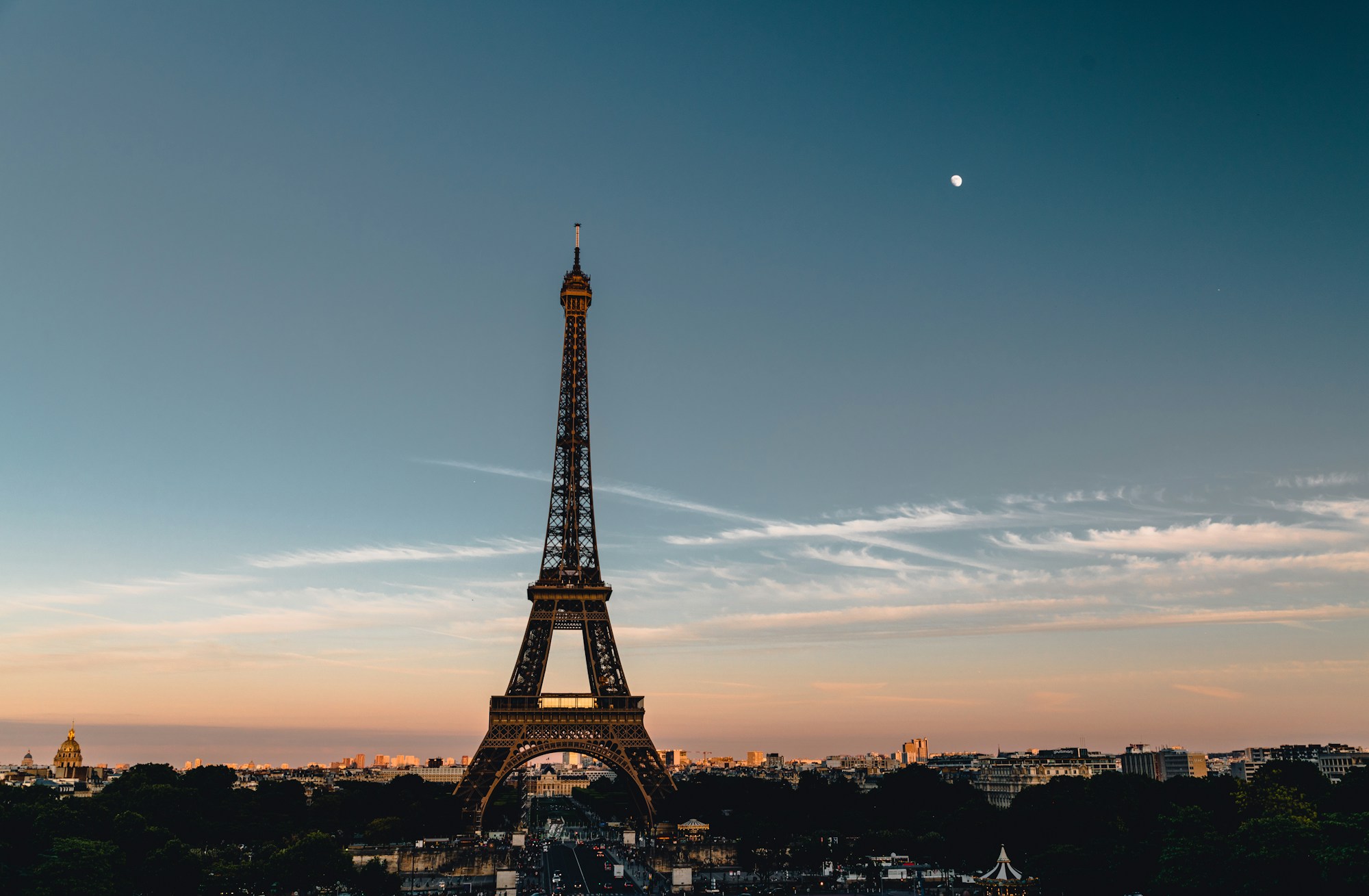
Paris: the Eiffel Tower from Saint-Cloud
From the Trocadéro esplanade, the Eiffel Tower lies to the south-east: the Moon rises to the left of the tower, not behind it. To get it above or beside the monument, cross to the other side of Paris: the Lanterne terrace in Saint-Cloud park and Mont-Valérien in Suresnes are 6 to 8 km to the west. The calculation puts the Moon at around 5° high at about 17:37 on the 25th, while the top of the tower is at about 2°: it passes above rather than behind. The Eiffel Tower itself lists its best photo spots. For a panorama without a precise alignment, Montmartre works: the Moon rises above the rooftops of eastern Paris. Paris is a short Eurostar hop from London St Pancras, so it fits a weekend, but remember that Paris time is an hour ahead of yours.
Highlights
- Reachable by public transport, no hike in
- Sunset at 17:42: night falls early, no long wait
- The Moon is high in the sky (declination around +20°): good light on the landscape
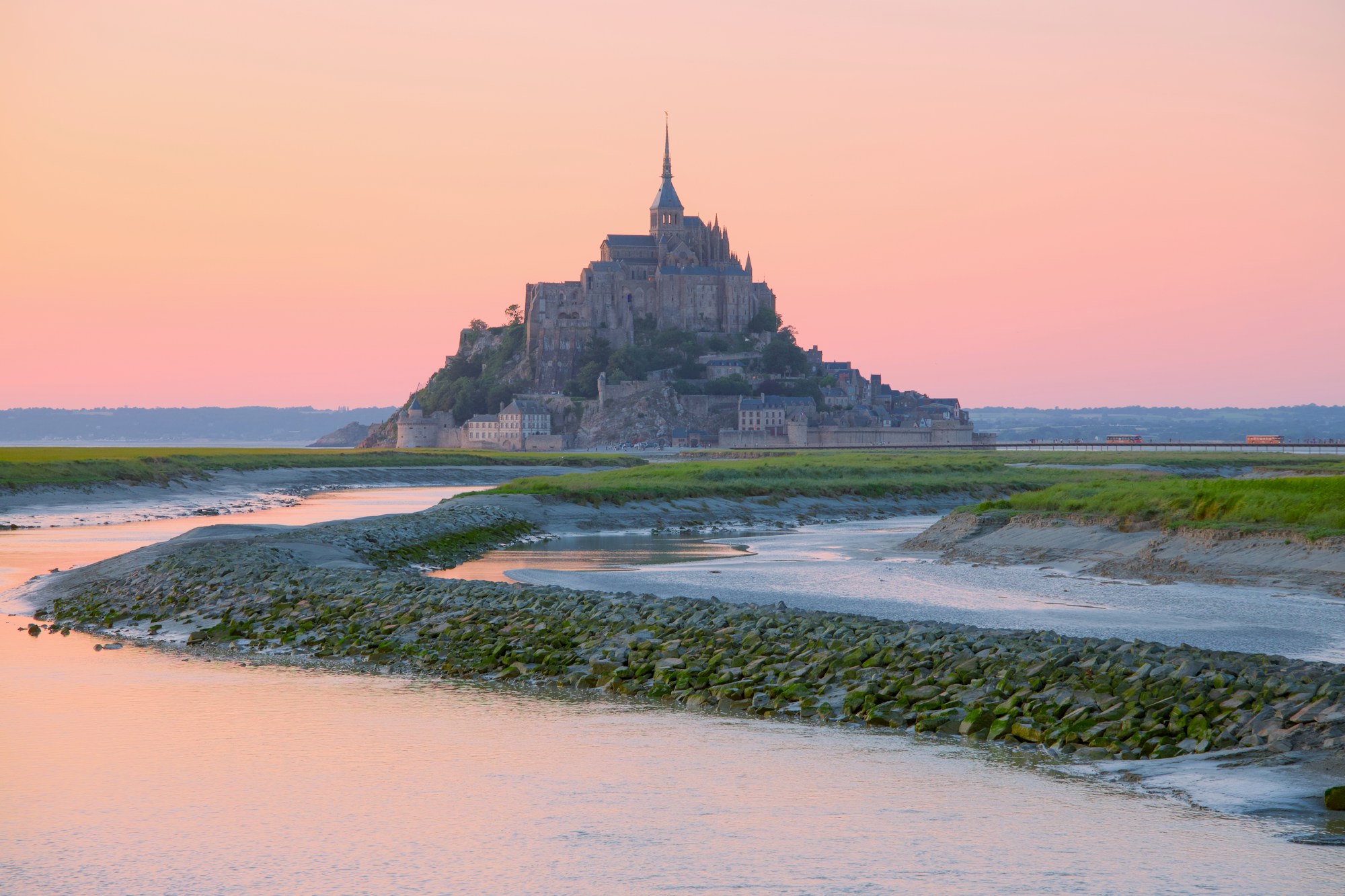
Mont-Saint-Michel and Étretat: Normandy at nightfall
At Mont-Saint-Michel, a full moon close to perigee brings big tides: coefficients of 87 to 92 on 25 October and 95 to 98 on the 26th, with high water at 18:25 on the 25th and 19:03 on the 26th, according to Météo Consult forecasts. Those times need confirming with SHOM, and you shouldn’t count on « the Mont turning into an island »: our guide to the big tides at Mont-Saint-Michel explains how to read the official calendar. As for alignment, a rough calculation puts the Mont-Dol viewpoint, south-west of the rock, on a Moon rising almost exactly behind the abbey on the 26th at about 17:43. Check it on the ground: at these distances, a few minutes’ difference moves the Moon from one edge of the Mont to the other.
At Étretat, the Moon rises in the east-north-east over the sea, at 17:04 on the 25th. The catch: on the beach you are facing west, towards the cliffs. For a moonrise over the water you need to look east from the Falaise d’Aval or the Falaise d’Amont path. Don’t promise friends « the Moon behind the Needle » before you have tested the alignment: it hasn’t been validated. Access to the cliff spurs is closed because of rockfalls.
Highlights
- Free Mont shuttle (07:30 to 23:00 until October) and the first 30 minutes of parking free
- One of the few « Moon behind the Mont » set-ups within reach in France
- Étretat: parking from €3 an hour to €15 a day, motorhome area at €14.32 for 24 hours
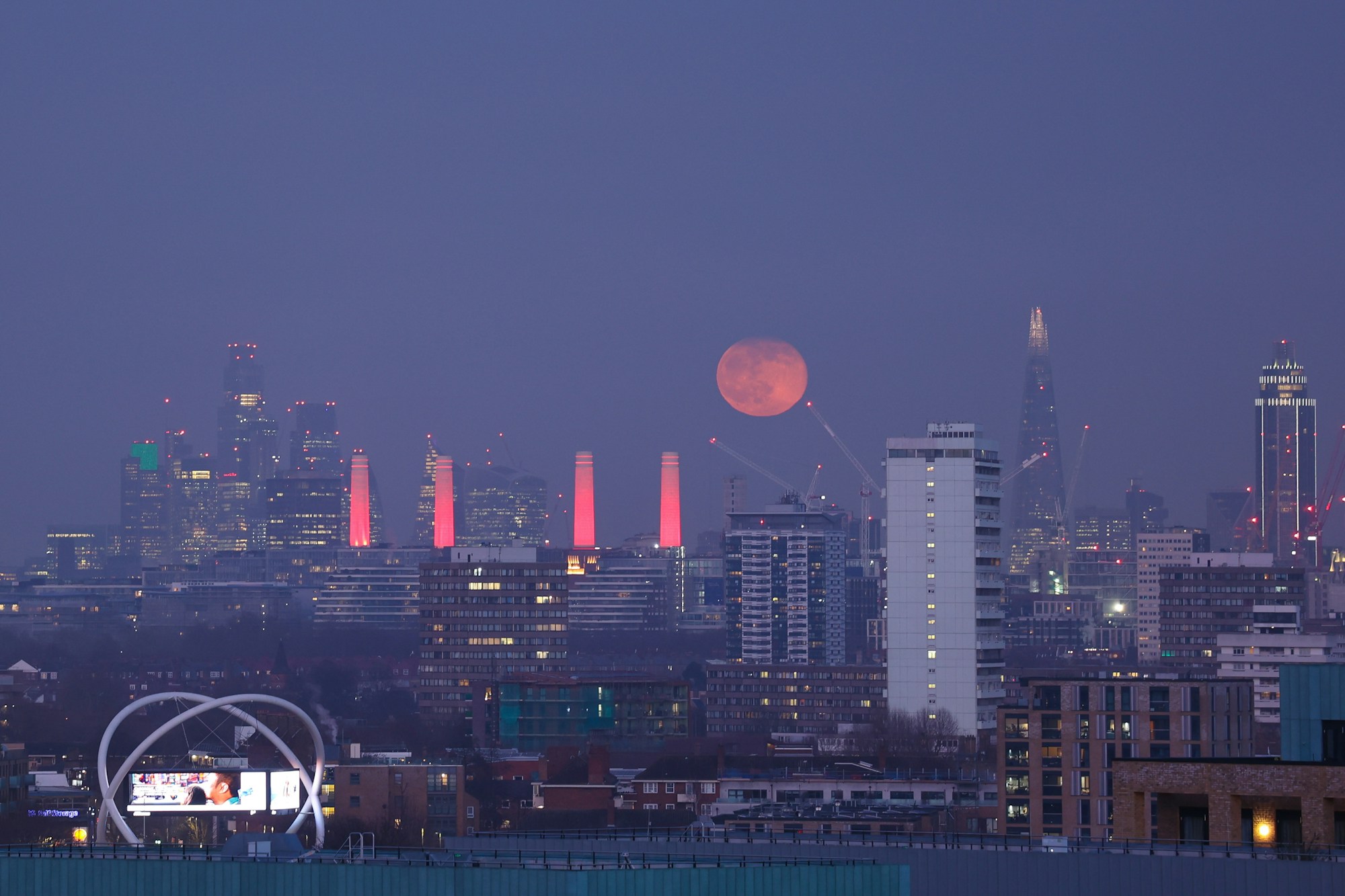
London and Edinburgh: a near-perfect alignment with St Paul’s
London offers one of the most promising alignments in this guide. From Waterloo Bridge, a rough calculation places the Moon behind St Paul’s Cathedral at about 17:03 on the 26th: it is about 5.1° high while the dome’s top is at 4.5°, almost exactly on axis. Confirm it with an ephemeris app. Waterloo Bridge carries traffic as well as walkers, so stay on the footway and bring a compact tripod that doesn’t block people. In Edinburgh, Calton Hill is free and open 24 hours a day, with a view over the Old Town and Arthur’s Seat; the Moon rises there at 15:59 on the 25th, before the 16:48 sunset.
Highlights
- Very early moonrise: more than 45 minutes of light over the city before dark
- Waterloo Bridge and St Paul’s alignment to test on the 26th
- A car-free weekend: everything is doable on foot or by Tube
Zermatt, Pic du Midi, Tre Cime: high mountains lit by the Moon
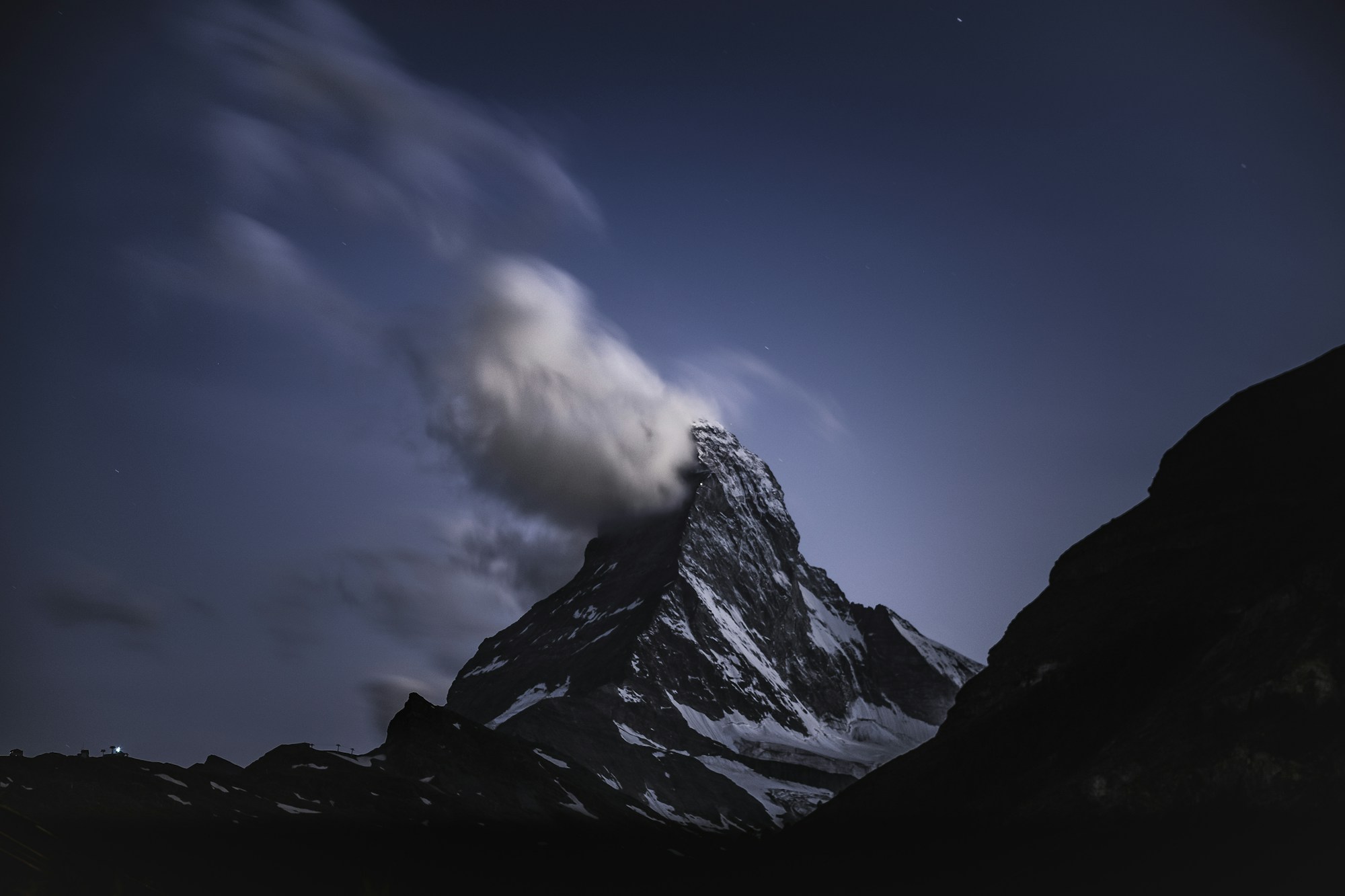
The mountains add scenery and a possible sea of clouds, at the price of a later moonrise: the times in the table assume a flat horizon, while ridges to the east delay the Moon’s real appearance. In Zermatt it surges up behind the eastern ridges, not behind the Matterhorn, which lies south-west of the village. To see it light up the summit, count on moonlight late in the evening, as in this Matterhorn Moonlight feature. The Gornergrat train costs CHF 66 one way and CHF 132 return, with a last departure at 19:24 and a maintenance break from 2 to 14 November 2026.
The Pic du Midi de Bigorre is open until 1 November 2026, so the 25th and 26th fall in its last days: tickets from €44, Galactic evenings at €90, overnight stays on reservation. It has been an International Dark Sky Reserve since 2013, but a full moon switches off the Milky Way: come for the moonlit landscape. In the Dolomites, the Tre Cime di Lavaredo road charges a €40 toll for cars and stays open until the end of October, weather permitting.
Highlights
- Above a sea of clouds, a moonrise is among the finest shots you can get
- Little haze at altitude, clear horizon if the terrain allows
- Sub-zero temperatures possible: head torch, thin gloves and spare batteries
Elsewhere in Europe: what to know before you go
- Lyon: from Fourvière, free, the Moon rises in front of you, above the Croix-Rousse and the Alps (16:54 on the 25th).
- Dune du Pilat: the Moon rises above the pines, facing east. Overnight parking is banned from 2am to 5am (€50 fine) and the 160-step staircase is open until October: check its condition.
- Budapest: the Fisherman’s Bastion, on the Buda side, looks east towards Pest, a good set-up (to be checked). Expect to pay about €4 for the upper terraces, free before 9am and after 7pm outside high season.
- Athens and Cape Sounion: the Acropolis closes at 6pm (last entry 5:30pm), and the Temple of Poseidon closes at sunset, so before the Moon. Shoot from the beach or the coastal road below.
- Berlin: at the Brandenburg Gate, from Pariser Platz, the Moon is behind you. Framed in the gate, it is setting: that is not a moonrise.
- Venice and Rome: alignments with San Giorgio Maggiore or the Colosseum remain uncertain. Test them with an app before you travel.
- Tromsø and Reykjavik: the Moon rises earlier on the 26th than on the 25th (13:22 versus 14:15 in Tromsø). The northern lights are still possible, but moonlight reduces their contrast: see our guide to the northern lights in Tromsø.
Weather and plan B: the real risk of the evening
The first enemy isn’t the Moon, it’s the sky. In Paris, cloud cover climbs from 51% to 63% through October according to Weather Spark, and Infoclimat records 118.6 hours of sunshine for the month. None of the public sources we checked provides a reliable statistic for clear nights by city: be wary of anyone quoting a precise percentage.
- Read the clouds in layers. Meteoblue, Clear Outside or Astrospheric separate low, medium and high cloud. Cirrus veils the Moon without hiding it and sometimes creates a spectacular halo.
- Check the eastern horizon. A haze bank on the horizon makes you miss the moonrise, even with clear sky overhead.
- Plan two evenings. The 25th and 26th, plus the evening of the 24th as plan C if you are on site.
- Go up if it’s socked in below. In October, valley fog is common: a sea of clouds is best photographed from the summits.
Light pollution matters little for a moonrise: the Moon is the light source and you are shooting at dusk. What matters is a clear eastern horizon and low haze. A full moon, however, drowns the Milky Way: if you want stars, wait for the new moon in early November. And if the subject grips you, also look at the best spots to watch the 28 August lunar eclipse.
Before you go
To follow cloud-layer forecasts and fine-tune your alignment on the spot, without roaming charges: France, Greece, Switzerland, Iceland, Norway.
Country and regional plansExpensive camera kit, mountains, an access road that can close: travel insurance covers the unexpected on an autumn trip.
Online quoteFrequently asked questions
When is the Hunter’s Moon in 2026?
Monday 26 October 2026 at 04:12 GMT (05:12 in Paris). The best time to see it rise is the evenings of 25 and 26 October, when it is already about 99.5% illuminated.
Is the 2026 Hunter’s Moon a supermoon?
Not according to the reference lists, which count 3 January, 24 November and 24 December 2026. It is about 368,870 km away, 4% closer than average: some sites count it as a supermoon in the loose sense, but the size gap with a true supermoon is 2 to 3%.
What time does the Moon rise in London on 25 October 2026?
At 16:00 GMT, 47 minutes before sunset (16:47). On the 26th it rises at 16:19, about 26 minutes before sunset. In Paris the times are 16:57 and 17:20 on local time.
Does the clock change affect moonrise time?
The real moonrise doesn’t change, but the time shown on the clock goes back an hour from 25 October 2026 (in the UK, 2am BST becomes 1am GMT in the early hours of the 25th). Moonrise times for the evening of the 24th are given in summer time, those for the 25th and 26th in winter time.
Which lens and settings should I use to photograph the Moon?
A 200 to 300 mm telephoto for detail, 400 mm or more for a Moon clearly visible behind a landmark. Starting settings: ISO 100 to 200, f/8 to f/11, 1/125 to 1/250 s, manual focus, with negative exposure compensation.
Can you see the Milky Way with a full moon?
No: a full moon drowns the Milky Way and most stars. For deep sky, wait for the new moon in early November. For 26 October, focus on the moonrise and the moonlit landscape.
When is the next true supermoon?
24 November 2026 (360,765 km), then 24 December 2026 (356,738 km), the closest full moon of the year.
Can I use a drone to photograph the Moon in Paris?
No: central Paris is a permanent no-fly zone for drones, hobby ones included, with fines of up to €75,000. Elsewhere, check local rules before taking off, especially around Mont-Saint-Michel, a protected site.
Sources
- Sky at Night: supermoons 2026: list of the year’s supermoons
- Almanac: what is a supermoon: definition and thresholds
- Almanac: October full moon: origin of the name
- SkyWhen: October 2026 full moon: loose 4% definition
- History.com: full moon names: nuances on Native American names
- Sky at Night: moonrise composite: settings and technique
- Sky at Night: how to photograph the full Moon: recommended focal lengths
- PetaPixel: planning an aligned moonrise: alignment method
- PetaPixel: Samsung and the Moon: Space Zoom controversy
- GOV.UK: when do the clocks change: UK clock change
- service-public.gouv.fr: winter time: clock change in France
- School Term Dates: October half-term in England
- Eiffel Tower: best photo spots
- Révision-Drone: no-fly zones in France
- Mountain Photographer: Matterhorn Moonlight
- Forbes: why the Moon sometimes looks orange
- Weather Spark: October weather in Paris
- Weather Spark: October weather in London
- Astrobackyard: weather apps for astronomy
Moonrise times calculated from ephemerides and cross-checked with the Paris Observatory and Espenak’s tables. Information verified on 5 October 2026. Prices and tides to be reconfirmed before departure.

Plan your trip with Pixidia
Pixidia learns how you travel and helps you build a trip that truly fits you and everyone coming along.
Open the planner
How to photograph the Hunter’s Moon rising
Gear
An interchangeable-lens camera shooting RAW, a sturdy tripod, a cable release or intervalometer and spare batteries: the cold drains them fast. For focal length, Sky at Night recommends 200 to 300 mm for lunar detail. For a Moon clearly visible behind a landmark, plan on 400 mm or more. The Moon is about 0.54° wide: with a 400 mm lens on full frame, it fills around 16% of the frame height. On an APS-C or Micro Four Thirds sensor it looks bigger at the same focal length.
Starting settings
Keep a shutter speed of at least 1/focal length (1/400 s for a 400 mm lens) to avoid motion blur, as the Moon moves about 0.25° per minute. Focus manually, in live view zoomed in on the edge of the Moon. Meter in spot or evaluative mode with negative exposure compensation: against a dark background, auto exposure overexposes the Moon.
Single shot or composite?
On 25 October a single shot is possible: for the 15 to 30 minutes after moonrise, the landscape is still lit and the Moon still clearly visible. On the 26th, or if you want a larger-than-life Moon in the frame, you need a composite: lock the camera down, shoot the foreground at the end of the day in a long exposure (10 to 30 s), shoot the Moon in a burst as it climbs, then blend in « Lighten » mode in Lightroom or Photoshop. Be wary of viral images of an enormous Moon behind a landmark: they are almost always composites, or shots taken at 600 mm from several kilometres away.
What about a smartphone?
A recent smartphone takes a lovely landscape shot with the Moon in the sky, but the Moon stays a small white dot. Switch to Pro mode, low ISO, focus at infinity, reduced exposure, on a minimal tripod with the self-timer. And bear in mind the 2023 controversy over Samsung’s « Space Zoom », reported by PetaPixel: a phone can add detail that isn’t in the real scene. For genuine lunar detail, you need a long optical focal length.
Why the Moon looks orange when it rises
Near the horizon, the light passes through a much thicker layer of atmosphere. Short wavelengths, the blues, are scattered, leaving orange and red, as Forbes explains. Dust and pollution strengthen the effect.