
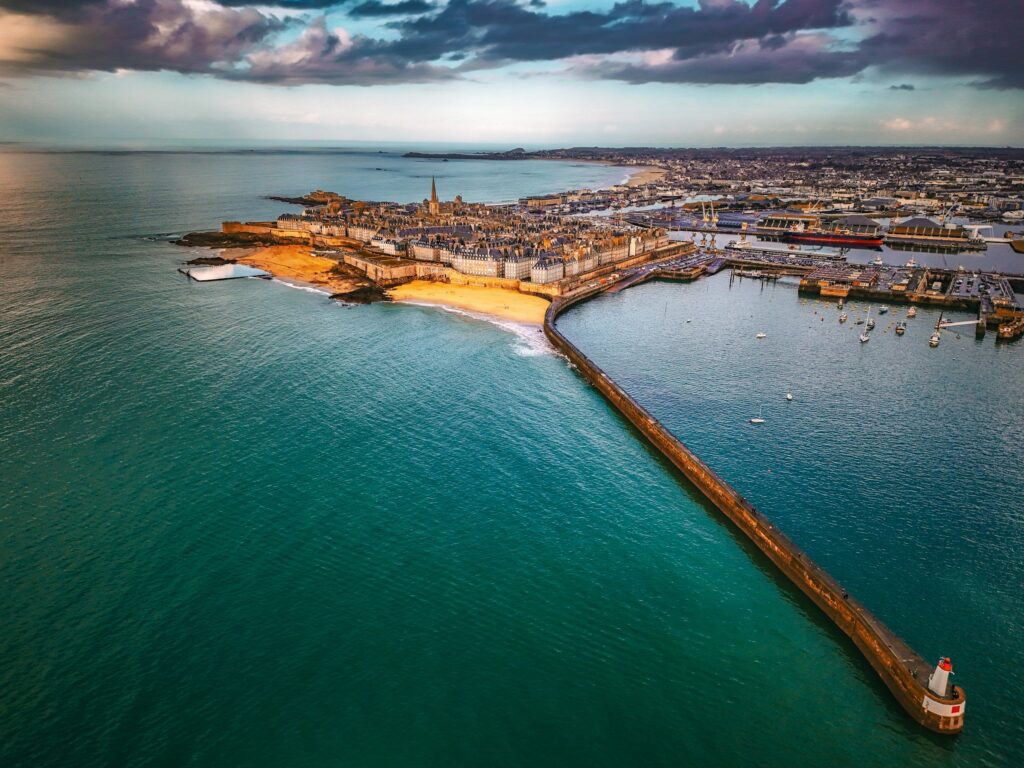
The Route du Rhum 2026 sets off on Sunday 1 November at 13:02 off Saint-Malo, and most of the experience actually happens before that day. The free départ village is open from 20 October to 1 November across 70,000 m², no ticket or booking needed, with the 118 boats moored just a few metres from the crowd. The land-based viewpoints for the start itself (the ramparts, Pointe de la Varde, Corniche d’Aleth) are also free. In 2022 a storm pushed the start back by three days, so it’s worth building some flexibility into your trip. To dodge the crowds, visit the village on a weekday, early in the morning.
You don’t need to be a sailor to make sense of this — and that’s rather the point. The Route du Rhum – Destination Guadeloupe is really a Saint-Malo story long before the starting cannon fires: thirteen days of free, open-to-everyone village life, where you can walk past all 118 competitors between lock crossings, before the city tips into the buzz of one of France’s biggest sporting gatherings on 1 November. Here’s how to plan your visit, where to stand, and what’s worth knowing before you book anything.
1. The départ village: the real Route du Rhum experience
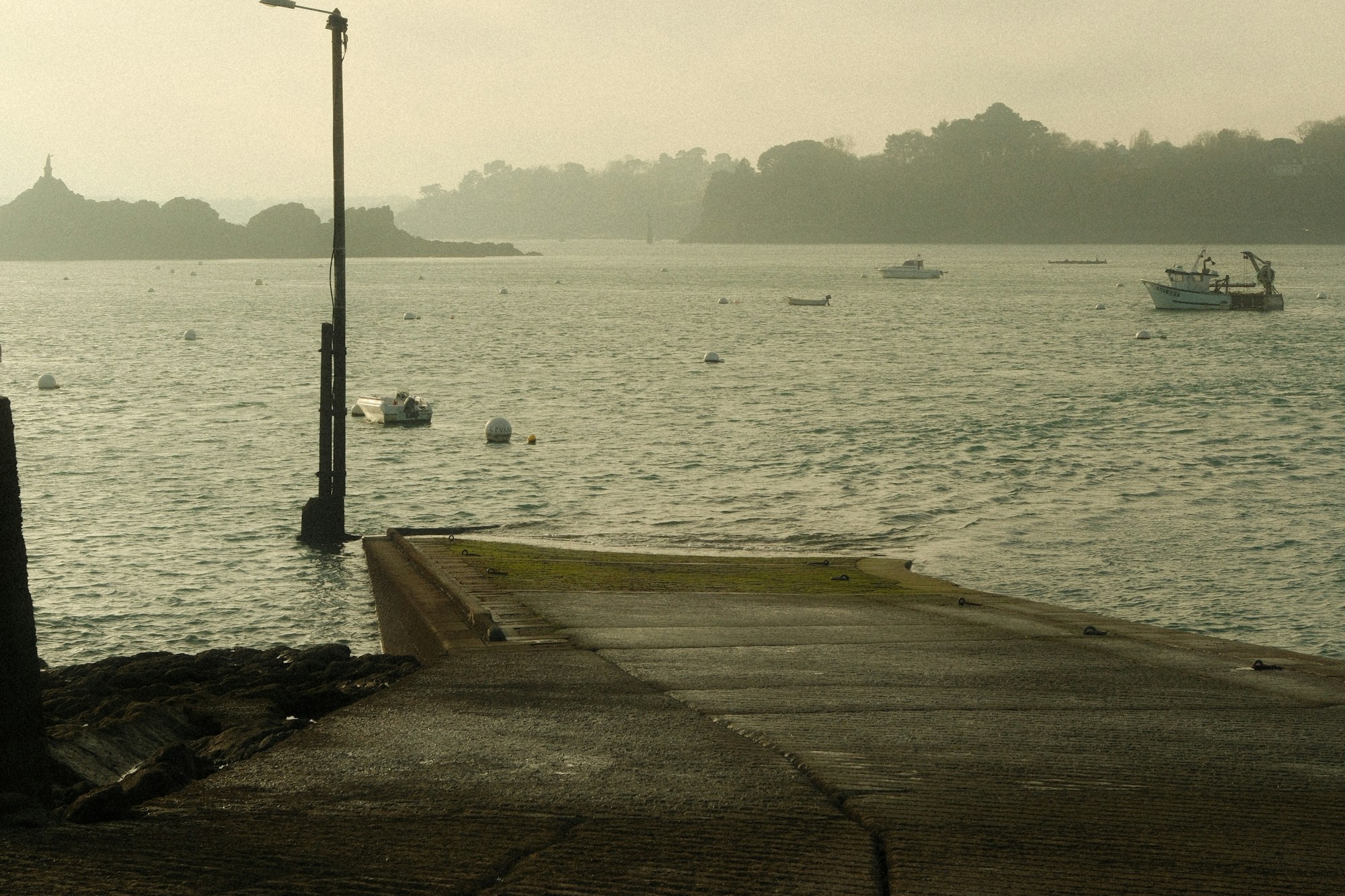
70,000 m² of free festival, 20 October to 1 November
The village opens on Tuesday 20 October 2026 at noon and closes on start day, Sunday 1 November. Across 70,000 m² wrapped around the harbour basins, 150 exhibitors — and above all the 118 boats of the fleet — sit moored at the pontoons, a few metres from the public. Entry is completely free, no ticket or booking required, whatever some old web pages might suggest: according to the race’s official site, no ticketing is needed to get in.
The site opens at 10am, exhibitors stay open until 8-10pm depending on the day, and the party often runs on until 1am. New for 2026: the « Rhum Park », near the Louis Martin entrance, has a big wheel overlooking the basins and an 85-metre zip line nicknamed « la Charalienne ». A floating Art Explora museum-boat and an immersive Guadeloupe pavilion round out the programme, alongside daily skipper meet-and-greets (5:30-6:30pm). The timed lock crossings draw crowds of up to 2,000 spectators into dedicated viewing zones.
Highlights
- Free access to the quays, just metres from the foils and cockpits of all 118 boats
- Rhum Park: big wheel, « la Charalienne » zip line, Art Explora museum-boat
- Daily skipper talks, plus the official fleet presentation on 25 October
2. A race born of a volcano and an advertising bet
The Route du Rhum owes nothing to Breton chance — it was born in Guadeloupe. In 1976, the eruption of La Soufrière forced the evacuation of Basse-Terre and dented the island’s image. Guadeloupe’s rum producers’ union set out to tell a different story about their craft, and found an ally in advertising man Michel Etevenon, who dreamed of a solo transatlantic race with no boat-size limit, in contrast to the English Transat. That alliance produced the first Route du Rhum start, on 5 November 1978. Canadian Mike Birch’s win on Olympus Photo, just 98 seconds ahead of Michel Malinovsky, remains one of the tightest finishes in offshore sailing history, according to Bateaux.com.
That first edition also carries a founding tragedy: sailor Alain Colas went missing at sea on 16 November 1978, caught in a storm off the Azores. His last, chilling radio message spoke of « mountains of water » around him. Neither he nor his boat was ever found. Eight years later, in 1986, Loïc Caradec disappeared when his giant catamaran capsized in a storm. That gravity, a little obscured today by the glamour of the village and its sponsors, is still very much part of the race’s story.
Two women stand out in the race’s history: Florence Arthaud, who won in 1990 despite a slipped disc and a broken radio, becoming the first woman to win a solo transatlantic race; and Ellen MacArthur, who won the monohull class in 2002 aged just 24. To place the Route du Rhum among the great offshore races: the Vendée Globe is non-stop, unassisted and monohull-only; the Transat Jacques Vabre is sailed two-handed; the Route du Rhum remains the only one open to every boat size, held every four years, solo.
3. The 2026 edition in numbers: a tighter fleet, a record for women skippers
Unveiled to the press on 22 September 2026, this 13th edition brings together 118 skippers from 12 nations, including 11 women — a record for the race, according to Figaro Nautisme. The fleet splits into six classes: 8 Ultim, 11 Ocean Fifty, 23 IMOCA (15 of them foiling), and a record 49 Class40 — a sign of just how much offshore racing has opened up. Two new classes, Vintage Multi and Vintage Mono (14 boats each), replace the old Rhum class and bring back legendary trimarans from the 1990s and 2000s, some pulled out of dry storage after a decade ashore.
Among the favourites, Charles Caudrelier (2022 winner and outright record holder at 6 days 19h47) tops the Ultim predictions ahead of Armel Le Cléac’h and Thomas Coville. In IMOCA, watch Sam Goodchild, Jérémie Beyou and Italy’s Ambrogio Beccaria. One late entry made headlines at the fleet presentation: Guirec Soudée, fresh off a world record for sailing against the prevailing currents, signed up for the Ultim class on 17 September, barely six weeks before the start. Nine skippers from France’s overseas territories will be racing, seven of them from Guadeloupe.
One notable rule change for 2026: competitors can no longer ship their boats to Saint-Malo by cargo. They now have to sail them there themselves — a measure aimed squarely at the criticism the sport has faced over its carbon footprint (more on that below).
If the event has you thinking about a longer trip to France, plenty of other trip ideas build naturally around a starting point like Saint-Malo.
4. Where to watch the start, on Sunday 1 November
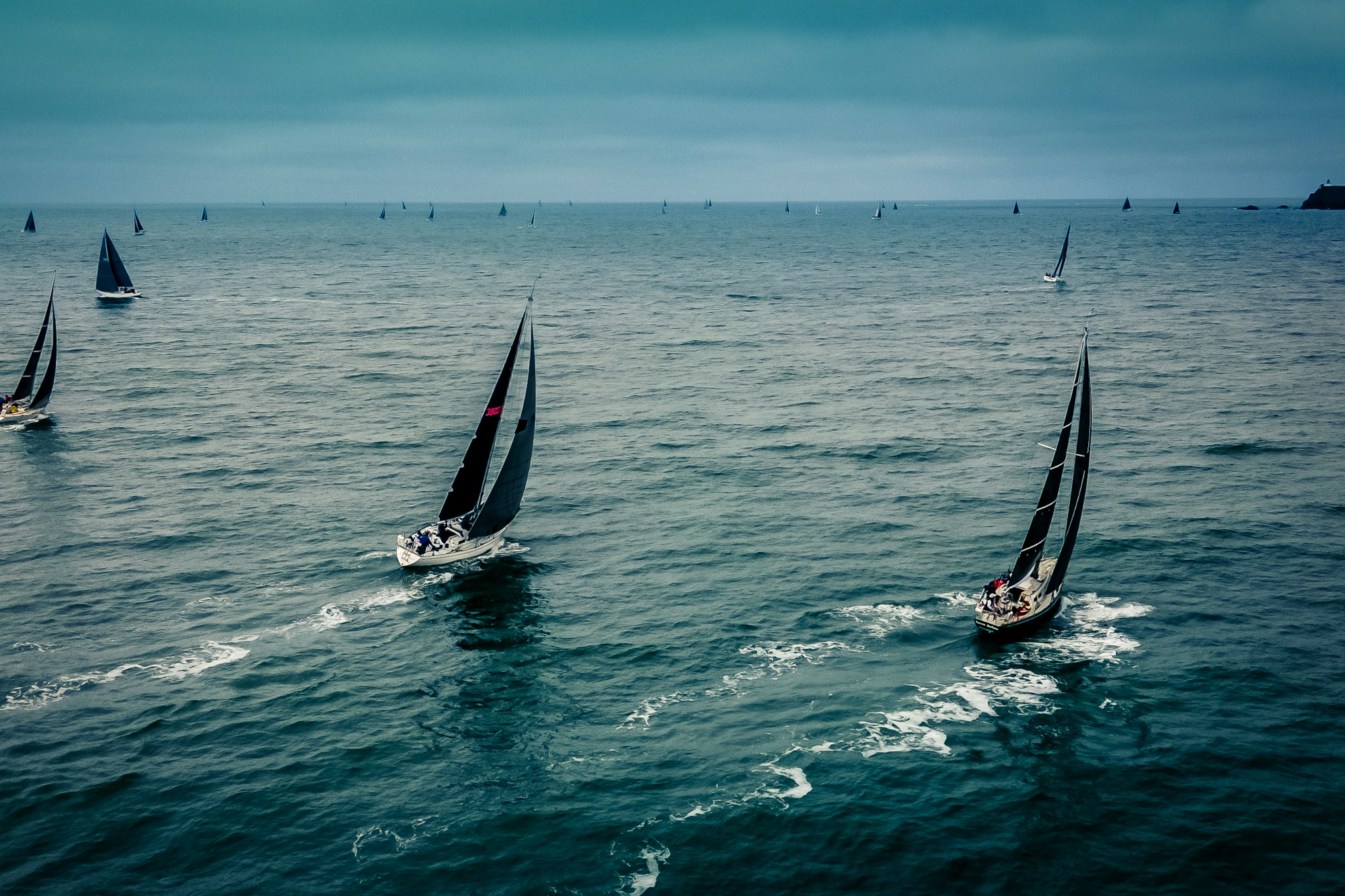
8 viewpoints, all free from land
The actual start line sits off the Pointe du Grouin, near Cancale — from land, no one gets a close view of it. According to Allovoyages, eight viewpoints stand out clearly. The Pointe du Grouin is closest to the actual start area, but parking fills up within the first few hours. Cap Fréhel, the fleet’s first mandatory landmark, offers what’s rated as an impressive show for the multihulls, with shuttle-only access that keeps crowd numbers in check.
In town, the ramparts carry the festive, communal atmosphere but don’t give a direct view of the line. The Môle des Noires puts the boats just a few dozen metres away, right in the exit channel from the port, but the spot is narrow and very exposed to the wind — best avoided with young children in bad weather. Pointe de la Varde and the Corniche d’Aleth (Saint-Servan) strike the best balance between a good view and manageable crowds. And on the other side of the estuary, Dinard and Saint-Lunaire — a ten-minute river-bus ride away — spread the crowds out while still giving a decent view of the leading boats.
Highlights
- Every land-based viewpoint is free and needs no booking
- Pointe de la Varde and the Corniche d’Aleth offer the best view-to-crowd ratio
- A boat trip (£165-235 / €190-270 per person) is the only way to get close to the fleet
5. Getting there, staying over and getting around during the event
By train, allow around 3 hours from Paris (TGV to Rennes, then 50 minutes on to Saint-Malo, with no direct link) and book early — trains on the start weekend sell out well before the end of October. Coming from London, the simplest route is Eurostar to Paris, then the TGV onward; allow the best part of a day door to door. By car, Saint-Malo is around 1 hour from Rennes and 4h30 from Paris outside traffic; it’s best to avoid the old town and park at the Paul Féval park-and-ride (€3.30/day, free shuttle included). By air, Dinard airport, 15km away, has Ryanair flights from London Stansted from £48 — a handy option if you’re coming from the UK — while Rennes airport is the best all-round choice for most other travellers.
From 20 October to 1 November, traffic inside the old town and along the Sillon is restricted to permit holders, mainly residents and businesses. Two free shuttle buses, every 15 minutes, run to the village from the park-and-ride car parks. The MAT bus network runs extra services throughout the period, and accessibility for wheelchair users is handled by the tourist office, which holds the « Tourisme & Handicap » label, with more than 180 reserved spaces around town.
Book your accommodation several months ahead — demand is fierce for the start weekend (31 October-1 November), when hotels and rentals fill up early. Dinard, Saint-Lunaire, Saint-Briac-sur-Mer or Dinan, 30km away, offer better value with easy access by bus or boat. B&Bs sometimes slip through the group bookings that fill up the standard hotel stock.
One last thing: Breton autumn isn’t gentle. November is Saint-Malo’s wettest month, with temperatures between 6 and 12°C and high humidity. Pack insulating layers that still work when wet, plus a proper waterproof, windproof jacket — especially for exposed viewpoints like Pointe du Grouin or Môle des Noires.
6. Saint-Malo beyond the event: ramparts, tides and rum merchants

The corsair city deserves a day or two beyond the village
Saint-Malo’s ramparts, rebuilt exactly as they were after the destruction of 1944, take a good hour to walk and give sweeping views over the walled city and its bay. Saint-Malo has one of Europe’s biggest tidal ranges: at low tide, huge stretches of sand appear, and the Bon-Secours seawater pool refills naturally twice a day. Fort National only opens at low tide, and mainly in summer — early November, it’s worth checking on the day rather than counting on it.
For a Breton town, Saint-Malo has a genuine rum culture, fitting given the race’s name: L’Officine à Rhum stocks 250 bottles, 150 of them rums; MaloRhum makes artisanal spiced rums; and Les Armateurs de Rhum age their bottles at sea, following an old maritime tradition. A neat way to lean into the « Route du Rhum » pun with a tasting, well away from the village crowds.
Highlights
- Cancale and its daily oyster market, 25km away on the road to Pointe du Grouin
- Cap Fréhel, cliffs over 70m high and a bird reserve, 40km away
- Combined trips to Mont-Saint-Michel, about an hour’s drive away
To build out this part of the trip beyond the village, all of Brittany is worth exploring as an itinerary, from the Malouin coast to the Finistère peninsulas.
7. A popular festival that’s also questioning its own carbon footprint
The race itself doesn’t pollute — it moves by sail, with no engine. But the ecosystem it creates comes at a documented cost. During the 2018 edition, the event generated roughly 145,000 tonnes of CO2 equivalent, three-quarters of it tied to logistics and public travel, according to an estimate cited by E6 Consulting. Building the boats themselves is an increasingly heavy line item too: a single Class40 generates around 25 tonnes of CO2 equivalent, 90% of it from composite material production.
In 2022, a group of 88 well-known sailing figures — including Francis Joyon, François Gabart and Isabelle Autissier — published an open letter with a blunt line: « we practise a magnificent sport that’s unreasonably polluting. » For 2026, organisers have responded with a few concrete measures: the village now runs entirely on the public electricity grid, ending the use of fossil-fuel generators, and cargo shipping of boats is banned, with every skipper now required to sail their own boat to the start.
One figure worth keeping in mind if you’re planning to visit: 64.4% of the event’s emissions come from spectators’ own travel, not the boats. Choosing the train or car-sharing over driving solo isn’t just a nice gesture — it’s the single most direct way to cut the footprint of your own trip.
Practical info for your trip
If you’re flying in from abroad (Dinard-Ryanair, for instance), an eSIM sidesteps roaming charges and activates before you even land in France.
Plans from a couple of eurosNomad Insurance covers cancellation, luggage and medical emergencies for a trip where crowds are heavy and the weather can turn fast.
From $56 / 4 weeksFrequently asked questions
Do I need a ticket to see the start of the Route du Rhum 2026?
No. Access to the départ village (20 October-1 November) and every land-based viewpoint for the start (ramparts, mole, headlands) is free, with no ticket or booking needed. Only spectator boat trips out on the water are paid, at roughly €190-270 per person. Official source.
What’s the best day to visit the village without the crowds?
A weekday, early — between 7:30 and 8am — ideally from opening day on 20 October, before the full fleet and the mass crowds arrive. The first weekend, and especially 31 October-1 November, are the busiest periods.
Where’s the best place to watch the start on 1 November 2026?
Pointe de la Varde and the Corniche d’Aleth strike the best balance between manageable crowds and a clear view. The ramparts in the old town carry the festive atmosphere, but the start line itself, off the Pointe du Grouin, isn’t visible up close from there. A paid boat trip remains the most immersive option.
Can the start be delayed because of the weather?
Yes, it’s happened before: in 2022, the start was pushed back three days because of a very violent storm forecast over the Channel. 1 November 2026 at 13:02 is the officially announced date, but it’s worth allowing some flexibility if you’re determined to see the real start.
How long does the crossing take the competitors?
The outright record is 6 days 19h47, held by Charles Caudrelier since 2022. IMOCA boats typically take 7 to 12 days. The finish village in Pointe-à-Pitre opens on 6 November 2026, with the first Ultim boats expected between 7 and 9 November.
How can I find affordable accommodation in Saint-Malo during the event?
Book several months ahead, especially for the 31 October-1 November weekend. Dinard, Saint-Lunaire, Saint-Briac-sur-Mer or Dinan, 30km away, offer better value, with easy bus or boat access to the village.
Is it a good event to bring young children to?
Yes, the village is genuinely family-friendly, with the Rhum Park’s big wheel and zip line, daily entertainment and the boats to admire up close. Pack warm, waterproof clothing, and avoid the Môle des Noires with young children in bad weather — it’s narrow and very exposed to the wind.
Sources
- Routedurhum.com — Getting to the village — official access, dates and opening hours
- City of Saint-Malo — official 2026 start dates
- IMOCA Class — confirmation of the start date
- Allovoyages — Where to watch the start — the 8 viewpoints
- Bateaux.com — Full list of the 118 skippers
- Figaro Nautisme — record for women skippers in 2026
- Bateaux.com — How the Route du Rhum began
- France 24 — 2022 start delayed for weather reasons
- E6 Consulting — environmental impact of the race
- Allovoyages — Getting to Saint-Malo — transport and parking

Plan your trip with Pixidia
Pixidia learns how you travel and helps you build a trip that truly fits you and everyone coming along.
Open the planner