
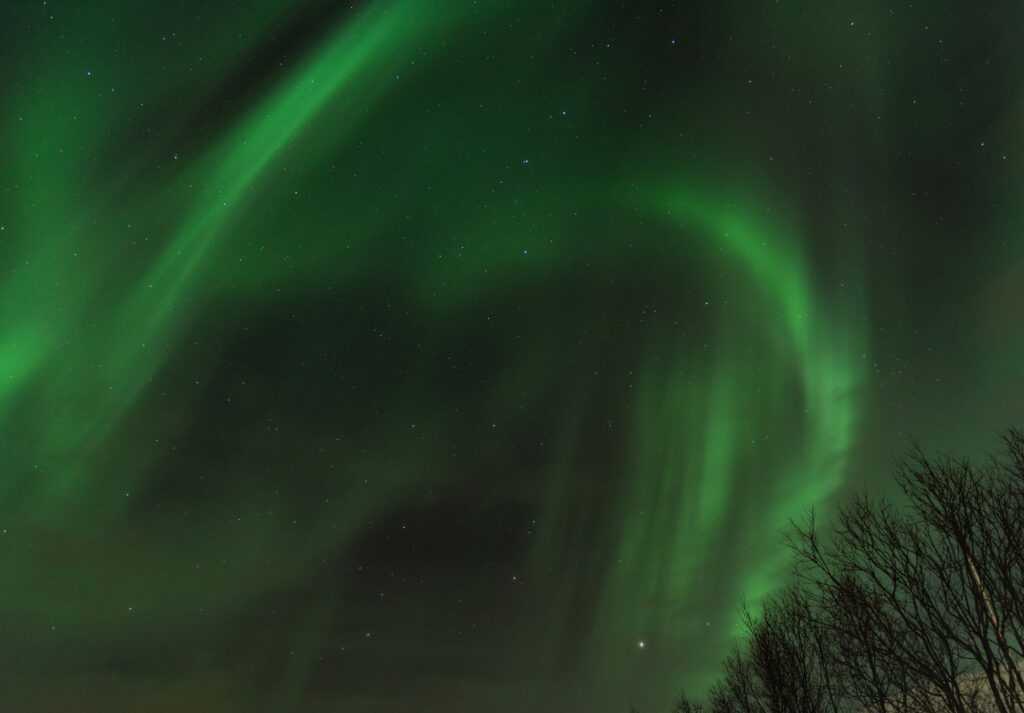
The best window to see the northern lights in October 2026 runs from 8 to 18 October, around the new moon on the 10th (16:50 BST). At high latitudes the sky stays completely Moon-free, with 7 to 9 hours of astronomical darkness in Tromsø. The 26 October full moon isn’t a supermoon, and it starts spoiling the nights from the 23rd. Aim for Tromsø or Lapland, plan four nights and watch the clouds as closely as the Kp index.
October isn’t about the full moon, it’s about the new one. Plenty of articles promise an October 2026 « supermoon » and make it the highlight of the month. For the aurora that’s a red herring: what matters is that the Moon is out of the sky while the night is properly dark. This guide works out those nights for six reference locations, explains what the equinox and the solar cycle still change, then helps you choose where to stay and when to head out.
The Moon-free window: 8 to 18 October 2026
New moon on 10 October, six locations calculated
The new moon falls on 10 October 2026 at 15:50 UTC, which is 16:50 in the UK (British Summer Time), according to the phase tables published by Fred Espenak (astropixels). For Tromsø, Abisko, Rovaniemi, Reykjavik, Fairbanks and Yellowknife, we calculated the hours when the Sun is more than 18° below the horizon and the Moon is below the horizon too. The result: from the evening of 8 October to the evening of 17 October, nights are completely Moon-free in all six places. On the 18th they still are in Tromsø, Abisko and Rovaniemi, and Reykjavik keeps 8 Moon-free hours.
The gain is clear. In Tromsø, astronomical night lasts about 5.8 hours on 1 October, 7.4 hours on the 10th and 10.2 hours on the 31st. On 1 September there was none at all. October is therefore the first month where the sky is dark enough for real chances, not September, despite the equinox.
What the window gives you
- A sky with no lunar competition: even a faint aurora stays easy to see.
- Nights of 7 to 9 hours at high latitudes, growing by about two hours every fortnight.
- Mild temperatures (0 to 5 °C in Tromsø) and unfrozen lakes that mirror the sky.
The night-by-night calendar, 5 to 31 October
Here’s the window in one table. Times are for Tromsø (local time, one hour ahead of the UK), calculated with our ephemerides. On 25 October Europe goes back to winter time, and the UK clocks go back that night too, so Tromsø stays one hour ahead of London. Iceland doesn’t change its clocks.
| Evening of | Moon | Moon-free hours in Tromsø | Verdict |
|---|---|---|---|
| 5 to 7 Oct | Last thin crescent, rising late | 1.5 to 6.5 h | Decent, better every night |
| 8 to 17 Oct | New moon on the 10th, absent or below the horizon | Whole night (7.3 h on the 10th) | Heart of the window |
| 18 Oct | First quarter (16:13 UTC) | Whole night (8.6 h) | Last full night |
| 19 Oct | Thick crescent | Whole night in Tromsø, 5.8 to 7.8 h elsewhere | Good, depending on latitude |
| 20 to 22 Oct | Gibbous, up earlier and earlier | About 5.7, then 3.5, then 1.6 h | The window is closing |
| 23 to 30 Oct | Full moon on the 26th (04:12 in the UK) | 0 h | Moon all night: strong auroras only |
The same calculation works as a template for Moon-free summer nights: it’s the angle of our guide to the Perseids 2026 under a Moon-free sky. Here, the polar night does the rest.
A supermoon on 26 October? No, and it’s not what matters
The full moon falls on 26 October 2026 at 04:12 UTC, which is 04:12 in the UK once the clocks have gone back. The reference lists don’t count it as a supermoon: Espenak, Sky at Night, EarthSky and Almanac only count three supermoons in 2026, on 3 January, 24 November and 24 December. That night the Moon is about 368,900 km from Earth, above the threshold used by those lists. Perigee comes on 28 October at 18:01 UTC, at about 364,400 km, two days later.
Some mainstream sites apply a looser criterion (a Moon at least 4% closer than average) and call it a supermoon. The term has no official astronomical definition: it comes from an astrologer’s definition in 1979. Above all, remember this: for an aurora, the Moon’s distance makes no difference. What counts is its phase and its height in the sky.
According to Aurora Forecast Iceland, moonlight mostly hides faint auroras, not strong ones. Photographers even find an upside: a lit-up landscape and a smaller aperture, as Ewen Bell describes. But to see anything of a modest aurora, the new moon is still unbeatable.
Equinox and solar cycle: what still matters in October
A fading plateau, not a peak
The equinox. According to the Russell-McPherron effect, described in 1973, Earth’s magnetic axis lines up better with the solar field around the equinoxes, which favours magnetic reconnection and geomagnetic activity in March-April and September-October. Cliver and colleagues found more than twice as many large storms at the equinoxes as at the solstices over 1868-1998. But the equinox was on 23 September: by 10 October the peak is two and a half weeks behind us. The effect lingers as a plateau and raises a probability, never a certainty.
Solar cycle 25. According to the SIDC, the smoothed sunspot maximum dates from October 2024 (160.9). NASA expects about 88 for September 2026, within a range of 69 to 117. So the cycle is declining, but it isn’t over: the SIDC writes that further very active episodes remain possible over the next two years, and the Met Office points out that the strongest storms can occur after the maximum. On 20 January 2026 a storm reached -218 nT on the Dst index, according to SpaceWeatherLive.
In the declining phase, coronal holes take over: their streams of fast solar wind return roughly every 27 days and produce modest storms (G1 to G2). That’s the most likely scenario in October, as on 5 October, when the SWPC expected a G1 episode driven by a coronal hole.
Where to go, depending on your profile
Five ways to use the window
| Your profile | Nights | Where | Good to know |
|---|---|---|---|
| Best chances, 5 free days | 8 to 16 Oct | Finnish Lapland (Saariselkä, Ivalo) or Abisko | Drier climate than the coast. As far as we know, there’s no direct London-Rovaniemi flight in October: expect a change, usually via Helsinki. |
| Long weekend from the UK | 9 to 12 Oct | Tromsø or Reykjavik | Reykjavik is about 3 hours from London with direct flights. For Tromsø, the direct London flights are mainly a winter-timetable affair that begins on 25 October, so for this window expect to connect (Oslo is the usual hub) and check current schedules. |
| Landscape photographer | 18 to 22 Oct | Lofoten, Tromsø, Iceland | Moon lights the foreground, then sets. Faint auroras get drowned out. |
| Can only go in late October | 23 to 31 Oct | Tromsø, Abisko, Lapland | 9.6 to 10.2 h of night, but Moon all night: only strong auroras are crisp. Direct London-Tromsø flights start to appear on the winter timetable. |
| From North America | 8 to 16 Oct | Fairbanks (Alaska) | Skip Yellowknife: Destination Canada advises against early October to mid-November because of cloud. |
Special cases
- Abisko: the « Blue Hole », a rain shadow created by the mountains, often brings clear skies when the Norwegian coast is clouded over. The Sky Station’s opening for night visits isn’t confirmed for the start of the window: check the STF page before building your plan around it.
- Tromsø: bus and minibus chases leave town for the interior or Finland. To compare the options, our guide to northern lights experiences in Tromsø breaks them down.
- Iceland: winter tyres, short days, and a new per-kilometre road charge since January 2026. Our guide to car hire in Iceland saves you from nasty surprises.
- Other places: for Senja, Svalbard, Inari or the Faroes, our northern lights 2026 overview covers the options.
Budget and logistics, in rough figures
All the prices below are « from » prices, checked on 5 October 2026 on public sites. They move with the date and demand: check them before you book.
- Flights: London-Reykjavik has direct flights of about 3 hours. For Tromsø, direct flights from London are tied to the winter timetable starting 25 October, so for the 8 to 18 October window plan on a change. Same for Rovaniemi. Prices swing a lot with the date: compare dates on a flight search before you commit.
- Northern lights chase in Tromsø: according to Visit Tromsø, from NOK 1,200 by bus and from NOK 1,759 by minibus, for evenings of 5 to 8 hours. Many operators offer another trip if nothing shows up: read the terms, it’s not a guarantee of an aurora.
- Entry rules: as a UK traveller you need a passport (an ID card won’t do) for Norway, Sweden, Finland and Iceland. It must have been issued less than 10 years before you arrive and be valid for at least 3 months after you leave the Schengen area, according to GOV.UK. No visa is needed for up to 90 days in any 180, and the EU’s Entry/Exit System may ask for fingerprints and a photo at the border. For Canada, the eTA costs CAD 7. For the United States, the ESTA costs $40.
- Gear: layered clothing, hand warmers, tripod, spare battery. Long exposure: widest aperture, a few seconds, ISO 1600 to 3200 as a rough guide.
Allow at least four nights in Tromsø to offset the cloud, as many travellers advise. According to Visit Rovaniemi, Finnish Lapland racks up about 150 aurora nights a year: the season starts there in late August, but it’s in October that the night turns properly dark.
Deciding the night before: three tabs to open
No serious forecast goes beyond a few hours to three days. So this guide won’t tell you « there will be an aurora on 12 October »: nobody knows. Instead, make this your routine each evening:
- Activity: the SWPC 3-day forecast gives the Kp index (G1 corresponds to Kp 5) and the 30-minute forecast helps with the last-minute call.
- Cloud: yr.no for Tromsø, and the Icelandic Met Office map (green: cloudy, white: clear sky) for Iceland.
- An alert app that combines Kp, cloud and Moon. None replaces the cloud map.
The SWPC also publishes a 27-day outlook based on the return of coronal holes. It’s an example of the method, not a forecast: it’s worthless several weeks out. Indicative thresholds from AuroraMe (a commercial source): Kp 1 is enough in Tromsø, Kp 2 in Abisko, roughly Kp 3 in Rovaniemi. With a clear sky, visibility decides, not the number.
Get ready to go
Cloud and aurora forecasts get checked in the field, sometimes far from any wifi. An eSIM saves you roaming charges.
Country and regional plansA flight cancelled by a storm or a bad fall on the ice gets expensive fast in the Far North. Compare the cover before you go.
From $56 / 4 weeksFrequently asked questions
What’s the best time in October 2026 to see the northern lights?
Roughly the nights of 8 to 18 October. The new moon falls on 10 October at 15:50 UTC and astronomical night lasts 7 to 9 hours in Tromsø, with no Moon in the sky at all. The wider window runs from 6 to 20 October.
Is the 26 October 2026 full moon a supermoon?
Not according to the reference lists: the 2026 supermoons are on 3 January, 24 November and 24 December. On 26 October the Moon is about 368,900 km away. Its perigee comes two days later, on 28 October. Some sites use the term with a looser criterion and no official definition.
Does a full moon stop you seeing the northern lights?
It mostly hides faint auroras; a strong aurora stays visible, and moonlight lights up the landscape for photos. To see a modest aurora, the new moon is better. Source: Aurora Forecast Iceland.
Does the equinox really boost the northern lights?
Yes, in terms of probability, through the Russell-McPherron effect: more magnetic reconnection in March-April and September-October. But the 23 September equinox has passed. The effect lingers as a plateau and guarantees nothing.
Is the solar cycle over?
No. The smoothed maximum dates from October 2024 and the cycle is declining, but the SIDC expects further very active episodes over the next two years. The declining phase favours coronal holes and their modest, recurring storms. Source: SIDC.
How many nights should you allow to have a chance of seeing an aurora?
At least four nights in Tromsø, a common traveller recommendation, to absorb the cloudy nights. Several sources quote high chances over three to four nights in remote places like Fairbanks or Finnish Lapland, but none is a guarantee.
How much does a northern lights chase in Tromsø cost?
From NOK 1,200 by bus and from NOK 1,759 by minibus, according to Visit Tromsø (« from » prices, checked on 5 October 2026). Many operators offer a free second trip if nothing shows up.
Do British travellers need a visa to see the northern lights in Norway, Finland or Iceland?
No visa, but you do need a passport: these countries are in the Schengen area, which allows 90 days in any 180 for tourism. Your passport must be less than 10 years old on arrival and valid for 3 months after you leave, and you may be asked for fingerprints and a photo under the EES. Canada requires an eTA (CAD 7); Alaska requires an ESTA ($40).
Can you see the northern lights from the UK?
Only during strong storms, mostly from northern Scotland, and it can reach further south in exceptional G4 or G5 events like May 2024. It’s no basis for planning a trip: for a real chance, head for the Far North.
Sources
- Phases of the Moon 2001-2100 (Fred Espenak, astropixels): October 2026 phase dates
- Aurora Forecast Iceland: the Moon’s effect on auroras
- Ewen Bell, Moonlight and Auroras: photographing auroras by moonlight
- Russell-McPherron effect (Wikipedia): geomagnetic activity at the equinoxes
- SIDC, progress of solar cycle 25: smoothed maximum and outlook
- Met Office, declining phase of solar activity: storms after the maximum
- SpaceWeatherLive, 2026 geomagnetic storms: storm of 20 January 2026
- NOAA SWPC, 3-day forecast and 30-minute forecast
- Icelandic Met Office, aurora forecast and yr.no, Tromsø weather
- STF, Abisko Aurora Sky Station: schedule to check
- Visit Rovaniemi, northern lights season
- Visit Tromsø, northern lights bus chase: « from » prices
- GOV.UK, Norway entry requirements and Iceland entry requirements: passport rules and EES for UK travellers
- AuroraMe, the Kp index: indicative thresholds (commercial source)
Data consulted and dates calculated on 5 October 2026. Moon times are ephemeris calculations cross-checked with Espenak.

Plan your trip with Pixidia
Pixidia learns how you travel and helps you build a trip that truly fits you and everyone coming along.
Open the planner