
The Descenso Internacional del Sella 2026 takes place on Saturday 8 August, for its 88th edition. Over 1,300 paddlers set off at midday from the Emilio Llamedo bridge in Arriondas to reach Ribadesella, 20 kilometres (12 miles) downstream, watched by around 200,000 spectators lining the banks or riding the River Train. This year’s big first: reigning world champion Sara Ouzande becomes the first woman to open cepo number one, the lead starting position. Book accommodation now — the town slows to a crawl from 9am that day.
Every first Saturday after 2 August, the Sella river becomes the stage for one of Spain’s biggest sporting festivals. On 8 August 2026, for the 88th time, more than a thousand paddlers set off from Arriondas to reach Ribadesella, watched by around 200,000 spectators. Between an unusual starting system, some powerful symbolism for this edition, and a tourist descent you can paddle from April to October, here’s how to experience the Descenso Internacional del Sella — whether you’re racing it, watching from the bank, or simply paddling for the fun of it.
A century of paddling: how the Sella became Asturias’ biggest popular festival
From the Piloña to the Sella: a story that began with a trip among friends in 1929
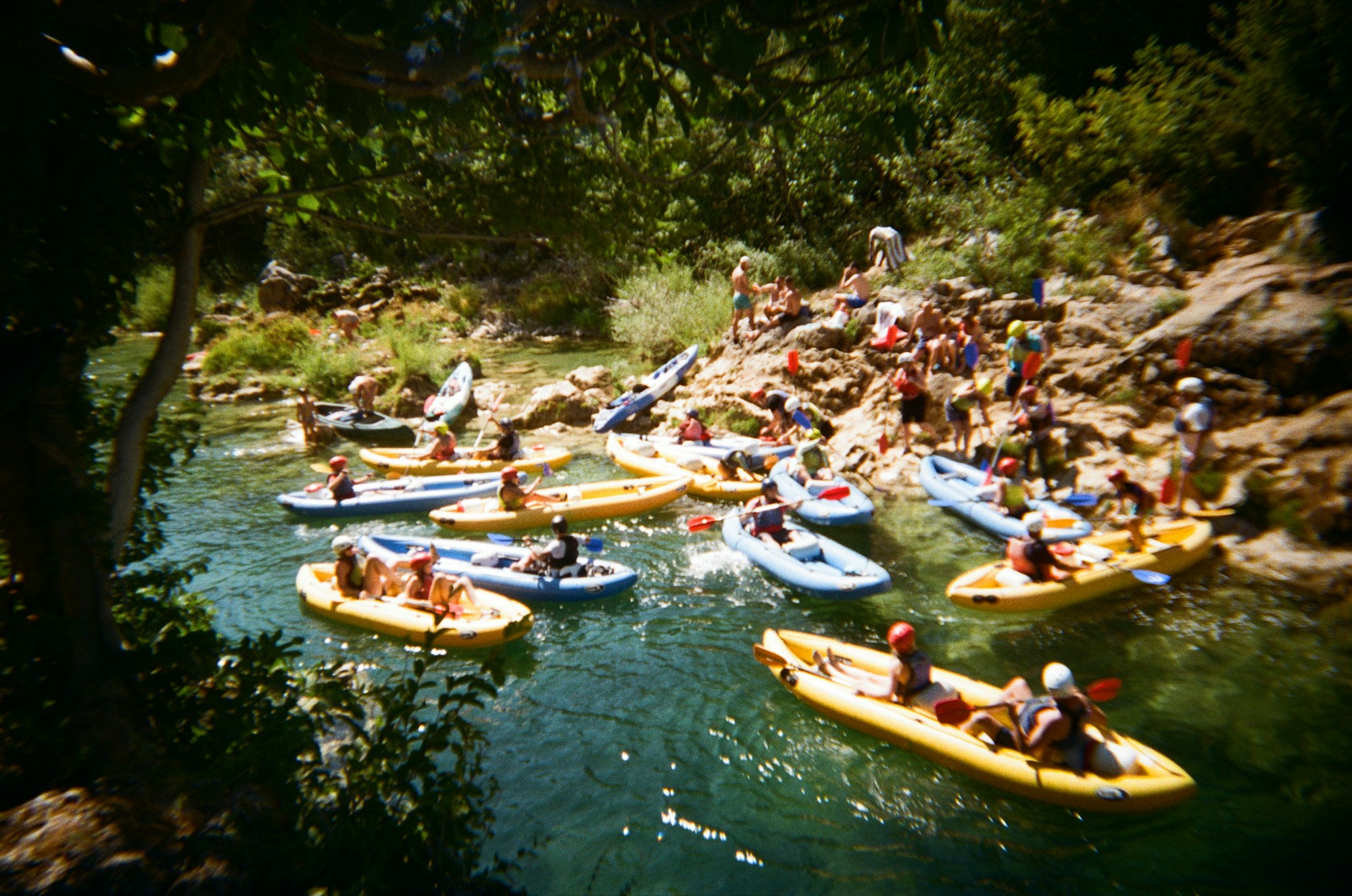
It all started as a trip among friends. In 1929, four residents of Arriondas — Dionisio de la Huerta, Alfonso Argüelles, Dr Benigno Morán and Manés Fernández — paddled folding canoes down the Piloña, a tributary of the Sella. According to Conocer Asturias, that 5-kilometre outing planted the seed of a tradition: by 1930, Dionisio de la Huerta had paddled solo from Coya to Arriondas, then pushed on to Ribadesella the following year. In 1932, thirteen paddlers from Oviedo, Gijón, Ribadesella and Infiesto raced the first genuinely competitive edition and fixed the Arriondas-to-Ribadesella course that hasn’t changed since.
The race didn’t run during the Spanish Civil War, between 1936 and 1943, before resuming on 11 August 1944 with just eleven boats, according to Wikipedia. It opened up to foreign competitors in 1951, created a women’s category in 1961, and was declared a Festival of International Tourist Interest in 1980. Only the pandemic interrupted it again, in 2020 and 2021. In 2026, the race reaches its 88th edition — one of the oldest and most continuously run canoe marathon competitions in the world. Britain has nothing quite like it: think the mass-participation spirit of the London Marathon, transplanted onto a Spanish river, with a village-fete atmosphere on both banks.
What sets the Sella apart from every other canoe-kayak classic is its starting system: competitors line up on dry land, paddle locked into a metal « cepo » that releases only when the light turns green, guaranteeing a perfectly simultaneous launch for well over a thousand paddlers. The race is organised by the Comité Organizador del Descenso Internacional del Sella (CODIS) on behalf of the Real Federación Española de Piragüismo, and is part of the International Canoe Federation‘s ICF Canoe Marathon World Series.
Highlights
- The « cepo »: a simultaneous start on dry land, unique among the world’s great canoe-kayak classics
- 88th edition in 2026: nearly a century of almost unbroken history since 1932
- A Festival of International Tourist Interest since 1980, part of the ICF Canoe Marathon World Series
Fancy feeling the Sella’s atmosphere for yourself, without racing the clock? All season long, the tourist descent of the same course welcomes anyone who can swim a few metres.
The 2026 edition in numbers: a new bridge, Santi Cazorla’s pregón and a historic first
Entries for the 2026 edition closed on 26 July, subject to availability, at a fee of €35 per paddler (canoe, paddle and life jacket included), according to the Federación de Piragüismo del Principado de Asturias. The official start is set for midday from the brand-new Emilio Llamedo bridge, a €5.2 million investment by the Asturian government that opened in July 2026, complete with a triple-glazed glass viewing platform overlooking the start line, according to Asturias Mundial. The leading paddlers should reach Ribadesella at around 1:10pm to 1:45pm; the all-time record of 1:01:14 has stood since 2009.
This 88th edition carries two powerful symbols. The opening pregón — the ceremonial address that kicks off race day — will be given by Santi Cazorla, the former Spain international and two-time European champion who also won the FA Cup with Arsenal, a name familiar to any Premier League follower and now a leading figure in Real Oviedo’s centenary year, according to Infobae. More significantly, Sara Ouzande, world champion and freshly crowned European champion in K4 500m, becomes the first woman in the event’s history to open cepo number one, according to RTPA. The women’s category has only existed at the Sella since 1961, and the race was at the centre of a heated controversy in 2016-2017: triple world champion Beatriz Manchón spoke out over discrimination after being forced to start in position 700, far behind the men, during an attempt to compete on equal terms in the absolute category. Spain’s Supreme Court ruled it was an organisational constraint rather than legally recognised discrimination, despite a petition that gathered 62,000 signatures. No source explicitly links the two events, but Sara Ouzande’s selection in 2026 lands, a decade on, as a symbol that’s unlikely to be a coincidence.
On the sporting side, the defending champions start as favourites: Walter Bouzán and Bertín Llera, both from Ribadesella, in men’s K2; Tania Fernández and Tania Álvarez, from Galicia, in women’s K2. The all-time honours list is still led by Julio Martínez (11 wins between 1998 and 2005) among the men and by Mara Santos, with an imposing 22 wins, among the women, according to SellaVirtual. Well over a thousand paddlers are expected at the start, a number close to the 2025 edition’s turnout (1,306 registered, 902 boats, 25 countries).
Another first for 2026: on 7 August, the day before the race, a « hermanamiento de aguas » (twinning of the waters) ceremony will symbolically unite the Sella with the Limay river in Argentine Patagonia. The official poster, designed by illustrator Sheila de la Maza from the nearby village of Llames de Parres, rounds off an edition the local press has called « particularly special and moving », according to Conocer Asturias.
Watching the race: the River Train, the best viewpoints and traffic restrictions
Since 1945, a tourist train nicknamed the « Tren de las Piragüas » (Canoe Train) has run alongside the race route on the old narrow-gauge railway linking Arriondas to Ribadesella. It covers the 20km (12 miles) in about an hour, with several stops where you can get off to watch the race, then hop back on board — one of the best vantage points over the whole event, according to Renfe. Demand runs high, so it’s worth booking tickets well in advance.
Watching from the banks costs nothing: the N-634 road runs alongside much of the course, with well-known viewpoints such as La Requexada (the longest straight on the route), the Llordón footbridge, the rapids at the old Presa de Santianes, or the Llovio bridge, one of the most spectacular moments just before the finish. Anyone staying home can follow the live broadcast on Asturian public broadcaster TPA/RTPA, usually from 11:15am to 2pm, streamed simultaneously on YouTube, Facebook, Instagram and Twitch.
Highlights
- River Train: Renfe tickets, worth booking well ahead given the demand
- Free access from the riverbanks (N-634, La Requexada, Llovio bridge)
- Live coverage on TPA/RTPA (TV and streaming) if you’re not travelling out
Paddling the Sella without racing: Asturias’ most popular tourist activity
The Descenso isn’t just about 8 August. All season long, typically from April to October, dozens of adventure operators offer the same course by canoe or kayak, with no previous experience required. It’s actually the most popular active-tourism activity in Asturias, with around 350,000 people taking part in a reference year. Expect to pay between €17 and €35 per adult depending on the operator, the distance you choose (a short version of about 7km/2 hours, or the full 14.5-20km/4-hour route) and any extras. Children’s rates typically run from €15 to €25.
The one genuinely essential skill is being able to swim about 25 metres comfortably. The route is rated easy difficulty (grade I-II), suitable for families, and a safety briefing precedes every departure. One important caveat: on race day itself, the river is reserved for the competition until it finishes. It’s best to shift your own descent to another day that same week, or wait until the afternoon.
Highlights
- No kayaking experience needed — just the ability to swim a few metres
- Easy-difficulty route (grade I-II), suitable for families
- Canoe, paddle, life jacket, safety briefing and return transfer usually included
If kayaking here has given you a taste for water-based adventure, our pick of the most scenic fjords in Norway, Greenland and the Faroe Islands to explore by kayak takes the experience well beyond Asturias.
Around the Sella: prehistoric caves, the Picos de Europa and Asturian food
Cuevas de Tito Bustillo, the Picos de Europa and the beach with dinosaur footprints
In Ribadesella, the Cuevas de Tito Bustillo hold one of Spain’s most important collections of Palaeolithic cave art, a UNESCO World Heritage Site since 2008. Visits, capped at fifteen people per group, must be booked well in advance, according to Turismo Asturias. A short walk away, Santa Marina beach preserves dinosaur footprints in the rock at one end, one of the symbols of Asturias’ « Costa de los Dinosaurios » (Dinosaur Coast).
Inland, the Picos de Europa national park (Spain’s first, created in 1918) and the Lakes of Covadonga make an easy excursion from Arriondas or Cangas de Onís. On the food side, Asturias has plenty going for it: fabada bean stew, cachopo, Cabrales or Gamoneu cheeses, and above all Casa Marcial, the Arriondas restaurant awarded a third Michelin star in 2025, a place that started life in 1993 as a simple neighbourhood dining room. Not forgetting cider and its signature move, the « escanciado » — poured from shoulder height, arm raised high, to wake up the drink’s natural fizz. There’s no obvious British equivalent, though the nearest comparison might be a real-ale enthusiast’s reverence for the perfect pour, minus the six-foot-high arc.
Highlights
- Cuevas de Tito Bustillo: booking required, maximum 15 people per visit
- Picos de Europa national park and the Lakes of Covadonga, under an hour away
- Casa Marcial (Arriondas), 3 Michelin stars since 2025
Getting there and staying: Arriondas and Ribadesella practicalities
By car, it’s about 1h15 from Oviedo via the A-64 (exit 14) then the N-634, or the A-8 if you’re coming from Santander or Bilbao. The ALSA coach company links Oviedo and Gijón to Arriondas four times a day, in around 1h06, from €7. The Renfe Cercanías line (the old FEVE narrow-gauge railway) also serves Arriondas, more slowly (nearly 1h50) but with a scenic run alongside the Sella. By air, Asturias Airport (OVD) is running around 8,700 flights and roughly 30 direct destinations for summer 2026, according to the Asturian government — including a direct Vueling route to London Gatwick, about 2h05 in the air. If Gatwick doesn’t suit, Ryanair flies from Stansted, Manchester and Edinburgh (plus a seasonal Birmingham route) into Santander, roughly 1h15 further down the A-8, while easyJet and Vueling connect several UK airports, Gatwick and Heathrow among them, to Bilbao, about 2h15 away on the same motorway. Extending your trip elsewhere in Spain? Three new AVE high-speed lines open in 2026 and are pushing rail fares down across the country.
Budget around €142 a night for a three-star hotel in Arriondas outside peak periods — expect that to climb sharply on Descenso weekend. Rural guesthouses start from about €20 per person per night, and Ribadesella rentals range from €15 to €110 depending on the season. Spain uses the euro throughout, and UK cards are accepted everywhere, though it’s worth checking your bank’s foreign transaction fees before you travel. Two campsites round out the options: Camping Sella, 500 metres from Arriondas’ canoe rental outfits, and Camping Covadonga, four kilometres from the sanctuary. Book at least five to seven days ahead in high season, and considerably earlier for 8 August specifically.
Fancy extending the trip? Our 5-day Andalusia itinerary lets you follow up with Seville, Cordoba and Granada, at the other end of the country.
Practical information for your trip to Asturias
Stay connected in Asturias from the moment you land, no hunting for a local SIM card: set up in minutes on your phone.
Data plans from a few eurosCover for the paddling, driving and hiking in this guide: medical emergencies, gear and trip cancellation, on top of what your GHIC covers in Spain.
Nomad Insurance from $56 / 4 weeksFrequently Asked Questions
When does the Descenso Internacional del Sella 2026 take place?
On Saturday 8 August 2026, for the 88th edition, between Arriondas and Ribadesella, in Asturias, according to the event’s official website.
How many kilometres is the race and how long does it take?
The course covers 20 kilometres (12 miles) between the Emilio Llamedo bridge, in Arriondas, and Ribadesella. The all-time record, set in 2009, is 1:01:14; for most of the amateur field, the descent takes several hours.
Can you watch the race for free?
Yes. Watching from the riverbanks (the N-634 road, viewpoints like La Requexada or the Llovio bridge) costs nothing. Only the River Train that runs alongside the course charges a fare, and it’s worth booking ahead given how high demand runs.
Do you need experience to do the Sella tourist descent?
No. No canoeing or kayaking experience is needed, just the ability to swim about 25 metres comfortably. The route is rated easy difficulty (grade I-II) and a safety briefing precedes every departure.
How much does the Sella tourist descent cost?
Between €17 and €35 per adult depending on the operator, the distance (a short version of about 7km or the full 14.5-20km route) and any extras chosen. Children’s rates typically run from €15 to €25.
Can you do the tourist descent on race day itself (8 August)?
The river is reserved for the competition that day until the race finishes. It’s best to shift your own tourist descent to another day the same week, or wait until the afternoon.
Where should you stay to watch the Descenso 2026?
Arriondas, on the start side, or Ribadesella, on the finish side and often recommended as a calmer base between beach and mountains. Book at least five to seven days ahead in high season, and considerably earlier for 8 August specifically.
Are there traffic restrictions on race day?
Yes. Arriondas closes to traffic from 9-10am, and the N-634 between Llovio and Arriondas is cut off from 11am until the event finishes. Plan a diversion (A-8 exit 300 or A-64 exit 14) or arrive early.
Is the Descenso del Sella dangerous?
The official race is a long-established, well-marshalled sporting event, with no serious incidents recorded in recent editions. The standard tourist descent remains broadly safe, but a fatal accident was recorded in April 2025 during a trip outside the official event: being able to swim and following the guides’ instructions remain essential, even on a route with a reputation for being easy.
Sources
- Descenso Internacional del Sella, official website: dates, schedule and information for the 2026 edition
- International Canoe Federation (ICF): entry in the 2026 international calendar
- Spain.info: official Spanish tourist board
- Turismo Asturias: official festival profile
- Real Federación Española de Piragüismo: 2026 favourites and entry list
- Ayuntamiento de Ribadesella: official town council
- Wikipedia: complete history of the event
- Infobae: Santi Cazorla, 2026 pregonero
- RTPA: Sara Ouzande, first woman to open cepo number one
- Asturias Mundial: the new Emilio Llamedo bridge
- El21Asturias: access, parking and traffic restrictions
- Renfe: River Train tickets
- MiOviedo: safety of the tourist descent
- Turismo Asturias: Cuevas de Tito Bustillo
- National Geographic: Asturias among the world’s best destinations
Research conducted on 29 July 2026.

Plan your trip with Pixidia
Pixidia learns how you travel and helps you build a trip that truly fits you and everyone coming along.
Open the planner