
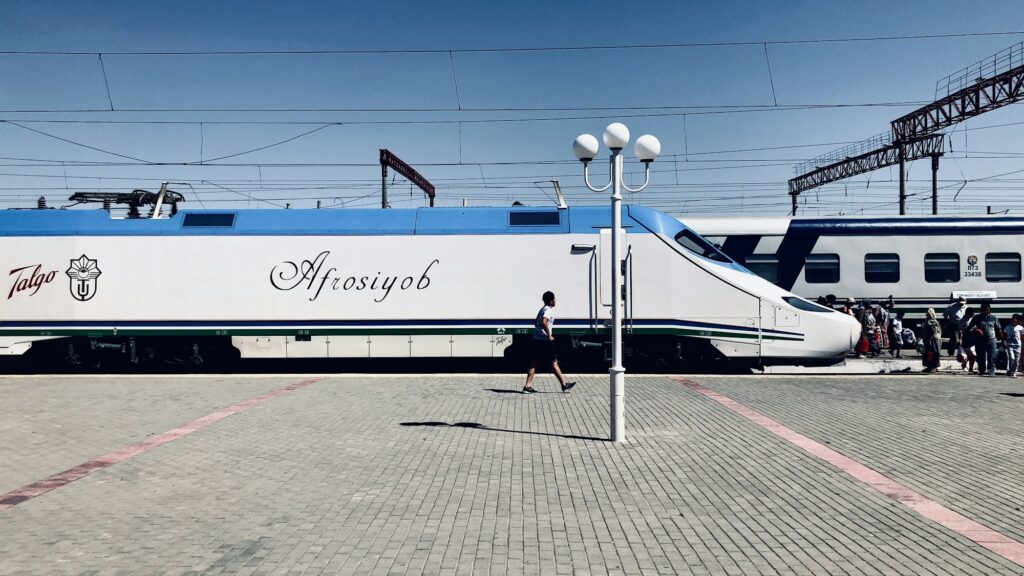
In Uzbekistan, the Afrosiyob runs from Tashkent to Samarkand in 2 h 08 to 2 h 30 for around €23 in Economy, then on to Bukhara in about 4 h 10 for €37. It stops there. For Khiva, the high-speed train is the Jaloliddin Manguberdi, in service since early May 2026: 7 h 31 from Tashkent for around €57 in Economy. Fares went up 15% on 1 February 2026, and tickets go on sale roughly 60 days before departure. Book early.
Tashkent, Samarkand, Bukhara, Khiva: you can now link all four Silk Road cities without hiring a car or taking a single flight. Uzbekistan’s rail network mixes very different trains, though, and plenty of guides muddle them up: the Afrosiyob doesn’t go to Khiva, and the Nasaf goes to neither Bukhara nor Khiva. Here’s the exact map, the euro prices we found in October 2026, how to actually land a ticket, and an 8 to 10 day itinerary that stays on the rails. For the wider geopolitical picture, read our dossier on the new Silk Road routes; and if you want to cut down on flying across the whole journey, our guide to travelling without flying in 2026 covers the alternatives.
1. Who goes where: Afrosiyob, Jaloliddin, Sharq and Nasaf
Four names come up again and again, and one table is enough to sort them out. They all leave from Tashkent Central station (also called « North »), not to be confused with Tashkent South, about 7 km away.
| Train | Route | Speed | Key point |
|---|---|---|---|
| Afrosiyob | Tashkent, Samarkand, Bukhara (plus Karshi, Shakhrisabz) | Up to 250 km/h | The benchmark train, doesn’t go to Khiva |
| Jaloliddin Manguberdi | Tashkent, Samarkand, Bukhara, Khiva | High speed (Korean-built train) | New in May 2026, the only high-speed service to Khiva |
| Sharq | Tashkent, Samarkand, Bukhara | About 140 km/h | Cheaper plan B, an hour slower to Samarkand |
| Nasaf | Tashkent, Samarkand, Karshi (base for Shakhrisabz) | Conventional train | 2nd class only, doesn’t serve Bukhara or Khiva |
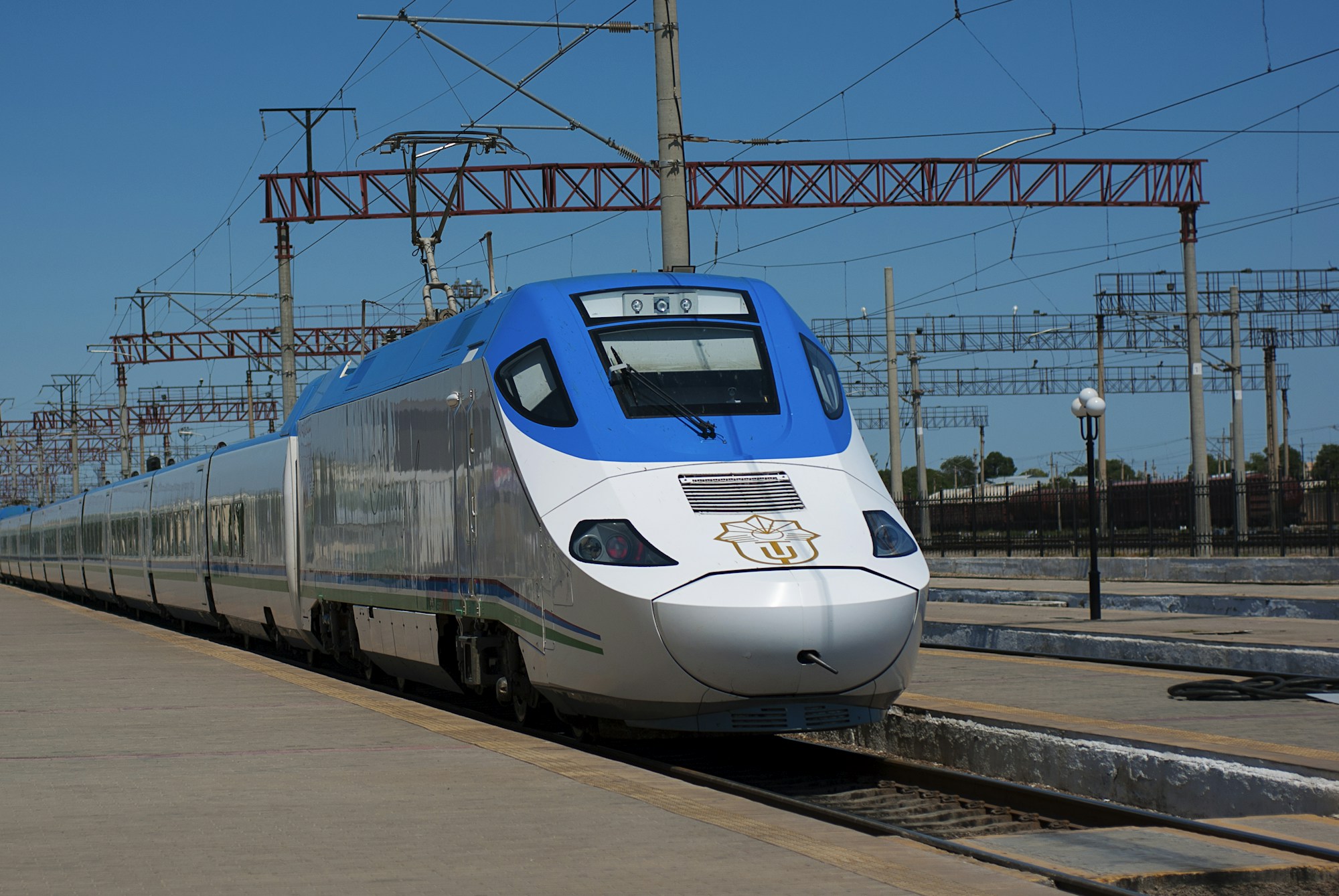
Afrosiyob: the Talgo that goes as far as Bukhara
The Afrosiyob is a Spanish Talgo 250 train, running between Tashkent and Samarkand since 8 October 2011 and extended to Bukhara in August 2016 (Wikipedia). It has three classes (Economy, Business, VIP) and a bistro car with steep prices, so bring water and snacks. According to Seat61, it takes around 4 h 10 from Tashkent to Bukhara, and roughly 1 h 40 between Samarkand and Bukhara. Since 27 March 2026, a dedicated Afrosiyob also serves Shakhrisabz, Tamerlane’s birthplace, on Fridays, Saturdays and Sundays (check times in the app).
Highlights
- The fastest option between Tashkent, Samarkand and Bukhara
- Reserved seats, air conditioning, power sockets
- An evening departure (around 19:20) usually fills up more slowly than the 08:00 ones
Jaloliddin Manguberdi: high speed all the way to Khiva
This is the real news of the year: a Hyundai Rotem train from the same family as Korea’s KTX, named after the last shah of Khorezm. Sources disagree on the launch date: service was announced for early May 2026, with a first commercial run on 5 May according to the Uzbek press. Train no. 752 leaves Tashkent at 07:00, calls at Samarkand at 09:13 and Bukhara at 10:54, then reaches Khiva at 14:31 (Seat61, Euronews, in French). The return service gets back to Tashkent around 15:00. The Bukhara-Khiva leg takes about 3 h 17, against 4 h 37 on the conventional train no. 707 (Advantour).
On speed, the train is designed for roughly 250 km/h, but other sources quote 200 km/h in service, so go with « up to 250 km/h depending on the section ». A second trainset reportedly entered service on 22 July 2026, bringing the offer to six round trips a week. The timetable has already moved between May and July, so check it in the app a week ahead, then again the day before.
Why it changes the game
- You save about a day compared with the conventional trains between Bukhara and Khiva
- You can get back from Khiva to Tashkent without flying out of Urgench (a 1.5 hour flight, but add the airport and transfers)
- An extension to Nukus has been mentioned, with no official date: treat it as a project
Sharq, Nasaf and night trains: plan B
The Sharq, a conventional express at about 140 km/h, links Tashkent and Samarkand in roughly 3 h 30: it’s the fix when the Afrosiyob is full. The Nasaf is a 2nd class train on the Tashkent, Samarkand, Karshi line, mostly useful for getting to Shakhrisabz; it goes to neither Bukhara nor Khiva (Eurasia Travel). Overnight sleeper trains (for example a Tashkent-Bukhara berth for around €13 in Platskartny) save a hotel night, but they often pull into Kogon at dawn, far from the centre. Older trains are poorly heated in winter and barely air-conditioned in summer.
2. How much tickets cost in October 2026
Fares rose 15% on 1 February 2026 on the Afrosiyob, Sharq and Nasaf, according to Kun.uz. That’s the third increase in three years: an Economy ticket from Tashkent to Samarkand cost 170,000 UZS at the end of 2023, against 311,000 today, about 83% more. The conversions below use €1 for roughly 13,690 UZS (Uzbek central bank rate, early October 2026) and are rounded.
| Route | Train, class | Fare (UZS) | Approx. (€) |
|---|---|---|---|
| Tashkent-Samarkand | Afrosiyob, Economy | 311,000 | €23 |
| Tashkent-Samarkand | Afrosiyob, Business | 455,000 | €33 |
| Tashkent-Bukhara | Afrosiyob, Economy | 509,000 | €37 |
| Tashkent-Bukhara | Afrosiyob, Business | 760,000 | €56 |
| Samarkand-Bukhara | Afrosiyob, Economy | about 198,000 (estimate) | about €14 |
| Tashkent-Samarkand | Sharq, 2nd class | 200,060 | €15 |
| Tashkent-Bukhara | Sharq, 2nd class | 276,820 | €20 |
| Tashkent-Khiva | Jaloliddin, Economy | 780,000 | €57 |
| Tashkent-Khiva | Jaloliddin, VIP | 1,815,000 | €133 |
Two honest caveats. The Samarkand-Bukhara Afrosiyob fare doesn’t appear in the official price list we found: we worked it out from the gap between the two fares from Tashkent (509,000 minus 311,000 = 198,000 UZS), which gives a ballpark of about €14 in Economy since February 2026. As for the Jaloliddin prices, they come from Seat61 and a single local source, so confirm them when you book. Sharq 2nd class works out around 35 to 45% cheaper than Afrosiyob Economy, at the cost of a longer journey.
3. Booking: sales window, channels and workarounds
Price isn’t the real issue, availability is. Afrosiyob trains sell out fast, especially in April-May and September-October, and around Navruz (21 March) or Independence Day (1 September).
When and where to buy
- Sales window: about 60 days before departure according to Journal of Nomads and Seat61, although older sources mention 45 days. Check the exact window in the app before you fix your dates.
- Official site: eticket.railway.uz, which now redirects to eticket.uzrailpass.uz, plus the « Uzrailways tickets » app (same account). You’ll need your passport, and the name must be typed exactly as it appears on the document.
- Station ticket offices: show your passport; they sometimes have seats the website no longer displays.
- Third-party platforms: 12go.asia or local agencies, with extra fees but more reliable acceptance of foreign cards.
Travellers’ workarounds when it’s full
- Pay with Google Pay if your physical card is declined.
- Ask your hotel or guesthouse to book for you: plenty do it for a small fee.
- Seats reappear when agency quotas are released, so check the app again over the following days.
- A tip reported by travellers, not official: buy a longer ticket (say to Bukhara) and get off along the way when the section you want shows as full.
- Switch to a Sharq, a Nasaf or another departure time.
Get to the station about 30 minutes before departure: bags go through a scanner and passports are checked. Luggage allowances vary by source, so travel light rather than counting on a precise figure. Online, watch out for mirror sites reselling tickets: check that the address ends in railway.uz or uzrailpass.uz.
4. An 8 to 10 day itinerary, 100% by rail
Here’s a loop that never uses the same train twice. It assumes a direct London-Tashkent flight with Uzbekistan Airways, currently operated two to three times a week (from Heathrow, with Gatwick also served): check fares for your travel month, they swing a lot. If you’re leaving from continental Europe, we’ve already mapped a 10 day itinerary around Samarkand, Bukhara and Shakhrisabz (in French) that you can adapt.
| Day | Stop | Train |
|---|---|---|
| D1-D2 | Arrive in Tashkent: metro, Chorsu bazaar, old town | None |
| D3 | Tashkent to Samarkand, the Registan at sunset | Afrosiyob |
| D4 | Samarkand: Gur-e-Amir, Shah-i-Zinda, Bibi-Khanym | None |
| D5 | Samarkand to Bukhara | Afrosiyob |
| D6 | Bukhara: old town at dawn, Kalon, the Ark | None |
| D7 | Bukhara to Khiva | Jaloliddin |
| D8 | Khiva: all of Itchan Kala, a night inside the walls | None |
| D9 | Khiva to Tashkent | Jaloliddin |
| D10 | Flight home | None |
The Jaloliddin only runs on certain days, so fix its dates first and build the rest around them. Express 7 day variant: Tashkent, Samarkand, Bukhara, then straight back on the Afrosiyob (about 4 h 10) and a flight, skipping Khiva. Weekend variant: the Afrosiyob to Shakhrisabz runs on Fridays, Saturdays and Sundays only.
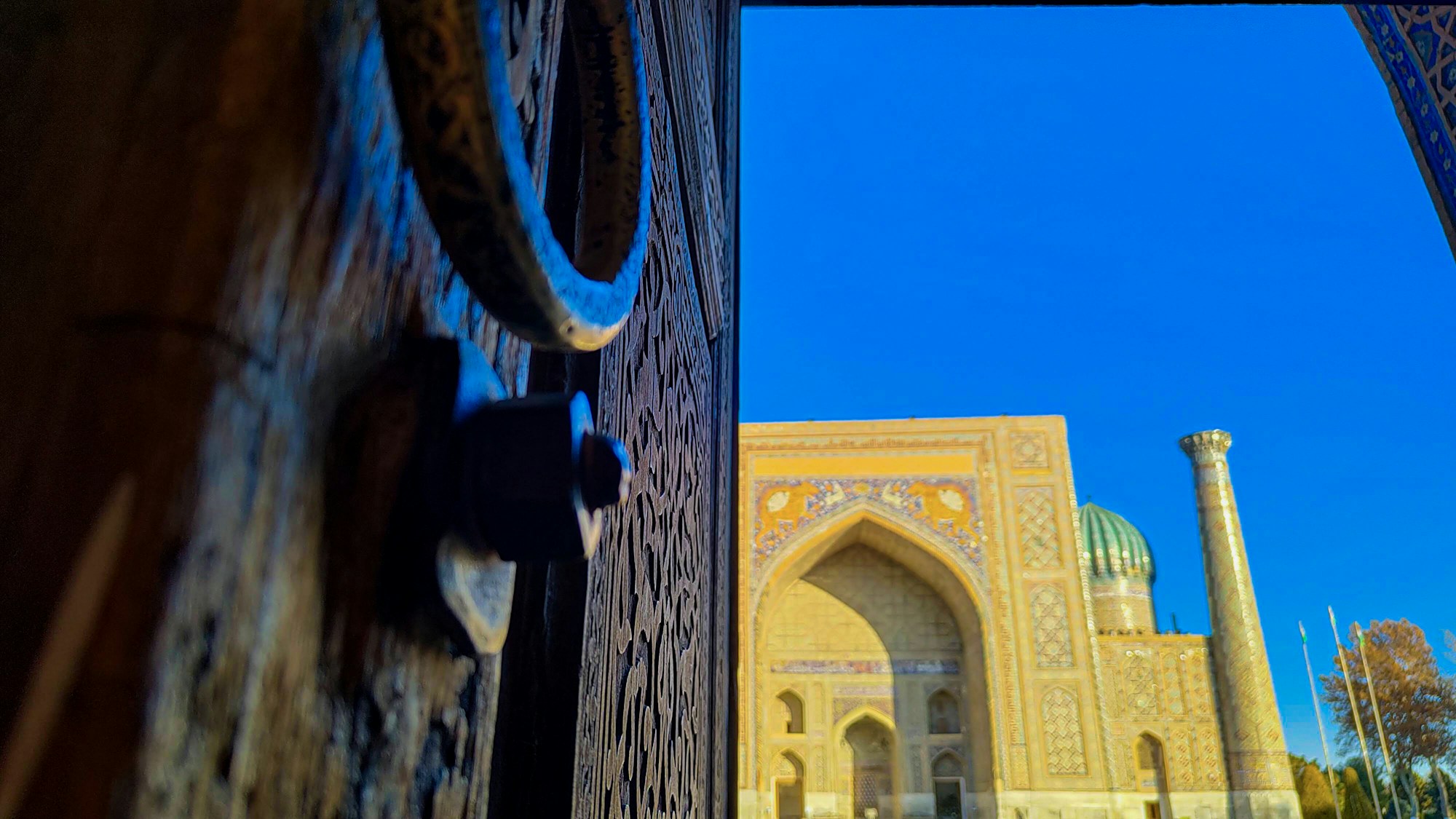
Samarkand: 2 to 3 nights
The Registan, Gur-e-Amir, Shah-i-Zinda, the Bibi-Khanym Mosque and Ulugh Beg’s observatory take two full days. According to travellers, the Registan has reportedly gone up to 100,000 UZS (about €7) after being cheaper earlier in 2026: confirm on the spot. It gets very busy (around 4 million visitors a year according to the local press), so aim for the morning or sunset rather than mid-afternoon.
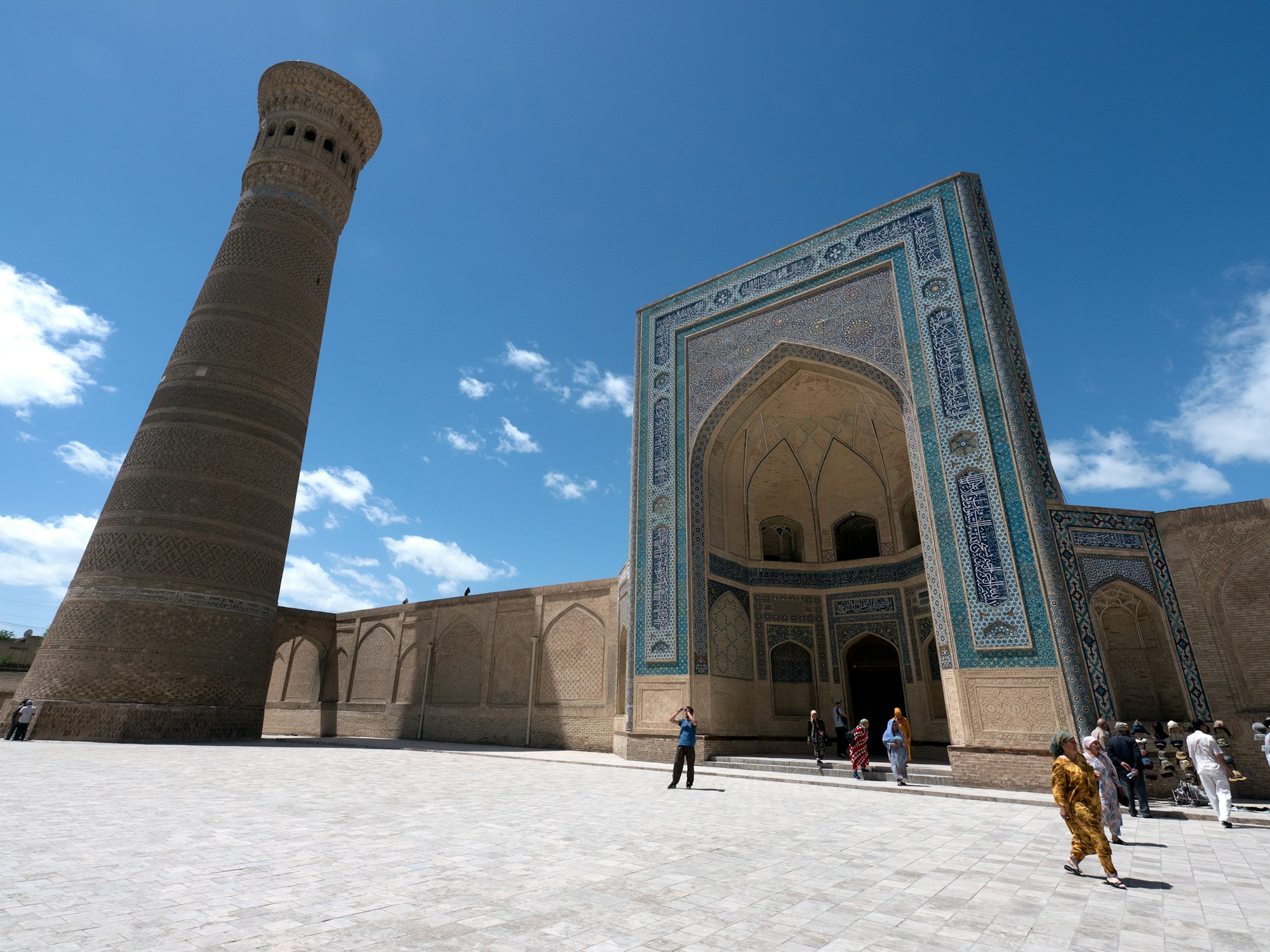
Bukhara: 2 to 3 nights
The old town is compact: two days are enough for the minaret and Kalon Mosque, the covered trading domes, the Ark citadel, the madrasas and the Lyab-i Hauz pool. There are lots of souvenir shops and some travellers call it « Disneyland », so head out at dawn, before the groups arrive.
5. Budget, season and entry rules
A ballpark budget
The figures below are Pixidia ballparks, per person, for 10 days excluding the international flight. They’re based on the fares above and on travellers’ budgets: one specialist guide quotes roughly €1,000 to €1,500 for two weeks excluding flights, with rooms at €20-30 a night and meals at €10-15 a day.
| Item | Shoestring | Comfort |
|---|---|---|
| Trains (full loop) | about €85 (Sharq, sleeper berths) | about €135 (Afrosiyob Economy + Jaloliddin) |
| Accommodation (8 nights) | about €200 | about €480 |
| Meals | about €80 | about €150 |
| Entry fees, taxis, extras | about €75 | about €120 |
| Total | about €440 | about €885 |
A tourist tax of around $0.75 per foreign adult per night in a guesthouse is reportedly applied from 1 September 2026, according to a single press article (Kursiv): confirm with your host, as we haven’t cross-checked it.
When to go
The best periods are April-May and September-October. In October, expect 7 to 25 °C depending on the city and little rain, according to Rough Guides; Bukhara and Khiva are warmer. Summer tops 38-40 °C, which makes an air-conditioned train a real advantage. In winter Khiva and Bukhara are almost empty, but pack a jacket for the older trains.
Visa, registration and health
- British passport holders can visit Uzbekistan without a visa for up to 30 days. The FCDO asks for a passport valid for at least 3 months after you arrive; some sources say 6 months, so check with your airline.
- You must register within 3 days of arriving (weekends count): your hotel normally handles it. Keep the paperwork until you leave the country.
- E-cigarettes have been banned since 1 April 2026, and electronic payment is compulsory for alcohol, tobacco and fuel.
- France’s foreign ministry issued a measles alert in March 2026: check your vaccinations on TravelHealthPro. For the Afghan border area around Termez, read the FCDO’s regional risk section before you plan anything there.
Entry rules come from the FCDO’s Uzbekistan travel advice, which changes: read it again before you go.
Practical info before you go
Handy for the train booking app and ride-hailing. Activate it before you leave. Compare options in our travel eSIM comparison.
Plans from a few eurosThe NHS won’t cover repatriation or private care in Uzbekistan, and a GHIC doesn’t apply there: a dedicated policy covers those cases during your trip.
Online quoteFrequently asked questions
Is there a high-speed train to Khiva?
Yes: the Jaloliddin Manguberdi, in service since early May 2026, links Tashkent and Khiva in 7 h 31 via Samarkand and Bukhara. The Afrosiyob stops at Bukhara.
Does the Nasaf serve Bukhara or Khiva?
No. The Nasaf is a conventional 2nd class train on the Tashkent, Samarkand, Karshi line, useful for reaching Shakhrisabz. For Bukhara, take the Afrosiyob or the Sharq; for Khiva, the Jaloliddin.
How much is an Afrosiyob ticket from Tashkent to Bukhara?
Since February 2026, 509,000 UZS in Economy (about €37), 760,000 in Business (about €56) and 1,138,000 in VIP (about €83), according to Kun.uz.
How far ahead should I book?
Sales open about 60 days before departure according to most sources (some say 45 days). Afrosiyob trains sell out quickly: check the exact window in the app and book as soon as it opens.
My bank card is declined on the website, what can I do?
Try Google Pay, a third-party platform such as 12go.asia, a station ticket office with your passport, or ask your hotel to book for you.
Do I need a visa for Uzbekistan with a UK passport?
No, not for stays of up to 30 days. Your passport needs to be valid for at least 3 months after arrival according to the FCDO, and you must register within 3 days of arriving (your hotel normally does it).
Is Bukhara’s station in the city centre?
No, it’s at Kogon, 12-15 km from the old town, about 30 minutes by taxi. Use a ride-hailing app if you can.
Is flying more practical than the train to Khiva?
The train is cheaper (about €57 in Economy, against roughly €94 for an Urgench-Tashkent flight) but slower: 7 h 31 versus a 1 h 33 flight, before airport transfers.
Sources
- Kun.uz: 15% fare increase and Afrosiyob price list from 1 February 2026
- Seat61: trains in Uzbekistan, Sharq fares, sleepers and the Jaloliddin
- Journal of Nomads: booking and sales window
- Wikipedia: high-speed rail in Uzbekistan
- Euronews: new Tashkent-Khiva line (in French)
- Advantour: Bukhara-Khiva trains
- Eurasia Travel: Afrosiyob, Sharq and Nasaf
- GOV.UK (FCDO): entry requirements for British citizens
- Kursiv: budget and tourist tax (single source)
- National Geographic: Khiva, Best of the World 2026
- Rough Guides: October weather in Uzbekistan
Fares and timetables recorded in October 2026. They change: confirm them in the official app before you book.

Plan your trip with Pixidia
Pixidia learns how you travel and helps you build a trip that truly fits you and everyone coming along.
Open the planner