
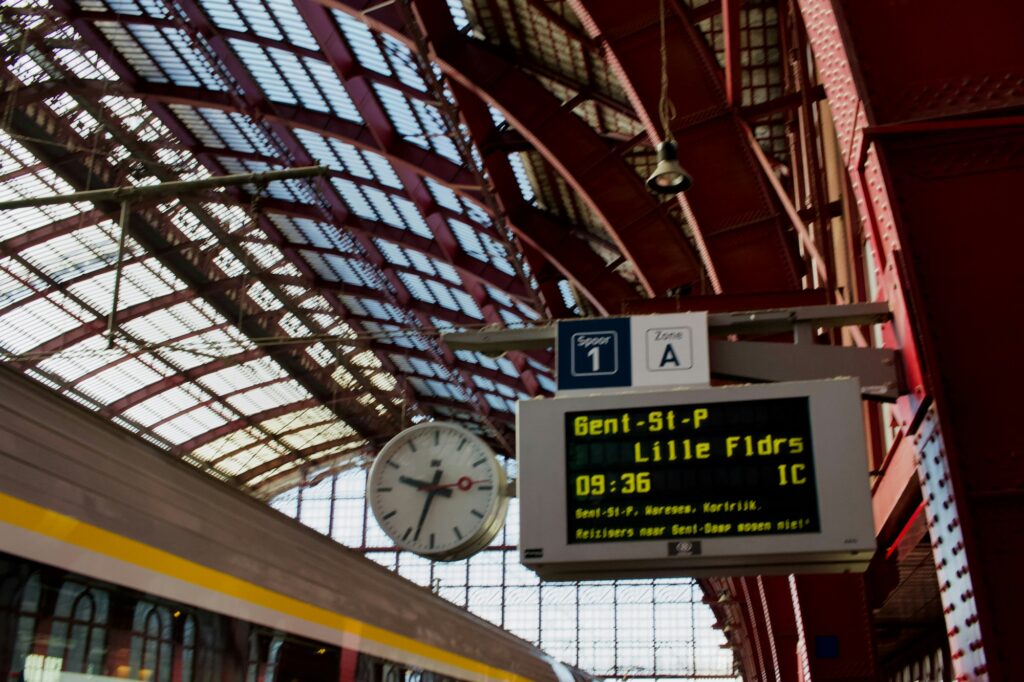
In the early hours of Sunday 25 October 2026, UK clocks go back: at 02:00 BST it becomes 01:00 GMT, and you gain an hour. France and the rest of the EU change the same night. The times on your flight, train or ferry ticket are local times, so they’re already corrected. What really changes: the gap with New York drops to 4 hours until 31 October, Dubai moves to 4 hours ahead of London, and Deutsche Bahn’s night trains make a one-hour stop. Check your watch, not your ticket.
25 October is the earliest possible date for clocks to go back. According to Paris Match Belgique, the same thing happened in 2020 and will happen again in 2037. If you’re travelling that weekend, with October half-term running from 26 to 30 October in most English councils according to Wego (and the French Toussaint holidays running from 17 October to 1 November in every zone, according to Journal de l’Économie), the real question isn’t « what time is it? » but « which time is my ticket based on, and what does my night train do when the clock goes back? » Here’s what is sourced, what is calculated, and what no operator has documented publicly.
1. Night trains: the extra hour is spent standing still

What a night train does during a 25-hour night
Between 01:00 and 02:00, local time happens twice. A train running at that moment would arrive an hour early if nothing changed. The only solid primary source we found is Deutsche Bahn: in its press pack on the clock change (March 2021), it explains that night trains stop at a suitable station during the extra hour, so they reach their destination at the timetabled time and not an hour earlier. For the 2026 change, netzwelt, citing DB, says the operator opts for a 60-minute stop rather than a delayed departure or an early arrival.
On the French side, as far as we know there’s no SNCF statement detailing the procedure for its night Intercités. According to the press (Journal de l’Économie, Yahoo Actualités), trains still running at the changeover generally stop for an hour at the nearest station. For Nightjet, European Sleeper and Caledonian Sleeper we found no published guidance, so we can’t tell you what applies to your train.
What to remember
- The arrival time shown on your ticket remains the reference: the stop exists precisely so that it’s kept.
- On a train that stands still for an hour, you’d simply sleep longer on the spot: that’s a logical consequence of DB’s practice, not a promise from any given operator.
- The stop may happen in a station or out on the line: no source says which.
If you’re planning an overnight journey, our guides to 10 European night train routes worth trying and to the new routes of 2026 give you the big picture. For specific lines, there’s European Sleeper’s Paris-Berlin, the Brussels-Milan service and ÖBB’s new Nightjet trains. Heading to Italy, our night train versus plane comparison puts numbers on price, journey time and CO2.
2. Flights: your ticket is already in local time

What changes for a flight, and what doesn’t
Airlines build their schedules in UTC: airport slots are requested in that reference, as the Dutch slot coordinators and the Irish authority point out in its draft decision on Dublin’s winter capacity. The time printed on your ticket is then converted into the local time for that day and place. According to Travel Extra, published schedules already reflect the change. There’s nothing to recalculate for a scheduled flight.
Apparent duration and real duration
A flight’s real duration doesn’t move. What moves is the gap between local departure and local arrival times. Here’s a worked example, with a made-up 8-hour flight and not an airline schedule: a flight leaving London at 11:00 on Saturday 24 October lands in New York at 14:00 (a 5-hour gap). The same flight, leaving at the same local time on Monday 26, lands at 15:00 (a 4-hour gap), because the United States only turns its clocks back on 1 November. If you see the displayed duration vary by an hour from one day to the next, it’s neither a delay nor a longer flight: it’s the time difference that has moved.
To keep their slots in Europe during this off-sync week, airlines may also shift their local times by an hour on North Atlantic routes. Hence the point of reading the time on your ticket and never inferring it from last year’s.
The winter season starts the same day
The IATA winter air season runs from 25 October 2026 to 27 March 2027, according to the Irish authority. It’s a separate mechanism from the clock change, but it lands on the same Sunday: airlines switch to their winter programme, and some routes disappear or appear. L’Écho touristique notes, for instance, that Ryanair is announcing a record winter programme. If your usual route has changed day or time, check your confirmation email.
What if your flight is delayed?
The 3-hour compensation threshold is measured at arrival at the final destination, when at least one aircraft door opens, according to the EU Court of Justice ruling Germanwings v Henning (case C-452/13, 2014), explained here. The legal amounts are €250, €400 or €600 depending on distance. Flights leaving the UK fall under the UK’s own version of these rules, with compensation set in pounds. We found no special rule for the night of the clock change: a delay is counted in real elapsed time, not in the difference between local times.
3. Ferry crossings: local times, at-sea procedure unpublished

Channel, Baltic, Corsica: what each case says
The only sourced fact from a ferry company: on its Newhaven-Dieppe route (a crossing of around 4 hours), DFDS states that times are given in local time. In other words, just like for flights, the departure port’s time and the arrival port’s time are each read in their own time zone.
On the Channel, the gap between the UK and France stays at one hour before and after 25 October, since both countries change on the same night (calculated from IANA time zone data; see gov.uk for the UK date). Same logic in the Baltic: Finland is one hour ahead of Sweden, before and after. Between mainland France, Corsica and Sardinia, there’s no time difference at all.
That leaves the overnight crossing that passes through the changeover: local time repeats itself there, as on a train. We found no ferry company (DFDS, Brittany Ferries, Corsica Linea, Corsica Ferries, Irish Ferries, Stena, Tallink, Viking Line) that publicly explains what it does on board or how it presents the arrival time that night. Rather than invent a procedure, it’s better to rely on two things: your booking confirmation and the announcement on board.
4. Time differences with London across the three periods
Not every country changes its clocks, and those that do don’t all act on the same night. The table below is a Pixidia calculation, made on 8 October 2026 with the IANA time zone database, and not operator data. How to read it: « +3 » means the city is 3 hours ahead of London; « -5 » means it’s 5 hours behind.
| City | Until 24 Oct | 25 to 31 Oct | From 1 Nov |
|---|---|---|---|
| Paris, Berlin, Rome | +1 | +1 | +1 |
| Reykjavik, Dakar | -1 | 0 | 0 |
| Tunis, Algiers | 0 | +1 | +1 |
| Johannesburg | +1 | +2 | +2 |
| Tel Aviv | +2 | +2 | +2 |
| Istanbul | +2 | +3 | +3 |
| Dubai, Réunion | +3 | +4 | +4 |
| Bangkok | +6 | +7 | +7 |
| Tokyo | +8 | +9 | +9 |
| Sydney (summer time under way) | +10 | +11 | +11 |
| New York, Montreal, Toronto | -5 | -4 | -5 |
| Los Angeles | -8 | -7 | -8 |
| Mexico City | -7 | -6 | -6 |
| Martinique, Guadeloupe | -5 | -4 | -4 |
| São Paulo | -4 | -3 | -3 |
Three takeaways. First, the week of 25 to 31 October belongs to North America: the United States and Canada go back on Sunday 1 November 2026 at 2am, which leaves a 4-hour gap with London for seven days instead of 5. Second, destinations that never change their clocks (Dubai, Tokyo, Bangkok, Réunion, the French Caribbean) drift an hour further ahead of London as the UK goes back (and an hour closer, for the French Caribbean). Turkey is included: it stays on UTC+3 all year and so goes from 2 hours ahead of London to 3, as Le Petit Journal Istanbul points out for France. Finally, Israel changes on the same night as Europe, according to time.now. Dublin and Lisbon follow the same clock as London throughout.
A few exceptions to keep in mind: Arizona (outside the Navajo Nation) and Hawaii don’t change their clocks, and some countries, including Egypt, return to winter time on another date, towards the end of October. If you’re going there, check the exact date before timing a connection. We haven’t put figures on Morocco, whose legal time follows a special regime during Ramadan.
5. Connections, car hire, alarm clocks: the checklist
On a single ticket, every time is local and the minimum connection time is a duration, not a clock time: it doesn’t change. The cases that need attention are elsewhere.
- Separate tickets. If you booked two tickets yourself, check each arrival and departure time in its own time zone. The trap: an arrival in the United States between 25 and 31 October with a connection planned around a 5-hour gap.
- Car pick-up or early-morning hotel arrival. If it affects you between 01:00 and 02:00 in a country that changes its clocks that night, ask for written confirmation of the agreed time.
- Phone. It updates itself if « set automatically » for date and time is switched on. Check that setting before you leave.
- Devices that don’t update themselves. Analogue watch, alarm clock, car, oven, kitchen clock: DB itself sets thousands of station clocks by hand.
- Return from half-term. Two consecutive Sundays are involved: 25 October for Europe, 1 November for North America.
6. Why the clocks still change in 2026
Because nothing has been settled. The European Commission proposed scrapping the seasonal change in 2018, and the European Parliament voted in favour in 2019, but the Council has never mustered a qualified majority, notably for lack of agreement between permanent summer time and permanent winter time, sums up LRT. According to Fastforward, the Commission launched a study in February 2026 with results expected at the end of 2026, and the Lithuanian presidency of the Union begins on 1 January 2027.
The practical upshot: the 25 October 2026 change will go ahead, and the next one, towards summer time, is set for Sunday 28 March 2027 (the last Sunday in March, under the rule in Directive 2000/84/EC). In the UK, gov.uk gives the same two dates: 25 October at 2am, and 28 March at 1am.
Practical info before you go
A data plan activated on landing lets your phone sync to the local network without waiting for airport wifi. Plans by country, to install before you leave.
Plans by country or regionEU regulation 261/2004 provides for €250, €400 or €600 depending on distance, subject to conditions, and the UK has its own equivalent. AirHelp reviews your case. No payout is guaranteed.
Eligibility checkFrequently asked questions
What time do the clocks go back on 25 October 2026?
In the UK, in the early hours of Sunday 25 October, at 02:00 BST it becomes 01:00 GMT, according to gov.uk. France changes the same night: at 03:00 it becomes 02:00. The European Union sets the change at 01:00 UTC on the last Sunday of October. You gain an hour of sleep, according to Paris Match Belgique.
My plane ticket says 06:30: is that summer or winter time?
It’s the local time on the day and at the place of departure. Your ticket is already calculated with the right time: don’t correct anything, just check your watch, as Ulysse explains.
Is my flight an hour longer if I leave that night?
No, the real duration doesn’t change. Only the difference between local departure and local arrival time can shift by an hour, because the time gap between the two cities has moved. It’s a calculation, not a delay.
Why is there only a 4-hour gap with New York in the week of 25 October?
Because Europe goes back on 25 October and the United States only on 1 November 2026 at 2am, according to Almanac. From 25 to 31 October, the gap with London is 4 hours instead of 5.
What do night trains do when it becomes 2am again?
According to Deutsche Bahn, they stop at a suitable station during the extra hour so as to arrive on time. For SNCF, the press describes the same practice, with no official statement that we could find.
Will I arrive an hour early on a night train?
Not with Deutsche Bahn: the stop exists precisely to keep the arrival time. For other operators, no guidance is published: check the local arrival time in their app.
And for an overnight ferry, for example to Corsica?
Times are in local time, as DFDS states for its Newhaven-Dieppe route. No ferry company publicly details how the extra hour is handled at sea: rely on your booking confirmation and the announcement on board.
Does my phone change time by itself?
Yes, if the « set automatically » date and time setting is switched on. Analogue watches, alarm clocks, cars and ovens still need setting by hand.
Will the clock change be scrapped in 2026?
No. The Council of the European Union remains deadlocked and the Commission is waiting for the results of a study at the end of 2026, according to LRT. The next change to summer time is set for 28 March 2027.
Do the United States also change their clocks on 25 October?
No, the US and Canadian change takes place on Sunday 1 November 2026 at 2am, according to Almanac.
Sources
- Paris Match Belgique: earliest possible date, 12 September 2026
- gov.uk: when do the clocks change in the UK
- Wego: October half-term 2026 dates by UK region
- Deutsche Bahn: press pack on the clock change, March 2021
- netzwelt: night trains standing still, 25 October change
- Journal de l’Économie and Yahoo Actualités: winter time 2026, night trains
- Ulysse: timetables, flights and trains
- Irish Aviation Authority: winter season 2026-2027, 8 April 2026
- Slot Coordination Netherlands: slot allocation process
- Travel Extra: effects of the clock change on aviation
- L’Écho touristique: Ryanair winter programme
- Bottonline: definition of arrival time (CJEU C-452/13)
- DFDS: Newhaven-Dieppe route
- Almanac: end of daylight saving time in North America
- time.now: Israel
- Le Petit Journal Istanbul: time difference with Turkey
- LRT and Fastforward: state of the European debate
Information checked on 8 October 2026. The time-difference table is a Pixidia calculation based on IANA time zone data.

Plan your trip with Pixidia
Pixidia learns how you travel and helps you build a trip that truly fits you and everyone coming along.
Open the planner