
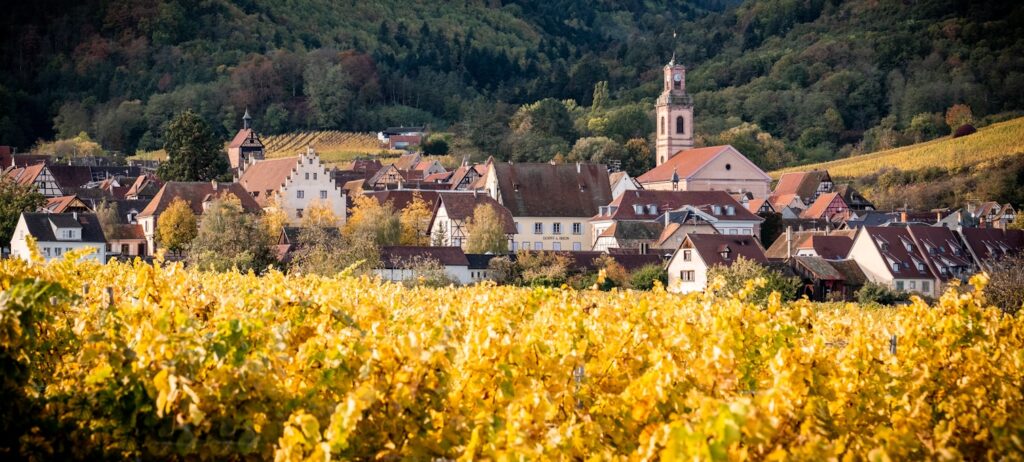
To link both banks of the Rhine in October 2026, plan a loop of 5 to 7 days: the Alsace Wine Route, the Kaiserstuhl and Freiburg, then the Schwarzwaldhochstraße. The grape harvest began as early as 12 August and is almost over, so October is the month of festivals, with Barr and Eguisheim on 2-4 October and Vignobles en Scène on 16-18 October. Germany has extended its border controls until March 2027, so carry your passport. For the quietest trip, aim for the festivals of the first weekend or the week of 5 October.
Colmar and Freiburg are barely 50 km (about 31 miles) apart, yet most people visit them on separate trips. The two banks share the same grape varieties, the same tarte flambée and the same tradition of new wine. This autumn has a twist: the harvest came three weeks early. Here is how to build a loop that takes that into account, without promising what October 2026 will not deliver. From the UK, the simplest way in is to fly to Strasbourg or EuroAirport Basel-Mulhouse-Freiburg and pick up a hire car there (check which airlines serve them from your airport).
1. The Alsace Wine Route: 170 km (106 miles) in four stretches
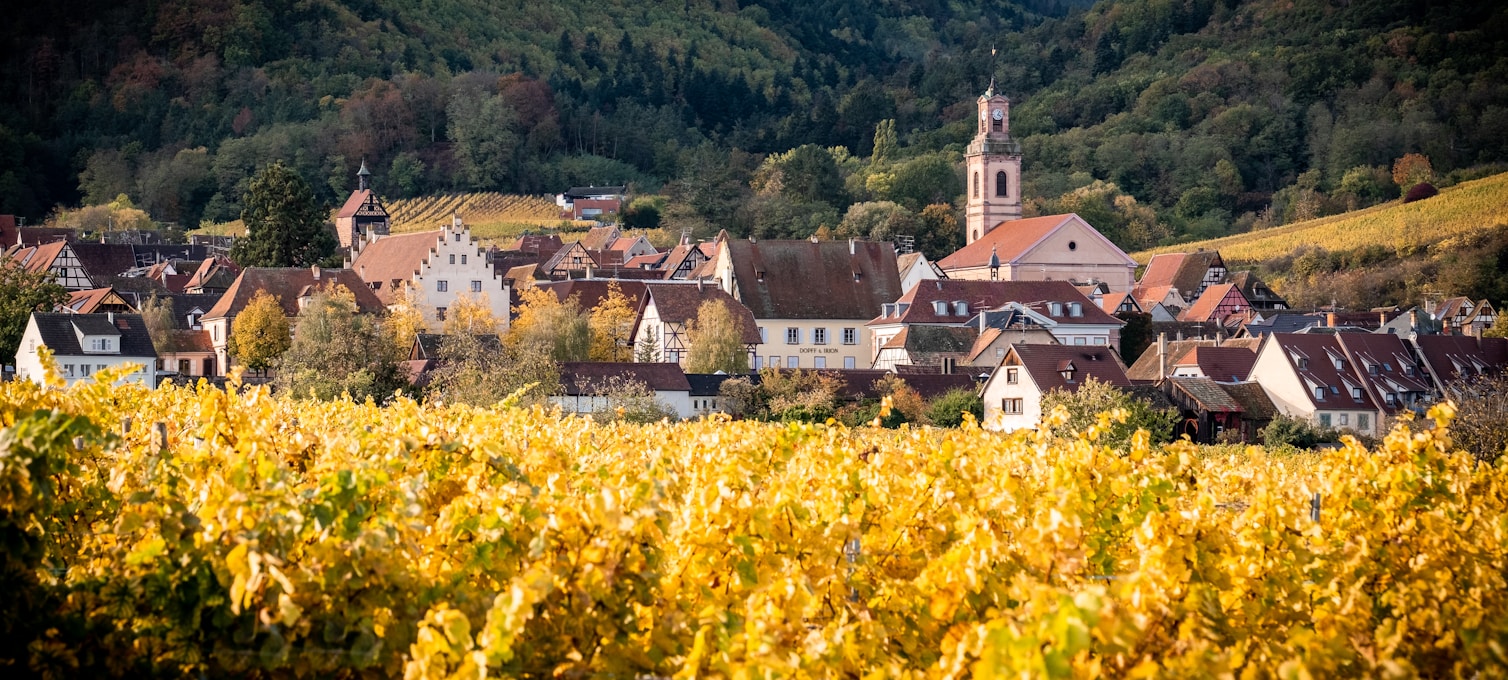
Marlenheim, Barr, Riquewihr, Eguisheim, Thann
According to Wikipedia (in French) and visit.alsace, the Wine Route runs for 170 km from Marlenheim in the north to Thann in the south. It passes through 67 villages out of the 119 wine-growing communes of Alsace and was inaugurated on 30 May 1953 by a rally with two convoys leaving from each end: it is the oldest wine route in France. Along the way you will meet 7 grape varieties, 51 grands crus and more than 300 estates.
On the ground, a straight line makes little sense. The experience works best in four stretches:
- North (Molsheim, Rosheim, Obernai, Barr): the Barr wine harvest festival on 2-4 October, plus independent cellars that see fewer visitors.
- Foothills (Andlau, Mittelbergheim, Dambach-la-Ville, Itterswiller): the quietest villages, including Mittelbergheim, one of the Plus Beaux Villages de France and Sylvaner country.
- Tourist heart (Ribeauvillé, Hunawihr, Riquewihr, Kaysersberg): the prettiest and the busiest, best visited early and on a weekday.
- South (Colmar, Eguisheim, Guebwiller, Thann): Eguisheim and its new wine festival on 3 and 4 October.
2. October 2026: festival season, not secateurs season
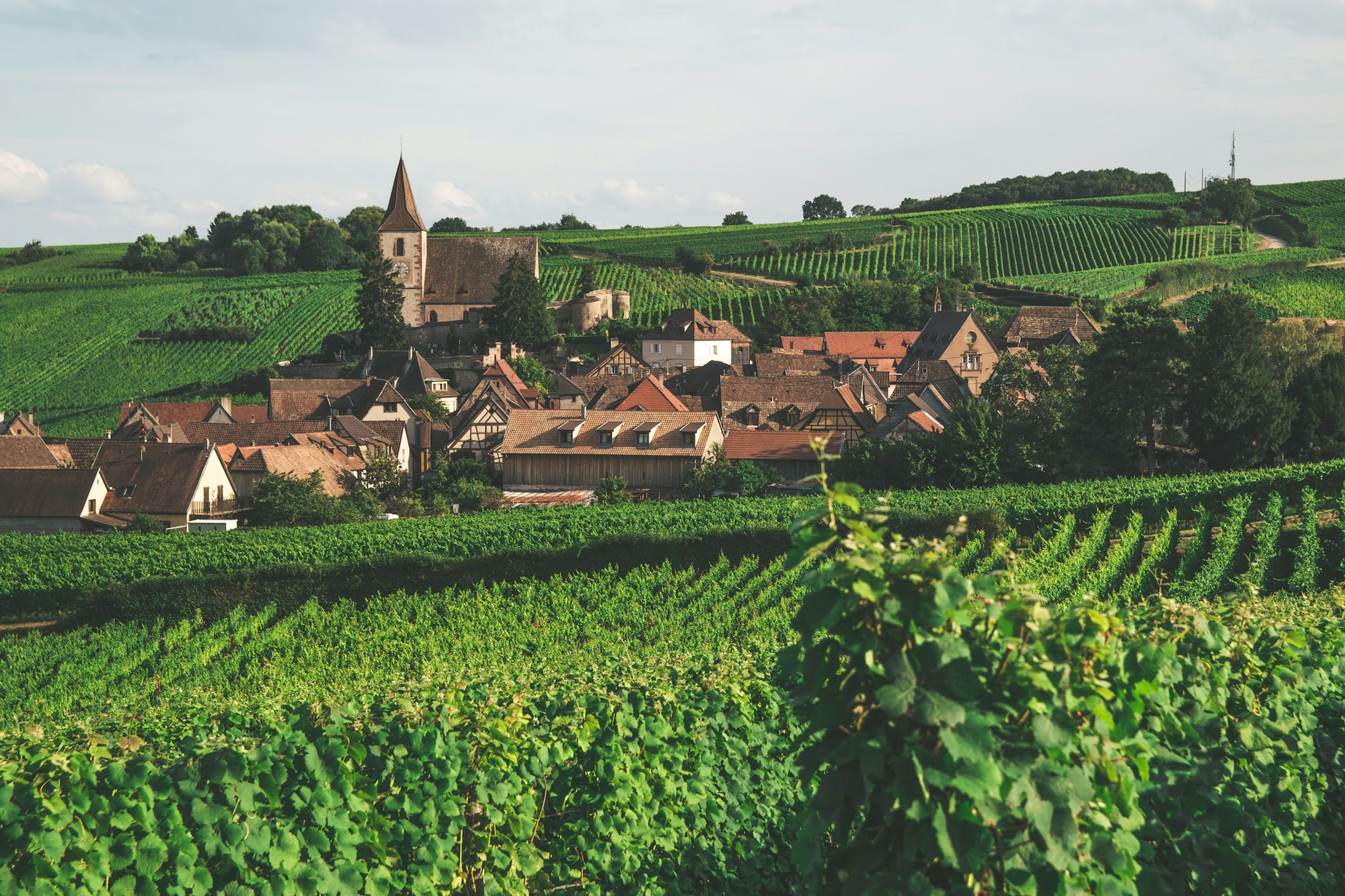
A harvest three weeks early
The classic brief for an autumn trip to Alsace is « see the grape harvest ». In 2026, that no longer works. According to France 3 Grand Est (in French), picking began on 12 August, a record for earliness, and winemaker Xavier Muller sums it up: « It’s unheard of. Thirty years ago, we started at the end of September, beginning of October. » According to Vinabox’s review published on 28 September, the last plots are being picked around 1 October, and only the Riesling and Gewurztraminer destined for late-harvest and noble-rot wines stay on the vine until mid-October. Volume falls to 804,000 hl, 4.4% less than in 2025, with some Rieslings hit hard by the heatwave.
On the German side, it is the same story: the first grapes for Federweißer were picked on 10 August and, according to the Stadtanzeiger Ortenau (in German), around 100 million litres are expected in Baden. Holger Klein of the Badischer Weinbauverband describes a vintage that is « very early and promising in quality, but not a year of large quantities ».
The dated highlights, on both sides of the Rhine
| Event | Place | 2026 dates | Good to know |
|---|---|---|---|
| Fête des Vendanges (wine harvest festival) | Barr (Bas-Rhin) | 2-4 October | Flower-float parade on Sunday, free entry |
| Fête du Vin Nouveau (new wine festival) | Eguisheim | 3-4 October | Saturday 12pm-6pm, Sunday 11am-6pm, free |
| Erntedank- und Weinfest (77th) | Sasbachwalden | 2-4 October | Parade on Sunday 4 October at 2pm |
| Bühlertäler Weinwandertag | Bühlertal | Saturday 3 October | Loop of about 9 km (5.6 miles), 8 stops, €3 pass |
| KaiserHerbst | Kaiserstuhl, Tuniberg | 10 October to 8 November | About a hundred events |
| Vignobles en Scène (2nd edition) | The whole Wine Route | 16-18 October | About 53 events, booking often required |
| Winzer-Kirwi | Kappelrodeck | 17-18 October | Winemakers’ Olympics on Saturday |
| Chestnut Festival (36th) | Oberbronn | Sunday 18 October | 10am-8pm, free, 50 km (31 miles) north of Strasbourg |
Sources: Alsace Wine Route (Barr), Eguisheim-Rouffach tourist office, Sasbachwalden, Badische Weinstraße, Naturgarten Kaiserstuhl, Vignobles en Scène.
3. Crossing the Rhine: border, low-emission zones and transport
The three logistical traps of 2026
1. Border controls
According to Sevenradio (in French), on 16 September 2026 Germany extended for six months the controls reinstated in September 2024, so until March 2027. They can cause queues of up to an hour on the Europe Bridge between Strasbourg and Kehl at commuter rush hours, and they also affect trams and trains. Carry your passport (most UK travellers have no national ID card), avoid 7am-9am and 4pm-6pm, and if you are coming from Colmar, go further south via Breisach. Entry conditions change, so check the Foreign Office advice for France and Germany before you go.
2. Crit’Air: yes in France, no in Germany
Strasbourg’s low-emission zone (ZFE) covers the 33 communes of the Eurométropole, 24 hours a day, and applies to foreign-registered vehicles too. According to Rue89 Strasbourg (in French), Crit’Air 4, 5 and unclassified vehicles have been banned there since 1 January 2025; Crit’Air 3 can still enter in 2026 but will be banned on 1 January 2027. The abolition of ZFEs, voted in April 2026, was struck down by the Constitutional Council on 21 May.
On the other side, according to the European Consumer Centre, Crit’Air is not recognised in any German environmental zone, and Freiburg scrapped its own on 2 May 2025. To our knowledge, there is none in Baden-Baden, Offenburg or Freudenstadt either. The subject only becomes real if you push on to Stuttgart, where the German green sticker (€10 to €20) is still compulsory.
3. Car, train or both
- No toll or vignette for a private car on German motorways, and you drive on the right on both sides of the Rhine.
- Filling up is no cheaper on the other side: at the end of September, petrol cost about 8 to 13 cents more in Germany than in France.
- The Baden-Württemberg-Ticket costs €27 for one person, then €9 for each additional person, valid from 9am on weekdays, starting from Kehl or Breisach.
- The KONUS guest card, given by accommodation in about 145 Black Forest localities, gives free regional buses and trains.
- If you hire in France, tell the rental company you are leaving the country (expect €15 to €60 in fees).
4. The Black Forest: Kaiserstuhl, Ortenau and the Schwarzwaldhochstraße
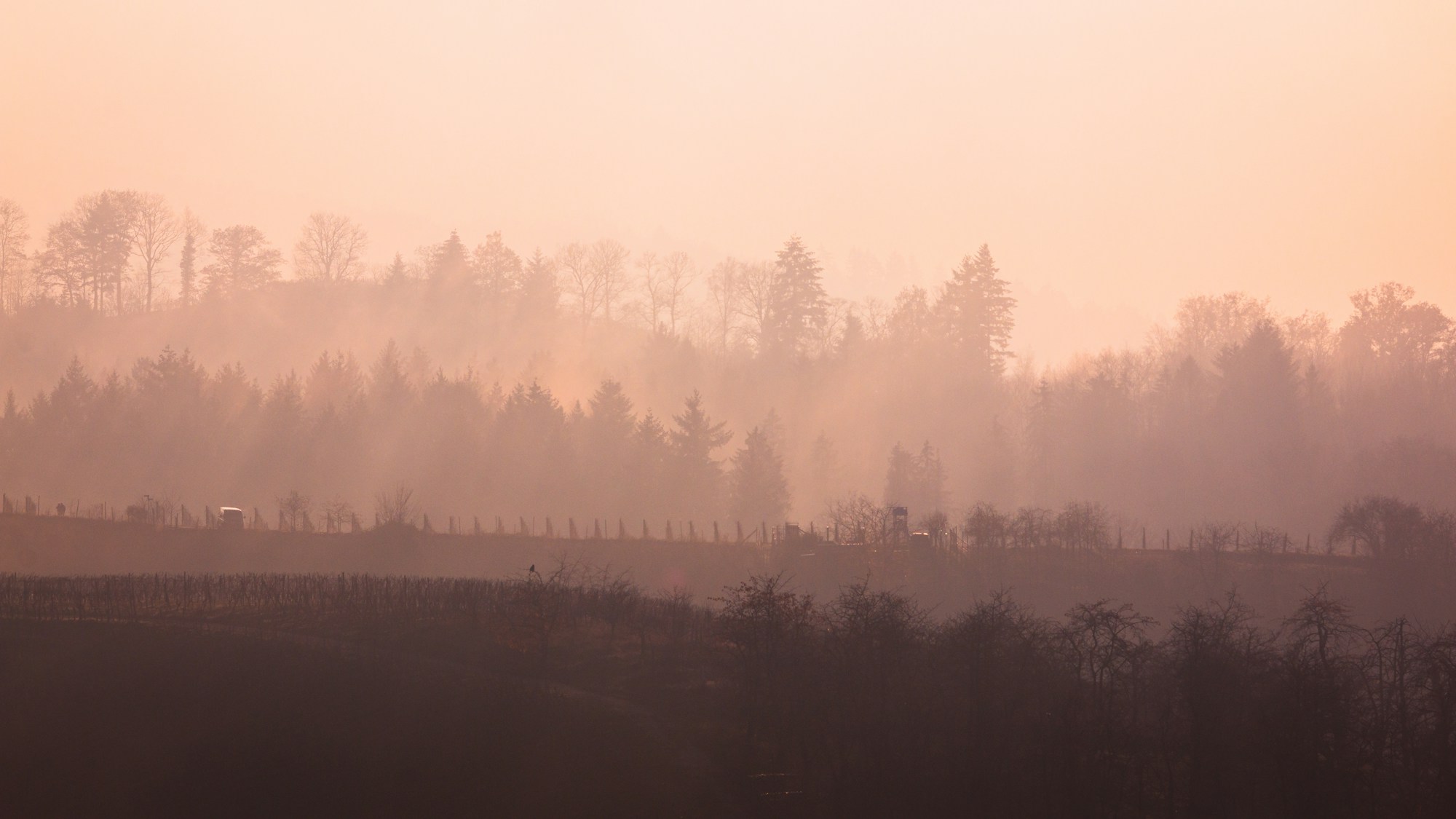
From the Kaiserstuhl vineyards to the B500 ridges
Kaiserstuhl and Freiburg
The KaiserHerbst runs from 10 October to 8 November with about a hundred events: walks, concerts, evenings on wine farms. The KaiserWii in Endingen (10 October, €25) brings together more than 70 winemakers. For smaller budgets, the Jechtingen-Amoltern co-operative offers a free tasting on Thursdays from 10am to noon until the end of October, and the Badischer Winzerkeller in Breisach a visit with tasting at €12 (Tuesdays and Thursdays, 2pm), according to Badische Weinstraße.
In Freiburg, there is no wine festival in October (the Weinfest took place in July), but the city remains an excellent stop: the Schlossbergbahn costs €3.50 one way (€6 return), the Schauinslandbahn €12 one way (€15 return). Right by the Rhine, Europa-Park in Rust, about 40 minutes from Colmar, runs its Halloween season until 1 November, with tickets from €56, according to the park.
Ortenau and the Badische Weinstraße
Between Offenburg and Baden-Baden, festivals follow one another: the Erntedank- und Weinfest in Sasbachwalden (2-4 October, parade on Sunday at 2pm), the Weinwandertag in Bühlertal on 3 October, the Winzer-Kirwi in Kappelrodeck on 17 and 18 October, Herbst Beben in Durbach on 23 October. Another regional institution is the Straußwirtschaft: a broom hung on the door signals that a winemaker is opening their dining room to sell their own wine, with Zwiebelkuchen, Flammkuchen and, depending on the year, Federweißer. The tradition is said to go back to a decree of Charlemagne around the year 800.
Baden-Baden and the Schwarzwaldhochstraße
The Schwarzwaldhochstraße (B500, opened in 1930) links Baden-Baden to Freudenstadt over about 60 km (37 miles), an hour’s drive without stops. The stops worth the detour: the Geroldsau waterfalls, the Mummelsee (a 3.7-hectare glacial lake), the Hornisgrinde (1,164 m, with views as far as the Vosges on a clear day), Ruhestein with its national park centre, and the Schliffkopf (1,053 m) and its free Lotharpfad trail. A useful detail: the access road to the Hornisgrinde plateau is closed to cars, so you park at the Mummelsee (free car park) and then walk 30 to 45 minutes or take the shuttle at €3.20. In Baden-Baden, the Caracalla Therme starts at €21 for two hours.
- Do not confuse the Schwarzwaldhochstraße with the Route des Crêtes in the Vosges, on the French side. The latter closes in winter, usually in mid-November (17 November in 2025): the 2026 date is not yet known.
- No roadworks have been spotted on the B500 for autumn 2026, but sections have been closed for works in recent years: check traffic conditions before you set off.
- In the national park, you do not pick plants or mushrooms, you stay on the paths and dogs must be kept on a lead.
5. At the table: tarte flambée, new wine and Federweißer
The same cooking on both sides of the Rhine
Flammekueche was born in the 18th century in the Kochersberg, north of Strasbourg, close to the border: bread-oven dough, cream, bacon, onions. Expect to pay €7.50 to €14.50 at members of the Confrérie du véritable flammekueche d’Alsace. In Germany, the autumn trio is Flammkuchen, Zwiebelkuchen and Federweißer.
New wine is called « Neier Siasser » in Alsatian: drawn from the vat after three or four days of fermentation, it is sparkling, cloudy, at 4-5% alcohol, and is drunk with walnuts, smoked bacon and country bread, according to ICI (France Bleu) (in French). Because the harvest was early, the very young product will be rarer and more advanced in October: ask the estate whether any is left. Harvest sausage, for its part, can be found from September to early November.
Federweißer does not travel. According to ZDF (in German), it is grape must still fermenting, to be carried upright with the cap loosened to let the gas out, and drunk within a few days: there is no point taking any home. For chestnut lovers, head to Oberbronn on 18 October.
Mushrooms: one rule per territory
In the state forests of the Vosges département, according to the chamber of agriculture (in French), the quota is 5 litres per person per day. The rules for the Bas-Rhin and Haut-Rhin have not been checked: ask locally, and remember that in private woodland you need the owner’s permission. In Baden-Württemberg, allow about 1 kg a day for your own consumption, with no resale, and nothing at all in the national park. The dry summer complicates the season. And never eat a mushroom that a pharmacist or a mycological society has not identified. For foraging in general, see our guide to mushroom foraging in the Périgord.
6. October weather and colours: what we can promise
Averages, not a forecast
According to ou-et-quand.net (in French), Strasbourg averages 12 °C in October (8 to 17 °C) and about 64 mm of rain; Colmar, sheltered by the Vosges, is one of the driest cities in France. In the Black Forest, Freudenstadt drops to an average of 7.8 °C with 81 mm, morning frosts are possible on the Hochstraße and fog is frequent at altitude.
In the Vosges, the foliage turns from 900 m in the first week of October, peaking in mid-October at altitude and more towards the end of October in the valley floors. But 2026 is a special year: after a scorching summer and marked water stress, sources such as the NZZ (in German) report a less colourful autumn, with early leaf fall. These are general observations, not a measurement of the Black Forest or the Vosges. The honest wording: the reds may be less blazing, and altitude (above 900 m) and the vineyards remain your best bets.
7. The 7-day itinerary and the budget
A loop from Strasbourg to Colmar, Freiburg, Baden-Baden and back
| Day | Stop | Note |
|---|---|---|
| D1 | Strasbourg, Marlenheim, Molsheim, Obernai, Barr | The weekend of 2-4 October, wine harvest festival |
| D2 | Andlau, Mittelbergheim, Dambach-la-Ville, Haut-Kœnigsbourg | Castle open Tuesday to Sunday 9.30am-5pm, €12 |
| D3 | Ribeauvillé, Hunawihr, Riquewihr, Kaysersberg | Get to Riquewihr early, on a weekday |
| D4 | Colmar, Eguisheim | New wine festival on 3 and 4 October |
| D5 | Breisach, Kaiserstuhl, Freiburg | KaiserHerbst from 10 October |
| D6 | Freiburg, A5, Baden-Baden, Ortenau | About 1h to 1h15 by motorway |
| D7 | Schwarzwaldhochstraße, Freudenstadt, Offenburg, Kehl, Strasbourg | Check the B500 before you set off |
With three days, choose a single side: southern Alsace plus the Kaiserstuhl and Freiburg, or northern Alsace plus Baden-Baden and the B500. Without a car, the regional TER train links Strasbourg to Colmar, then German regional tickets take over at Kehl or Breisach. With children, think of Europa-Park Halloween, the Haut-Kœnigsbourg and the Triberg waterfalls (€9).
Indicative budget (prices noted at the end of September 2026, to be checked before booking)
| Item | Range |
|---|---|
| Estate tasting, Alsace | €15-40 per person (€8-15 refundable on purchase at many estates, co-operatives often free) |
| Flammekueche | €7.50-14.50 |
| Meal in a winstub | €20-30 per person |
| Guesthouse around Colmar or Riquewihr | €99-145 a night |
| Kaiserstuhl tasting | €0-18 (gala events from €25 to €275) |
| Caracalla Therme, Baden-Baden | €21 (2h), €25 (3h), €35 for the day |
| Petrol, end of September | about €2.22 to €2.38 a litre in France, €2.27 to €2.46 in Germany |
The two limits to accept
The crowds. Colmar welcomes about 3.5 million tourists a year and, according to France 3 (in French), Riquewihr sees 1.5 million visitors pass through for a village of about 1,700 inhabitants. October is less saturated than July or December, but festival weekends stay busy: prefer Tuesday to Thursday for Riquewihr and Colmar, do not park on delivery spaces and respect the quiet streets. To widen your playground, see our European alternatives to avoid the crowds.
The wheel. A tasting road trip and the road do not mix: name a driver who does not taste, spit rather than swallow, sleep on site or favour cellars reachable on foot, by bike (Véloroute du vignoble) or on a guided excursion. And do not sell this trip as eco-friendly: it is a trip by car, unless you combine train, bike and a hire car on the spot.
Practical info: car and insurance
For the Alsace and Black Forest loop, compare hire companies and say when you book that you are crossing the border.
Local rental companies comparisonMedical costs and repatriation: a UK GHIC covers state healthcare only, so cover is useful if you hike at altitude on the B500 or in the Vosges.
Online quoteFrequently asked questions
Can you still see the grape harvest in Alsace in October 2026?
Almost not. Picking began on 12 August, the last plots are being picked around 1 October, and only the Riesling and Gewurztraminer destined for late-harvest and noble-rot wines stay on the vine until mid-October. The wine harvest festivals in Barr (2-4 October) and Eguisheim (3-4 October) are still on. Vinabox.
When is the Barr Fête des Vendanges in 2026?
From 2 to 4 October 2026, with the election of the queen on Friday, a gala concert on Saturday and the big flower-float parade on Sunday 4 October. Entry is free. Alsace Wine Route.
Do you need a vignette to drive in Germany?
No, not for a private car: there is no toll or vignette on German motorways. Ornikar.
Is my Crit’Air sticker valid in the Black Forest?
No, it is not recognised in any German environmental zone. Freiburg scrapped its own in May 2025, and no zone has been identified on the Freiburg, Baden-Baden and Freudenstadt stops. Stuttgart has one, with a German green sticker at €10-20. European Consumer Centre.
Do you need a Crit’Air sticker in Strasbourg?
Yes: the low-emission zone covers the 33 communes of the Eurométropole, 24 hours a day. Crit’Air 4, 5 and unclassified vehicles have been banned since 1 January 2025, and Crit’Air 3 will be on 1 January 2027. Rue89 Strasbourg.
Are there checks on the French-German border?
Yes. On 16 September 2026 Germany extended its controls for six months, until March 2027. Bring your passport and allow extra time at rush hour in Strasbourg-Kehl. Sevenradio.
Can you pick mushrooms in the Black Forest?
Not in the Black Forest National Park, where picking plants and mushrooms is forbidden. Elsewhere in Baden-Württemberg, allow about 1 kg a day for personal use, with no resale. Nationalpark Schwarzwald.
Which transport pass should you choose to get around the Black Forest as two or more?
The Baden-Württemberg-Ticket: €27 for one person, then €9 for each additional person up to five, valid from 9am on weekdays and from midnight at weekends, starting from Kehl or Breisach. It does not cover France. Escapadeur.
Can you take Federweißer home with you?
It is not designed for it: Federweißer is still fermenting, travels upright with the cap loosened and keeps for only a few days. ZDF.
Sources
- Alsace Wine Route: Barr wine harvest festival (in French)
- Alsace Wine Route: Vignobles en Scène (in French)
- Eguisheim-Rouffach tourist office: new wine festival (in French)
- Sasbachwalden: Erntedank- und Weinfest (in German)
- Badische Weinstraße: events (in German)
- Naturgarten Kaiserstuhl: KaiserHerbst (in German)
- France 3 Grand Est: record early harvest (11 August 2026, in French)
- Vinabox: 2026 harvest review in Alsace (28 September 2026, in French)
- Stadtanzeiger Ortenau: Baden harvest review (in German)
- Sevenradio: border controls extended (17 September 2026, in French)
- Rue89 Strasbourg: ZFE and Crit’Air 3 (in French)
- CEC-ZEV: environmental stickers in Germany
- Nationalpark Schwarzwald: park rules (in German)
- Europa-Park: Halloween 2026
- ZDF heute: Federweißer season (in German)
- GOV.UK: Foreign travel advice, France
- GOV.UK: Foreign travel advice, Germany
- Wikipedia: Route des vins d’Alsace (in French)
Information and prices noted on 1 October 2026: check dates, opening times and prices with the organisers before you book.

Plan your trip with Pixidia
Pixidia learns how you travel and helps you build a trip that truly fits you and everyone coming along.
Open the planner